Your Competitors Already Have AI Agents. Here's What That Means for You.
The AI agent gap is real, it's measurable, and it's widening every quarter. According to PwC's 2025 AI Agent Survey of 308 U.S. executives, 79% of organizations are already adopting AI agents at some level — and of those, 66% report measurable productivity gains. If your organization is still in "evaluation mode," you are not in the majority. You are in the minority — and falling further behind.
This is not a prediction about the future. It's a description of the present.
Key Takeaways:
Nearly 8 in 10 companies are already adopting AI agents, with two-thirds reporting measurable productivity gains.
73% of executives believe AI agent strategy will deliver significant competitive advantage within 12 months.
The gap isn't just about technology — it's about operating model. Competitors are redesigning how work gets done, not just adding new tools.
Full-scale deployment is still rare. That window to close the gap is open, but not indefinitely.
The bottleneck isn't AI capability. It's organizational readiness to delegate to it.
What "Already Adopted" Actually Means
Before you dismiss the 79% adoption figure as hype, it's worth understanding what the data is — and isn't — saying.
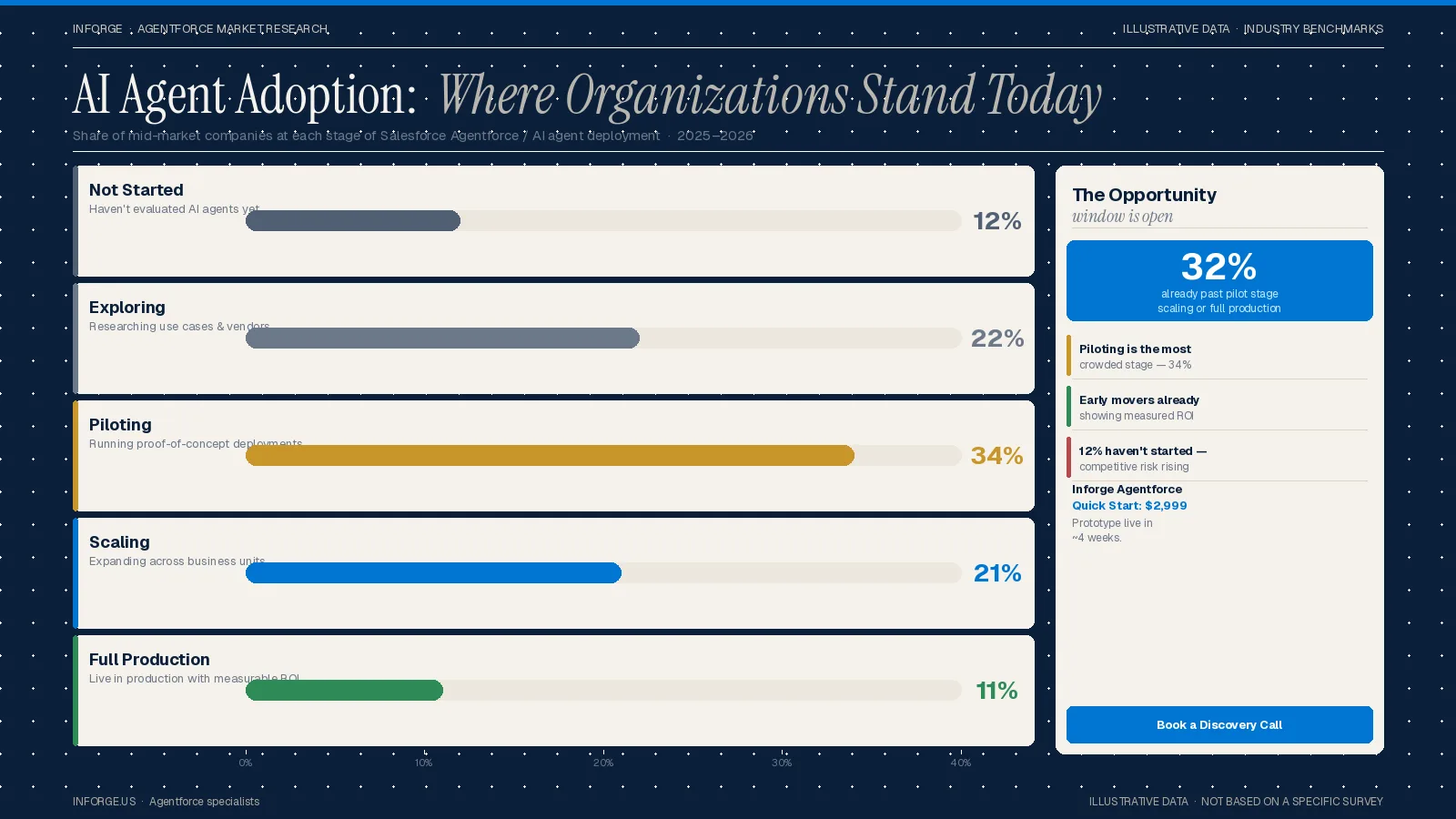
According to McKinsey's State of AI 2025, 23% of organizations are actively scaling agentic AI, with an additional 39% in active experimentation phases. That's 62% of enterprises in some form of live engagement with AI agents — not planning decks, not vendor demos, but running systems.
At the same time, McKinsey notes that fewer than 10% of organizations have scaled AI agents in any individual business function. So the picture is nuanced: widespread adoption, but shallow depth. Most companies have agents running somewhere. Few have them running everywhere.
Here's why that distinction matters for you: the window to be an early mover at depth is still open. The organizations that move from surface-level experimentation to genuine operational integration in the next 12–18 months will define the competitive baseline for the next decade.
The Productivity Gap Is Already Compounding
Here's what your competitors who've committed to AI agents are actually reporting:
66% report increased productivity (PwC, 2025)
57% report measurable cost savings
55% report faster decision-making
54% report improved customer experience
These are not projections. These are outcomes from organizations already running agents in production.
Look further out and the picture sharpens: enterprises deploying AI agents expect an average 30% productivity improvement from automation of complex, multi-step workflows. Organizations using enterprise AI already report employees saving 40 to 60 minutes per day on routine and knowledge-intensive tasks.
That's not a marginal efficiency gain. At scale, it's a structural cost advantage — one that compounds every month you're not building it.
According to Gartner, by 2028, 33% of enterprise software applications will include agentic AI, up from less than 1% in 2024. That's a 33-fold increase in four years. The organizations building agent fluency now are the ones who will be positioned to absorb that infrastructure shift without disruption.
At Tenfold, we've seen this play out directly. Our sister company Inforge now delivers full Salesforce implementations entirely through AI agents — faster timelines, more consistent quality, and a fraction of the traditional cost. That model exists because someone decided to stop experimenting and start operating. The proof is in the delivery, not the pitch.
Why Most AI Agent Strategies Stall
The data also reveals a sharp warning: having AI agents is not the same as winning with AI agents.
McKinsey's research found that while 39% of respondents attribute any level of EBIT impact to AI, most say less than 5% of their organization's EBIT comes from AI. The productivity gains are real. The bottom-line transformation is not — yet.
The reason? Most organizations are running agents in isolation. PwC put it plainly: "Using a few AI agents in isolation won't move the needle." Real value comes from connecting agents across workflows and functions — and very few companies have done that.
According to McKinsey, the highest-performing companies stand apart because they treat AI as a catalyst to redesign workflows, not as a layer on top of existing ones. They are nearly three times as likely as their peers to have fundamentally redesigned individual workflows around AI capabilities.
The bottleneck is not the technology. The bottleneck is organizational readiness to delegate to it.
The Competitive Moat Is Being Built Right Now
Here is the uncomfortable reality: 73% of executives believe their AI agent strategy will give them significant competitive advantage in the next 12 months. Your competitors are not quietly tinkering. They are consciously building moats.
McKinsey's analysis frames this precisely: the real value from AI lies in reshaping offerings, business models, and market structures before competitors do — not just improving operational efficiency. Advantage accrues disproportionately to organizations that move early, learn faster than peers, and build capabilities that compound even as AI-assisted practices become industry norms.
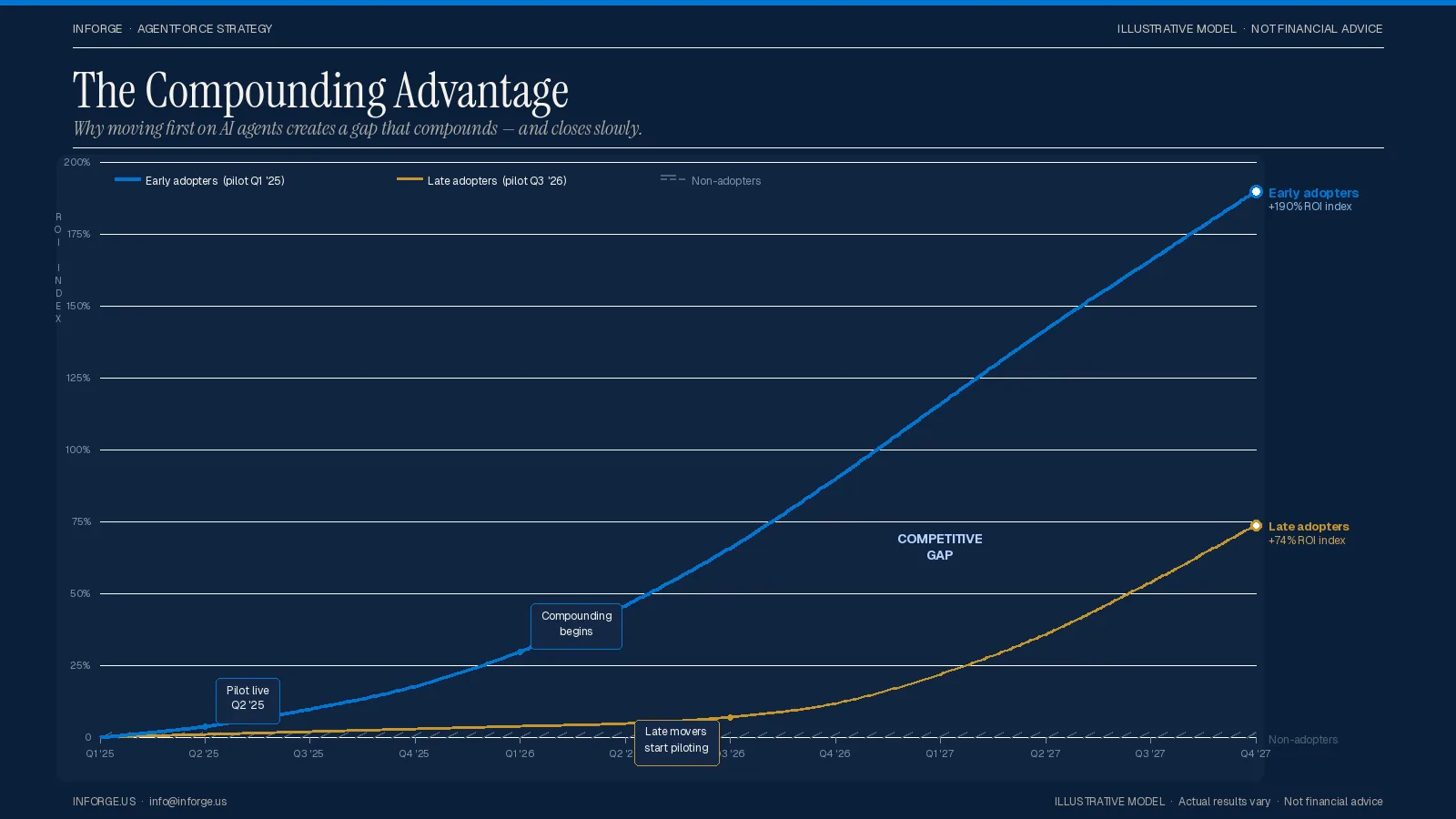
Translated: early adoption creates compounding returns. Late adoption creates catch-up costs.
The numbers validate this. Companies that moved early into generative AI adoption report $3.70 in value for every dollar invested, with top performers achieving $10.30 returns per dollar. AI agent adoption working alongside human employees is expected to grow by 327% over the next two years — meaning the opportunity curve is steep, and the early-mover premium is substantial.
46% of executives already say they're concerned their company is falling behind competitors in AI agent adoption. If you are reading this, you have likely had that conversation internally. The question is what you do next.
What a Clear-Eyed Response Looks Like
You do not need to boil the ocean. You need to pick the right entry point and execute fast enough to build institutional learning before the window closes.
Based on where leading organizations are seeing the earliest, most durable returns:
1. Identify your highest-friction, highest-volume workflows first.
Agents perform best where the task is repetitive, data-rich, and currently consuming significant human time. CRM data hygiene, lead qualification, contract review, and customer case routing are proven entry points.
2. Design for integration, not isolation.
An agent that updates Salesforce records without connecting to your billing system, your support queue, or your onboarding flow generates partial value. Multi-agent architectures — where agents coordinate across functions — are where the real efficiency multipliers live.
3. Plan for human-in-the-loop from day one.
76% of enterprises now include human-in-the-loop processes to catch errors before deployment. This is not a crutch. It is a governance structure that lets you move fast without compounding errors.
4. Measure what moves.
The critical value gap — 44% of business leaders report workforce efficiency gains from AI but only 24% see measurable profit impact — exists because organizations measure inputs, not outcomes. Define the business metric you want to move before you deploy, not after.
5. Get an implementation partner who has already done it.
At Tenfold, we built the agent-first operating model that Inforge runs on every day. We are not theorizing about what AI agents can do. We operate them at production scale and bring that same model to our clients.
Summary
The AI agent competitive landscape is not forming — it has formed. 79% of organizations are already in motion. The gap between those building agent-first operations and those still in evaluation is compounding every quarter. The good news: full-scale, enterprise-wide deployment is still rare. That means the window to establish a real operational advantage is open. But it will not stay open indefinitely. The organizations that act with clarity and speed now are the ones that will set the standard everyone else benchmarks against.
Tenfold helps C-suite and operations leaders design, deploy, and scale AI agent strategies that produce measurable outcomes — backed by a delivery model that runs on the same technology every day. [Get in touch to talk through your AI agent roadmap.](/contact)
Frequently Asked Questions
Q: How many companies are already using AI agents?
A: According to PwC's 2025 survey of 308 U.S. executives, 79% of organizations are already adopting AI agents at some level. McKinsey's data shows 23% are actively scaling and 39% are in live experimentation — putting 62% of enterprises in active engagement with agentic systems.
Q: What competitive advantage do AI agents actually deliver?
A: Among companies already running AI agents, 66% report increased productivity, 57% report cost savings, and 55% report faster decision-making (PwC, 2025). Enterprises expecting the full impact project an average 30% productivity improvement and 40–60 minutes saved per employee per day.
Q: Is it too late to start implementing AI agents if competitors are ahead?
A: No — but the window is narrowing. Fewer than 10% of organizations have scaled agents in any individual function (McKinsey, 2025). Full enterprise-wide deployment is still rare. Organizations that commit to depth of implementation now, rather than breadth of experimentation, can still build durable advantage.
Q: What's the biggest reason AI agent strategies fail?
A: Isolation. Most organizations deploy agents in a single function without connecting them across workflows. PwC notes that running agents in isolation won't move the needle. The real value comes from multi-agent architectures that coordinate across departments and systems.
Q: How do I know if my organization is ready for AI agents?
A: Start with data readiness, workflow clarity, and governance structure. Organizations with clean CRM data, well-documented processes, and defined human-in-the-loop checkpoints see the fastest time-to-value. If those three aren't in place, the first step is getting them there — and a specialist implementation partner can accelerate that significantly.
