Why Is Nobody Using Your Salesforce? Fixes to Boost User Adoption After Go Live
Your Salesforce implementation went live. The project team celebrated. Users completed training. Stakeholders signed off. Six months later, deals are being tracked in spreadsheets, pipeline data is incomplete, and leadership is asking why the CRM spend isn't showing up in the numbers.
This is not a rare edge case. According to Radin Dynamics, user adoption is the #1 cause of CRM failure — responsible for more project failures than any technical issue. The platform works. The people don't use it. That's the actual problem, and it has a specific set of causes — and fixes.
Quick Answer: Salesforce adoption fails after go live because the system wasn't designed around how users actually work, training stops at launch, and managers don't reinforce usage in daily workflows. The fix requires reconfiguring for usability, embedding continuous enablement, and making Salesforce the system of record for decisions — not just data entry.
Key Takeaways:
According to Johnny Grow, 55% of CRM implementations fail to meet their planned objectives — user adoption is the primary driver of that failure rate.
40% of users cite time-consuming data entry as their top reason for avoiding the CRM, and 35% say they never felt properly trained for their specific role.
Go-live is not the finish line. The 90 days after launch are where adoption is won or lost.
Salesforce reps report spending 60% of their time on non-selling tasks — a dynamic that makes a poorly designed CRM feel like a punishment, not a tool.
Adoption is a process problem before it's a people problem. If users resist, the system probably deserves it.
The Real Reason Salesforce Adoption Fails After Go Live
Blaming users is the fastest path to a second failed implementation. The evidence points elsewhere.
According to Salesforce's State of Sales report, sales reps spend 60% of their time on non-selling tasks — including manual CRM data entry. When a tool adds to that burden instead of reducing it, avoidance is the rational response. The graveyard of failed CRM rollouts is not filled with lazy reps. It's filled with systems that were built for reporting, not for the people doing the actual work.
A survey by Whatfix, referenced in research by Salesforce Ben, found that 40% of users don't use their CRM regularly because data entry is too time-consuming, and 35% don't feel equipped because the training they received didn't match their actual daily tasks. These aren't attitude problems. They're design and enablement failures.
The pattern is consistent: organizations invest in the platform, rush to go live, declare victory, and pull back the support structure — right at the moment users need it most.
Fix 1: Redesign the System for the Person Using It, Not the Person Who Bought It
Over-complex page layouts, too many required fields, and irrelevant tabs are a configuration problem — not a training problem.
If reps have to navigate five screens to log a call, they won't log the call. The fix isn't a memo about CRM compliance. It's reducing friction at the point of data entry. Audit every page layout, every required field, and every workflow against the actual steps your users take in a day. Remove anything that doesn't serve the person using the system.
This means role-based design. A service agent doesn't need pipeline visibility. An account executive doesn't need case queues. When Salesforce is configured to reflect how each role actually works — using their language, their process stages, their daily tasks — usage follows naturally.
At Inforge, we've consistently found that the highest-leverage post-go-live intervention is a configuration audit, not more training. Most orgs have built complexity for admins, not usability for end users. The two goals conflict — and users always lose.
Fix 2: Stop Treating Go Live as the Finish Line
Training delivered at go live is rarely enough to support long-term adoption — and the data is unambiguous on this point.
Research cited by Vantage Point shows users forget 70% of what they learned within one week of a single training session. A one-time launch event creates initial awareness, not lasting capability. Meanwhile, as Salesforce evolves — new automations, updated processes, additional fields — static training decays and users are left guessing.
The organizations with the highest adoption rates replace one-time training with continuous enablement: role-based refresher modules, in-app guidance that reaches users where they already work, and regular check-ins that surface confusion before it becomes workaround behavior.
According to Salesforce Ben, failing to keep training materials current after go live is so common it has a name: the "Day 2 Trap." The fix is simple in concept and requires real commitment in practice — treat enablement as a recurring operational function, not a project milestone.
Fix 3: Make Managers Use It First
Salesforce adoption is top-down. When it isn't, it fails.
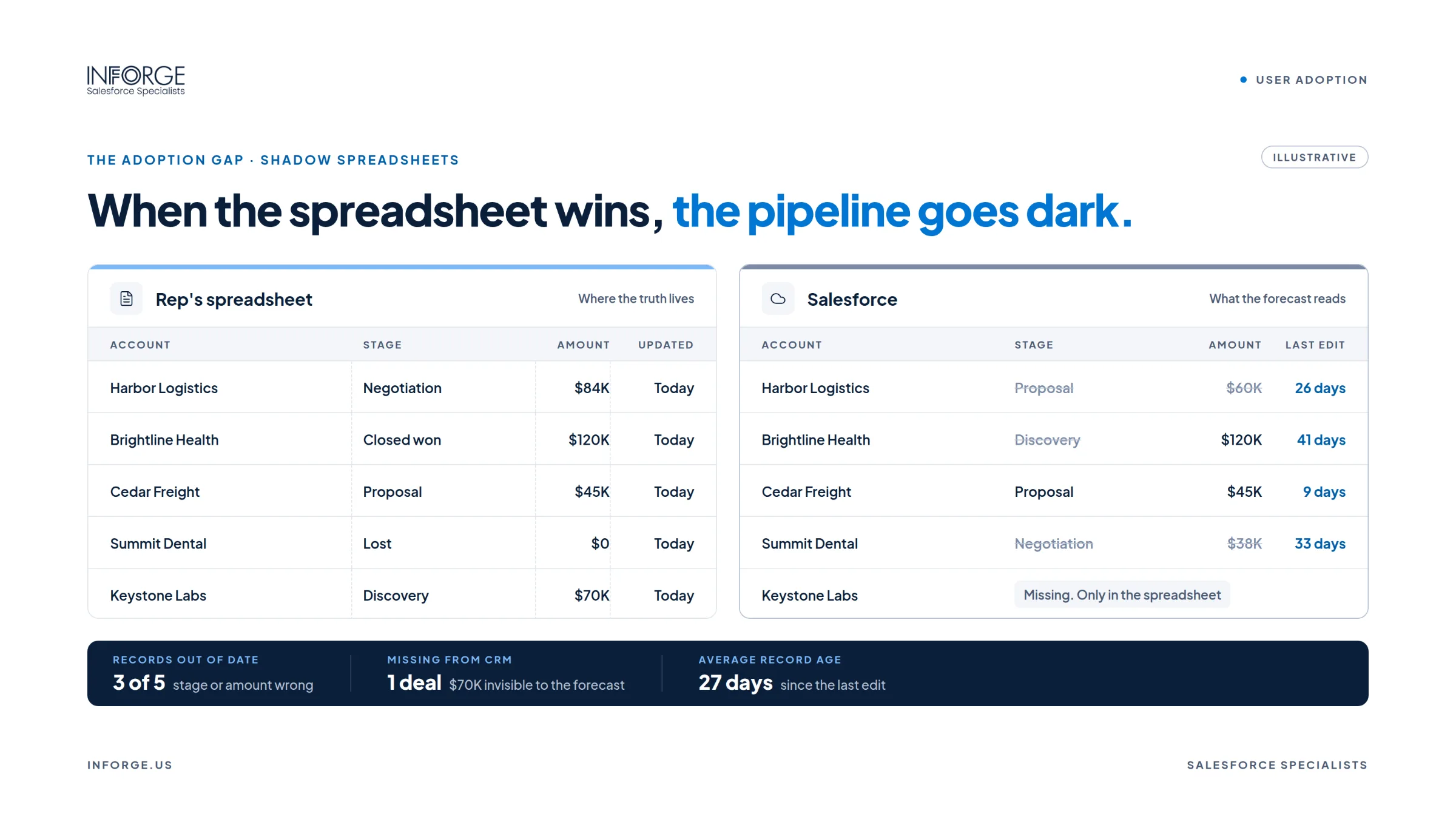
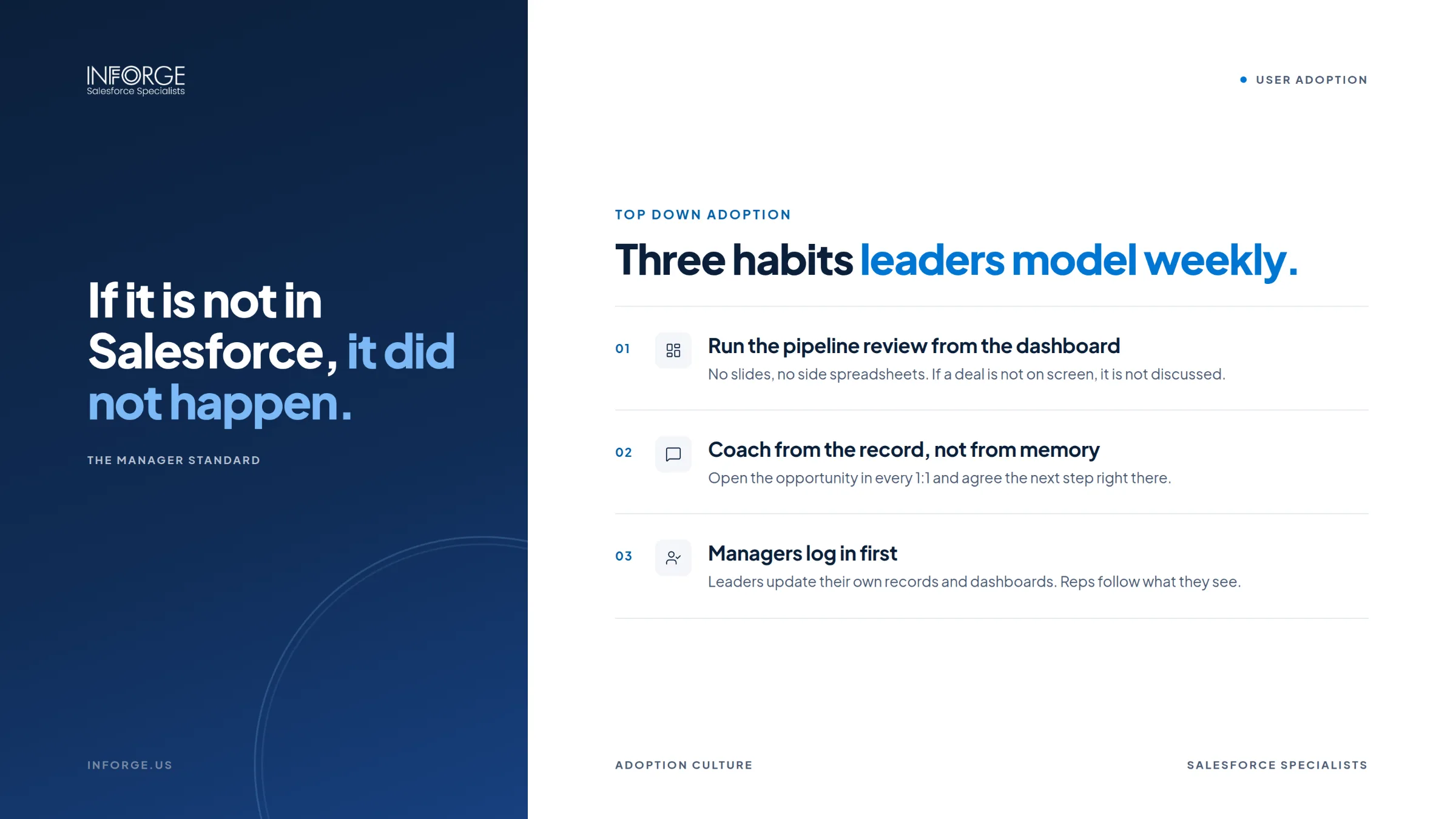
If managers run pipeline reviews in PowerPoint, hold forecast discussions over email, and coach reps from gut feel rather than Salesforce data — reps learn fast that what they enter in the CRM doesn't matter. When performance conversations happen outside Salesforce, adoption inside Salesforce collapses.
The highest-impact behavioral change in any post-go-live recovery isn't with the reps. It's with the managers. When leadership pulls their dashboards from Salesforce, when pipeline reviews reference opportunity records, and when coaching conversations start with data in the system — the message is clear: this is where work happens.
Executive sponsorship and managerial reinforcement consistently correlate with higher adoption rates. According to research from Vantage Point, active, visible leadership is one of the top predictors of CRM success — while technology itself accounts for only 20–30% of implementation success. People and process account for the rest.
Fix 4: Measure Adoption, Then Fix What the Numbers Reveal
You can't improve what you don't track. Most organizations check login rates and consider the job done. That's not adoption measurement — that's attendance.
Real adoption metrics include: opportunity hygiene scores (are stages and close dates being updated?), activity logging rates (are calls and emails being recorded?), data completeness across key fields, and report usage — are users pulling insights from Salesforce or exporting to Excel?
Target benchmarks matter. Girikon's post-implementation research suggests aiming for 70% daily active users by the end of month three. Build adoption dashboards visible to leadership. Run quarterly reviews. When the data shows a specific workflow being skipped, that's a signal to investigate the process — not punish the user.
Tracking also removes the subjectivity from adoption conversations. When a manager asks "is anyone using this?" you want data, not impressions.
Fix 5: Build a Champion Network, Not a Helpdesk Queue
Centralised support desks can handle break-fix issues. They can't drive behavioural change at scale.
The most effective post-go-live support model is peer-led. Identify one champion per team — someone who understands the workflows, can translate between business process and Salesforce configuration, and can handle the "how do I..." questions in real time. Champions answer questions before they become frustration, surface feedback before it becomes resistance, and model the behaviours the organisation needs to normalise.
According to research from Dwinsoft, department champions who support peers after launch keep adoption climbing well beyond go-live day. The role doesn't require deep technical knowledge — it requires trust, proximity, and a willingness to help. That's something a helpdesk ticket can't replicate.
Pair the champion network with a structured 90-day hypercare period: dedicated support resources, weekly check-ins, and a clear escalation path for issues that require admin or consultant intervention.
Fix 6: Make Salesforce Useful Before Making It Mandatory
Enforcing CRM usage through reminders and warnings converts Salesforce from a selling tool into a surveillance tool. That framing creates resistance, not engagement.
The more effective sequence: make the system genuinely useful first, then reinforce its use through process and culture. When Salesforce surfaces a next-best action for a rep, auto-populates contact details, or generates a follow-up task from an email — it saves time. When it saves time, reps use it voluntarily.
Fewer than 40% of organisations using CRM software achieve end-user adoption rates above 90%, according to data aggregated by Cynoteck. The common thread among the ones that do: they made the system valuable before they made it required. Quick wins — automations that eliminate repetitive tasks, dashboards that replace manual reporting, mobile access that lets reps update records on the go — build trust in the platform faster than any enforcement policy.
Summary
Salesforce adoption doesn't fail because users are resistant or lazy. It fails because the system wasn't designed for the people using it, training stopped at go live, and managers never made it the centre of how work actually gets done. The fixes are concrete: reconfigure for usability, move to continuous enablement, enforce adoption from the top down, measure what actually matters, and make the system earn its place in users' daily workflow before demanding compliance.
At Inforge, we've delivered full Salesforce implementations using an AI-agent-first model — faster, more consistently, and at a fraction of traditional consulting costs. Post-go-live adoption support is where that investment compounds. If your org went live and usage stalled, we know exactly where to look.
Frequently Asked Questions
Q: Why does Salesforce adoption drop so quickly after go live?
A: Adoption drops because the support structure that carried users through implementation is removed at the moment they need it most. Training decays, processes drift, and without reinforcement from management, users revert to familiar habits — email, spreadsheets, and personal notes. The 90 days after go live are the most critical window for adoption, and most organisations treat them as a wind-down rather than a launch.
Q: What is the #1 reason Salesforce implementations fail?
A: Poor user adoption. According to multiple sources including Radin Dynamics and Johnny Grow, 55% of CRM implementations fail to meet their planned objectives, and user adoption is consistently identified as the primary cause — ahead of technical issues, integration failures, or budget overruns.
Q: How do I get sales reps to actually use Salesforce?
A: Start with the system, not the people. Audit page layouts and required fields for friction. Move to role-based configuration so each user sees only what's relevant to their work. Then ensure managers use Salesforce in pipeline reviews and coaching — when leadership relies on the data, reps provide it. Enforcement without usefulness creates resistance; usefulness without enforcement still drives adoption.
Q: What are the right metrics to track Salesforce adoption after go live?
A: Track beyond login rates. Measure opportunity hygiene (stage accuracy, close date currency), activity logging rates, data completeness on key fields, and whether users are running reports inside Salesforce or exporting to spreadsheets. Aim for 70% daily active users by end of month three, and review adoption dashboards quarterly with leadership.
Q: How long does it take to fix Salesforce adoption after go live?
A: A structured 90-day hypercare program can stabilise adoption and surface the highest-friction issues quickly. Meaningful, sustainable improvement — where Salesforce becomes the genuine system of record — typically takes six months of consistent enablement, process reinforcement, and configuration refinement. There's no shortcut, but the ROI compounds fast once adoption crosses a threshold: better data quality, more accurate forecasting, and reduced manual reporting overhead.