What Makes a Great Salesforce Implementation Partner (And How to Spot One Before It's Too Late)
The right Salesforce implementation partner accelerates revenue, tightens operations, and delivers a system your team actually uses. The wrong one leaves you with technical debt, low adoption, and a CRM that nobody trusts. The difference between those two outcomes almost never comes down to Salesforce itself — it comes down to the partner running the project.
Quick Answer: A great Salesforce implementation partner combines verified technical expertise across relevant Salesforce clouds, a structured-yet-adaptive delivery methodology, genuine industry knowledge (not surface familiarity), and a track record of measurable outcomes — not just go-live dates.
Key Takeaways:
Between 30% and 70% of Salesforce implementations fail to meet strategic objectives — the primary causes are partner selection errors, not platform limitations.
Technical certifications are table stakes; what distinguishes great partners is architectural depth, cross-cloud experience, and real engineering capability.
Industry knowledge determines configuration quality — a partner who's never worked in your sector will learn on your budget.
Methodology matters more than speed: phased, agile-hybrid delivery consistently outperforms big-bang deployments.
At Inforge, we deliver full Salesforce implementations through AI agents — faster timelines, consistent quality, at a fraction of traditional cost. That's not a claim. It's our operating model.
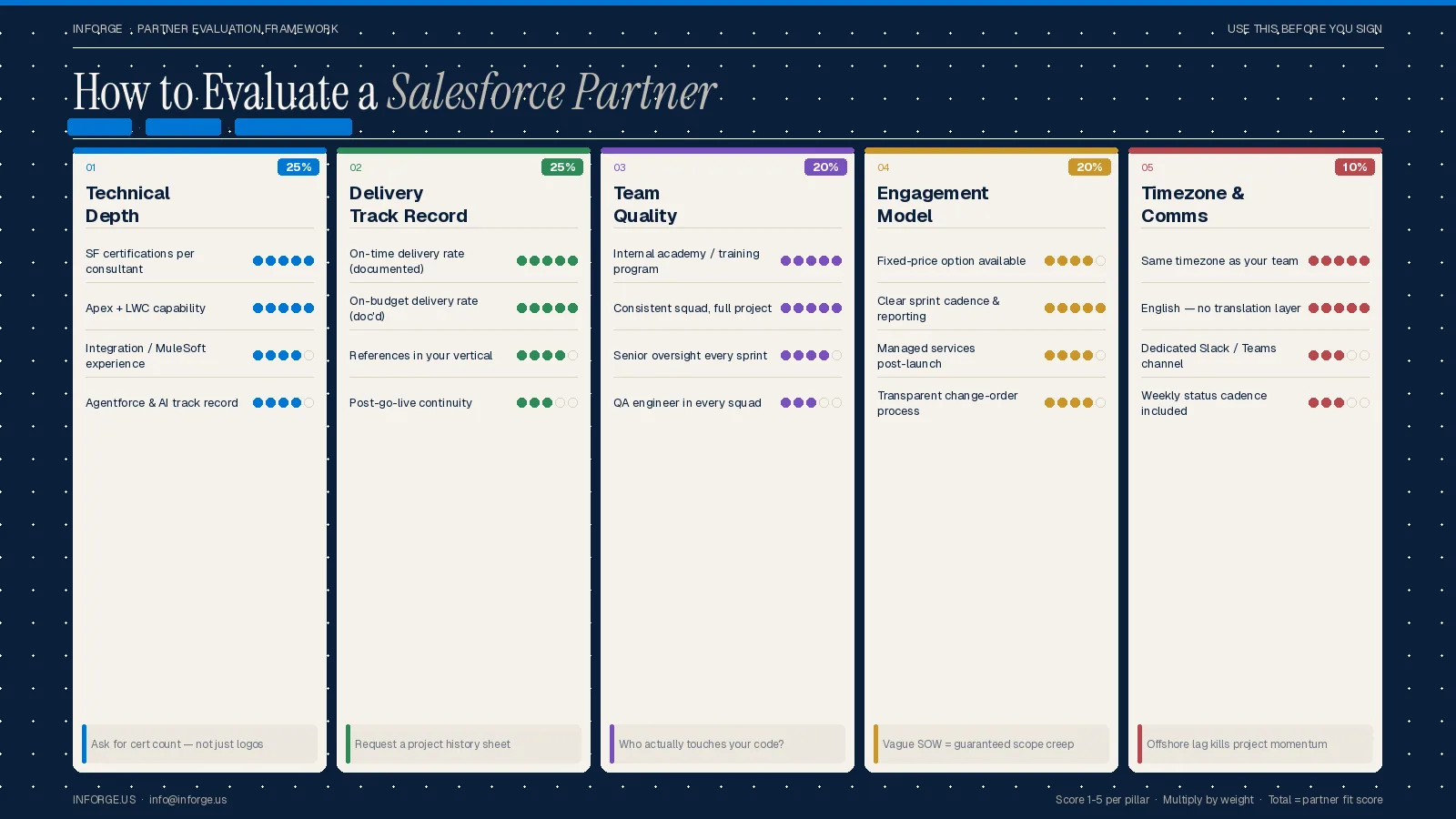
Why Most Salesforce Projects Miss the Mark
According to multiple industry analyses, between 30% and 70% of Salesforce implementations still fail to meet their strategic objectives — most often due to misaligned goals, poor user adoption, or flawed execution by the delivery team. The platform is not the problem. Salesforce serves more than 150,000 companies worldwide and has held the #1 CRM position for over a decade. The failure point is almost always execution.
Choosing the wrong Salesforce implementation partner is the single biggest risk factor in any CRM project. The cost doesn't show up on day one. It shows up in scope creep six weeks in, in user adoption rates at quarter-end, and in the rework budget that nobody planned for.
Understanding what "great" actually looks like is the most important decision you'll make before signing any SOW.
Technical Expertise: Beyond the Certificate Count
Certifications are a baseline, not a differentiator. Admin, Developer, and Architect credentials prove that a team has studied the platform and passed rigorous exams — they do not prove that the team can architect a production-grade solution for your specific environment.
The technical questions that actually matter:
Cross-cloud architecture. Modern Salesforce success rarely happens in a single cloud. Implementation partners must demonstrate a deep understanding of how Sales Cloud, Service Cloud, Revenue Cloud, and Marketing Cloud interact — and how data flows between them without siloing. If your business needs data to move from a marketing click to a closed invoice, you need a partner with genuine cross-cloud architecture experience.
Engineering depth vs. admin-heavy teams. Many partners rely heavily on declarative, clicks-not-code customisation. That works for straightforward use cases. But if your project requires custom Apex triggers, complex Lightning Web Components, or deep integrations via MuleSoft or REST APIs, you need a partner with real engineering capability — not just admins who've passed a consultant exam. Ask directly: what percentage of your team are developers vs. admins vs. consultants? A partner with only admins and consultants will hit a ceiling when complexity increases.
Data governance and integration architecture. A capable partner must understand how to engineer your Salesforce solution in the context of your existing enterprise systems. Their approach to data governance — source-of-truth consistency, permission models, migration cleansing — will directly determine implementation quality.
AI and Agentforce readiness. In 2026, any SFDC implementation partner who hasn't evolved their toolkit for the era of Agentforce and Data Cloud is already behind. Partners who piloted Einstein GPT-based automation early and are actively implementing Agentforce for clients represent the current standard of technical leadership. At Inforge, AI agents don't just augment our delivery — they are our delivery model.
Methodology: The Framework That Either Holds or Breaks Projects
How a partner runs a project is as important as what they know. Methodology determines whether scope creep kills the timeline, whether go-live is a crisis or a controlled event, and whether the system your team receives on day one is the same system they can maintain on day ninety.
The delivery approaches worth understanding:
Waterfall is sequential and rigid — ideal for fixed, well-defined requirements. It provides predictability but offers no flexibility when business needs shift mid-project, which they always do.
Agile is iterative and sprint-based. It adapts well to evolving requirements and enables early validation of built features. The risk is that without structured milestones, scope expands quietly until the budget doesn't.
Hybrid ("Wagile") is the approach most experienced partners use in practice: structured Waterfall milestones combined with Agile sprints during core build and configuration phases. This model provides predictability and flexibility — the two things a mid-market implementation needs simultaneously.
A strong partner will also insist on phased rollout over big-bang deployment. A modular, phased implementation allows each stage to be validated before the next begins, dramatically reducing the risk of organisation-wide disruption at go-live.
Ask any prospective partner: *How do you handle scope change requests mid-sprint? Can you show us a project where requirements shifted and explain how you managed it?* The answer will tell you more than any slide deck.
Industry Knowledge: The Differentiator Nobody Talks About Enough
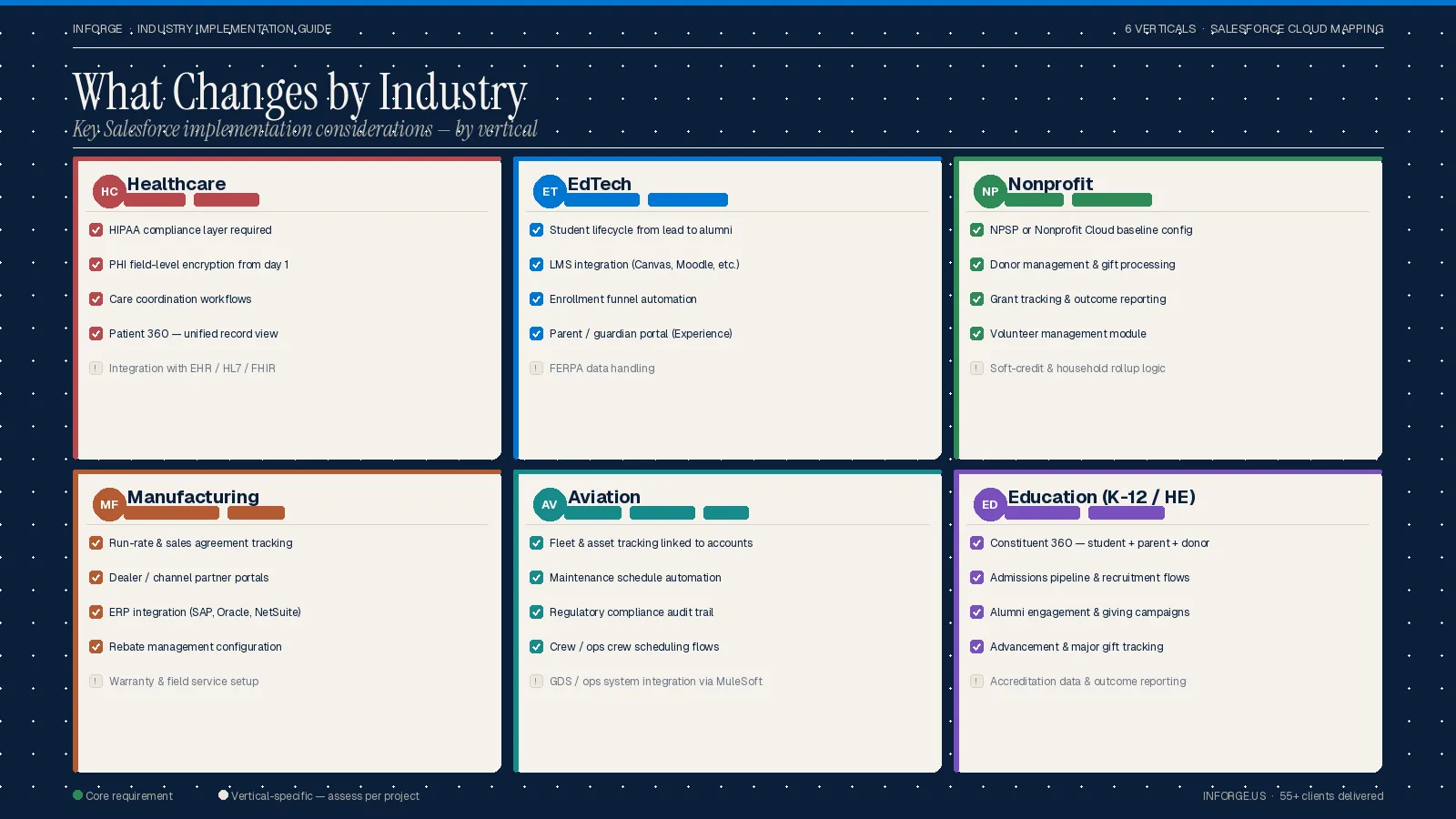
A partner who has built Salesforce solutions for healthcare organisations understands HIPAA compliance constraints. One who has worked in manufacturing knows how to structure dealer management and complex quoting workflows. This kind of domain knowledge cannot be faked — and it determines configuration quality from day one.
Industry-specific experience means the partner is already aware of the most effective instruments and strategies for your sector. As a rule, customisation from an industry-knowledgeable firm is better-suited and faster to implement than generic configuration applied by a generalist team working in your space for the first time.
The practical test: ask for references in your specific industry. If a partner cannot provide at least two or three examples of comparable projects in your sector, that is a signal they will be learning on your budget.
Industry knowledge also directly affects compliance. GDPR-like regulations in 15+ countries now mandate partners to implement granular consent management and data anonymisation features within Salesforce deployments. A partner without sector experience is likely to miss these requirements — or discover them late.
Common Pitfalls — And the Partners Who Cause Them
The failure modes in Salesforce implementations are well-documented. The ones that trace directly back to partner decisions:
Unclear goals at discovery. Many companies rush into Salesforce without defining what success looks like — and many partners let them. A great partner pushes back at discovery, defines measurable objectives, and refuses to proceed without a project charter that aligns business goals to platform configuration.
Over-engineering and scope creep. Implementing unnecessarily complex solutions that exceed actual business requirements is one of the most frequent implementation mistakes. Over-engineering increases maintenance costs, slows performance, and complicates user experience. Customisation vs. configuration balance is a skill — the best partners know when native functionality is sufficient and when custom code is genuinely necessary.
Data migration underestimated. Migrating from legacy CRMs and synchronising data with other business systems can be intricate. It requires extensive data mapping, transformation, cleansing, and testing. Partners who treat data migration as a checkbox item rather than a project phase create data quality problems that persist long after go-live.
No change management plan. Without strong executive sponsorship and a structured user adoption plan, a Salesforce rollout can stall regardless of technical quality. Research shows that 70% of information is forgotten within 24 hours without reinforcement — a partner who delivers training as a single end-of-project session is setting adoption up to fail.
Low-cost bids that mask risk. Partners with surprisingly low pricing are likely to have untrained staff or take shortcuts in security and process governance. The cost of fixing a poorly architected implementation consistently exceeds the cost of doing it properly the first time. Never prioritise lowest cost over a partner's proven quality and delivery track record.
What to Ask Before You Sign
Evaluate partners not by their pitch decks but by their answers to specific, outcome-oriented questions:
*How many certified developers (not just admins) are assigned to projects of this scope?*
*What is your approach when requirements change mid-sprint?*
*What compliance frameworks have you implemented for clients in our industry?*
*What does post-go-live support look like — and what's covered in the SLA?*
*Can you walk us through a project that didn't go to plan and how you resolved it?*
High-performing partners distinguish themselves through technical precision, proactive optimisation, and a relentless focus on measurable outcomes — not just delivery milestones. The best proposal balances competitive pricing with a comprehensive approach, proven expertise, and transparent communication.
Also verify certifications through Salesforce AppExchange partner profiles, where certified credentials are publicly listed and cross-referenceable against delivery history.
Summary
A great Salesforce implementation partner is defined by four things: technical depth that goes beyond certification counts, a delivery methodology that's structured enough to control scope and flexible enough to adapt, genuine industry knowledge that shapes configuration from the first discovery call, and a track record of measurable post-go-live outcomes. At Inforge, we've rebuilt what implementation delivery looks like — using AI agents to handle every phase of a Salesforce project with more consistency and less overhead than traditional consultancy models. If you're evaluating partners for your next Salesforce project, the standard has changed. The question isn't just who has the most certifications — it's who can actually deliver.
Frequently Asked Questions
Q: How do I verify a Salesforce implementation partner's expertise?
A: Check their profile on Salesforce AppExchange for certified credential counts and client reviews. Go deeper by asking for case studies in your specific industry and requesting references you can contact directly. Certifications confirm knowledge — delivery history confirms capability.
Q: Does the Salesforce partner tier (Summit, Crest, Ridge) guarantee quality?
A: Partner tier gives you a baseline credibility signal, not a quality guarantee. A Ridge or Crest partner that specialises in your industry and project type will often outperform a generalist Summit firm that assigns junior consultants to your account. Tier is a starting filter, not a final decision.
Q: What's the most common reason Salesforce implementations fail?
A: Between 30% and 70% of implementations fail to meet strategic objectives — most often due to misaligned goals, poor user adoption, or flawed execution. The platform is rarely the cause. Partner selection, change management, and data quality are the three variables that most consistently determine success.
Q: Should I prioritise the lowest-cost Salesforce partner?
A: No. Partners with surprisingly low pricing frequently lack experienced staff or take shortcuts in process governance and security. The cost of reworking a poorly architected implementation consistently exceeds the cost of a quality partner upfront. Evaluate on expertise, industry fit, and delivery methodology — not sticker price.
Q: What post-implementation support should I expect from a great partner?
A: Great partners provide formal SLAs covering response times, issue resolution processes, and ongoing system optimisation. Post-go-live support should include help absorbing Salesforce's three annual update cycles, tuning AI models and automations based on real-world usage, and structured knowledge transfer so your internal team builds capability over time.
