What Makes a Good Salesforce Consulting Partner (And How to Spot One)
A good Salesforce consulting partner doesn't just implement technology — they become a strategic ally in your business growth. That distinction matters. Because picking the wrong one doesn't just slow you down; it costs you real money, real time, and real competitive ground.
Quick Answer: A good Salesforce consulting partner combines verified certifications, industry-specific experience, a structured delivery methodology, and post-launch support. In 2025, the best ones also bring AI-readiness into every engagement.
Key Takeaways:
Certifications matter, but they're a floor — not a ceiling. Look beyond credentials to delivery track record.
Industry experience cuts implementation time by 25–40% compared to generalist partners.
The relationship shouldn't end at go-live. Ongoing support separates transactional vendors from true partners.
AI capability is now a baseline expectation, not a differentiator.
The delivery model itself tells you more than any sales pitch.
1. Certifications Are the Starting Point, Not the Whole Story
Certifications validate that a consulting team knows what they're doing. They're necessary — but not sufficient.
<cite index="11-3,11-4">When selecting a consulting partner for your Salesforce implementation, it's important to verify Salesforce certification. These certifications are evidence of how knowledgeable the consultants are about Salesforce technology and best practices.</cite> That's the baseline. What you're really evaluating is whether those certified people have shipped real projects at real scale.
<cite index="13-14,13-15">Industry experience is the top selection factor, rated 95% in importance by successful implementations. Healthcare, financial services, and manufacturing firms report 25–40% faster implementations with industry-specialized partners.</cite>
<cite index="13-16,13-17,13-18">Technical certifications rank 90% in importance, making them critical indicators of competency. Leading partners maintain certification ratios of 35%+ across their workforce and continuously invest in training.</cite>
So: verify certifications, then go deeper. Ask what they've built, for whom, and what the outcome was.
2. Delivery Methodology Tells You Everything
How a partner operates is more revealing than what they promise.
<cite index="2-14,2-15">Elite partners begin by understanding your business objectives, challenges, and growth targets before recommending Salesforce solutions. Top partners develop tailored Salesforce configurations that align perfectly with your unique business processes, never forcing your operations to fit generic templates.</cite>
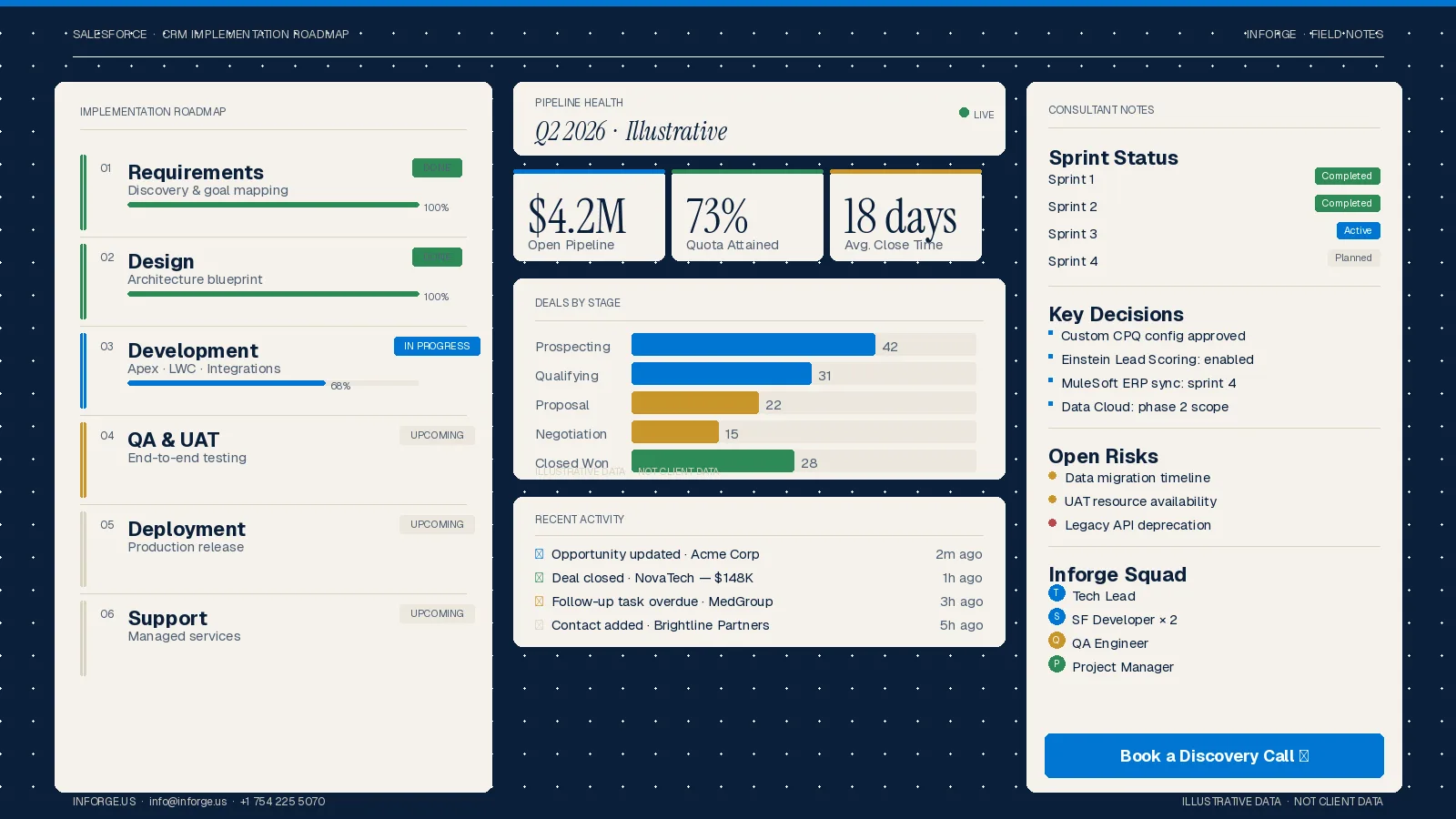
<cite index="2-16">Expect detailed implementation roadmaps with clear timelines, milestones, and resource allocations to ensure smooth execution from start to finish.</cite>
A partner without a clear methodology is a partner improvising on your budget. Ask for the playbook before you sign anything.
At Inforge, we've found that the delivery model is the product. We replaced traditional headcount-driven implementation with an AI-agent-first approach — full Salesforce implementations delivered through prompts, not project sprawl. Faster timelines. More consistent quality. A fraction of the cost. That's not positioning. That's how we operate, every day.
3. Industry Experience Shortens the Learning Curve Dramatically
A generalist partner will figure out your industry on your dime. A specialized one arrives with pre-built accelerators, compliance knowledge, and sector-specific playbooks.
<cite index="7-17">Modern consulting partners set themselves apart through deep industry expertise, fetching pre-built accelerators, compliance knowledge, and verified playbooks tailor-made to specific sectors.</cite>
<cite index="4-21">A partner that has delivered for your industry — financial services, health cloud, manufacturing — will bring reusable assets and a shorter learning curve.</cite>
This isn't a nice-to-have. For regulated industries especially, it's the difference between a smooth go-live and a compliance incident.
4. Post-Launch Support Is Where Most Partners Fall Short
The go-live isn't the finish line. It's the starting gun.
<cite index="2-19">Premium partners don't disappear after launch — they provide ongoing optimization, troubleshooting, and proactive system maintenance.</cite>
<cite index="13-27,13-28">A successful Salesforce journey doesn't end at go-live. Leading partners provide continuous support and optimization, ensuring long-term ROI.</cite> And the numbers back it up: <cite index="13-30">organizations that invest in long-term partnerships report 40% higher satisfaction and significantly better platform utilization.</cite>
Before you sign, ask specifically: what does hypercare look like? What's the managed services model? What's the SLA after go-live? If a partner gets vague here, that's a signal.
<cite index="16-16">Confirm the firm offers a period of "hypercare" — intensive support immediately after go-live — and a clear option for ongoing managed services to protect your investment for years to come.</cite>
5. AI Readiness Is No Longer Optional
The Salesforce consulting landscape has shifted.
<cite index="3-2,3-3">In 2025, Salesforce consulting has entered a new era defined by agentic AI, revenue-level orchestration, and data-native execution. Salesforce's Agentforce platform is already driving adoption — folding intelligent agents into workflows that do more than recommend: they execute actions.</cite>
<cite index="3-6">For buyers scanning the landscape of 2026, the benchmark has shifted: your next consulting partner must build scalable orgs, design, operate, and evolve agentic systems, multi-cloud integration, and real-time data flows that address specific business needs.</cite>
The bottleneck isn't AI capability. It's that most consulting firms aren't yet set up to build and operate agentic systems — they're still running the same delivery model they had five years ago with an AI slide deck bolted on.
<cite index="8-8">In 2025, choosing the best Salesforce consulting partner is not just about implementation; it is about finding a partner who is delivering continuous innovation.</cite>
Ask any partner you're evaluating: do you use AI in your own delivery process? The answer will tell you everything.
6. The Numbers Don't Lie — ROI Depends on Partner Quality
This isn't abstract. Partner selection has measurable financial consequences.
<cite index="1-1">Companies working with expert Salesforce partners achieve 3.5x higher ROI and 42% faster implementations.</cite>
<cite index="13-10,13-11">Research shows that well-executed implementations deliver an average ROI of 29% within just nine months. Conversely, failed projects can result in millions of dollars lost to low adoption, wasted effort, and delayed competitive advantage.</cite>
<cite index="13-12">The right partner can accelerate delivery by up to 78% using proven methodologies, pre-built accelerators, and reusable components.</cite>
Those numbers reflect the delta between a partner who's done this before and one who's learning at your expense.
Summary
A great Salesforce consulting partner brings certified expertise, a structured delivery methodology, genuine industry experience, and a commitment that extends well beyond go-live. In 2025, they also bring AI capability that's operational — not theoretical. The firms that have replaced legacy delivery models with agent-first execution aren't just faster; they're consistently better.
At [Inforge](https://www.inforge.us/), that's exactly how we operate. We're a Salesforce consultancy that replaced its entire traditional delivery model with AI agents — full implementations, delivered through prompts. If you're evaluating partners for your next Salesforce project, we'd be glad to show you what that looks like in practice.
Frequently Asked Questions
Q: What should I look for in a Salesforce consulting partner?
A: Look for verified certifications, a clear delivery methodology, industry-specific experience, and a defined post-launch support model. In 2025, AI readiness is also a baseline requirement — not a bonus.
Q: How important are Salesforce certifications when choosing a partner?
A: Certifications are necessary but not sufficient. They validate foundational knowledge; what you actually want to evaluate is real delivery track record — projects of similar scope, complexity, and industry focus.
Q: What's the difference between a consulting partner and an implementation partner?
A: In practice, the best partners are both. A consulting partner advises on strategy and platform design; an implementation partner builds and deploys it. The strongest firms handle the full lifecycle — from discovery through go-live and ongoing optimization.
Q: How do I evaluate a Salesforce partner's AI capability?
A: Ask directly whether they use AI in their own delivery process. A partner with real AI capability won't just talk about it — they'll demonstrate it. Ask for specific examples: how are agents used in your implementation workflow today?
Q: What does a failed Salesforce implementation actually cost?
A: More than you'd expect. Beyond the direct project costs, failed implementations result in low user adoption, rework, delayed competitive advantage, and in some cases, significant data integrity issues. Choosing the right partner upfront is almost always cheaper than fixing a bad one mid-project.
