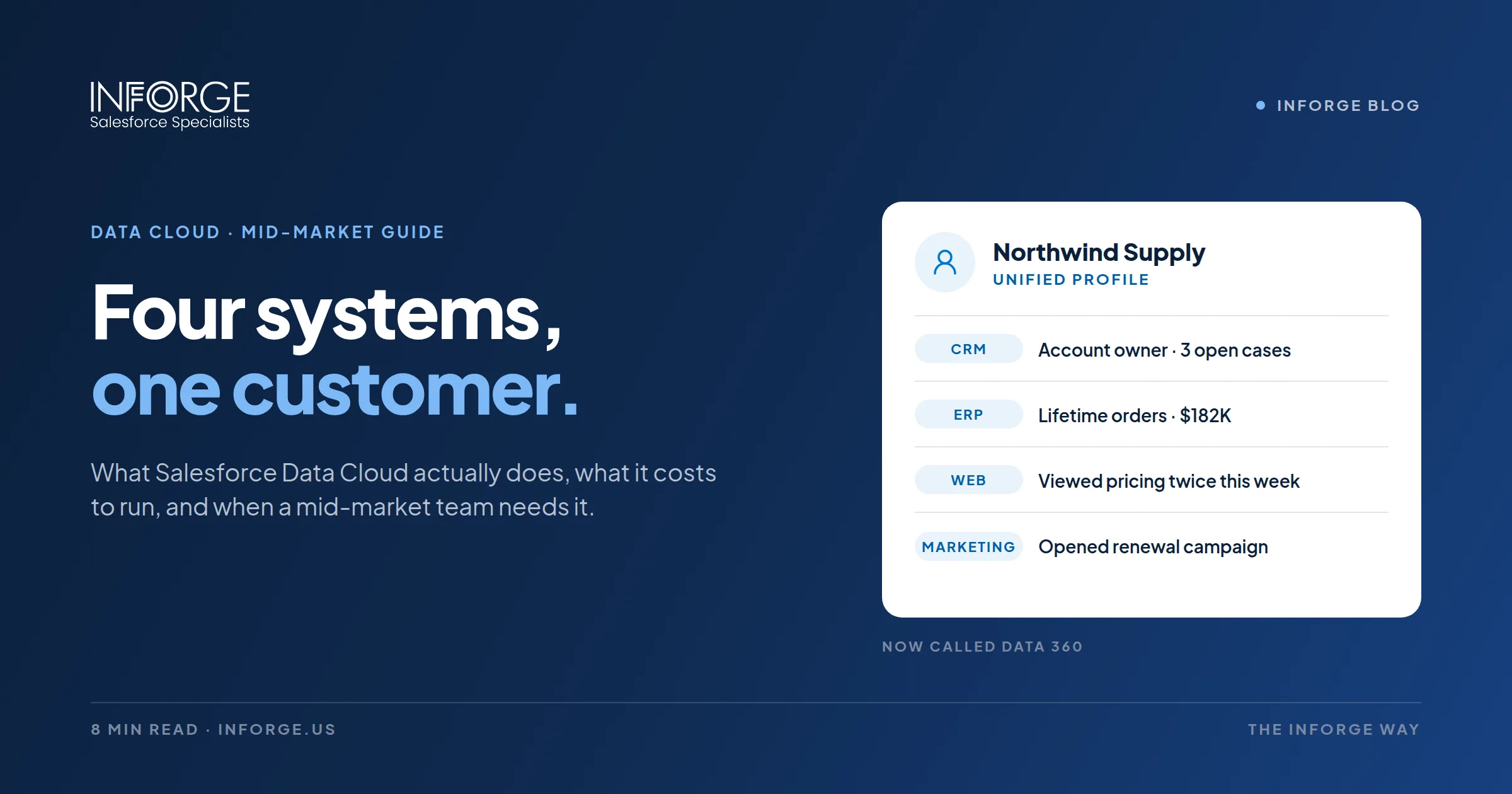
What Is Salesforce Data Cloud? A Practical Guide for Mid-Market Companies
Salesforce Data Cloud is Salesforce's data platform for unifying customer data from every system your company uses into a single, real-time profile inside Salesforce. In October 2025, Salesforce renamed it Data 360, but the core idea is the same: pull together data from your CRM, ERP, website, marketing tools, data warehouse, and apps, match it to the right customer, and make it usable for sales, service, marketing, analytics, and AI agents.
Quick Answer: Salesforce Data Cloud (now Data 360) is a customer data platform built into Salesforce. It ingests data from Salesforce and outside systems, resolves duplicate identities into unified customer profiles, calculates insights, builds segments, and activates that data across Salesforce apps and Agentforce. Pricing is consumption-based, starting at $500 per 100,000 Flex Credits, with profile-based options starting at $240 per 1,000 profiles per year. For mid-market companies, it makes sense when customer data is spread across multiple systems and that fragmentation is blocking personalization, reporting, or AI.
Key Takeaways:
Salesforce renamed Data Cloud to Data 360 at Dreamforce in October 2025. Most people still search for it as Data Cloud.
Data 360 unifies data from Salesforce and external systems into a single customer profile, using identity resolution to match records across sources.
It's the data foundation for Agentforce. AI agents are only as useful as the customer data they can access.
Pricing is consumption-based: $500 per 100,000 Flex Credits, or $240 to $420 per 1,000 profiles per year on profile-based plans, per Salesforce's public pricing.
Mid-market companies get the most value when they start with one or two specific use cases instead of trying to unify everything at once.
What Salesforce Data Cloud (Data 360) Actually Does
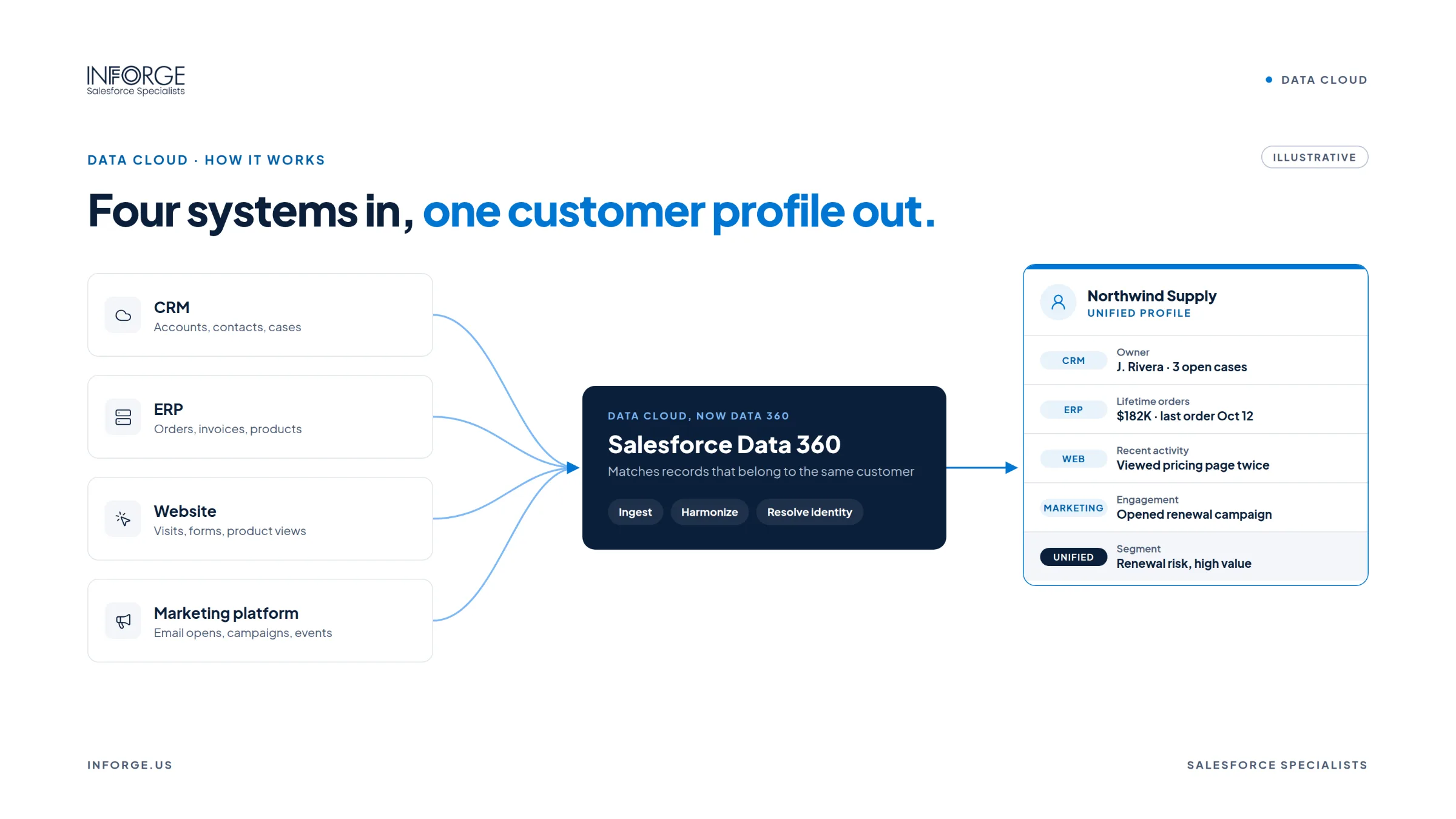
Most mid-market companies have the same problem. Customer data lives in five, ten, or twenty systems. Sales sees one version of the customer in Salesforce. Finance sees another in the ERP. Marketing sees another in its email platform. Support sees another in its ticketing tool. Nobody has the full picture.
Data 360 is built to fix that. It does five main things:
1. Connects and ingests data
Data 360 brings in data from Salesforce clouds and from outside sources like data warehouses, ERPs, websites, mobile apps, and marketing platforms. It also supports zero-copy integration with major data warehouses and lakehouses, so in some cases data can be accessed without physically copying it into Salesforce.
2. Harmonizes the data
Data from different systems comes in different formats. Data 360 maps it to a common data model so a "customer" or an "order" means the same thing regardless of where it came from.
3. Resolves identities
This is the core capability. Identity resolution matches records across systems, such as an email in your marketing tool, a contact in Salesforce, and a customer ID in your ERP, and links them into one unified profile.
4. Generates insights and segments
With unified profiles, teams can calculate metrics like lifetime value, engagement scores, or churn risk, and build segments of customers based on behavior and attributes across every system.
5. Activates the data
Unified profiles and insights flow back into Sales Cloud, Service Cloud, Marketing Cloud, analytics, and Agentforce. A rep sees recent product usage on the account. A service agent sees open invoices. An AI agent personalizes its response with the customer's full history.
Why Data Cloud Matters for AI and Agentforce
Data 360 has become central to Salesforce's AI strategy. Agentforce agents rely on it to access unified customer context, so they can answer questions, take actions, and personalize responses accurately.
This is the practical reason many mid-market companies are evaluating it now. An AI agent connected to fragmented, duplicate, or incomplete data will give fragmented, duplicate, or incomplete answers. Data 360 is how Salesforce gives agents a trusted, unified view of the customer.
How Much Does Salesforce Data Cloud Cost?
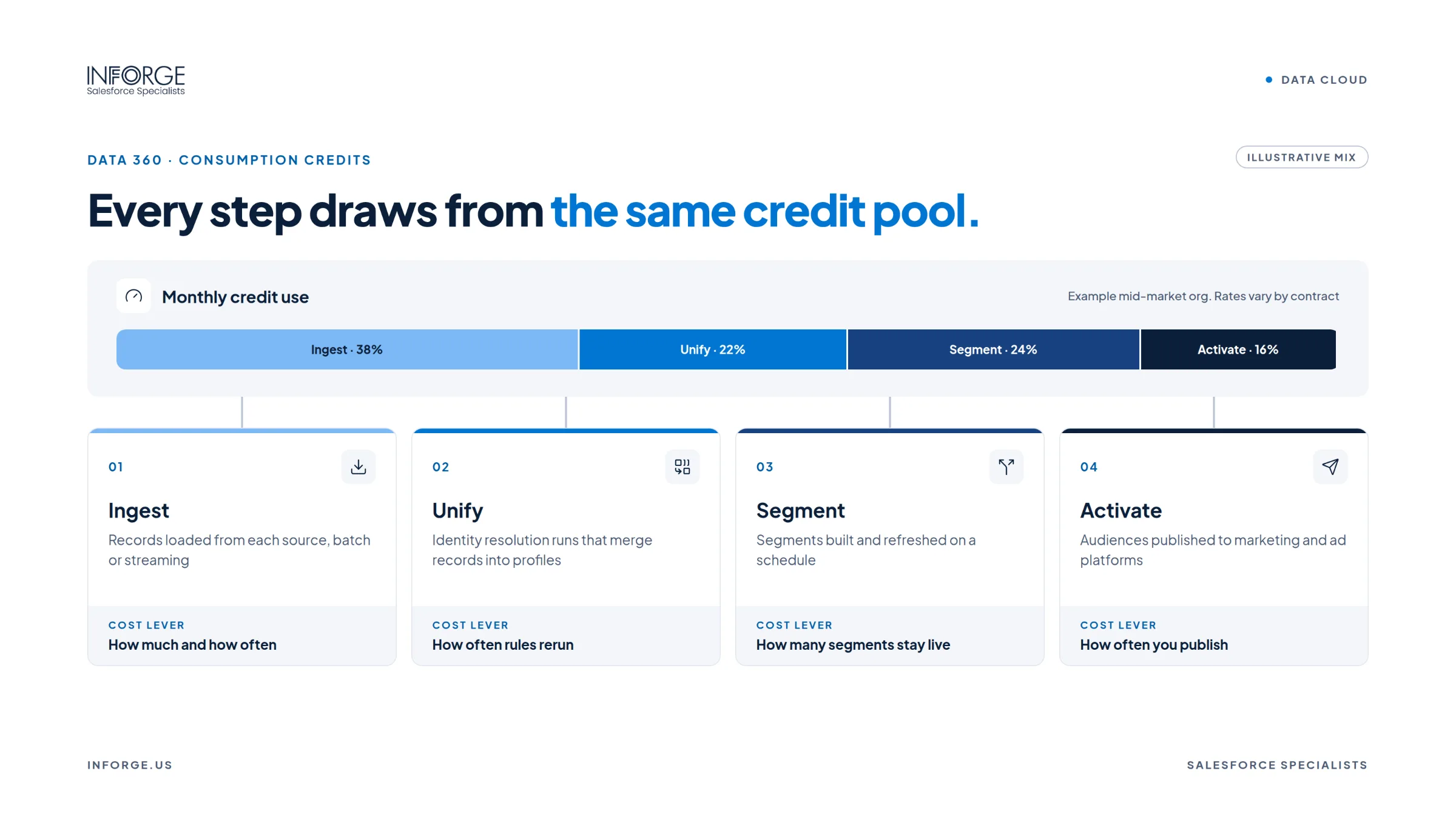
Data 360 doesn't use per-user licensing like Sales Cloud. It's priced on consumption, and Salesforce currently offers three main ways to buy, according to its public pricing page.
Flex Credits: $500 per 100,000 credits. Every Data 360 action, like ingesting records, running identity resolution, refreshing segments, or querying data, consumes credits. Flex Credits can also be shared between Data 360 and Agentforce.
Profiles: $240 per 1,000 profiles per year, with essential Data 360 actions included and one Flex Credit per profile per year.
Profiles (premium tier): $420 per 1,000 profiles per year, with more actions included, two Flex Credits per profile, and add-ons like data masking.
Data storage and certain premium features can add to the total. Because costs depend heavily on data volume, refresh frequency, and how many use cases you run, Salesforce provides a pricing calculator and usage monitoring through its Digital Wallet. Pricing and packaging have changed several times, so confirm current rates with Salesforce before budgeting.
The biggest cost risk for mid-market companies isn't the list price. It's poorly designed data pipelines that refresh too often or process more data than needed, quietly burning through credits.
When Data Cloud Makes Sense for a Mid-Market Company
Data 360 is powerful, but it isn't the right first move for every company. It's usually a strong fit when:
Customer data lives in multiple core systems and teams regularly make decisions without the full picture.
You're deploying Agentforce and need agents to access customer context from outside your core CRM.
Marketing needs better segmentation and personalization based on behavior, purchases, or product usage.
You need a 360-degree customer view for sales and service teams without building custom integrations for every system.
You have a data warehouse already and want to activate that data in Salesforce without duplicating it.
It's probably not the right first step if:
Your Salesforce data itself is messy and poorly adopted. Fix the foundation first.
Most of your customer data already lives in Salesforce.
You don't have a specific use case with a measurable outcome.
How to Get Started Without Overspending
Pick one or two use cases. For example, giving service agents a unified view of orders and invoices, or building a churn-risk segment for marketing. Specific use cases control scope and cost.
Map your data sources. Identify exactly which systems and fields the use case needs. Don't ingest everything.
Clean the data first. Identity resolution works better when source data is deduplicated and standardized.
Design for credit efficiency. Choose refresh frequencies based on business need, not defaults. Many use cases don't need real-time updates.
Monitor consumption from day one. Track credit usage by feature so there are no surprises at renewal.
Expand once value is proven. Add sources and use cases after the first one is delivering results.
At Inforge, we've found that the mid-market companies getting the most out of Data Cloud aren't the ones that connect every system on day one. They're the ones that start with a clear use case, clean the data that feeds it, and design pipelines that keep credit consumption under control.
Summary
Salesforce Data Cloud, now called Data 360, unifies customer data from Salesforce and external systems into a single, real-time profile that powers sales, service, marketing, analytics, and Agentforce. It's priced on consumption, starting at $500 per 100,000 Flex Credits or $240 per 1,000 profiles per year. For mid-market companies, it delivers the most value when customer data is fragmented across systems and there's a specific use case to solve. Start small, clean your data, design for credit efficiency, and expand once the value is clear.
Inforge helps mid-market companies plan, implement, and optimize Salesforce Data Cloud with nearshore Salesforce consultants, architects, and developers working in your time zone.
Frequently Asked Questions
Q: What is Salesforce Data Cloud used for?
A: It's used to unify customer data from Salesforce and other systems into a single profile, then use that data for personalization, segmentation, analytics, service, sales insights, and AI agents through Agentforce.
Q: Is Salesforce Data Cloud the same as Data 360?
A: Yes. Salesforce renamed Data Cloud to Data 360 at Dreamforce in October 2025. The product's core purpose of unifying customer data stayed the same.
Q: How much does Salesforce Data Cloud cost?
A: According to Salesforce's public pricing, Flex Credits cost $500 per 100,000 credits, and profile-based pricing starts at $240 per 1,000 profiles per year, with a premium tier at $420. Total cost depends on data volume, refresh frequency, storage, and use cases.
Q: Do I need Data Cloud to use Agentforce?
A: Agentforce relies on Data 360 to access unified customer data, and it's central to how Salesforce delivers grounded AI responses. How much Data 360 you need depends on how much customer context your agents require from outside your core Salesforce data.
Q: Is Salesforce Data Cloud a good fit for mid-market companies?
A: It can be, especially when customer data is spread across several systems and that fragmentation is limiting personalization, reporting, or AI. Mid-market companies get the best results by starting with one or two focused use cases and controlling credit consumption from the start.
Sources used (for fact checking, not for publishing): Salesforce Data 360 pricing page · Data Cloud renamed Data 360 at Dreamforce 2025 (Rework) · CDP.com overview of Data 360