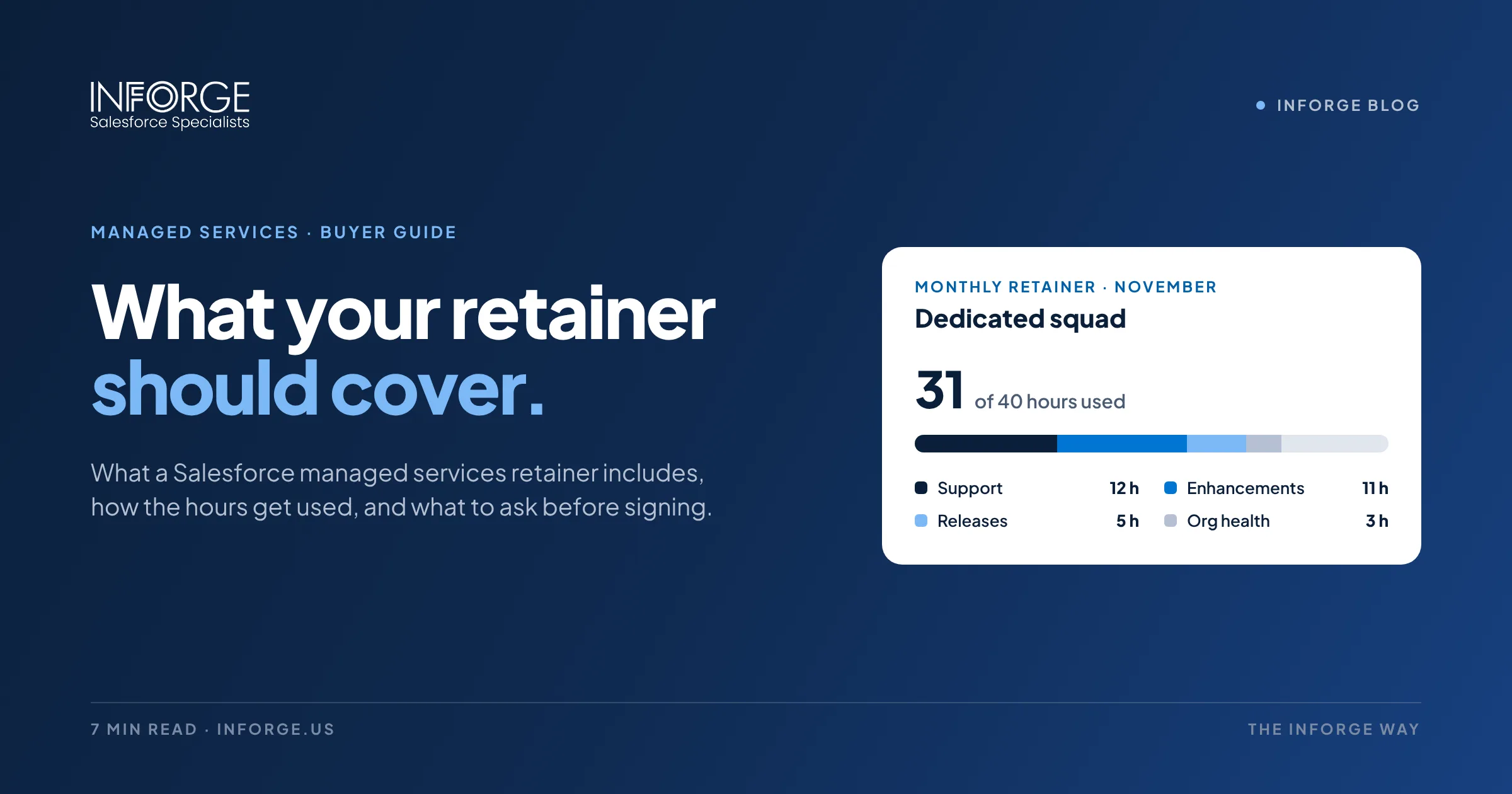
What Does a Salesforce Managed Services Retainer Include? A Buyer's Guide
A good retainer gives you a dedicated team that keeps your Salesforce org healthy, handles user requests, builds enhancements, manages releases, and helps plan what's next, for a predictable monthly fee. What it actually includes varies a lot from partner to partner, which is why the details matter more than the price. This guide covers what to expect, how pricing works, and how to compare offers.
Quick Answer: A Salesforce managed services retainer typically includes a monthly allocation of hours from a team of admins, developers, and consultants; user support and break-fix; configuration changes and small enhancements; release management for Salesforce's three annual releases; org health monitoring; data quality maintenance; reporting; and regular roadmap reviews. Published 2026 pricing from US partners commonly ranges from about $2,000 to $8,000 per month for 10 to 50 hours, with larger and more complex orgs paying more.
Key Takeaways:
A retainer reserves monthly capacity from a team, not a single person, so you get admin, developer, and consultant skills as needed.
Core inclusions are user support, enhancements, release management, org health, data quality, and roadmap planning.
Published 2026 pricing from US partners commonly ranges from roughly $2,000 to $8,000 per month for 10 to 50 hours of work.
For comparison, a mid-level US Salesforce admin earns a median of $92,000 in base salary alone, per SF Ben's 2026 data.
The most important terms to clarify are scope, response times, unused hours, and who is actually on your team.
Why Companies Choose a Managed Services Retainer
Salesforce doesn't stop needing attention after go-live. Users need help, business processes change, Salesforce ships three major releases every year, data quality drifts, and leadership keeps asking for new reports and features.
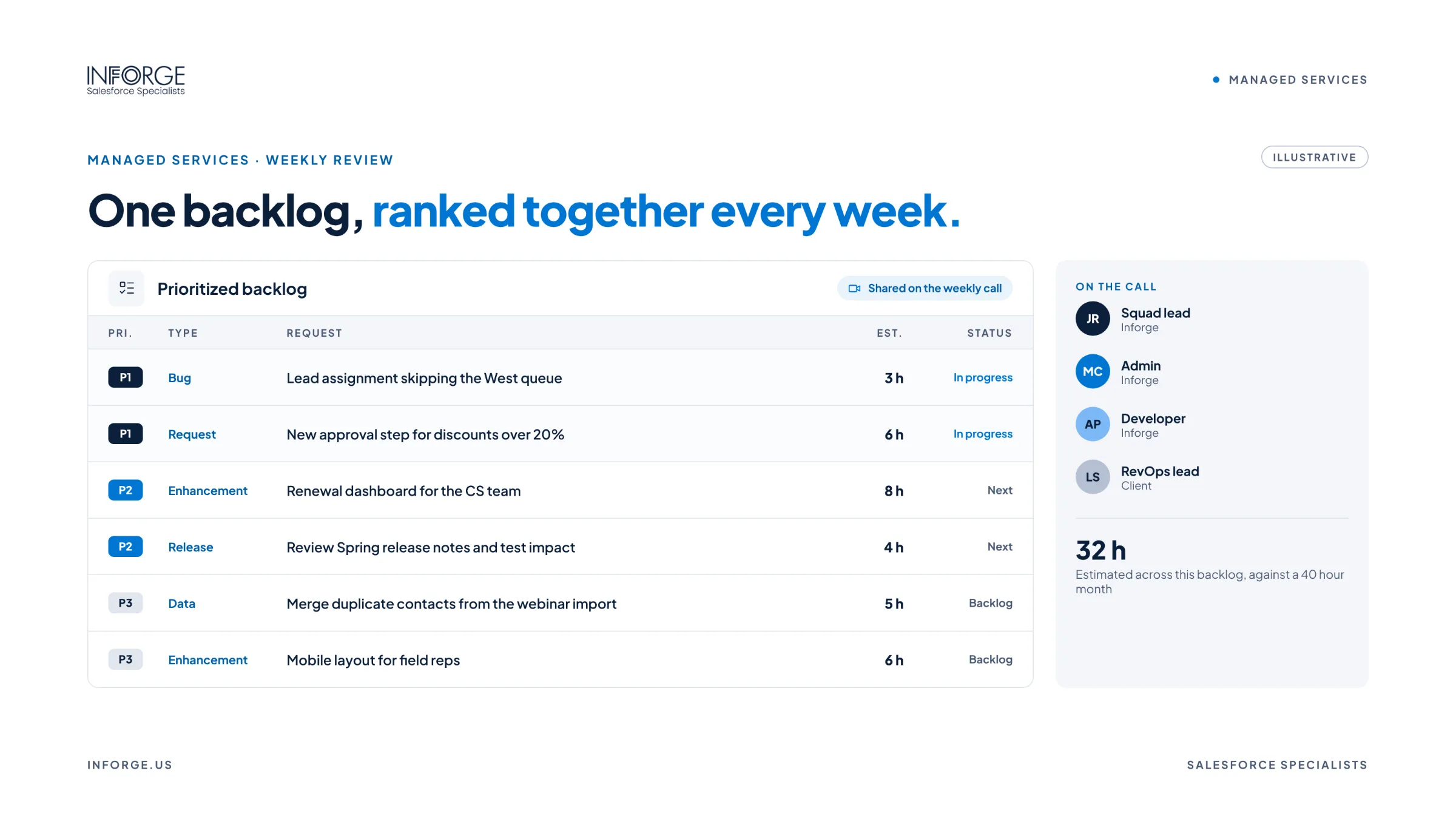
Many companies try to cover that with one in-house admin, or with nobody at all. The problems are predictable: one person can't cover admin, development, integration, and architecture; vacations and turnover leave gaps; and the backlog keeps growing.
A managed services retainer solves that by giving you access to a team with different skill sets, a predictable monthly cost, and continuity that doesn't depend on a single hire. For context, SF Ben's 2026 salary data puts a mid-level US Salesforce admin at a median of $92,000 in base salary, before benefits, recruiting, and ramp time. A retainer can deliver admin, developer, and consultant capacity for less than many companies would spend on one full-time hire.
The bottleneck isn't Salesforce. It's having the right people available when you need them.
What a Salesforce Managed Services Retainer Typically Includes
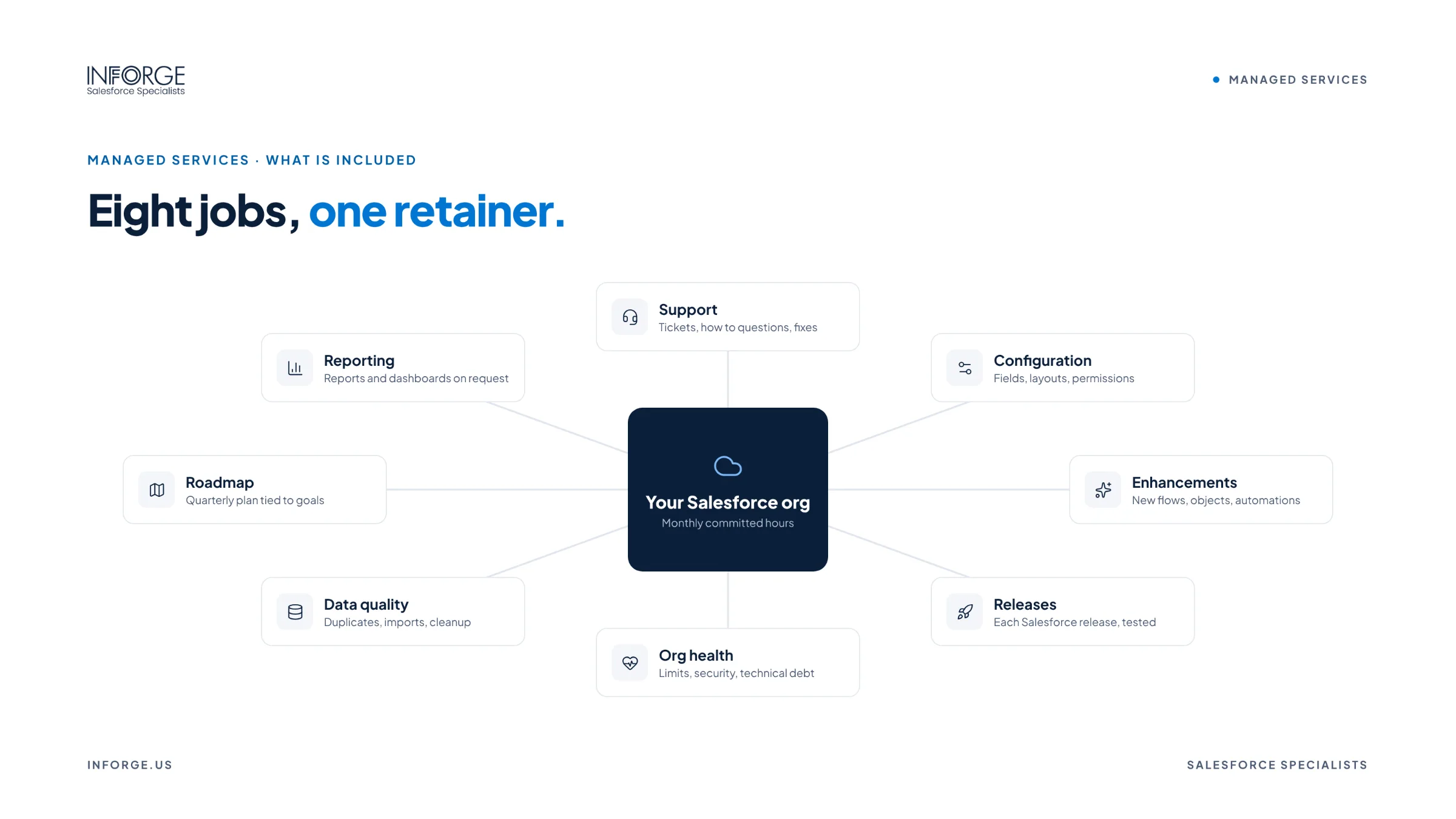
1. User support and break-fix
Password resets, permission issues, broken reports, failed automations, and "why can't I see this record?" questions. Most retainers include a ticketing process with defined response times by priority.
2. Administration and configuration
User management, profiles and permission sets, page layouts, fields, picklists, validation rules, reports, and dashboards. This is the day-to-day work that keeps Salesforce aligned with how the business operates.
3. Enhancements and small projects
New Flows, process improvements, custom components, and integration tweaks. Retainers usually cover small to medium enhancements within the monthly hours, with larger projects scoped separately.
4. Release management
Salesforce releases major updates three times a year. A good partner reviews each release, tests impact in a sandbox, flags changes that affect your org, and recommends new features worth adopting.
5. Org health and monitoring
Regular checks on security settings, storage, API usage, governor limits, failing automation, and technical debt, so problems are caught before users notice.
6. Data quality
Duplicate management, imports, field hygiene, and ongoing data cleanup to keep reporting and automation reliable.
7. Strategic guidance and roadmap
Monthly or quarterly reviews of what's working, what's next, and how Salesforce can support upcoming business goals, including where new capabilities like Agentforce fit.
8. Reporting on the retainer itself
A clear monthly summary of hours used, work completed, open items, and recommendations.
What's Usually Not Included
Clarify these upfront, because they're the most common sources of surprise:
Large implementation projects, like a new cloud rollout or a major integration, are typically scoped separately.
Salesforce licenses are purchased from Salesforce, not the partner.
24/7 support is often an add-on rather than standard.
Third-party app licenses and AppExchange subscriptions.
Hours beyond the monthly allocation, which are usually billed at an overage rate.
How Retainer Pricing Works
Most retainers are priced on a monthly block of hours, sometimes with tiers based on response times and service level. Published 2026 pricing from several US Salesforce partners commonly falls between about $2,000 and $8,000 per month for 10 to 50 hours, while larger organizations with complex, multi-cloud environments can pay significantly more.
The main factors that affect price:
Hours per month and the mix of admin, developer, and architect time
Response time commitments, especially for critical issues
Org complexity, number of clouds, users, and integrations
Coverage hours and time zone
Contract length, since longer commitments usually lower the effective rate
Where the team is located, with nearshore and offshore teams typically costing less than US-based teams
Questions to Ask Before You Sign
Who exactly will work on our account, and will we have a named lead?
What's included in the monthly hours, and what's billed separately?
What happens to unused hours? Do they roll over or expire?
What are the response times for critical, high, and normal priority issues?
How do you handle release management?
How will you report on work completed and hours used?
How do you handle requests that exceed the monthly allocation?
What's the contract term, and how do we scale up, down, or exit?
Are your team's working hours aligned with ours?
Red Flags
Vague scope with no list of inclusions and exclusions
No named team or account lead
Purely reactive support with no proactive health checks or roadmap
No reporting on hours or work completed
Long lock-in terms with no way to adjust capacity
At Inforge, we've found that the best managed services relationships aren't defined by the number of hours. They're defined by a team that knows your org, works in your time zone, catches problems before users do, and helps you get more out of Salesforce every quarter.
Summary
A Salesforce managed services retainer gives companies ongoing access to admin, developer, and consultant skills for a predictable monthly fee. Typical inclusions are user support, configuration, enhancements, release management, org health monitoring, data quality, roadmap planning, and monthly reporting. Published 2026 pricing commonly ranges from about $2,000 to $8,000 per month for 10 to 50 hours, depending on scope, complexity, and service levels. Before signing, clarify who is on the team, what's included, how unused hours work, response times, and how to scale.
Inforge provides Salesforce managed services to US companies with nearshore admins, developers, and consultants from Latin America who work in your time zone as an extension of your team.
Frequently Asked Questions
Q: What is a Salesforce managed services retainer?
A: It's an ongoing agreement where a Salesforce partner provides a set amount of monthly support from a team of admins, developers, and consultants, covering support, enhancements, maintenance, and strategic guidance for a predictable fee.
Q: How much does a Salesforce managed services retainer cost?
A: Published 2026 pricing from US partners commonly ranges from roughly $2,000 to $8,000 per month for 10 to 50 hours. Complex, multi-cloud orgs or 24/7 coverage cost more, and nearshore teams are typically more cost-effective than US-based teams.
Q: Is a retainer cheaper than hiring a Salesforce admin?
A: Often, yes. SF Ben's 2026 data puts the median base salary for a mid-level US Salesforce admin at $92,000, before benefits and recruiting. A retainer also gives you access to developer and consultant skills a single admin may not have.
Q: What happens to unused retainer hours?
A: It depends on the contract. Some partners roll unused hours over for a limited time, while others expire them monthly. Clarify this before signing.
Q: Does a managed services retainer include new projects?
A: Small and medium enhancements are usually covered by monthly hours. Larger projects like new cloud implementations or major integrations are typically scoped and priced separately.