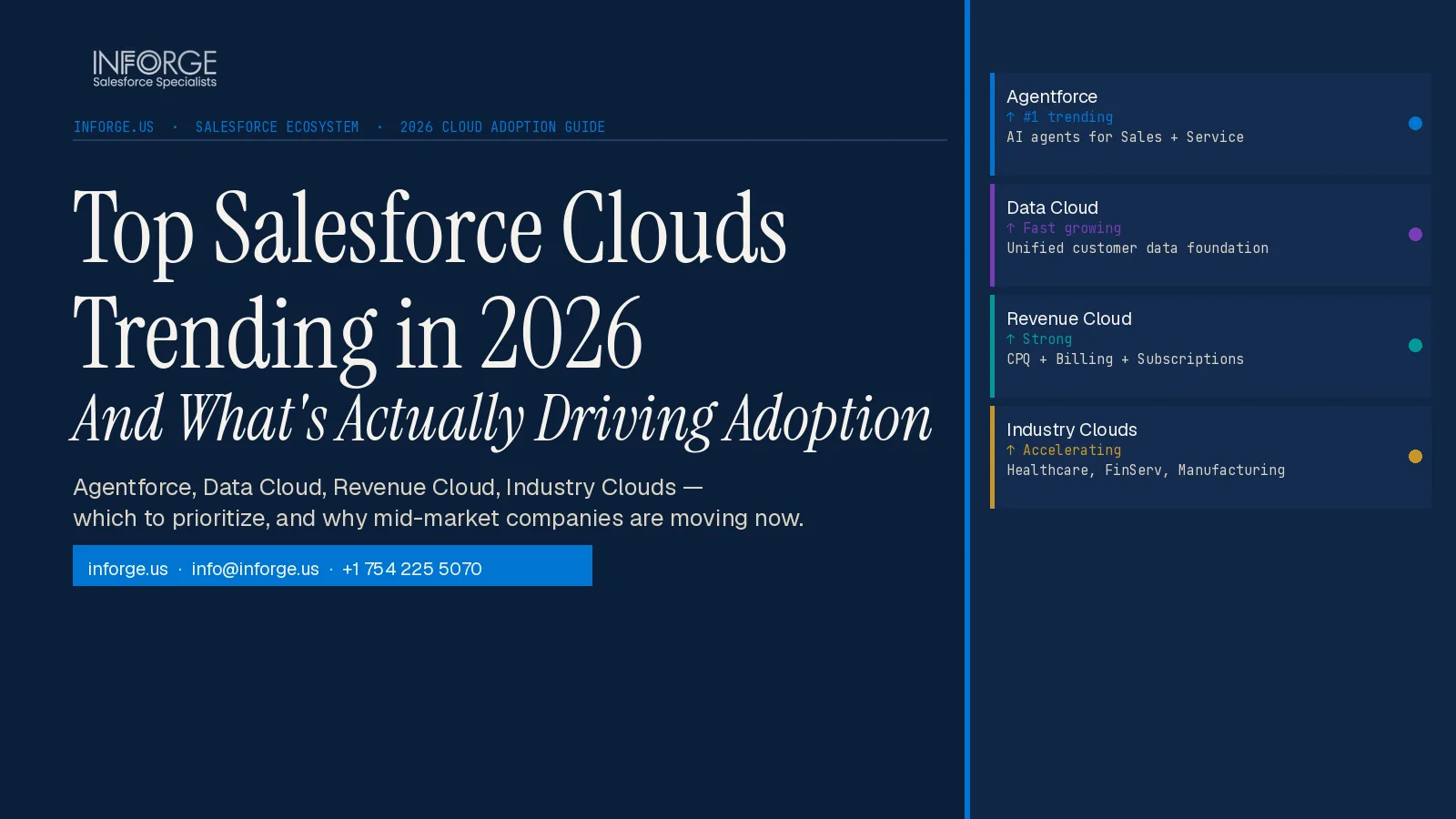
Top Salesforce Clouds Trending in 2026 (And What's Actually Driving Adoption)
The Salesforce portfolio now spans more than 15 clouds. Most orgs use a handful. But in 2026, the gap between the clouds that are accelerating and the ones sitting idle is wider than it's ever been. If you're making platform decisions this year, the question isn't "which Salesforce clouds exist" — it's "which ones are actually moving the needle, and why?"
At Inforge, we run full Salesforce implementations through AI agents every day. We see what organizations are actually buying, what's getting used, and what's sitting unlicensed. This post is the data-backed version of that field view.
Key Takeaways:
Agentforce and Data Cloud are the fastest-growing products in Salesforce history, with combined ARR crossing $3.4 billion and growing over 200% year-over-year as of Q1 FY27.
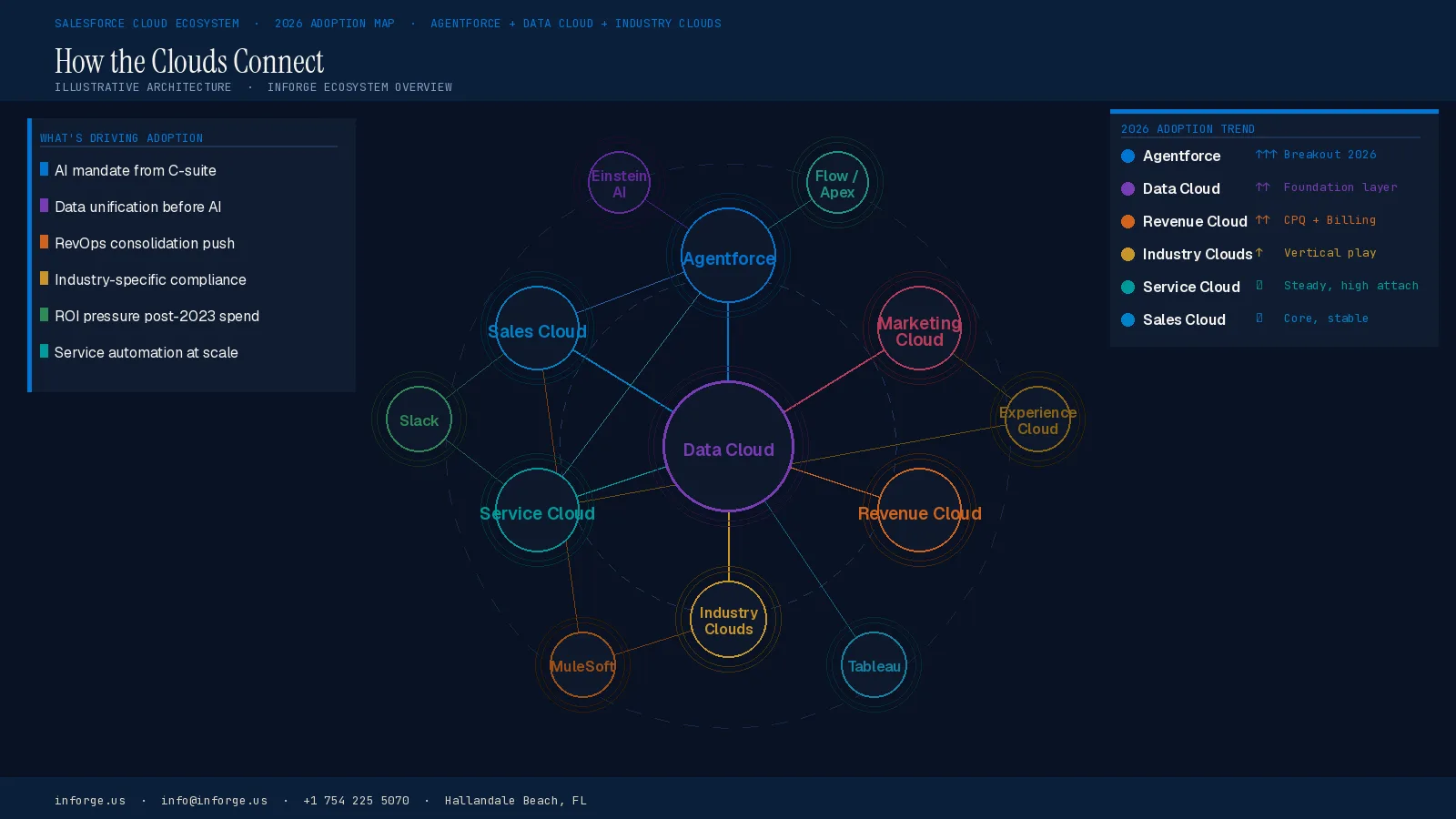
Data Cloud has shifted from a marketing add-on to the foundational data layer that every other cloud depends on.
Industry-specific clouds — particularly Financial Services Cloud, Health Cloud, and Manufacturing Cloud — are replacing generic CRM setups across regulated sectors.
Revenue Cloud is gaining fast traction among SaaS companies and any business moving toward subscription or usage-based billing models.
Service Cloud remains the highest revenue-generating cloud in the Salesforce portfolio.
Quick Answer: The Salesforce clouds trending hardest in 2026 are Agentforce (AI agents across Sales and Service), Data Cloud (the unified data foundation powering everything else), Revenue Cloud (quote-to-cash automation), and industry-specific clouds for financial services, healthcare, and manufacturing. Each is trending for a structurally different reason — not just hype.
1. Agentforce: The Cloud That's Redefining What "Salesforce" Means
Agentforce is not a feature update to Sales Cloud. It's Salesforce's bet on becoming the central AI agent platform for the enterprise — and the early numbers suggest it's working.
According to Salesforce's Q1 FY27 earnings filing, Agentforce and Data 360 combined annual recurring revenue reached nearly $3.4 billion, up over 200% year-over-year. Agentforce alone surpassed $1.2 billion in ARR, growing 205% year-over-year. Salesforce has closed over 18,500 Agentforce deals since launch, including 9,500 paid deals — making it the fastest-growing product category in the company's history.
What makes Agentforce distinctly different from what came before it is the reasoning layer. Unlike rule-based bots, Agentforce agents built on the Atlas Reasoning Engine dynamically understand context, identify what data they need, and autonomously take action across Service Cloud, Sales Cloud, Commerce Cloud, and third-party systems. According to Gartner, 40% of all enterprise applications will have task-specific agents by 2026 — Salesforce is positioning Agentforce as the platform underneath all of them.
The operational signal is real. Salesforce's own support org cut case volume 7% year-over-year using Agentforce on help.salesforce.com, handling over 1.4 million customer requests in Q2 FY26 alone.
For organizations still treating Agentforce as a future-state consideration, the window to be an early mover is closing. More than 50% of Agentforce and Data 360 bookings in Q1 FY27 came from existing customers expanding — not new logos.
2. Data Cloud: No Longer Optional — Now the Foundation Everything Else Runs On
Data Cloud has gone from a "nice-to-have" add-on to the foundational layer that powers almost every other Salesforce trend in 2026. Without clean, unified data, Agentforce agents can't reason properly. Personalization fails. Industry clouds underperform.
According to Salesforce's Q1 FY27 earnings release, Data 360 ingested 52 trillion records in Q1, up 136% year-over-year. Zero Copy — which allows Data Cloud to query Snowflake, Databricks, or BigQuery in place without physically moving data into Salesforce — processed 35 trillion of those records, up 277% year-over-year. That single capability eliminates the sync lag and storage costs that made unified data painful to maintain.
The adoption signal from customers is equally striking. In Q2 FY26, Salesforce reported a 140% year-over-year surge in Data Cloud customer adoption. Nearly 50% of Fortune 100 companies have adopted Data Cloud and AI solutions, according to Salesforce's own investor disclosures.
What changed in 2026 is how organizations are using it. Data Cloud is no longer primarily a marketing personalization tool. It's now being positioned as the context layer for Agentforce — the system that ensures AI agents are reasoning on accurate, real-time, unified customer data rather than stale CRM records.
Organizations with mature Data Cloud implementations see 2–3x higher engagement rates from their personalization efforts compared to those running personalization on siloed data, according to analysis from SalesforceBen.
If your org is evaluating Agentforce, the architecture question isn't "which agent template should we use?" It's "is our data foundation ready to support it?"
3. Service Cloud: Still the Revenue Leader, Now AI-Native
Service Cloud remains Salesforce's single highest-revenue-generating cloud. According to Backlinko's analysis of Salesforce's SEC filings, Service Cloud generated $9.05 billion in fiscal year 2025, up 9.81% over 2024. In every Q2 FY26 top 10 deal, Service Cloud and Platform were both present.
The reason it stays at the top isn't inertia. It's that customer service is the highest-volume touchpoint most enterprises have — and the AI leverage there is massive. Agentforce Service handles routine case resolution, deflects volume before it reaches human agents, and escalates intelligently when it can't resolve. The productivity math is straightforward: fewer cases reaching human agents, faster resolution for the ones that do.
For Salesforce, Service Cloud is also the primary vehicle through which Agentforce is landing in organizations that aren't yet AI-native. Many companies start with an Agentforce Service agent before expanding to sales and commerce use cases.
4. Revenue Cloud: The Hidden Trend Among SaaS and Subscription Businesses
Revenue Cloud isn't generating the headline ARR numbers that Agentforce is. But among SaaS companies, professional services firms, and manufacturers moving toward recurring revenue models, it's one of the highest-ROI Salesforce investments available in 2026.
The core value: Revenue Cloud unifies product configuration, pricing, quoting, contract management, billing, and revenue recognition into a single data model. According to Noltic's 2026 Revenue Cloud guide, the platform's 2026 updates include enhanced handling of pricing-agreement contracts, improved performance for large order volumes, and stronger compliance and audit controls — directly addressing the friction that made complex enterprise deals slow.
The trend driving adoption is the move to usage-based billing. As Minuscule Technologies notes, Revenue Cloud is critical for any business moving toward subscription or usage-based revenue models. Managing subscriptions, tiered pricing, usage metering, and international tax requirements manually doesn't scale — and the cost of stitching together CPQ, invoicing, and accounting with separate tools is exactly what Revenue Cloud eliminates.
For RevOps leaders evaluating whether to build or buy this capability: the 2026 version of Revenue Cloud, now branded Agentforce Revenue Cloud, also adds AI-assisted quoting and contract drafting on top of the base quote-to-cash workflow.
5. Industry-Specific Clouds: Financial Services, Health, and Manufacturing Are Pulling Ahead
Generic CRM configurations are losing ground to purpose-built industry clouds. Salesforce now offers specialized solutions for healthcare, financial services, manufacturing, automotive, communications, education, and more — each with pre-built data models, workflows, and compliance features tailored to the sector.
According to Minuscule Technologies' 2026 analysis, industry clouds give organizations 60–70% of what they need out of the box, so implementation teams can focus on the remaining 30–40% that makes the business unique. That math matters when custom Salesforce development is expensive and implementation timelines are long.
Here's where the strongest 2026 adoption is occurring:
Financial Services Cloud is the fastest-growing industry vertical on the platform. Loan origination workflows, client financial profiles, household relationship mapping, and regulatory compliance tracking — all of which required heavy custom development on Sales Cloud — now come pre-built. According to Cirrus Insight's market analysis, financial services accounts for 9.7% of Salesforce's customer base and is one of the highest-growth segments.
Health Cloud received its most significant update yet in Spring '26, according to Salesforce's Spring '26 release notes — with deeper EHR system integration, HIPAA-compliant data sharing, and Agentforce agents that power more connected care experiences and streamline provider operations.
Manufacturing Cloud is gaining traction as manufacturers connect Salesforce to ERP systems like SAP and Oracle. Sales agreements, account-based forecasting, and demand planning tied directly to production data give operations and commercial teams a unified view they've historically never had.
The strategic implication: companies that try to build industry-specific functionality from scratch on standard Sales Cloud or Service Cloud consistently end up spending more on customization and ongoing maintenance. The total cost of ownership shifts materially when you start with an industry cloud.
6. MuleSoft: The Integration Layer That Makes Multi-Cloud Work
No cloud discussion in 2026 is complete without the layer that connects them. MuleSoft remains Salesforce's primary integration platform — and in 2026, it's gotten meaningfully easier to use.
The Anypoint Platform now includes AI-assisted API development that generates integration flows from natural language descriptions. For organizations running multi-cloud Salesforce footprints alongside ERPs, data warehouses, and third-party tools, MuleSoft is what prevents those systems from becoming another set of silos.
At Inforge, we've found that organizations underestimate integration complexity at the start of almost every Salesforce implementation — and overestimate how long it takes to resolve when the right architecture is in place from day one. MuleSoft, used correctly, compresses timelines and eliminates the "who owns this data" debates that slow down cross-functional Salesforce rollouts.
Summary
The top Salesforce clouds trending in 2026 are Agentforce, Data Cloud, Service Cloud, Revenue Cloud, and the leading industry verticals — Financial Services, Health, and Manufacturing Cloud. Each is trending for a different reason: Agentforce because enterprises are activating on AI agent ROI; Data Cloud because AI can't work without unified data; Service Cloud because it's the highest-leverage AI deployment surface; Revenue Cloud because subscription businesses need infrastructure that doesn't break at scale; and industry clouds because the TCO math on generic CRM customization finally stopped making sense.
At Inforge, we implement all of these — and we do it through AI agents, not headcount. Faster timelines, more consistent quality, a fraction of the cost. If you're evaluating any of these clouds and want a clear view of what implementation actually looks like in 2026, talk to us.
Frequently Asked Questions
Q: Which Salesforce cloud is growing the fastest in 2026?
A: Agentforce is the fastest-growing product in Salesforce history. Combined with Data 360, the two products reached $3.4 billion in ARR as of Q1 FY27, growing over 200% year-over-year. Agentforce alone crossed $1.2 billion in ARR, up 205% year-over-year.
Q: Do I need Data Cloud to use Agentforce?
A: Technically no, but practically yes. Agentforce agents reason on customer data — and without a unified, real-time data layer, that reasoning degrades quickly. Data Cloud is the context layer that makes Agentforce outputs accurate and trustworthy. Most serious Agentforce deployments include Data Cloud from the start.
Q: Which Salesforce cloud generates the most revenue?
A: Service Cloud is Salesforce's highest revenue-generating cloud, producing $9.05 billion in fiscal year 2025. It appears in virtually every large enterprise deal Salesforce closes.
Q: Should I use an industry cloud or build on Sales Cloud?
A: If a Salesforce industry cloud exists for your sector, use it. Building industry-specific functionality from scratch on standard Sales Cloud consistently results in higher customization costs, longer timelines, and more maintenance overhead. Industry clouds give you 60–70% of your requirements out of the box.
Q: What is Agentforce and how is it different from Einstein AI?
A: Einstein AI was primarily a layer of predictive analytics and scoring embedded in existing Salesforce clouds. Agentforce is an autonomous AI agent platform built on the Atlas Reasoning Engine — agents that don't just surface insights, but take multi-step actions across Salesforce and third-party systems without human input at each step. It's a fundamentally different category of capability.
