Salesforce vs HubSpot: Which CRM Is Right for Your Business?
The CRM decision comes down to one question: how complex is your revenue operation, and how much are you willing to pay — in time, headcount, and budget — to run it?
Salesforce is the most powerful CRM on the market. HubSpot is the easiest to deploy. Both claims are true. But those facts alone won't tell you which one belongs in your business.
This guide covers everything that actually moves the needle: real pricing (including what the contract won't show you), implementation timelines, AI tooling, and the precise company profiles where each platform earns its cost.
Quick Answer: HubSpot is the stronger fit for SMBs and mid-market teams that want fast deployment, an all-in-one platform, and predictable costs. Salesforce is the right call for large enterprises with complex sales processes, regulated industries, and the budget to staff an admin and implementation partner. The gap between them is less about features than it is about operational overhead.
Key Takeaways:
HubSpot offers a free CRM tier and faster time-to-value; Salesforce is more customisable but requires significant setup investment.
For a 50-user deployment over three years, Salesforce can cost 3.4x more than HubSpot at comparable tiers — driven by implementation, admin headcount, and AI add-on fees.
Salesforce Agentforce is the most powerful autonomous AI in the CRM space; HubSpot Breeze AI is faster to deploy and included at no extra cost.
The right choice depends on your team size, process complexity, budget, and whether you have the internal resources to manage enterprise-grade tooling.
If you're on Salesforce and not extracting full value from it, the issue is rarely the platform — it's the implementation.
What Salesforce and HubSpot Actually Are
These are not interchangeable tools competing for the same customer. They were built with different philosophies and they serve different operational realities.
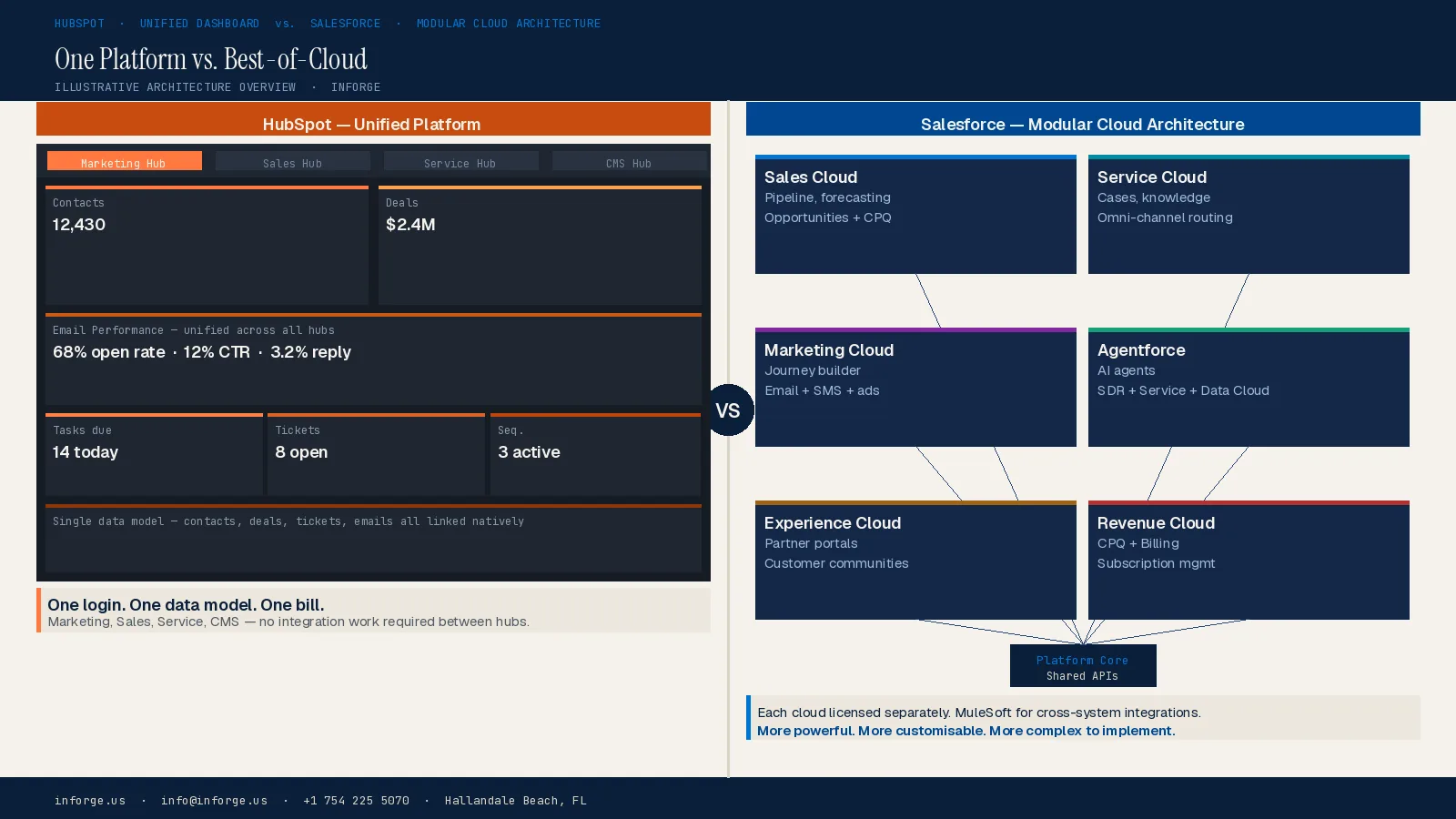
According to Resonate HQ, the core difference is structural: HubSpot is an all-in-one platform where marketing, sales, service, and CMS share a single database. Salesforce is a modular ecosystem where you purchase separate clouds — Sales Cloud, Service Cloud, Marketing Cloud — and integrate them. One platform prioritises ease of use. The other prioritises customisation depth.
Salesforce, founded in 1999, was the world's first cloud-based CRM. Its architecture reflects that origin: infinitely configurable, built to handle the most complex enterprise sales operations on the planet, and trusted by 90% of the Fortune 500. The trade-off is real — configuring it properly requires expertise, and maintaining it requires dedicated resource.
HubSpot, founded in 2006 as an inbound marketing tool, evolved into a cohesive CRM platform covering sales, service, marketing, and content — all sharing one database, no integration required. Its free tier and consumer-grade UX made it the dominant choice in the SMB and mid-market segment. According to Resonate HQ's 2026 market data, HubSpot ended 2025 with 288,706 paying customers and is now the fastest-growing major CRM by customer count.
Both platforms are investing heavily in AI. But how they've done it — and who it's for — differs sharply.
Pricing: What the Contract Actually Costs
Pricing is where the Salesforce vs HubSpot comparison gets genuinely complicated — because list price is rarely the whole story.
HubSpot Pricing
HubSpot's free CRM tier provides basic contact management, deal pipelines, and email tracking for up to two users with no time limit. Paid tiers start at $15 per seat per month (Starter, repriced in early 2026) and scale through Professional and Enterprise. The key advantage: marketing automation, meeting scheduling, basic quoting, and dashboards are all native — no add-ons required.
According to Avidly Agency's 2026 TCO benchmarks, a typical mid-sized company (20 sales users, 5 marketing users) can expect HubSpot to cost between €35,000 and €60,000 in Year 1 — software plus onboarding — with annual recurring costs of roughly €30k–€50k thereafter.
One important nuance: Tech Insider notes that HubSpot's pricing scales with seat count at Professional and Enterprise tiers, and add-ons like dedicated IP and transactional email can accumulate. The free tier looks attractive at first; budget discipline matters as you scale.
Salesforce Pricing
Salesforce Sales Cloud subscriptions range from $25 to $500 per user per month. Salesforce raised its Enterprise and Unlimited tier prices by 6% in August 2025, pushing Enterprise to approximately $165/user/month and Unlimited to $330/user/month.
But the license is only part of the number. According to Avidly Agency, a standard Salesforce implementation takes 3–6 months and typically costs €30k–€100k+ via a specialised consultancy. Add to that the near-universal requirement for a dedicated, certified Salesforce Administrator — and the ongoing cost of that role — and the total cost of ownership climbs fast.
For add-ons: Salesforce's marketing automation (Marketing Cloud/Pardot) requires separate licensing, starting at $1,250/month. Einstein AI features sit behind premium tiers and carry additional per-user fees. Agentforce, Salesforce's autonomous AI platform, adds $50–$125/user/month on top of existing plans.
The 3-year math: According to Tech Insider's 2026 analysis, for a 50-user deployment, Salesforce costs 3.4x more than HubSpot at the Professional tier over three years. The primary cost drivers are implementation, dedicated admin, and AI add-on fees — not the base license.
For mid-market teams under 500 employees, Avidly Agency's benchmarks put HubSpot's total annual cost at 20–30% lower than a comparable Salesforce stack, once all operational costs are included.
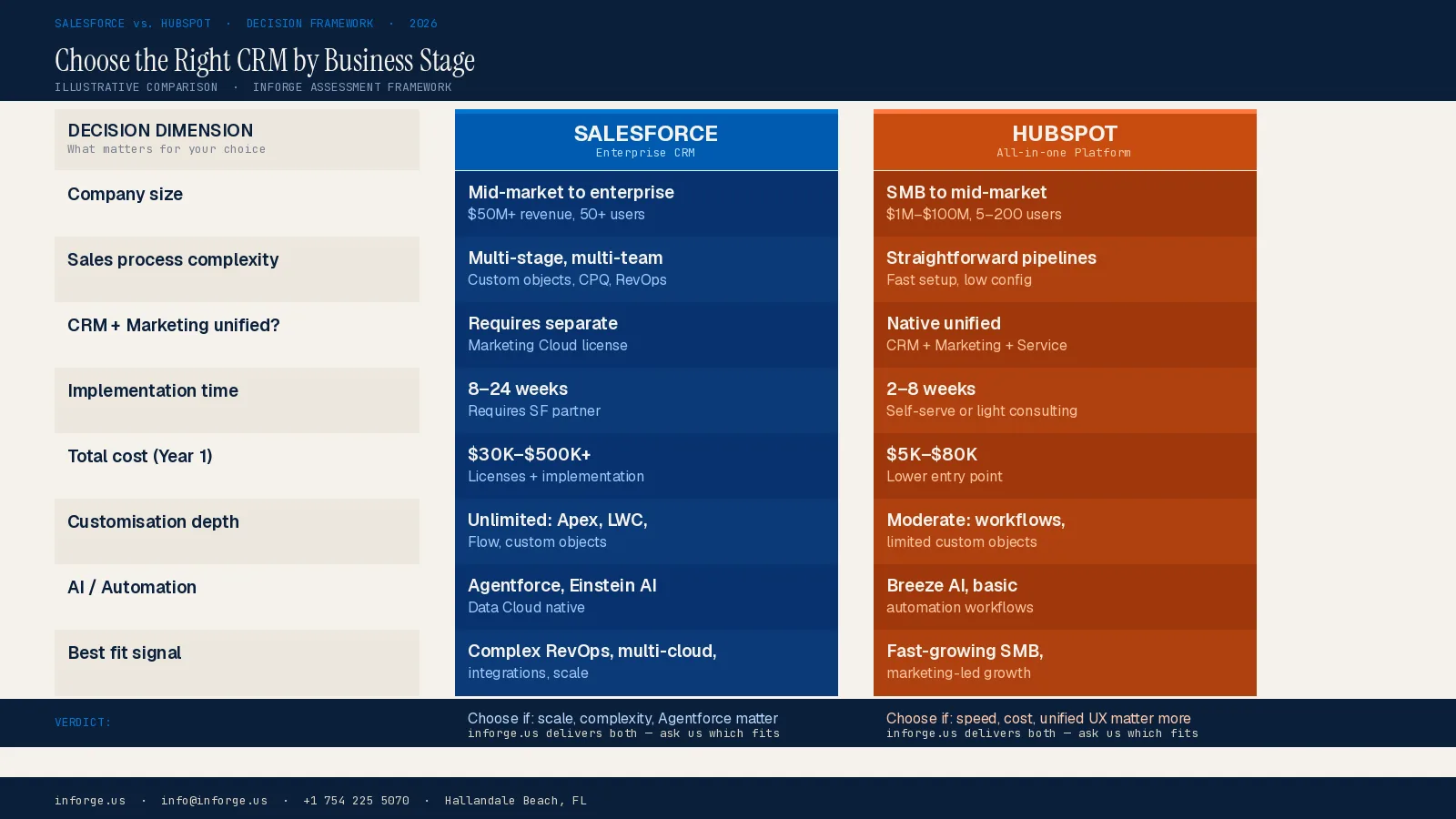
| | HubSpot | Salesforce |
|---|---|---|
| Free plan | ✅ Yes (up to 2 users) | ❌ No (30-day trial only) |
| Starting price | $15/user/month | $25/user/month |
| Enterprise pricing | On request | ~$165/user/month |
| Marketing automation | Native, included | Separate product ($1,250+/mo) |
| AI tooling | Breeze AI, included | Agentforce, $50–$125/user/month add-on |
| Implementation timeline | 4–8 weeks | 3–6 months |
| Admin requirement | Low (VP Ops can manage) | High (dedicated certified admin) |
Ease of Use and Implementation
This is where the platforms diverge most sharply — and it directly affects adoption, data quality, and ROI.
HubSpot is consistently rated higher for usability across G2, Capterra, and TrustRadius. Most small teams can start tracking deals, contacts, and pipelines in the same week they sign up. Onboarding typically takes 2–6 weeks, and the platform is designed so that marketing and sales teams can configure most features without a developer or admin. Cirrus Insight's analysis puts it plainly: if you want your team selling tomorrow, HubSpot's simplicity is a win.
Salesforce is built for customisation and scale. That comes with a steeper learning curve — navigation and setup can feel overwhelming to new users, and most organisations need a dedicated Salesforce administrator to manage configurations, integrations, and permissions. According to Resonate HQ, implementation for Enterprise Salesforce typically takes 2–6 months, and most organisations also hire external consultants. The modular architecture — Sales Cloud, Service Cloud, and Marketing Cloud don't always share data seamlessly out of the box — creates integration overhead that HubSpot avoids entirely.
One of the biggest reasons CRM projects fail is low adoption. If reps don't log activity or keep records current, the system loses value quickly regardless of how capable the platform is. Salesforce's complexity is the primary adoption risk; HubSpot's consumer-grade UX typically produces higher and faster adoption, reducing the time-to-productivity for new hires.
At Inforge, we've found that the Salesforce implementations that underperform almost never fail because of the platform — they fail because of under-investment in configuration, training, and governance. The platform can do everything. The question is whether your team is set up to use it.
Features: Where Each Platform Wins
Sales Automation
Salesforce's sales automation capabilities are enterprise-grade. AI-powered predictive lead scoring, next-best-action suggestions, territory management, collaborative forecasting, complex approval workflows, and role hierarchies make it the strongest platform for large, structured sales organisations. Every workflow, field, and report can be tailored to match the exact needs of the business.
HubSpot's approach to sales automation is straightforward and fast to deploy. Deal management, email tracking, meeting scheduling, pipeline visualisation, and automated sequences are all native. For teams that want to spend their time selling rather than administering a CRM, HubSpot's design is purpose-built for that outcome.
Marketing Automation
This is HubSpot's clearest structural advantage. Marketing Hub is included at every paid tier — email campaigns, landing pages, A/B testing, ABM tools, SEO, and workflow automation all share the same database as the CRM. There's no integration overhead, no data sync lag, no additional licensing.
According to Resonate HQ, Salesforce splits marketing across Marketing Cloud and Pardot (starting at $1,250/month), which require separate setup and don't natively share the CRM data model. For mid-market teams and below, HubSpot's integrated marketing is significantly easier to operate and substantially cheaper.
For enterprise marketing teams requiring advanced journey orchestration, predictive audiences, and cross-channel personalisation at scale, Salesforce's Marketing Cloud does offer more ceiling — but only for organisations that can absorb the implementation and operational cost.
Reporting and Analytics
Salesforce's analytics capabilities are extensive: customisable dashboards, AI-driven forecasting, and deep reporting across all objects in your org. If your RevOps team runs on data and needs granular control over every report dimension, Salesforce is the stronger platform.
HubSpot's reporting tools are intuitive and sufficient for most mid-market teams. Advanced options are available in higher-tier plans. The limit isn't sophistication — it's the depth of custom object reporting, which Salesforce handles better for complex data architectures.
Integrations
Salesforce's AppExchange ecosystem contains 7,000+ apps, with native connectors to virtually every enterprise tool — ERP systems, legacy databases, industry-specific platforms. For businesses with complex existing technology stacks, Salesforce's integration depth is a genuine competitive advantage.
HubSpot's App Marketplace has grown substantially and now offers over 1,000 integrations. For teams running modern SaaS stacks, this is typically sufficient. The integration experience is simpler and faster to configure than Salesforce's, though the ceiling is lower for bespoke enterprise requirements.
Compliance and Data Security
For regulated industries — financial services, healthcare, government — Salesforce is the stronger choice. Salesforce Shield provides AES 256-bit encryption, 10-year field audit trails, event monitoring across 50+ event types, and industry-specific compliance certifications. HubSpot offers GDPR toolkits, encryption, MFA, and role-based access, but does not match Salesforce's depth for organisations subject to strict regulatory requirements.
AI Capabilities: Agentforce vs Breeze AI
AI is now a primary battleground between these two platforms — and in 2026, both are genuinely capable. The question is complexity versus immediacy.
Salesforce Agentforce
Agentforce is Salesforce's autonomous AI platform, built on the Atlas Reasoning Engine. According to Salesforce's own Q3 FY2026 earnings, Agentforce surpassed 3.2 trillion tokens processed — a sign of real enterprise adoption at scale. The platform lets organisations deploy autonomous agents that can reason through problems, execute multi-step workflows, update records, route cases, and interact with customers without constant human intervention.
According to Salesforce's 2026 State of AI report, 83% of IT leaders say AI agents will handle routine tasks independently within the next two years — and many are already doing it with Agentforce. Salesforce has also introduced Agentforce SDR agents that can send intro emails, follow up on cold leads, handle objections, and schedule meetings automatically — personalised by industry, role, and sales signal.
The constraint: Agentforce requires Enterprise+ tier licensing and technical setup. It adds $50–$125/user/month to an already premium price point, and unlocking its full capability typically requires a skilled implementation partner.
This is exactly the space Inforge operates in. We deliver full Salesforce implementations — including Agentforce configuration — entirely through AI agents. Faster timelines. More consistent quality. A fraction of the traditional consultancy cost. That's not a positioning statement. That's our operating model.
HubSpot Breeze AI
HubSpot's Breeze AI is included across all paid tiers at no extra cost. It delivers lead scoring, content generation, email optimisation, chatbots, and workflow automation directly within the CRM. Onboarding is fast, the UX is accessible to non-technical teams, and the time-to-value is immediate.
According to Resonate HQ, Breeze AI delivers faster AI time-to-value; Agentforce offers more AI flexibility for enterprises with data science teams. For mid-market teams that want AI to start working this quarter — not after a multi-month implementation — Breeze AI is the practical choice.
For organisations where autonomous AI agents are central to customer service, sales productivity, or operational automation at scale, Salesforce's Agentforce justifies the premium. The capability ceiling is significantly higher.
Who Should Choose Salesforce
Salesforce is the right platform for:
Large enterprises (500+ employees) with complex, multi-region sales processes and dedicated admin resource.
Regulated industries — financial services, healthcare, government — that require Salesforce Shield's compliance depth and audit capabilities.
Organisations with sophisticated data architectures — complex object relationships, legacy ERP integrations, bespoke custom objects — that require Apex code-level customisation.
Revenue teams deploying autonomous AI at scale, where Agentforce's capability ceiling justifies the additional per-user cost.
Fortune 500-grade operations with structured implementation budgets and long planning cycles.
According to Tech Insider's 2026 analysis, Salesforce's 20.7% global CRM market share and 90% Fortune 500 penetration exist for a reason — no other CRM matches its enterprise capability ceiling.
Who Should Choose HubSpot
HubSpot is the right platform for:
SMBs and mid-market teams (1–500 employees) that want a fast deployment, low admin overhead, and predictable costs.
Marketing-led organisations where inbound, content-driven lead generation is a primary growth driver and tight sales-marketing alignment is a priority.
Teams without a dedicated CRM administrator — HubSpot is designed so that sales managers and RevOps generalists can handle configuration.
Startups and growth-stage businesses that need to be operational quickly and can't absorb a 3–6 month implementation cycle.
Companies prioritising AI time-to-value over AI ceiling — Breeze AI starts working on day one, at no extra cost.
According to Avidly Agency's benchmarks, HubSpot's Enterprise tier is explicitly built for companies with 200–2,000 employees. If you're under 500 employees, you're in HubSpot's sweet spot — not approaching its ceiling.
The Decision Framework
Answer these five questions. The answers tell you which platform you belong on.
1. How complex is your sales process? Multiple stages, territories, approval hierarchies, and custom data objects → Salesforce. Single pipeline, standard deal stages, moderate automation → HubSpot.
2. What's your implementation runway? Can you absorb 3–6 months and a €30k–€100k implementation project? → Salesforce. Need to be live in 4–8 weeks? → HubSpot.
3. Do you have dedicated CRM admin resource? Hiring or have a certified Salesforce Admin → Salesforce. RevOps generalist managing the stack → HubSpot.
4. How important is marketing-CRM integration? Marketing and sales on one platform with one database, zero sync overhead → HubSpot. Enterprise marketing automation with custom journey orchestration → Salesforce (with Marketing Cloud investment).
5. Are you in a regulated industry? FCA, NHS, HIPAA, or government-grade compliance requirements → Salesforce. Standard GDPR and data security needs → HubSpot handles it.
[INTERNAL LINK: How Inforge delivers Salesforce implementations faster using AI agents]
Summary
Salesforce and HubSpot are both credible, capable platforms — but the wrong choice costs organisations years of underperformance and significant money. HubSpot wins on speed, cost-efficiency, and ease of use for SMB and mid-market teams. Salesforce wins on depth, customisation, compliance, and autonomous AI capability for enterprise operations.
If you're evaluating Salesforce for your organisation — or if you're already on Salesforce and not extracting full value from the investment — Inforge delivers full implementations through an AI-agent model: faster timelines, more consistent quality, and a fraction of traditional consultancy cost. The proof isn't in our pitch. It's in our operating model.
Ready to evaluate what a Salesforce implementation actually looks like in 2026? [Talk to Inforge.](https://inforge.ai)
Frequently Asked Questions
Q: Is Salesforce or HubSpot better for a small business?
A: HubSpot is the stronger choice for most small businesses. It offers a free CRM tier, a fast setup timeline of 2–6 weeks, and low admin overhead — all of which matter when you don't have a dedicated CRM team. Salesforce's depth and customisation only pay off at scale, and the implementation cost alone often exceeds what a small business can absorb.
Q: How much does Salesforce cost compared to HubSpot?
A: On list price alone, Salesforce starts at $25/user/month versus HubSpot's free tier and $15/user/month Starter plan. But total cost of ownership over three years tells a different story: for a 50-user deployment, Salesforce can cost 3.4x more than HubSpot at comparable tiers, once implementation, admin headcount, and AI add-on fees are included.
Q: Can HubSpot scale to enterprise size?
A: Yes — more than most comparisons suggest. HubSpot's Enterprise tier is built for companies with 200–2,000 employees. Notably, HubSpot's fastest-growing segment in 2025 was 500+ seat customers, which grew 5x year-over-year. It does have limits around custom object complexity and compliance depth, which is where Salesforce pulls ahead.
Q: What is Salesforce Agentforce and is it worth the cost?
A: Agentforce is Salesforce's autonomous AI platform — it deploys AI agents that can reason through problems, execute multi-step workflows, and handle customer interactions without human intervention. It's the most capable enterprise AI in the CRM space, but it adds $50–$125/user/month to an already premium price and requires Enterprise+ licensing and a skilled implementation partner to unlock fully. For organisations where autonomous AI is central to their operations, it justifies the investment. For most mid-market teams, HubSpot's Breeze AI delivers enough AI value at no extra cost.
Q: How long does a Salesforce implementation take?
A: A standard Salesforce Enterprise implementation typically takes 3–6 months through a traditional consultancy. At Inforge, we deliver full Salesforce implementations using an AI-agent delivery model — which compresses timelines significantly and reduces implementation cost without compromising configuration quality.
Q: Do I need a dedicated admin for Salesforce?
A: For most Salesforce deployments, yes. Salesforce's complexity means most organisations need a dedicated, certified Salesforce Administrator to manage fields, flows, integrations, and permissions. This is a real ongoing cost that rarely appears on the initial software contract. HubSpot, by contrast, is typically manageable by a RevOps generalist without dedicated admin resource.
