Salesforce Implementation Cost in 2026: The Full Pricing Breakdown
Salesforce implementation cost in 2026 ranges from $10,000 for a basic single-cloud setup to well over $500,000 for a multi-cloud enterprise rollout with custom development and AI integrations. Most mid-market companies land somewhere between $75,000 and $150,000 all-in — but only if they budget correctly from the start.
The real problem? Most orgs budget for the license and forget everything else. The license is just the entry ticket.
Quick Answer: A Salesforce implementation in 2026 costs $10,000–$500,000+ depending on company size, cloud count, customization depth, and consulting model. License fees account for only 20–30% of true Year 1 cost. The rest is consulting, data migration, integrations, training, and ongoing administration.
Key Takeaways:
Salesforce license pricing spans $25/user/month (Starter Suite) to $550/user/month (Agentforce 1 Sales), billed annually.
Implementation services typically cost 1.5x to 3x your annual license fee — most orgs underestimate this by a wide margin.
Consulting rates in 2026 range from $100–$300/hour for certified partners to $250–$500+/hour for Big 4 firms.
Agentforce AI pricing runs $2/conversation or $500 per 100,000 Flex Credits — a new cost layer most budgets don't account for.
AI-first delivery models, like the one Inforge operates, compress timelines and reduce total implementation spend significantly versus traditional headcount-heavy consulting.
Salesforce License Pricing in 2026: What You're Actually Paying Per Seat
Salesforce licenses are the most visible cost — and the most misunderstood. The published per-user price is a starting point, not the number you'll pay.
Sales Cloud and Service Cloud follow the same per-user, per-month pricing model (billed annually):
| Edition | Price/User/Month | Key Capability |
|---|---|---|
| Starter Suite | $25 | Basic CRM, email, contacts, leads |
| Pro Suite | $100 | Forecasting, quoting, AppExchange access |
| Enterprise | $175 | Full API, advanced customization, sandbox |
| Unlimited | $350 | Predictive AI, higher limits, premier support |
| Agentforce 1 | $550 | Full Einstein + generative AI, Data Cloud credits |
For most mid-market organizations, Enterprise at $175/user/month is the practical floor — it's the first tier with full API access, which is required the moment you need integrations with any external system.
Beyond the core seats, Salesforce's marketing products shift to a per-organization model: Account Engagement (Pardot) starts at $1,250/org/month for the Growth edition, rising to $2,500/month (Plus) and $4,000/month (Advanced). Marketing Cloud Growth Edition starts at $1,500/org/month.
One negotiation point most buyers miss: Salesforce negotiates, especially on multi-year deals and volume expansions. Multi-year commitments, competitive quotes, and end-of-quarter timing routinely yield 15–25% off list price. The first number you receive is not the final number.
Agentforce and AI Pricing: The New Cost Layer in 2026
Agentforce is Salesforce's autonomous AI agent platform. It's also the most significant new cost variable in 2026 — and the one most orgs fail to model before signing.
Salesforce lists Agentforce at $2 per conversation. That price applies only to customer-facing agents under a specific buying structure. Enterprises running multi-team deployments need a different model entirely.
The two live pricing models as of April 2026:
Conversations model: $2 per conversation, customer-facing agents only.
Flex Credits model: $500 per 100,000 credits (~$0.10 per AI action), covering customer, employee, and voice use cases.
Flex Credits and the Conversations model cannot be used in the same Salesforce org simultaneously — a constraint that forces an early architectural decision most teams aren't prepared to make.
Agentforce 1 Sales ($550/user/month) includes 2.5 million Data Cloud Credits per org per year. For all other editions, Data Cloud is a separate product with contract-dependent pricing.
According to reported figures, Agentforce surpassed $500 million in annual recurring revenue in Q3 FY2026 — up 330% year-over-year — making it the fastest-growing product in Salesforce's history. Adoption is accelerating fast. So is the complexity of pricing it correctly.
At Inforge, we've found that the organizations that burn the most on AI licensing are the ones who bought the top tier before they were architecturally ready to use it. The $550/user/month Agentforce 1 tier only delivers value if your data is clean, your Data Cloud is configured, and your org is structured to delegate to agents.
Implementation Services: The Cost Most Budgets Ignore
The license gets your team into Salesforce. Implementation services are what make Salesforce actually work.
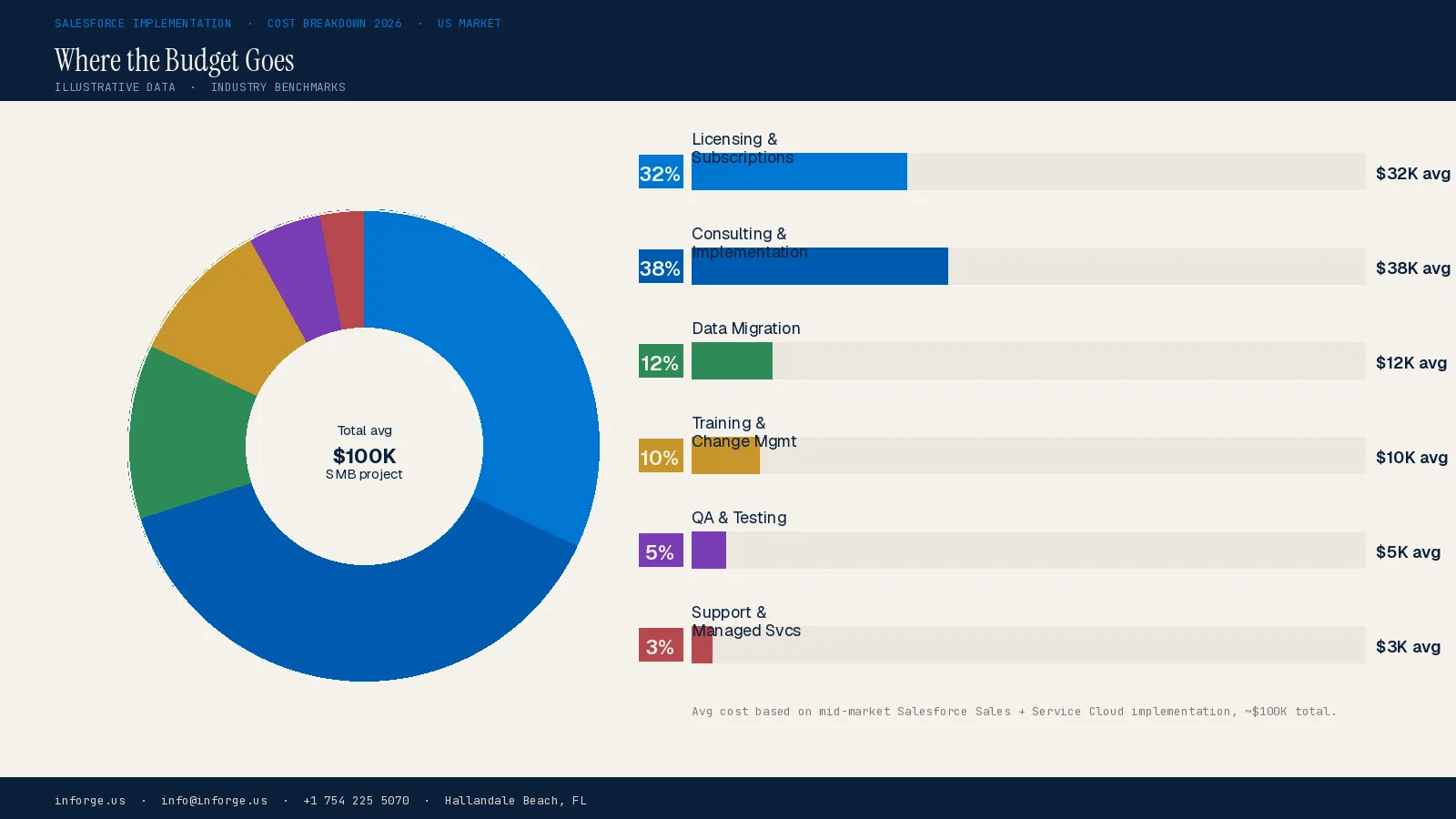
A realistic implementation cost breakdown by project phase:
| Phase | % of Implementation Budget |
|---|---|
| Discovery & Planning | 10–15% |
| System Configuration | 35–45% |
| Data Migration | 15–20% |
| Training & Documentation | 10–15% |
| Post-Launch Support | 5–10% |
The industry rule of thumb: budget 40–80% above your license cost for true Year 1 total cost of ownership. If you're spending $60,000 on licenses, your real Year 1 cost is likely $84,000–$108,000 when everything is factored in. Implementation expenses typically run 1.5x to 3x your annual license cost.
Custom development pushes the number higher. Custom Apex code, Lightning Web Components, and advanced Flows typically run $100–$200/hour, and full custom builds can exceed $85,000 in 2026 on their own.
Data migration is where most budgets blow up. If your legacy data has inconsistent formats, duplicate records, or missing fields, the cleanup work happens *before* a single record enters Salesforce — and that work is billable. Each integration with an external system (ERP, billing, marketing automation) adds 20–40 hours to the project.
Consulting Rates in 2026: What You're Paying Per Hour
Who delivers your implementation determines how much you pay — and how well it goes.
Rate Benchmarks by Model
| Delivery Model | Hourly Rate | Best For |
|---|---|---|
| Certified partner (mid-level) | $100–$250/hr | Standard Sales/Service Cloud |
| Senior architect / CPQ specialist | $200–$400/hr | Complex orgs, multi-cloud |
| Big 4 (Accenture, Deloitte, KPMG) | $250–$500+/hr | Enterprise, compliance-heavy |
| Offshore partner | 30–50% discount vs. onshore | Budget-constrained projects |
| AI-first delivery (Inforge model) | Fraction of traditional spend | Mid-market, speed-to-value |
Most Big 4 engagements use a blended rate model — senior US resources directing offshore delivery teams — bringing the blended rate to $200–$300/hour. The headcount model works, but it's slow and expensive to staff.
For the mid-market, the gap between a boutique certified partner and a Big 4 firm isn't always capability — it's overhead. A 4–6 person SI team has project managers, account executives, and QA layers that add cost without adding configuration.
This is the model Inforge has moved away from entirely. Our implementations are delivered through AI agents — no headcount padding, no billable coordination overhead. Faster timelines. More consistent quality. A fraction of the cost. That's not a pitch. That's how we operate, every day.
Salesforce Implementation Cost by Business Size
Here's how total first-year costs stack up across org sizes — license plus implementation, not just seats:
Small Business (5–25 users, Sales Cloud only)
License: $300–$3,300/month depending on edition and user count
Implementation: $8,000–$25,000 one-time
Total Year 1: $12,000–$65,000
Mid-Market (25–100 users, 1–2 clouds, moderate customization)
License: negotiated enterprise or unlimited seats
Implementation: $75,000–$150,000
Total Year 1: $100,000–$200,000+
Enterprise (100+ users, multi-cloud, custom development, complex integrations)
License: six figures annually
Implementation: $150,000–$500,000+
Total Year 1: $300,000–$750,000+ depending on partner tier
For enterprise financial services specifically — where FSC, compliance workflows, and AI deployment converge — boutique specialist engagements typically run $150,000–$750,000; Global Systems Integrator equivalents often start above $1M.
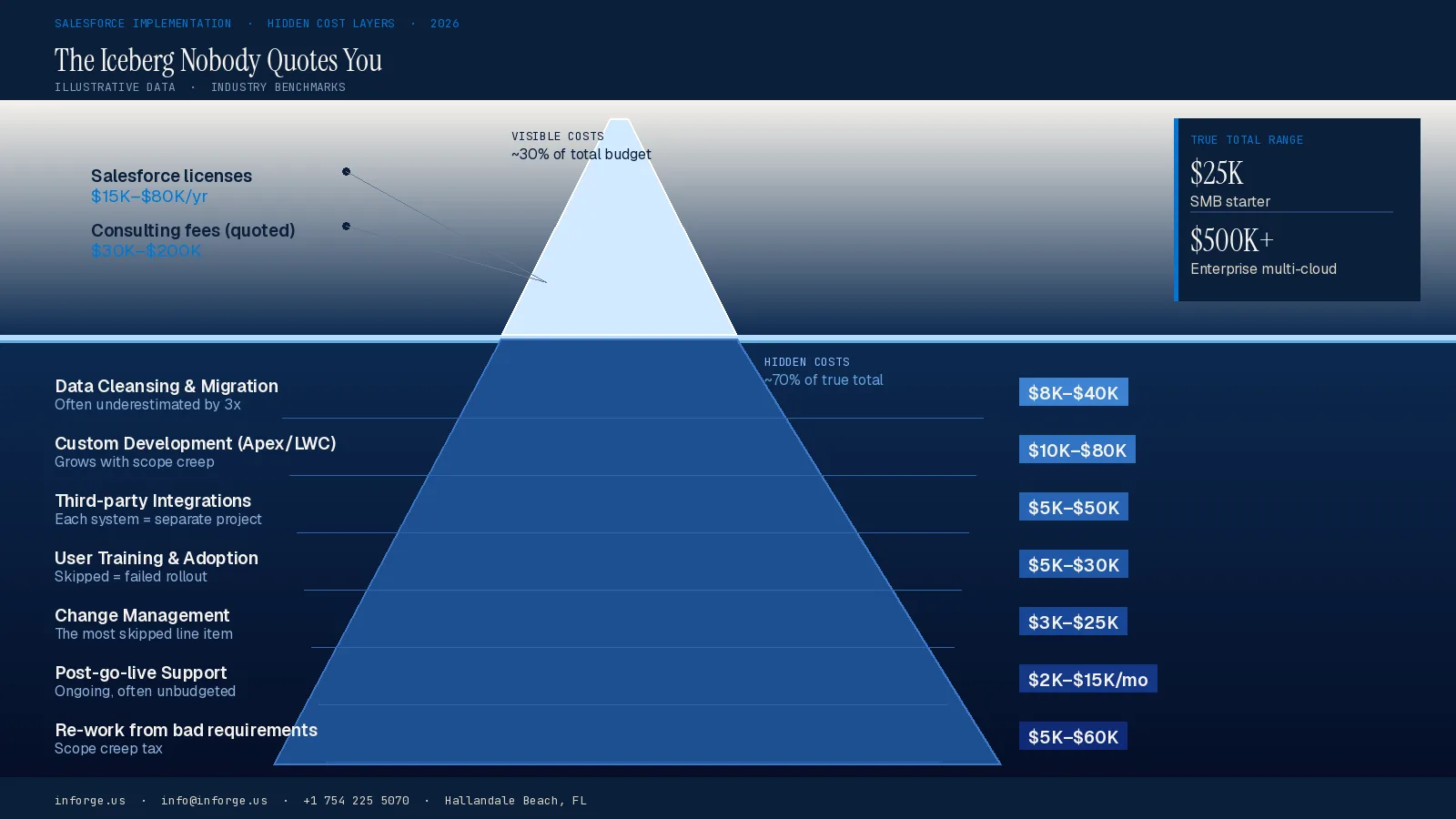
The Hidden Costs That Blow Up Budgets
The license is visible. These costs usually aren't — until they appear mid-project.
Post-launch admin gap: Once the consulting engagement closes, someone has to maintain what was built. A full-time Salesforce admin costs $80,000–$130,000/year in 2026. Most orgs end up paying $3,000–$10,000/month in managed services within 3–6 months of go-live.
AppExchange add-ons: CPQ tools, document generation, e-signature, advanced analytics — third-party apps can add $20–$100 per user per month on top of core licensing. These rarely appear in initial budget conversations.
Storage overages: Salesforce includes 1 GB of data storage and 10 GB of file storage per org as a baseline. Additional storage runs $125/month per 500 MB of data. Data-heavy organizations hit this ceiling faster than expected.
Premier Success Plan: Salesforce's Premier support tier costs an additional 30% of your license fee. The Signature Plan (dedicated account management) is priced on request. Most enterprise deployments need at least Premier during implementation — and often beyond.
Renewal escalations: Salesforce typically increases list prices 5–10% annually. Without cap clauses negotiated into your contract, renewal quotes will be higher than your first-year spend.
Change orders: Requirements shift mid-project. Plan a 15–20% buffer for change orders on any fixed-price engagement. Integration surprises alone typically run $10,000–$50,000 per unexpected connection.
Fixed-Price vs. Time-and-Materials: Which Contract Model Fits Your Project
Contract structure determines financial risk as much as rate does.
Fixed-price works when scope is fully defined up front. You get cost certainty; the partner absorbs overrun risk. The trade-off: scope changes trigger formal change orders, slowing delivery and adding cost if requirements evolve.
Time-and-materials (T&M) works when requirements are complex or likely to evolve. You absorb the overrun risk, but you get flexibility. For enterprise implementations with unclear legacy data or evolving business requirements, T&M is often more honest — even if it feels less comfortable.
AI-first delivery models change this equation. When implementation is driven by agents rather than billable consultant hours, the distinction between fixed and T&M matters less — because the cost-per-task is lower and more predictable across the engagement.
Summary
Salesforce implementation cost in 2026 is not one number — it's a stack of decisions: which edition, how many clouds, how complex the data, which delivery model, and how much ongoing support you need after go-live. Most orgs get the license right and underestimate everything else. The rule of thumb holds: budget 1.5x–3x your annual license cost for the full implementation. Then add a buffer for the hidden costs that almost always appear.
At Inforge, we've replaced the traditional consulting headcount model with AI-agent delivery. That means faster timelines, more consistent output, and significantly lower implementation cost for mid-market Salesforce deployments. If you're evaluating how to get Salesforce implemented without the traditional cost structure, that's exactly the conversation we're built for.
Frequently Asked Questions
Q: How much does a Salesforce implementation cost for a small business in 2026?
A: Small businesses typically pay $12,000–$65,000 in Year 1, combining license fees ($300–$3,300/month depending on edition and user count) with a one-time implementation cost of $8,000–$25,000. The Starter Suite at $25/user/month is the entry point, though most growing businesses need at least Pro Suite ($100/user/month) to access forecasting and AppExchange integrations.
Q: What is included in Salesforce implementation costs beyond the license?
A: Implementation cost covers system configuration, data migration, user roles and security setup, workflow and automation build, third-party integrations, user training, and post-launch documentation. Together, these typically run 1.5x to 3x the annual license fee — the single most commonly underestimated budget line in any Salesforce project.
Q: How much do Salesforce consultants charge per hour in 2026?
A: Certified mid-level Salesforce consultants charge $100–$250/hour. Senior architects and CPQ specialists run $200–$400/hour. Big 4 firms (Accenture, Deloitte, KPMG, EY) charge $250–$500+ per hour for senior resources, with blended offshore-onshore rates landing at $200–$300/hour for most enterprise engagements.
Q: What is Agentforce and how does it affect implementation cost?
A: Agentforce is Salesforce's autonomous AI agent platform, priced at $2/conversation for customer-facing agents or $500 per 100,000 Flex Credits for broader use cases. It adds a consumption-based cost layer on top of traditional licensing. Implementation and configuration of Agentforce requires either specialized internal expertise or an external partner — and for multi-team rollouts, that consulting cost can match or exceed the first year of AI licensing.
Q: Can you negotiate Salesforce pricing?
A: Yes. Salesforce publishes list prices but negotiates, especially on multi-year deals, volume expansions, and end-of-quarter closes. Multi-year commitments and competitive quotes routinely yield 15–25% off list price. Never accept the first commercial proposal without negotiating scope, term structure, and renewal cap clauses.
