Salesforce Data Cloud Explained: What It Does and Whether Your Business Needs It
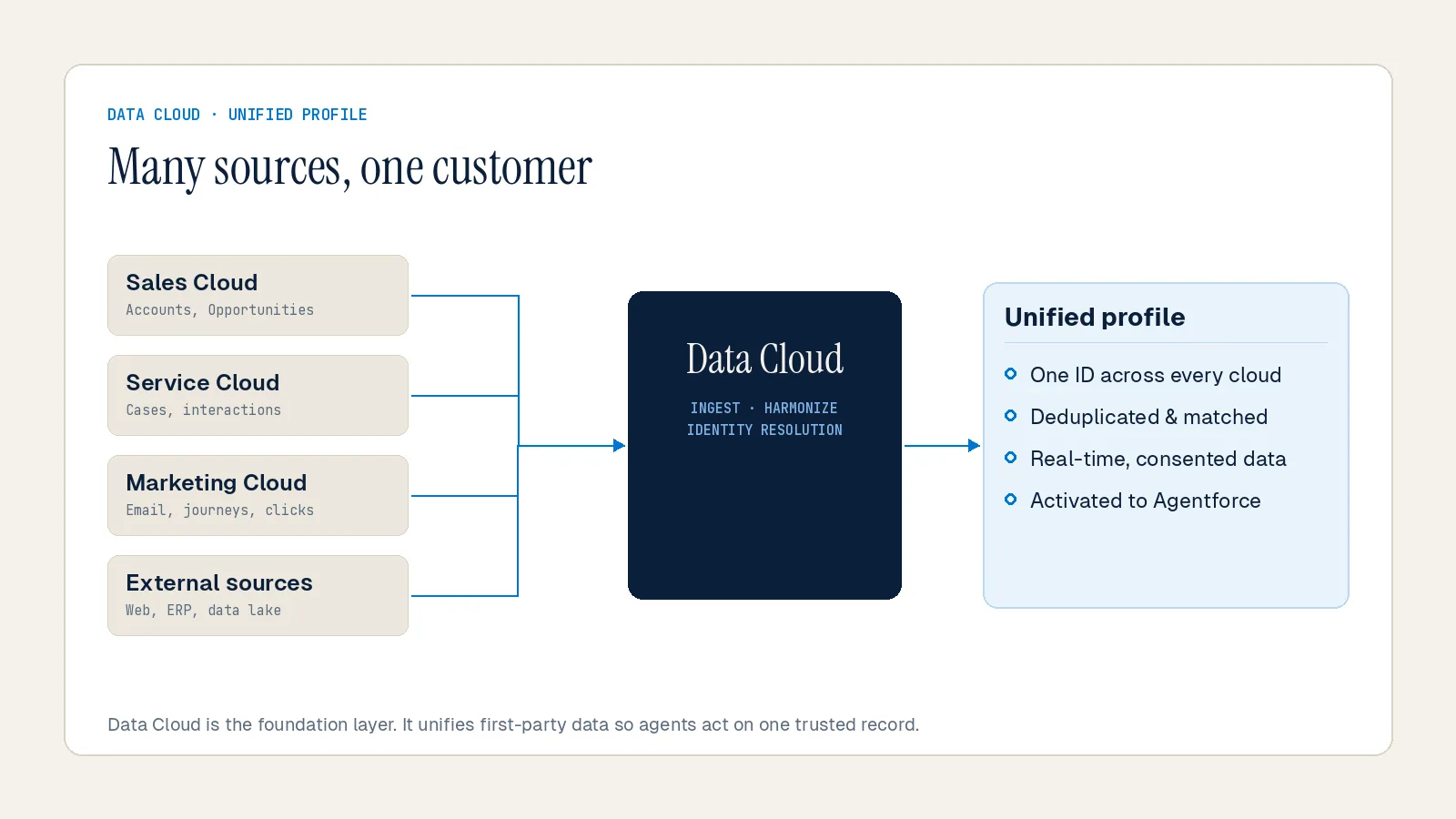
Salesforce Data Cloud is the data unification layer built natively into the Salesforce platform. It ingests customer data from every connected system, resolves duplicate identities into a single unified profile, and makes that live data available to every Salesforce cloud — and to AI agents — in real time. If your org runs Salesforce across sales, service, and marketing but operates off siloed, stale data, Data Cloud is the architecture that fixes that.
Quick Answer: Salesforce Data Cloud (rebranded Data 360 in October 2025) is a real-time customer data platform (CDP) that unifies structured and unstructured data from across your Salesforce ecosystem and external systems. It creates one trusted customer profile per individual, segments those profiles, and activates them to drive personalization, automation, and AI use cases. It is the data foundation for Salesforce's Agentforce platform.
Key Takeaways:
Data Cloud unifies customer data from Sales Cloud, Service Cloud, Marketing Cloud, Commerce Cloud, and external systems into a single, real-time profile per customer.
Identity resolution — the process of linking records across systems to the same individual — is the core mechanism that makes unified profiles reliable.
Pricing is consumption-based (Flex Credits at $500 per 100,000 credits), with a free tier and a paid Starter SKU listed at $60,000/year.
Data Cloud delivers maximum value inside an all-Salesforce environment; organizations with non-Salesforce stacks face added integration complexity.
It is the grounding data layer for Agentforce AI agents — without it, AI agents are working without reliable context.
What Salesforce Data Cloud Actually Does
Data Cloud is a Salesforce-native data layer for connecting, harmonizing, querying, and activating customer data. It is not a replacement for Sales Cloud records or a data warehouse. It sits beside those systems and lets teams use data from many sources without forcing every use case into a CRM object design.
Here is how the four core layers work in practice:
1. Data Ingestion
Data Cloud connects data from CRM, ERP, marketing platforms, websites, mobile apps, and third-party systems. It supports batch ingestion, streaming ingestion, and zero-copy federation — the ability to query data in external warehouses like Snowflake or BigQuery without physically copying it into Salesforce. As of 2025, ingesting structured data from other Salesforce products (Sales Cloud, Service Cloud, Marketing Cloud) is free — no credits consumed on import.
2. Data Modeling and Harmonization
Once data arrives, it is mapped to standardized Data Model Objects (DMOs) — Salesforce's canonical representation of entities like Individual, Contact Point, Order, and Interaction. This standardization is what makes data from 12 different source systems comparable and usable in the same query. The data processing layer cleans, transforms, and standardizes data to ensure consistency across platforms.
3. Identity Resolution
This is the mechanism that makes or breaks a Data Cloud implementation. Identity resolution is the process of identifying and linking records that refer to the same individual across different channels, devices, and systems — even when those records use different identifiers.
A customer who signs up with an email on your website, uses a phone number in your mobile app, and interacts via a loyalty card in-store appears as three separate records across three systems. Identity resolution links those records into a single Unified Profile.
Data Cloud uses two matching approaches:
Deterministic matching: exact identifiers like email, phone number, or customer ID.
Probabilistic matching: indirect signals like behavioral patterns or address similarities when exact matches are unavailable.
When identity resolution is under-built, you get duplicate profiles — the same customer split across records. When it is over-built, different customers get merged. Either breaks segmentation, personalization, analytics, and ROI reporting. Getting the match rules right is not a configuration detail — it is the foundational decision of any Data Cloud implementation.
4. Segmentation, Activation, and AI
Once unified profiles exist, Data Cloud enables teams to build segments and activate them in real time across Salesforce clouds and external platforms. Updates flow in near real time, allowing segmentation and activation to reflect current behavior instead of outdated snapshots.
The AI layer is where this gets strategically significant. According to Salesforce, Data Cloud serves as the grounding layer for Agentforce — its autonomous AI agent platform that entered general availability in October 2024. AI agents query unified profiles to make decisions and take actions across Salesforce clouds. An agent handling a service escalation can query a customer's full purchase history, loyalty status, and last five interactions — all resolved into one trusted record — before composing a response or triggering an action.
What It Is Not
Before evaluating whether your business needs Data Cloud, understand what it does not replace:
Not a data warehouse. Long-term storage, raw analytics, and large-scale historical analysis still belong in data warehouses like Snowflake or BigQuery.
Not a reporting tool. Dashboards and analysis consume Data Cloud data, but reporting lives in Tableau or CRM Analytics.
Not a plug-and-play personalization feature. Identity design, data modeling, governance, and activation strategy require deliberate architectural decisions. According to CDP.com, standard deployments take 8 to 16 weeks; enterprise-scale rollouts with multiple clouds and complex data models can extend to 3 to 12 months.
The mistake most orgs make at the start is treating Data Cloud like a large custom object store. That creates duplicated logic, unclear ownership, and expensive downstream fixes.
How Data Cloud Is Priced
Data Cloud uses a consumption-based pricing model, not a per-seat license. The three core components are credits, storage, and premium add-ons.
Consumption Credits (Flex Credits)
Flex Credits are the primary unit of usage. They are purchased in blocks and applied against active use — identity resolution, segmentation runs, activations, AI agent queries on unstructured data, and data zero-copy sharing. According to Salesforce's official pricing, the published rate is $500 per 100,000 credits. Ingesting data from Salesforce's own products is free — no credits consumed on import from Sales Cloud, Service Cloud, or Marketing Cloud.
Storage
Data storage is billed monthly. According to Salesforce's published rate card, the list price is $23 per terabyte per month — storing 10 TB costs approximately $230/month.
Entry Points
Salesforce offers a $0 provisioning SKU (Data 360 Everywhere) for orgs using Salesforce products that depend on Data Cloud functionality. The paid Starter SKU is listed at $60,000 per year. Two pricing models now exist: Flex Credits (consumption-based, maximum flexibility) and Profile-based pricing (flat per-profile rate for predictable billing on marketing personalization use cases).
Important cost caveats: Total cost of ownership is typically higher than the Starter SKU alone. Full CDP use cases often require additional Salesforce clouds — Marketing Cloud for email activation, Service Cloud for service use cases, and potentially MuleSoft for complex external data integration. Most deployments also require a Salesforce consulting partner, adding professional services fees.
Does Your Business Actually Need It?
Data Cloud is not the right call for every Salesforce org. Here is an honest framework.
You likely need Data Cloud if:
You run multiple Salesforce clouds and data does not travel cleanly between them. Sales, service, and marketing teams are working off different views of the same customer. Reps close deals without knowing a customer just submitted three service tickets. Marketers send renewal campaigns to churned accounts. Data Cloud is the architectural fix.
You are deploying Agentforce or serious AI use cases. AI agents need real-time, unified, trusted data to make reliable decisions. Without it, agents act on incomplete context. At Inforge, when we configure Agentforce for clients, the first question is always whether their data foundation is clean enough for an agent to act on.
You operate in a data-rich, customer-facing industry — retail, financial services, healthcare, or B2C e-commerce — where customer behavior changes faster than batch data pipelines update. According to research cited across Salesforce implementation partners, only 26% of organizations report delivering a fully connected customer experience, while 81% of IT leaders cite siloed data as the top barrier to digital transformation.
You need real-time personalization at scale. A retailer detecting a cart abandonment and triggering a relevant offer within seconds requires a live, unified profile — not a nightly ETL job into Marketing Cloud.
You probably do not need it yet if:
You are primarily on one Salesforce cloud. Data Cloud's value compounds when data needs to cross cloud boundaries. A Sales Cloud-only org with clean CRM data and no adjacent system complexity does not need a full CDP layer.
You do not have a clear, business-critical use case tied to data unification. Implementing Data Cloud without defined activation goals is expensive infrastructure with no short-term ROI.
Your data foundations are not yet ready. Identity resolution quality is heavily driven by source data quality, match key completeness, and contact point accuracy. If those are weak, no amount of better match rules will produce reliable unified profiles.
You run a primarily non-Salesforce stack. Data Cloud delivers maximum value within an all-Salesforce environment. Organizations using competing CRM, marketing automation, or commerce platforms face integration complexity that erodes the native-integration advantage.
What a Real Data Cloud Engagement Looks Like
At Inforge, the orgs that get the most out of Data Cloud start by identifying 1–3 business-critical scenarios tied to measurable KPIs before they touch a connector. Not "we want a 360-degree customer view" — that is a feature aspiration, not a business outcome.
Real starting questions look like: "Why are our service agents spending 12 minutes per call locating context that should be at their fingertips?" or "Why is our marketing team sending re-engagement campaigns to customers who bought three weeks ago?"
From those questions, the implementation becomes purposeful. Data sources get connected because they answer a specific question. Identity resolution is designed around the quality of available identifiers. Segments are built for real workflows, not hypothetical use cases.
We have also found that the consumption-based pricing model rewards orgs that implement deliberately. Teams that run identity resolution incrementally, avoid unnecessarily high segmentation frequencies, and use zero-copy federation for historical analysis rather than importing everything into Data Cloud keep costs predictable and ROI visible.
Summary
Salesforce Data Cloud (Data 360) is the real-time data unification layer that makes a multi-cloud Salesforce investment work as a single system. It resolves customer identities across sources, keeps profiles current as behavior changes, and provides the trusted data foundation that AI agents and personalization workflows depend on. It is not a starting point for every Salesforce org — but for organizations running multiple clouds, deploying AI, or competing on customer experience, it is increasingly the infrastructure that separates orgs that can act on data from those that can only store it. If you are evaluating whether Data Cloud fits your architecture, that conversation starts with your use cases — not the SKU sheet. Inforge helps mid-market Salesforce orgs scope, implement, and operate Data Cloud the right way. Let's talk.
Frequently Asked Questions
Q: What is the difference between Salesforce Data Cloud and Salesforce CRM?
A: Salesforce CRM (Sales Cloud, Service Cloud) is where customer records, cases, and opportunities live. Data Cloud is the layer above it — it connects CRM data with marketing, commerce, mobile, and external systems, resolves duplicate identities, and makes the combined data available in real time. CRM stores records. Data Cloud unifies context.
Q: How long does a Salesforce Data Cloud implementation take?
A: Standard deployments take 8 to 16 weeks. Enterprise-scale rollouts with multiple clouds and complex data models typically run 3 to 12 months. Deployment time is heavily influenced by data quality, the number of source systems, and how clearly the business use cases are defined before implementation begins.
Q: Is Salesforce Data Cloud free?
A: There is a $0 provisioning SKU (Data 360 Everywhere) available to Salesforce customers, providing limited storage and credits. It does not include full segmentation or activation capabilities. The paid Starter SKU is listed at $60,000 per year, with additional credits at $500 per 100,000. Ingesting data from Salesforce's own products is free under the 2025 pricing model.
Q: Do I need Salesforce Data Cloud to use Agentforce?
A: Data Cloud is the grounding data layer for Agentforce. You can run Agentforce without it, but agent performance is limited to whatever structured data exists in standard CRM objects. For agents to act on real-time, cross-channel customer context, Data Cloud is the required foundation.
Q: What is the biggest mistake companies make when implementing Data Cloud?
A: Over-architecting the solution at the start — beginning with every possible data source and use case in scope at once. Implementations that succeed start with one or two clearly defined business outcomes, build identity resolution around high-confidence identifiers, validate profiles before activating, and expand from there.
