Salesforce CPQ vs Revenue Cloud: Which Quoting Tool Fits Your Business?
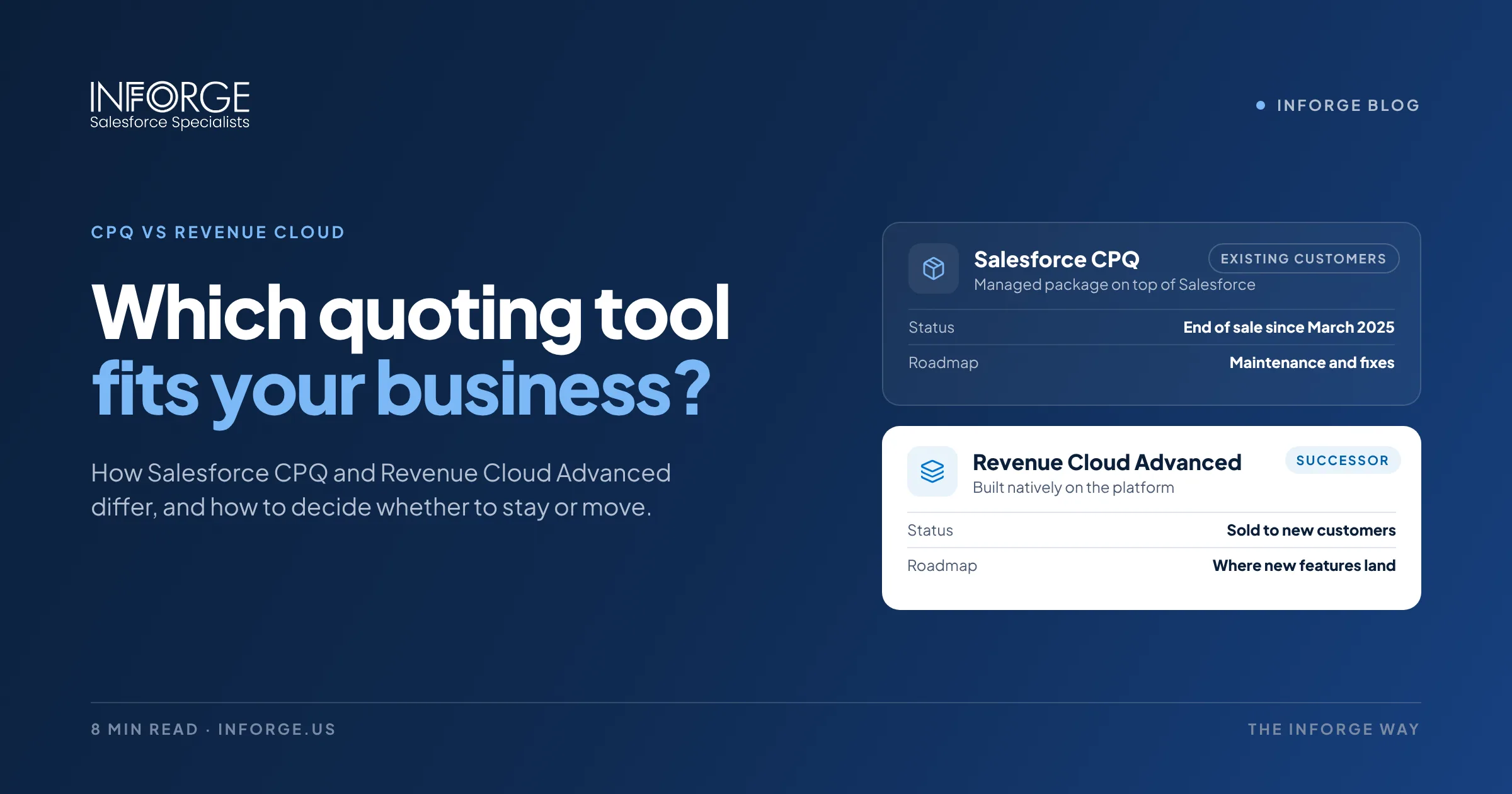
If you're buying a Salesforce quoting tool today, the answer is Revenue Cloud, because Salesforce no longer sells CPQ to new customers. If you already run Salesforce CPQ, the answer depends on how well it serves you today and where your revenue model is heading. CPQ still works and is still supported, but Salesforce's new investment is going into Revenue Cloud Advanced, now part of the Agentforce Revenue Management suite.
Quick Answer: Salesforce CPQ entered end of sale in March 2025, meaning it's no longer sold to new customers, but existing customers can keep using it with support and critical fixes. Its successor is Revenue Cloud Advanced, part of Salesforce's Agentforce Revenue Management suite, which is built natively on the Salesforce platform and covers pricing, quoting, contracting, orders, assets, and billing. New buyers should evaluate Revenue Cloud. Existing CPQ customers should plan a move when their pricing model, billing needs, or AI plans outgrow CPQ, rather than migrating in a rush.
Key Takeaways:
Salesforce CPQ entered end of sale in March 2025. Salesforce describes it as end of sale, not end of life.
Existing CPQ customers continue to receive support and critical fixes, but new product innovation is focused on Revenue Cloud Advanced.
Revenue Cloud Advanced is the successor to CPQ and is part of the Agentforce Revenue Management suite, alongside Revenue Cloud Billing.
CPQ is a managed package installed on top of Salesforce. Revenue Cloud Advanced is built natively on the platform and designed to be API-first and composable.
Moving from CPQ to Revenue Cloud is usually a reimplementation, not a simple upgrade, so it should be planned carefully.
What Changed with Salesforce CPQ
Salesforce CPQ, originally built by SteelBrick and acquired by Salesforce, has been the standard quoting tool in the Salesforce ecosystem for years. In March 2025, Salesforce confirmed it had entered end of sale.
According to Salesforce, that means CPQ is moving into a maintenance phase. Existing customers continue to receive support and critical fixes, and there is no forced migration. But Salesforce's investment in quote-to-cash has shifted to Revenue Cloud Advanced, part of the Agentforce Revenue Management suite.
The product names have changed several times, which has caused confusion. Revenue Lifecycle Management, Revenue Cloud Advanced, and Agentforce Revenue Management all refer to the same family of capabilities, with Revenue Cloud Billing as a complementary product for billing and collections.
The question isn't whether CPQ will stop working tomorrow. It won't. The question is whether it's still the right foundation for where your business is going.
How Salesforce CPQ and Revenue Cloud Compare
Architecture
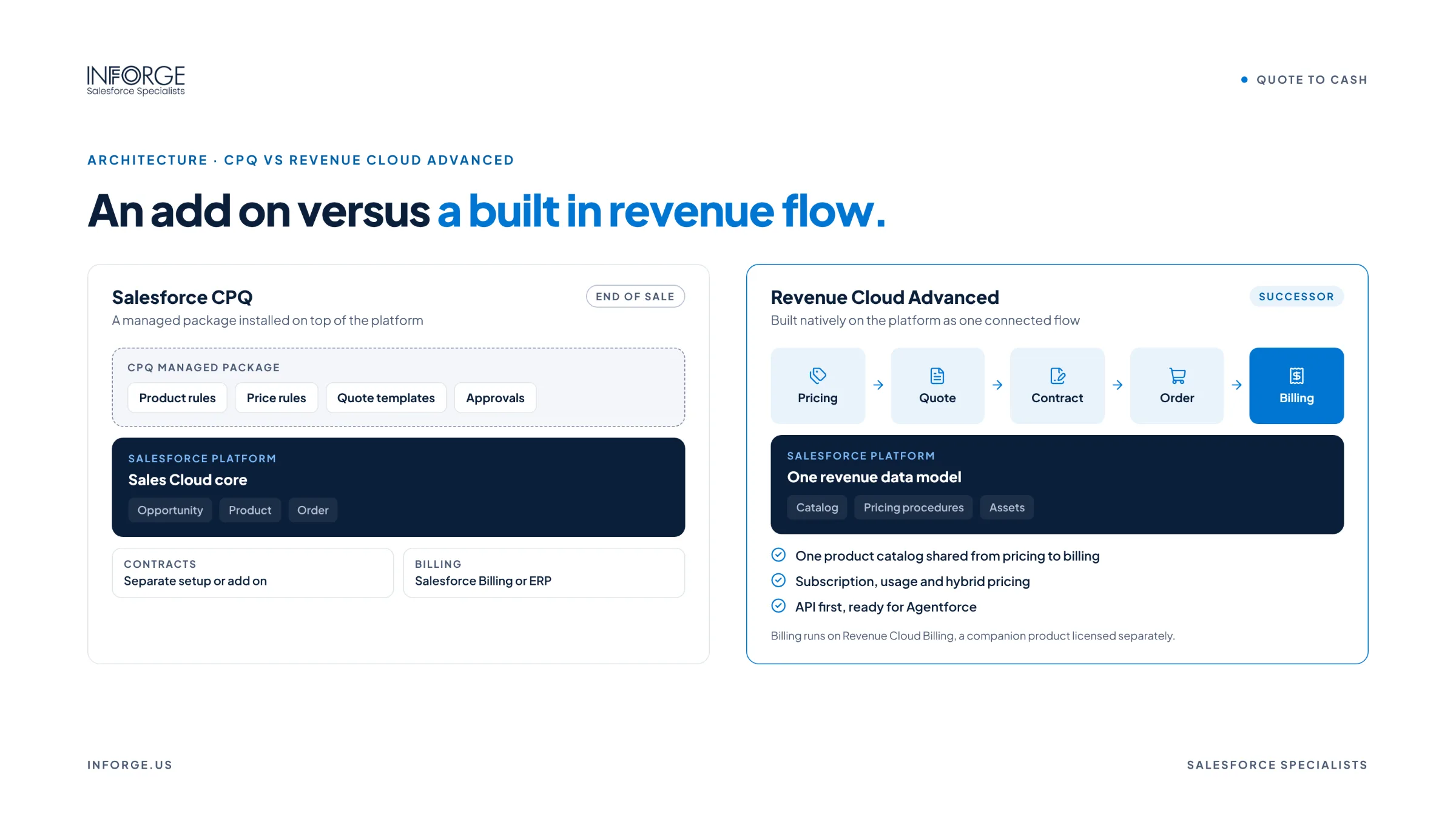
CPQ is a managed package installed on top of Salesforce. Revenue Cloud Advanced is built natively on the Salesforce platform and is designed to be API-first and composable, which makes it easier to connect to other systems and channels.
Scope
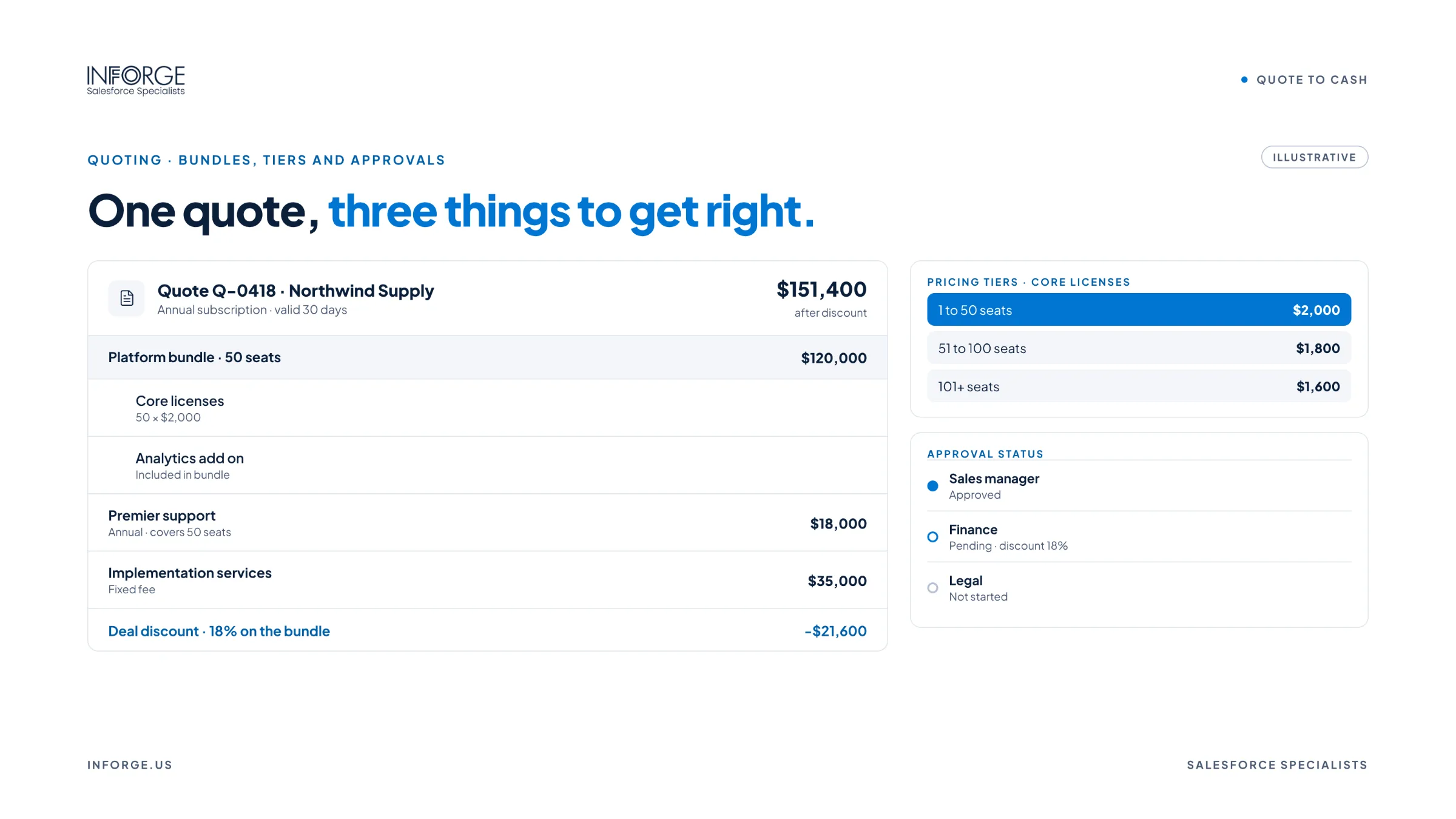
CPQ focuses on the front end of quote-to-cash: product configuration, pricing, discounting, approvals, and quote generation. Revenue Cloud Advanced covers a broader lifecycle, including pricing, quoting, contracting, orders, and assets, with Revenue Cloud Billing handling billing and collections.
Pricing models
CPQ handles traditional product and subscription pricing well. Revenue Cloud is designed for more complex and modern models, including usage-based pricing, ramp deals, and selling across multiple channels.
AI and automation
CPQ relies on pricing rules, product rules, and approvals configured by admins. Revenue Cloud is built to work with Agentforce, so the product, pricing, and contract data you set up can support AI-assisted quoting, renewals, and other agentic workflows.
Future investment
CPQ is in maintenance. Revenue Cloud is where Salesforce is building new capabilities.
Who Should Choose Revenue Cloud
New Salesforce quoting customers. CPQ is no longer available to new buyers, so Revenue Cloud is the Salesforce-native option.
Companies with complex or changing pricing models, like usage-based, consumption, or hybrid subscription pricing.
Businesses that want quoting, contracting, orders, and billing connected in one platform.
Teams planning to use Agentforce for quoting, renewals, or revenue operations.
Organizations already planning a major CPQ redesign, where rebuilding on Revenue Cloud may cost little more than reworking CPQ.
Who Can Stay on CPQ for Now
Existing customers whose CPQ setup works well and meets current needs.
Teams with stable, straightforward pricing and no near-term plans for usage-based models or billing changes.
Companies with other major projects underway that need to sequence a migration later.
Staying on CPQ is a reasonable short-term choice. But it should be a deliberate decision with a plan, not an assumption that nothing will change.
How to Plan a Move from CPQ to Revenue Cloud
Because Revenue Cloud uses a different data model and architecture, moving from CPQ is usually closer to a reimplementation than an upgrade. Plan it accordingly:
Assess your current CPQ setup. Document your product catalog, pricing rules, discount schedules, approvals, templates, and customizations.
Simplify before you move. Retire unused products, consolidate pricing logic, and clean up quote and contract data.
Define your future revenue model. Pricing models, billing needs, channels, and AI plans should shape the design.
Map data and integrations. Plan how products, price books, quotes, contracts, and assets move, and how ERP and billing connect.
Phase the rollout. Many companies start new business on Revenue Cloud while legacy contracts run on CPQ, then migrate renewals over time.
Train the team. Sales, deal desk, and finance teams will work differently, so adoption needs planning.
At Inforge, we've found that the companies handling the CPQ transition best aren't the ones rushing to migrate. They're the ones that assess what they have, simplify their pricing first, and design Revenue Cloud around where their revenue model is going.
Summary
Salesforce CPQ entered end of sale in March 2025. It still works and is still supported for existing customers, but Salesforce's innovation now goes into Revenue Cloud Advanced, part of the Agentforce Revenue Management suite. New buyers should evaluate Revenue Cloud. Existing CPQ customers should decide based on their pricing complexity, billing needs, and AI plans, and treat the move as a planned reimplementation rather than a quick upgrade.
Inforge helps companies assess, plan, and implement Salesforce quoting and revenue solutions, including CPQ optimization and Revenue Cloud implementations, with nearshore Salesforce consultants and developers working in your time zone.
Frequently Asked Questions
Q: Is Salesforce CPQ being discontinued?
A: Salesforce CPQ entered end of sale in March 2025, meaning it's no longer sold to new customers. Salesforce describes it as end of sale, not end of life. Existing customers continue to receive support and critical fixes.
Q: What replaces Salesforce CPQ?
A: Revenue Cloud Advanced is the successor to Salesforce CPQ. It's part of the Agentforce Revenue Management suite, which also includes Revenue Cloud Billing.
Q: Do I have to migrate from CPQ to Revenue Cloud?
A: Not immediately. There is no forced migration. But new features are being built for Revenue Cloud, so existing CPQ customers should plan when and how to move based on their business needs.
Q: What's the difference between Salesforce CPQ and Revenue Cloud?
A: CPQ is a managed package focused on configuring, pricing, and quoting. Revenue Cloud Advanced is built natively on Salesforce, covers a broader lifecycle including contracts, orders, and assets, supports more complex pricing models, and is designed to work with Agentforce.
Q: Is moving from CPQ to Revenue Cloud an upgrade?
A: It's usually closer to a reimplementation, because Revenue Cloud uses a different architecture and data model. Plan it as a project with assessment, design, data migration, testing, and training.