Salesforce CPQ vs Revenue Cloud: Which Is Right for Your Business in 2026?
If you're running Salesforce CPQ in 2026, the decision isn't really "CPQ vs Revenue Cloud" anymore. Salesforce made it for you. CPQ reached End of Sale in March 2025 — no new licenses, no new features, no roadmap. Revenue Cloud, now rebranded as Agentforce Revenue Management, is the only forward path Salesforce is investing in.
The question worth answering is: when should your business migrate, and what does the transition actually involve?
At Inforge, a Salesforce consultancy that delivers implementations through AI agents rather than traditional headcount, we've worked through this landscape with mid-market RevOps and IT teams. The stakes are real — and the right answer isn't the same for every org.
Quick Answer: Salesforce CPQ handles configure, price, and quote for sales teams. Revenue Cloud (Agentforce Revenue Management) covers the full revenue lifecycle — quoting, contracts, billing, orders, subscriptions, and AI-driven automation — on a single native platform. If you're a new customer, CPQ is no longer available. If you're an existing customer, migration is a matter of when, not if.
Key Takeaways:
Salesforce CPQ officially reached End of Sale in March 2025. Existing users can still renew, but no new features will be developed.
Revenue Cloud — now called Agentforce Revenue Management — is built natively on the Salesforce Core platform, not as a managed package.
Companies staying on legacy CPQ are locked out of Agentforce AI agents, which require the core-native architecture to function.
Migration is not a lift-and-shift. It is a re-implementation that requires business design decisions at every step.
The right time to migrate depends on your revenue model, technical debt levels, and whether you need subscription, usage-based, or multi-entity billing.
What Is Salesforce CPQ — And Why Is It Being Retired?
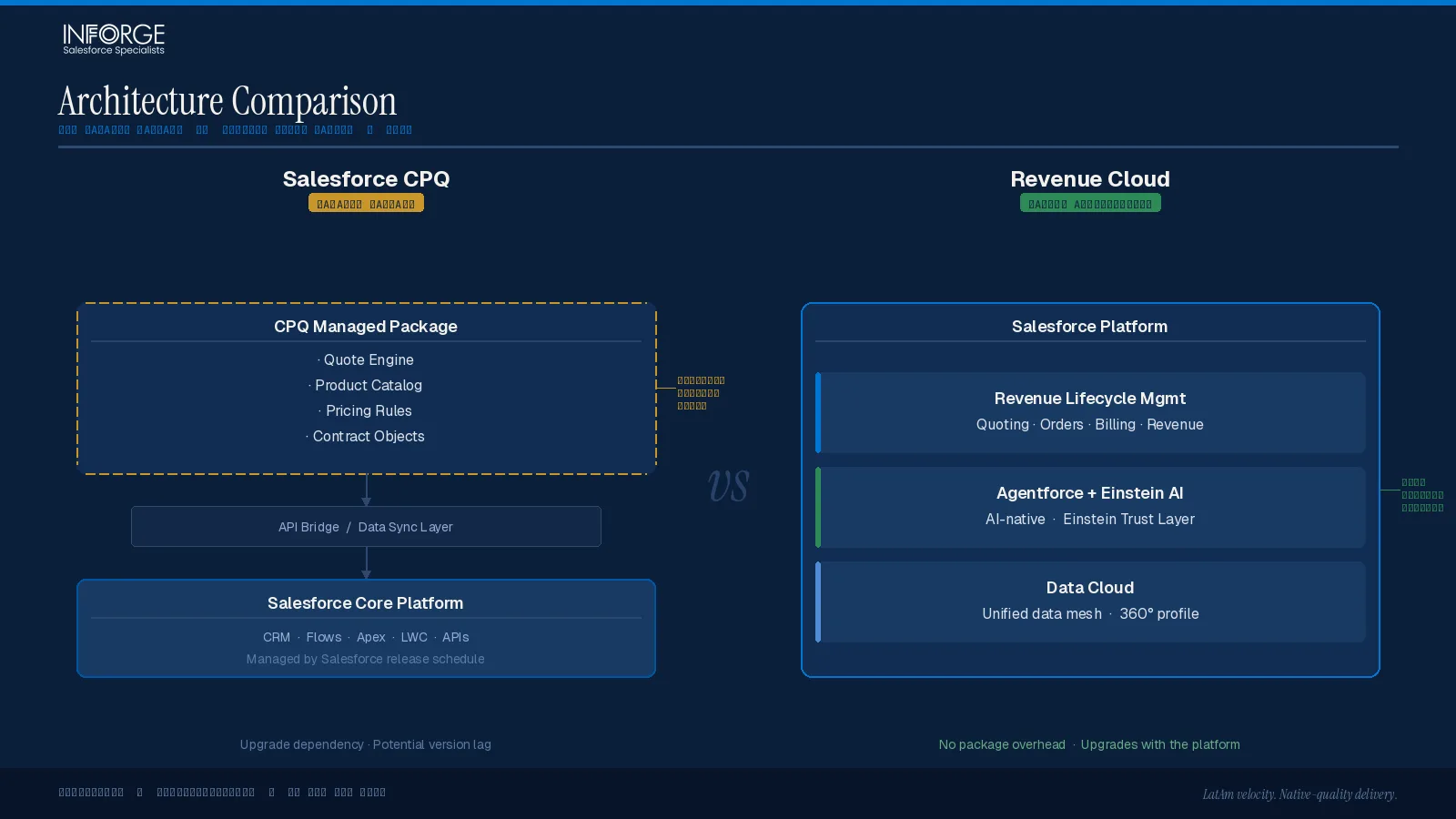
Salesforce CPQ (Configure, Price, Quote) is a managed package built on the SteelBrick acquisition Salesforce completed in 2015. For over a decade, it was the standard tool for automating complex pricing and quoting inside Sales Cloud. Sales teams used it to configure product bundles, apply discount and approval rules, and generate quote documents — all tightly integrated with Opportunity and Account records.
CPQ solved a real problem: it reduced quote errors and accelerated time-to-close by codifying product and pricing rules within the sales process. But it was always a package that sat *on top of* Salesforce, not *inside* it.
That architectural choice is the root of CPQ's current limitation. The core objects, pricing engine, and quoting logic sat largely outside the native Salesforce data model. That made the product powerful for its time — but brittle over time. Customisations accumulated, upgrades became risky, and the gap between what CPQ could do and what the broader Salesforce platform offered kept widening.
According to Aquiva Labs, CPQ has entered maintenance mode — there will be no more major innovations, just patching and support. Salesforce is not selling it to new customers, and all R&D has shifted to Revenue Cloud.
For RevOps leaders managing a CPQ implementation today: you're not being forced to migrate immediately. But you are being told the clock is running.
What Is Revenue Cloud (Agentforce Revenue Management) in 2026?
Revenue Cloud is Salesforce's next-generation revenue platform — and as of early 2026, it carries a new name. According to Sirocco Group, in early 2026 Salesforce renamed Revenue Cloud to Agentforce Revenue Management, with the Spring '26 release notes carrying it as the new official name and AI agents woven through quoting, billing, and order orchestration in ways that were not possible under the previous architecture.
The naming history is worth knowing to avoid confusion:
Salesforce CPQ — the name used from 2016 to 2024 (legacy managed package)
Revenue Lifecycle Management (RLM) — internal early-access name for the new core-native product
Revenue Cloud / Revenue Cloud Advanced (RCA) — official product name as of 2025
Agentforce Revenue Management — current strategic name as of Spring '26
What matters architecturally: Revenue Cloud is built natively on the Salesforce Core platform — the same high-performance infrastructure as Sales and Service Cloud. It is API-first, uses a unified data model, and integrates product catalog, pricing, contracts, orders, and billing in a single platform.
The practical capability difference is significant. Where CPQ stops at the signed contract, Revenue Cloud manages everything that happens after:
Subscription lifecycle — renewals, amendments, term changes, cancellation handling
Billing and invoicing — rated usage, invoice generation, credit memos
Payment orchestration — integrations to payment gateways and collections systems
Contract Lifecycle Management (CLM) — automated approvals, redlining, and renewals
Revenue recognition — accounting subledger or ERP integrations
Headless APIs — platform-native components that simplify automation and large-scale integrations
According to Noltic, the latest Winter '26 Release improves guided setup, adds multi-order creation from a single quote, introduces new pricing formulas, and deepens integration with Agentforce AI for forecasting.
Revenue Cloud Growth is priced at $150 per user per month; Revenue Cloud Advanced at $200 per user per month — both billed annually and both requiring an active Sales or Service Cloud license.
The Real Difference: CPQ Stops at the Quote. Revenue Cloud Runs the Lifecycle.
This is the clearest way to frame the comparison for a business decision.
CPQ is a sales-side tool. It makes quoting faster and more accurate. It does not handle what happens after the contract is signed — billing, renewals, amendments, fulfillment, or revenue recognition. For organizations running simple, transactional revenue models with stable product catalogs, that scope was sufficient for years.
Revenue Cloud is a revenue operations platform. It covers the full lifecycle — from product configuration and pricing through billing, subscription management, and downstream ERP integration — in one unified architecture.
According to Apex Hours, CPQ perfects the quote; Revenue Cloud manages what happens after the contract is signed.
The ownership implications matter too. CPQ is a sales team tool. Revenue Cloud involves sales, RevOps, and finance — because it manages the data those teams all depend on. Implementation and adoption complexity scales accordingly.
Here's a direct comparison across the dimensions that matter for most mid-market businesses:
| Dimension | Salesforce CPQ (Legacy) | Revenue Cloud / Agentforce RM |
|---|---|---|
| Architecture | Managed package (on top of Salesforce) | Core-native (inside Salesforce) |
| Scope | Configure, Price, Quote | Full revenue lifecycle — quote to billing |
| Subscription management | Limited / add-on | Native |
| Billing & invoicing | Requires Salesforce Billing add-on | Built in |
| Agentforce AI compatibility | Not compatible | Fully integrated |
| New licenses available | No (End of Sale, March 2025) | Yes |
| Pricing engine performance | JavaScript-based, hits limits at ~500 lines | Server-side, processes thousands of lines |
| Data Cloud integration | Disconnected | Native |
| New features / R&D | Halted | Active |
The Agentforce Factor: Why This Matters More Than a Feature Comparison
The timing of this platform shift is not accidental. According to Salesforce's State of Sales report for 2026, 87% of sales organisations are now using some form of AI, and 51% of sales leaders using AI identify disconnected systems as their primary obstacle.
Agentforce Revenue Management is Salesforce's answer to both of those findings — but it only works if your revenue data sits in the core-native architecture.
According to Bluvium, companies staying on legacy CPQ are locked out of Agentforce: the new autonomous AI agents require the core-native architecture of Revenue Cloud Advanced to function effectively.
What that means in practice: with Agentforce Revenue Management, AI agents can identify renewals coming up in 90 days, check Data Cloud for the customer's actual product usage, automatically generate a right-sized renewal quote, and email the customer to start the negotiation. According to Bluvium, this level of automation is virtually impossible in the legacy managed package environment.
This is why Salesforce's rebranding to Agentforce Revenue Management is not a cosmetic exercise. According to Sirocco Group, when Salesforce moves something inside the Agentforce umbrella, that decision signals where future investment will go — and, indirectly, what is being deprioritized.
According to SQ Magazine, Agentforce and Data 360 combined annual recurring revenue reached nearly $1.4 billion in Q3 fiscal 2026 — up 114% year-over-year — making it the fastest-growing product category in Salesforce history. Salesforce has closed 18,500 Agentforce deals since launch, including 9,500 paid deals.
For organizations evaluating whether to stay on CPQ or migrate: this is the signal that matters more than any feature checklist.
Who Should Migrate Now — And Who Can Wait?
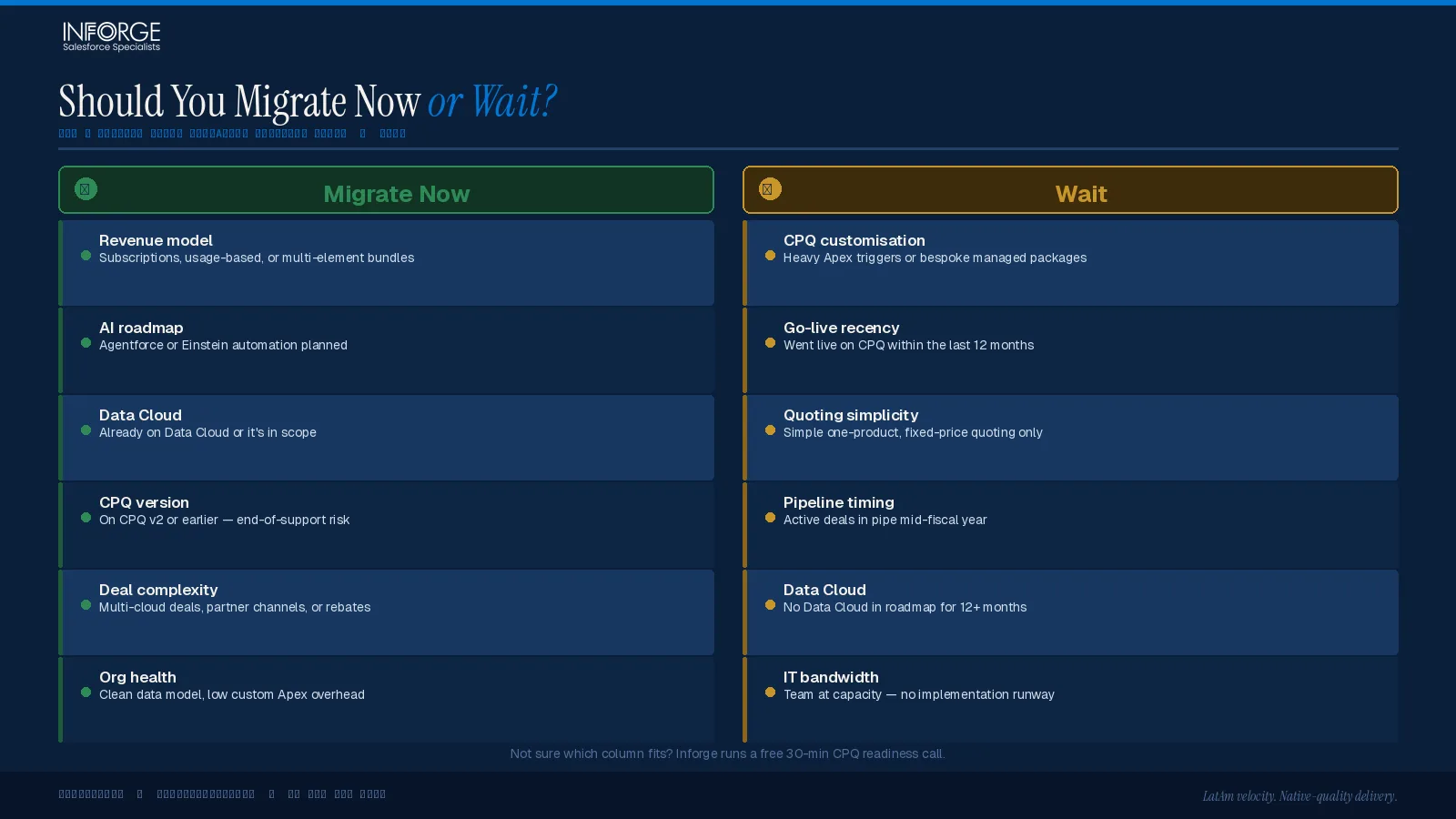
Not every organization running Salesforce CPQ needs to migrate in 2026. The right answer depends on the nature of the revenue model, the maturity of the existing implementation, and the commercial roadmap for the next two to three years.
According to Sirocco Group, migration tends to have a clear business case for organisations that have moved — or are actively moving — toward subscription or usage-based pricing. The billing and contract management capabilities in Agentforce Revenue Management are specifically designed for recurring revenue models.
Strong case to migrate now:
Your business runs subscription, usage-based, or consumption pricing models
You need multi-entity or multi-currency billing that scales
You want to deploy Agentforce AI agents in your revenue workflow
Your CPQ implementation carries significant technical debt — accumulated custom price rules, workarounds, and brittle configurations
Your quotes regularly exceed 500 line items (legacy CPQ's JavaScript engine hits performance ceilings here)
You're a new Salesforce customer (CPQ is simply not available)
Reasonable to stay on CPQ for now:
Your revenue model is simple and transactional — one-time deals, standard pricing, minimal post-sale complexity
Your CPQ implementation is clean, well-documented, and working reliably
Your organization has no near-term requirement for AI-driven revenue automation
A migration would destabilize a revenue process that is currently stable and delivering accurate results
At Inforge, we've seen the damage a poorly timed migration does. Migrating before your business processes are documented and your product catalog is cleaned up is a fast path to a failed implementation. The organizations that succeed treat this as a re-implementation — with business design decisions at every step — not a system swap.
What Migration Actually Involves
Migration from Salesforce CPQ to Agentforce Revenue Management is not a lift-and-shift. The data models are different. Approval hierarchies need to be redesigned. Pricing models work differently. Order management, billing, and ERP integrations all shift.
According to Mountain Point, organizations that struggle with CPQ migrations are the ones who planned for a lift-and-shift and discovered three months in that the lift wasn't possible. The ones that succeed treat it as a re-implementation with business design decisions at every step.
According to Aquiva Labs, a phased approach works best: avoid big-bang rollouts, phase migration by module or brand, and plan rollbacks. The path begins with a Readiness Assessment, moves into a Proof of Concept, and then a phased rollout.
Specifically, three categories of migration work emerge:
Automatable — standard bundles, basic attributes, standard discounts
Assisted — advanced pricing logic, complex rules, multi-tier approvals
Manual redesign — features that don't map to the new architecture (e.g., dynamic bundles in CPQ have no direct equivalent in Revenue Cloud's constraint-based configurator)
According to Noltic, to avoid disruption, a phased migration where Salesforce CPQ and Revenue Cloud run in parallel before full adoption is strongly recommended.
The timeline depends on complexity. According to RevSolutions, straightforward deployments typically take 8 to 16 weeks. Enterprise implementations with ERP integration, multi-entity billing, and complex pricing models can take 4 to 9 months.
The most important step before any migration begins: audit your existing CPQ org. Most legacy CPQ instances contain inactive products, orphaned price rules, and customizations nobody can explain. Use this migration as the opportunity to shed the workarounds of 2018 and build the revenue architecture your business actually needs in 2026.
Summary
Salesforce CPQ served a generation of revenue teams well. In 2026, it is in maintenance mode — no new features, no new licenses, and no path to Agentforce AI integration. Revenue Cloud, now Agentforce Revenue Management, is the only platform Salesforce is building for. The decision for most organizations is not whether to migrate, but when and how to do it without disrupting the revenue operations that drive the business.
At Inforge, we deliver Salesforce implementations — including Revenue Cloud migrations — entirely through AI agents. Faster timelines. More consistent quality. A fraction of the cost. That's not a pitch. That's how we operate, every day. If your organization is evaluating a CPQ migration or a net-new Revenue Cloud implementation, we're the right conversation to have first.
Frequently Asked Questions
Q: Is Salesforce CPQ being discontinued?
A: Salesforce CPQ reached End of Sale in March 2025, meaning no new licenses are sold and no new features will be developed. Existing customers can continue to use it and renew their subscriptions, but Salesforce has halted all major R&D investment in the product. The future of revenue operations on Salesforce is Agentforce Revenue Management.
Q: What is the difference between Salesforce CPQ and Revenue Cloud?
A: CPQ is a managed package focused on configure, price, and quote — it handles the sales quoting process. Revenue Cloud (Agentforce Revenue Management) is a core-native platform that covers the entire revenue lifecycle: quoting, contracts, orders, billing, subscription management, and AI-driven automation. CPQ stops at the signed deal; Revenue Cloud manages everything that follows.
Q: Can Revenue Cloud replace Salesforce CPQ completely?
A: Yes. Revenue Cloud includes all of the quoting and configuration functionality CPQ offered, plus billing, contract lifecycle management, subscription management, order orchestration, and Agentforce AI integration. It is not a partial replacement — it is a superset, built on a different and more capable architecture.
Q: How long does a Salesforce CPQ to Revenue Cloud migration take?
A: Timeline depends on the complexity of your existing implementation. Straightforward migrations typically take 8 to 16 weeks. Enterprise implementations with ERP integration, multi-entity billing, and complex pricing models can run 4 to 9 months. The most important variable is how much technical debt and undocumented customization exists in the legacy CPQ org.
Q: Do I need to migrate from CPQ to Revenue Cloud right now?
A: Not necessarily — but the pressure is building. If your revenue model involves subscriptions, usage-based pricing, or recurring billing, the case for migrating now is strong. If your model is simple and transactional and your CPQ implementation is clean, you may have more time. The hard stop is AI: legacy CPQ is incompatible with Agentforce agents, which require the core-native architecture of Revenue Cloud to function.
Q: How much does Salesforce Revenue Cloud cost?
A: Revenue Cloud Growth is priced at $150 per user per month (billed annually) and Revenue Cloud Advanced at $200 per user per month (billed annually). Both require an active Sales or Service Cloud license. Implementation, customization, and integration costs are separate and depend on project complexity.
*Ready to evaluate your CPQ migration path? At Inforge, we assess your current Salesforce environment and build the Revenue Cloud architecture your revenue process actually needs — delivered entirely through AI agents. [Get in touch.](/contact)*
