Salesforce Clouds Explained: What Each One Does and Which One You Actually Need
Most people come to Salesforce looking for a CRM. What they find is something far bigger — a suite of more than 20 specialised products, each called a "cloud," each solving a different business problem. If you've ever stared at the Salesforce product page wondering what half of it means, this guide is for you.
Quick Answer: Salesforce clouds are purpose-built, cloud-hosted products that cover different business functions — sales, service, marketing, commerce, data, and more. Most mid-market companies start with Sales Cloud and Service Cloud, then expand into specialised clouds as their needs grow.
Key Takeaways:
Salesforce offers more than 20 clouds in 2025, ranging from core business tools to industry-specific solutions.
The six major clouds — Sales, Service, Marketing, Commerce, Experience, and Data — cover the majority of business use cases.
Revenue Cloud, Analytics Cloud, and Nonprofit Cloud are purpose-built extensions for specific operational needs.
Most large enterprises use six or more clouds running in combination.
Choosing the wrong mix, or over-licensing is one of the most common (and expensive) mistakes in a Salesforce implementation.
At Inforge, we're a Salesforce consultancy that delivers full implementations using AI agents. We see the cloud selection problem constantly: companies paying for clouds they don't use, or missing the one cloud that would solve their biggest operational bottleneck. This guide exists to cut through the confusion.
What Is a Salesforce Cloud?
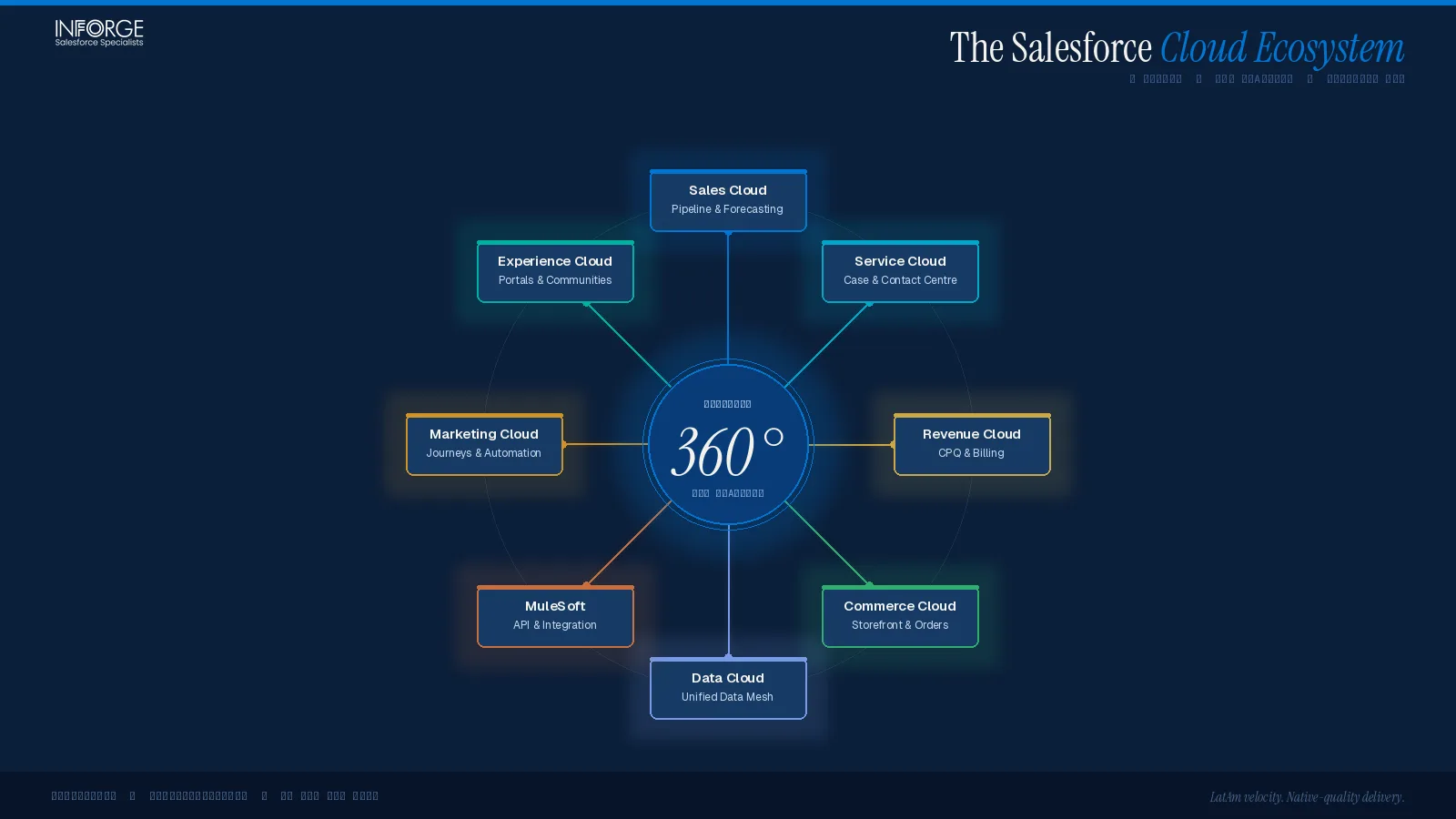
A Salesforce cloud is a specific set of cloud-based services within the Salesforce platform — each designed to address a distinct area of business operations. They share the same underlying infrastructure and data model, which means they're built to work together rather than as separate, disconnected tools.
These tools are referred to as "clouds" because they're delivered entirely through cloud computing — no on-premises software, no local installation. Every cloud runs on the Salesforce platform, giving you a shared view of customer data across whichever products you use.
The value of the cloud model is integration. When your sales team closes a deal in Sales Cloud, service agents in Service Cloud see that context. When marketing sends a campaign through Marketing Cloud, the engagement data flows back into the CRM. That connected view is the whole point.
The Six Core Salesforce Clouds
These are the clouds most businesses engage with first. They cover the full customer lifecycle — from acquisition through to retention — and are the foundation of almost every Salesforce implementation.
1. Sales Cloud
Sales Cloud is Salesforce's flagship product and the reason the company exists. Released when Salesforce was founded in 1999, it remains the largest-share CRM product available today.
Its primary purpose is straightforward: help companies accelerate their sales cycle. It provides tools to manage leads, opportunities, accounts, and the individuals a sales team works with. It's primarily aimed at B2B businesses and includes features like quoting, product management, and revenue forecasting for sales managers.
Key capabilities:
Contact and lead management with 360-degree customer views
Opportunity management across the full sales pipeline
Revenue forecasting and sales performance dashboards
Territory management and Salesforce Maps for field teams
Native integration with Einstein AI and Agentforce for automated lead qualification
Salesforce has progressively layered AI into Sales Cloud. The platform has evolved Einstein into Agentforce — a suite of autonomous AI agents that don't just suggest actions but can independently execute tasks like qualifying leads, scheduling meetings, and resolving service cases.
Who needs it: Any company with a structured sales process. It's the default starting point for nearly every Salesforce implementation.
2. Service Cloud
Service Cloud is the customer support counterpart to Sales Cloud. It's a CRM built specifically for customer service teams, helping them respond to inquiries and support requests faster and more effectively.
It covers case management for handling customer issues and omnichannel support — reaching customers across email, live chat, phone, WhatsApp, and more. It also supports Agentforce agents to handle routine tasks like troubleshooting, suggesting next best actions to human agents, and providing proactive status updates.
According to Salesforce's own financial reporting, Service Cloud generates approximately $6.2 billion in annual revenue — making it one of the company's highest-earning products alongside Sales Cloud.
Key capabilities:
Omnichannel case management
Self-service knowledge base and customer portals
AI-powered agent assistance and automated case routing
Service analytics and SLA tracking
Who needs it: Any business that handles inbound customer support at volume. B2C companies, SaaS platforms, and any org with a dedicated support function.
3. Marketing Cloud
Marketing Cloud is an all-inclusive digital marketing platform that enables businesses to create, automate, and personalise marketing campaigns across multiple channels — from email and SMS to social media and advertising.
It's designed to deliver personalisation at scale. Instead of running disconnected campaigns, Marketing Cloud connects channels like email, social media, SMS, and paid advertising into one platform, allowing marketers to map customer journeys from first touch to purchase.
Key capabilities:
Email Studio for personalised campaign creation and audience segmentation
Journey Builder to automate customer journeys based on behaviour
Social Studio for scheduling, monitoring, and social campaign analytics
Mobile marketing including SMS and push notifications
Account Engagement (formerly Pardot) for B2B marketing automation and lead nurturing
Note on Account Engagement: Pardot is now officially known as Salesforce Account Engagement. It remains the go-to tool for B2B marketing automation and lead nurturing within the Salesforce environment — but it's a distinct product from Marketing Cloud, which is primarily B2C-focused.
Who needs it: Marketing teams running multi-channel campaigns at scale. B2C companies with complex customer journeys. B2B teams focused on lead nurturing should look at Account Engagement specifically.
4. Commerce Cloud
Commerce Cloud provides the backbone for digital storefronts — whether you sell to consumers (B2C) or businesses (B2B). It supports catalogues, shopping carts, checkout processes, and order management, all within the Salesforce ecosystem.
One of Commerce Cloud's key differentiators is its ability to manage both B2C and B2B commerce on a single platform. Instead of stitching together separate systems, companies can track orders, payments, and fulfilment in one place — and the experience feels unified even when customers buy across multiple channels.
Key capabilities:
Pre-built, device-responsive storefront templates that shorten time-to-launch
Centralised order management across all channels
Third-party marketplace seller onboarding
B2B-specific features including contract pricing and bulk ordering
Who needs it: Retailers, consumer brands, and any company with a direct-to-consumer or B2B e-commerce channel.
5. Experience Cloud
Experience Cloud — previously known as Community Cloud — is Salesforce's digital experience platform. It lets businesses build branded portals, websites, and communities connected directly to their CRM data.
Experience Cloud allows customers, partners, and employees to interact with your brand through secure, easy-to-use digital spaces. You can create self-service portals where customers solve their own support issues, partner networks for channel sales teams, or employee intranets — all without writing code.
With over 50 million active users and more than 2,000 digital portals built on the platform, Experience Cloud supports some of the highest-traffic branded digital experiences in the market.
Key capabilities:
Drag-and-drop portal and website builder (no coding required)
Self-service knowledge bases and community forums
Partner relationship management (PRM) portals
Mobile-responsive, device-agnostic experiences
Direct integration with Sales Cloud, Service Cloud, and CRM data
Who needs it: Companies that want to extend the Salesforce platform outward — to customers, partners, or employees — without building a separate web infrastructure.
6. Data Cloud
Data Cloud is the most strategically significant cloud Salesforce has launched in recent years — and the one most companies underestimate.
It acts as the central nervous system for customer data across the entire Salesforce platform. It brings together information from multiple sources, segments customers based on behaviour, and powers real-time personalisation across marketing, sales, and service. Agentforce itself relies on Data Cloud to deliver dynamic, personalised responses to anyone interacting with an agent.
The growth numbers reflect how seriously enterprises are taking it. According to Salesforce's own filings, Data Cloud and AI annual recurring revenue exceeded $1.2 billion in Q2 FY2026 — up 120% year-over-year. Data Cloud surpassed 50 trillion records in FY2025, doubling year-over-year. Nearly half of the Fortune 100 are now Data Cloud and AI customers.
Key capabilities:
Unified customer profiles built from multiple data sources
Real-time audience segmentation
Zero-copy data sharing to avoid duplication
Powers personalisation across all Salesforce clouds
Foundation layer for Agentforce AI agents
Who needs it: Any organisation that wants AI-driven personalisation at scale. If you're deploying Agentforce or running multi-cloud Salesforce, Data Cloud is essential infrastructure — not optional.
Revenue Cloud and Analytics Cloud: The Operational Pair
Revenue Cloud
Revenue Cloud simplifies the entire quote-to-cash process by unifying sales, billing, and revenue management. While Sales Cloud helps you close deals, Revenue Cloud ensures every deal translates into revenue accurately — captured, billed, and tracked without manual intervention.
It covers the full revenue lifecycle: quotes, contracts, billing, and renewals in one connected flow. The platform includes contract lifecycle management embedded within it, allowing users to create and amend contracts while enforcing consistent terms throughout the revenue process.
Revenue Cloud replaces what was previously Salesforce CPQ (Configure, Price, Quote), which has been moved to end-of-sale. The replacement — Revenue Cloud Advanced — includes broader product management, pricing strategy, order fulfilment, and invoicing capabilities.
Who needs it: SaaS companies managing subscriptions, manufacturers with complex pricing, and any business where billing errors or revenue leakage is a real operational problem.
Analytics Cloud (Tableau)
Analytics Cloud — now built around Tableau — embeds AI-driven insights directly into your Salesforce workflow. It offers real-time insights, natural language queries, and embedded analytics to help teams make faster, data-driven decisions. Whether you're tracking performance metrics or analysing trends, Analytics Cloud brings actionable intelligence directly into your workflows.
For enterprise teams running multiple Salesforce clouds, Tableau serves as the single analytics layer that surfaces what's happening across the entire stack.
Who needs it: Ops teams and leadership that need advanced reporting beyond standard Salesforce dashboards. Companies where BI is a decision-making priority.
Industry Clouds: When Your Vertical Has Specific Requirements
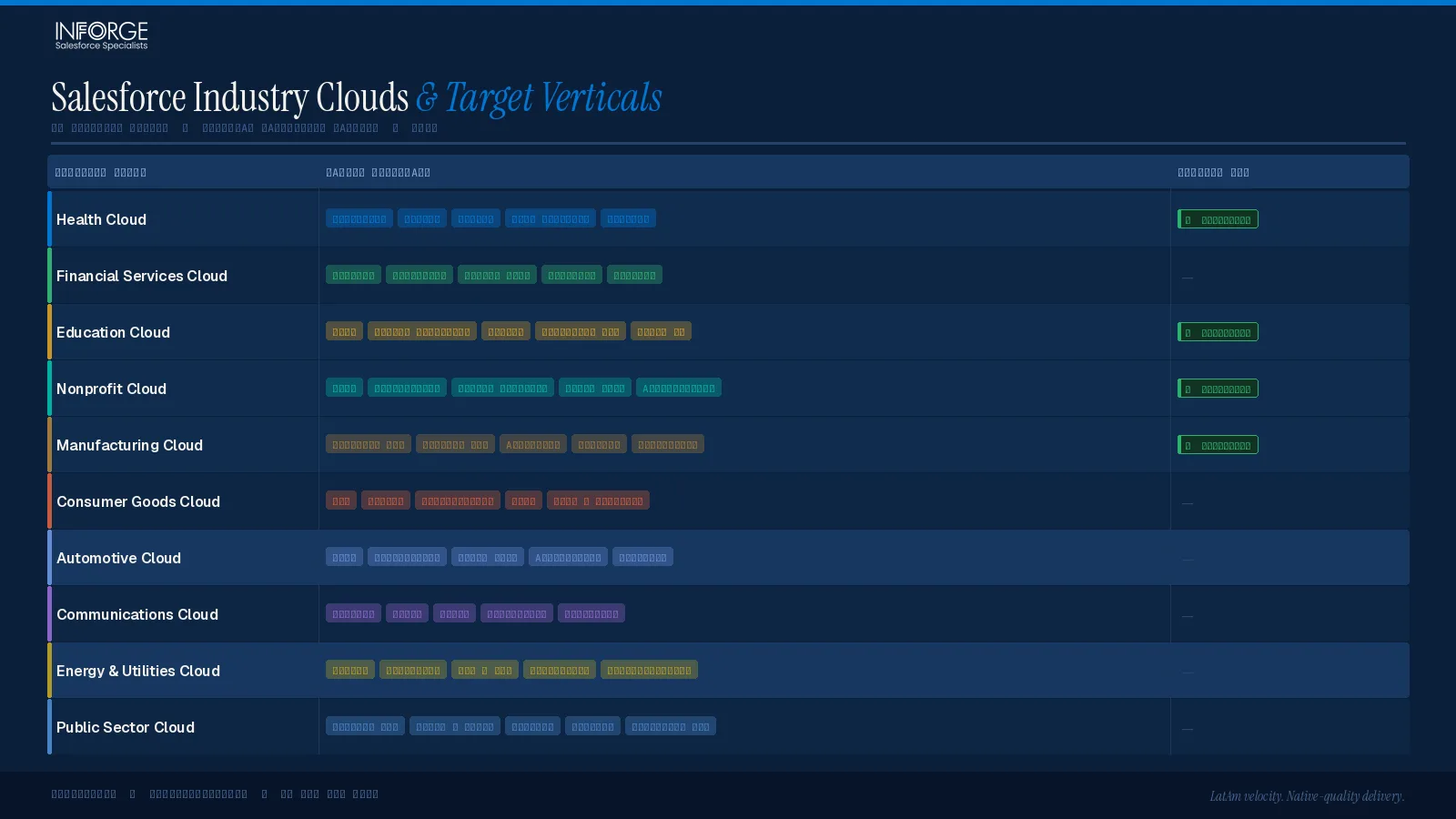
Beyond the core clouds, Salesforce offers a growing library of industry-specific solutions. These clouds are tailored to meet the unique needs of specific sectors — with pre-built data models, workflows, and compliance features built for the vertical.
In 2025, Salesforce offers specialised clouds for:
Health Cloud — Built for healthcare providers, payers, and life sciences companies. Manages patient data, care coordination, and regulatory requirements. Pricing starts at $325 per user per month.
Nonprofit Cloud — Salesforce's primary offering for nonprofits, charities, and social housing associations. Covers fundraising management, volunteer coordination, grant tracking, and programme outcomes. Built on the same data model as Health Cloud, making interoperability straightforward for healthcare nonprofits.
Financial Services Cloud — For banking, insurance, and wealth management firms. Handles relationship management across households and financial accounts with compliance-ready features.
Education Cloud — For higher education institutions managing student recruitment, enrolment, and alumni relations.
Automotive Cloud — For vehicle manufacturers and dealer networks managing the full buyer journey.
Manufacturing Cloud — For manufacturers needing visibility across sales agreements, partner channels, and production forecasting.
Communications Cloud — For telecoms and media companies managing subscriber lifecycles and partner ecosystems.
These industry clouds reduce the configuration burden significantly. Instead of customising a generic CRM to fit healthcare or financial services workflows, you start from a product built for those workflows from day one.
According to Salesforce data, nearly 90% of Forbes' Top 50 AI companies run on Salesforce, with an average of four clouds per customer — suggesting that multi-cloud deployments are the norm, not the exception, at the enterprise level.
How to Choose the Right Salesforce Clouds
The most common mistake we see at Inforge isn't choosing the wrong cloud — it's over-licensing before understanding what each product actually does in production.
Here's a practical framework:
Start with the problem, not the product. Define the business function you're trying to fix first. If your sales cycle is broken, that's Sales Cloud. If your support team is drowning, that's Service Cloud. If your marketing is disconnected from CRM data, that's Marketing Cloud or Account Engagement.
Don't buy clouds you're not ready to adopt. Most businesses start with Sales Cloud and Service Cloud, add Marketing Cloud when campaigns mature, and bring in Commerce or Analytics once scaling demands it. Buying everything upfront and using 20% of it is a guaranteed way to erode ROI.
Think about the data layer from day one. If you're planning to use Agentforce or AI-driven personalisation at any point, Data Cloud needs to be part of the architecture conversation early — not retrofitted later.
Industry clouds save time but require commitment. If you're in healthcare, financial services, or nonprofit, an industry cloud will reduce configuration time significantly. But they're purpose-built, which means less flexibility for businesses that sit outside the vertical's standard workflows.
Summary
Salesforce is not a single product. It's a platform — and the clouds are the product. Each one solves a specific business problem, and the power of the platform comes from how they connect. Sales Cloud closes deals. Service Cloud retains customers. Marketing Cloud drives engagement. Data Cloud makes it all intelligent. The right combination depends entirely on where your business is today and where it's going.
At Inforge, we deliver full Salesforce implementations through AI agents — faster timelines, more consistent quality, and significantly lower cost than traditional delivery models. If you're evaluating which clouds belong in your stack, or inheriting a Salesforce org that needs to be rationalised, we can help you cut through the noise and build something that actually works.
Frequently Asked Questions
Q: How many Salesforce clouds are there in 2025?
A: More than 20, including both core and industry-specific products. Most businesses operate across the six major clouds — Sales, Service, Marketing, Commerce, Experience, and Data — and add specialised clouds as needed.
Q: What's the difference between Sales Cloud and Service Cloud?
A: Sales Cloud is built for sales teams — managing leads, opportunities, and pipeline to close deals. Service Cloud is built for support teams — handling inbound customer issues, cases, and omnichannel service. They're different products built for different functions, though they share the same underlying Salesforce data.
Q: Do we need Data Cloud?
A: If you're running multiple Salesforce clouds, using Agentforce, or need real-time AI personalisation, yes. Data Cloud acts as the unified data layer that makes all of it work together. Without it, you're leaving significant platform capability unused.
Q: What is the difference between Marketing Cloud and Account Engagement (Pardot)?
A: Marketing Cloud is primarily a B2C platform built for high-volume, multi-channel consumer campaigns. Account Engagement — formerly Pardot — is a B2B marketing automation tool focused on lead nurturing within the sales cycle. Most B2B companies use Account Engagement; most B2C companies use Marketing Cloud.
Q: What is the right Salesforce cloud for a nonprofit?
A: Salesforce's dedicated Nonprofit Cloud is the primary recommendation. It covers fundraising, volunteer management, grant tracking, and programme outcomes — and is built on the same data model as Health Cloud, making it especially useful for healthcare-adjacent nonprofits. Eligible nonprofits can access 10 free licenses through Salesforce's Power of Us Program.
