Salesforce Agentforce vs. Einstein Copilot: Which AI Tool Should Your Sales Team Actually Use?
If your sales team is trying to figure out which Salesforce AI tool to invest in, here is the direct answer: Einstein Copilot (now called Agentforce Assistant) is right for reps who want faster task completion inside Salesforce. Agentforce autonomous agents are right for teams ready to hand off entire workflows — lead qualification, pipeline updates, follow-up sequencing — to AI that executes without waiting to be asked.
The confusion is understandable. Salesforce renamed Einstein Copilot to Agentforce in January 2025, then kept the Einstein brand alive for analytics, and now markets everything under the Agentforce umbrella. Most sales teams don't know what they're actually buying. This post cuts through it.
Key Takeaways:
Einstein Copilot was quietly renamed to Agentforce in January 2025 — with no changes to functionality at the time of the rename.
The two tools represent fundamentally different operating models: assisted AI vs. autonomous AI.
Agentforce autonomous agents can execute multi-step sales workflows without human input; Copilot-style AI waits for a prompt.
77% of B2B Agentforce deployments fail due to data quality issues — your CRM hygiene determines your readiness.
Pricing has changed three times since launch. Budget $125–$550/user/month depending on the tier, plus hidden Data Cloud costs.
The Rename That Confused Everyone
In January 2025, Salesforce renamed "Einstein Copilot for Salesforce" to "Agentforce." According to Salesforce's own release notes, there were no functionality changes — just updated UI labels and permissions documentation.
So why does everyone act like they're two completely different products? Because they are — just not in the way the rebrand suggests.
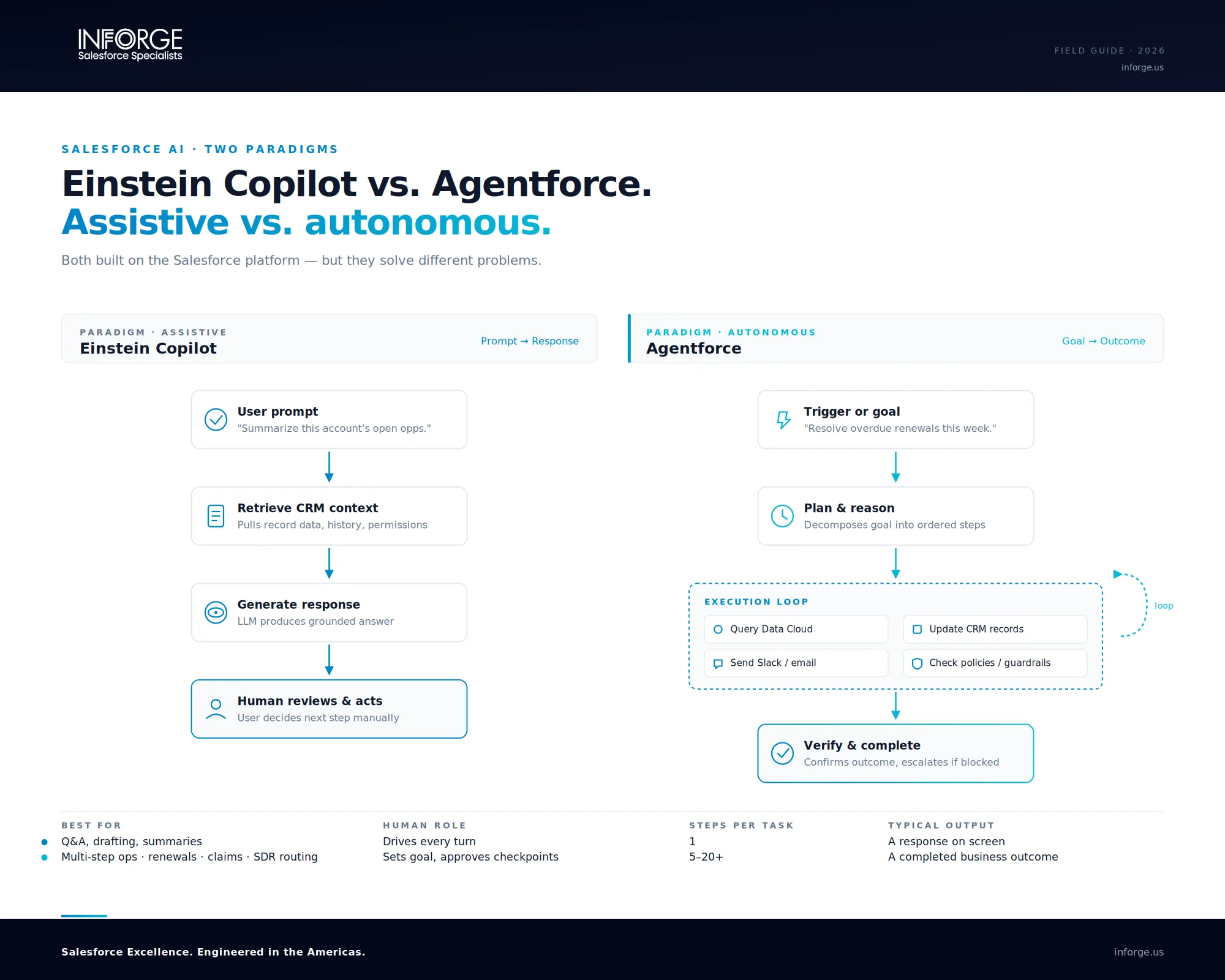
The assistive AI layer (what Copilot was) still exists. It's now sometimes called Agent Studio or branded as Agentforce Assistant. But Agentforce the platform is something architecturally different: an autonomous agent framework where you define topics, actions, and instructions, and agents execute multi-step business processes without waiting for a human to type the next prompt.
Treating Agentforce as "Copilot with a new name" is the fastest way to misarchitect your implementation — and the most common mistake we see.
What Einstein Copilot (Now Agentforce Assistant) Actually Does
Einstein Copilot is Salesforce's AI assistant embedded across Sales Cloud, Service Cloud, and Marketing Cloud. It helps employees work faster by surfacing insights, drafting communications, and recommending next actions based on CRM data.
The interaction model is user-driven: the employee asks, the Copilot responds. A rep asks "Summarize this opportunity" and gets a summary. They ask "Draft a follow-up email" and get a draft. Every action starts with a human prompt.
This is not a limitation — it's by design. Copilot's risk surface is intentionally small. If it gets something wrong, the human catches it before anything happens to the system. According to Salesforce, sales professionals can use it to accelerate deal closures by summarizing records or generating customized communications for more personalized client engagement.
What Copilot-style AI is good for on sales teams:
Record summarization and meeting prep
Drafting outreach emails grounded in CRM data
Next-best action recommendations
Quick data lookups without leaving the workflow
This is where it stops. Copilot does not advance a deal on its own. It does not follow up on a stalled opportunity. It does not route a new lead to the right rep. A human initiates every step.
What Agentforce Autonomous Agents Actually Do
Agentforce autonomous agents are a different architecture entirely. You define the scope, the actions, and the guardrails. Then agents execute — monitoring pipeline health, following up on stalled deals, scheduling meetings, updating opportunity stages, and drafting outreach — without waiting for a rep to ask.
According to the Atlas Reasoning Engine (Agentforce's orchestration layer), an agent receives a request, classifies it against configured topics, selects appropriate actions, reasons through an execution plan, and carries out multi-step workflows. The user does not need to ask follow-up questions or manually chain operations.
A concrete example: in Einstein Copilot, a rep asks "What is the status of deal X?" and gets a summary. To follow up, they type another prompt. To update the stage, another prompt. In Agentforce, the agent detects the deal is stalling, checks the SLA, sees an open renewal opportunity, and takes coordinated action — all autonomously.
As Girikon puts it: "Einstein Copilot made individuals faster. Agentforce affects how much work gets completed overall."
What autonomous agents can handle for sales teams:
Lead qualification based on intent signals, engagement history, and firmographic data
Automatic lead routing to the right rep, territory, or partner — reducing response times
Pipeline monitoring with proactive outreach on stalled deals
Sales sequence progression without manual nudges
Meeting scheduling and CRM record updates without rep intervention
According to Salesforce's own ROI data, AI-driven lead scoring has increased sales team efficiency by 25% in early adopters. Enterprises leveraging pre-built Agentforce workflows report 20% lower total cost of ownership compared to custom-built AI solutions.
The Real Difference: Assisted vs. Autonomous
Here is the mental model that makes the decision clear:
Einstein Copilot / Agentforce Assistant = a highly capable digital colleague. It accelerates the work your reps are already doing. It amplifies individual output.
Agentforce Autonomous Agents = a digital sales operations layer. It completes work that would otherwise require human initiation at every step. It affects total throughput.
For teams handling high volumes — inbound sales, SDR sequencing, campaign-driven leads — the difference shows up in throughput rather than individual efficiency. The bottleneck isn't AI capability. It's that most orgs aren't yet set up to delegate to it.
At Inforge, we've found that the teams who get the most from Agentforce agents are the ones who treat data quality as a prerequisite, not an afterthought. The 77% B2B deployment failure rate isn't a product problem — it's a data problem.
Pricing Reality Check
Agentforce pricing has changed three times since the September 2024 launch. Here is where it stands now:
Flex Credits (consumption-based): $500 for 100,000 credits. Each standard action costs ~20 credits, making each action approximately $0.10. This is the default model for variable usage.
Per-user add-ons: Agentforce add-ons start at $125/user/month for unlimited internal agent usage across Sales, Service, and Field Service.
Agentforce 1 Edition (enterprise): Starts at approximately $550/user/month, bundling the full AI and Data Cloud stack.
What does not appear in the marketing materials: Data Cloud is a mandatory prerequisite for advanced Agentforce functionality. Salesforce partners quote $2,000–$6,000 per agent for setup and training, with timelines of two to five weeks. These costs are real and common.
For teams evaluating budget: by May 2025, only about 8,000 of Salesforce's 150,000+ customers had adopted Agentforce — and price was cited as a major impediment to wider mid-market adoption. Know what you're actually committing to before you sign.
Which Should Your Sales Team Use?
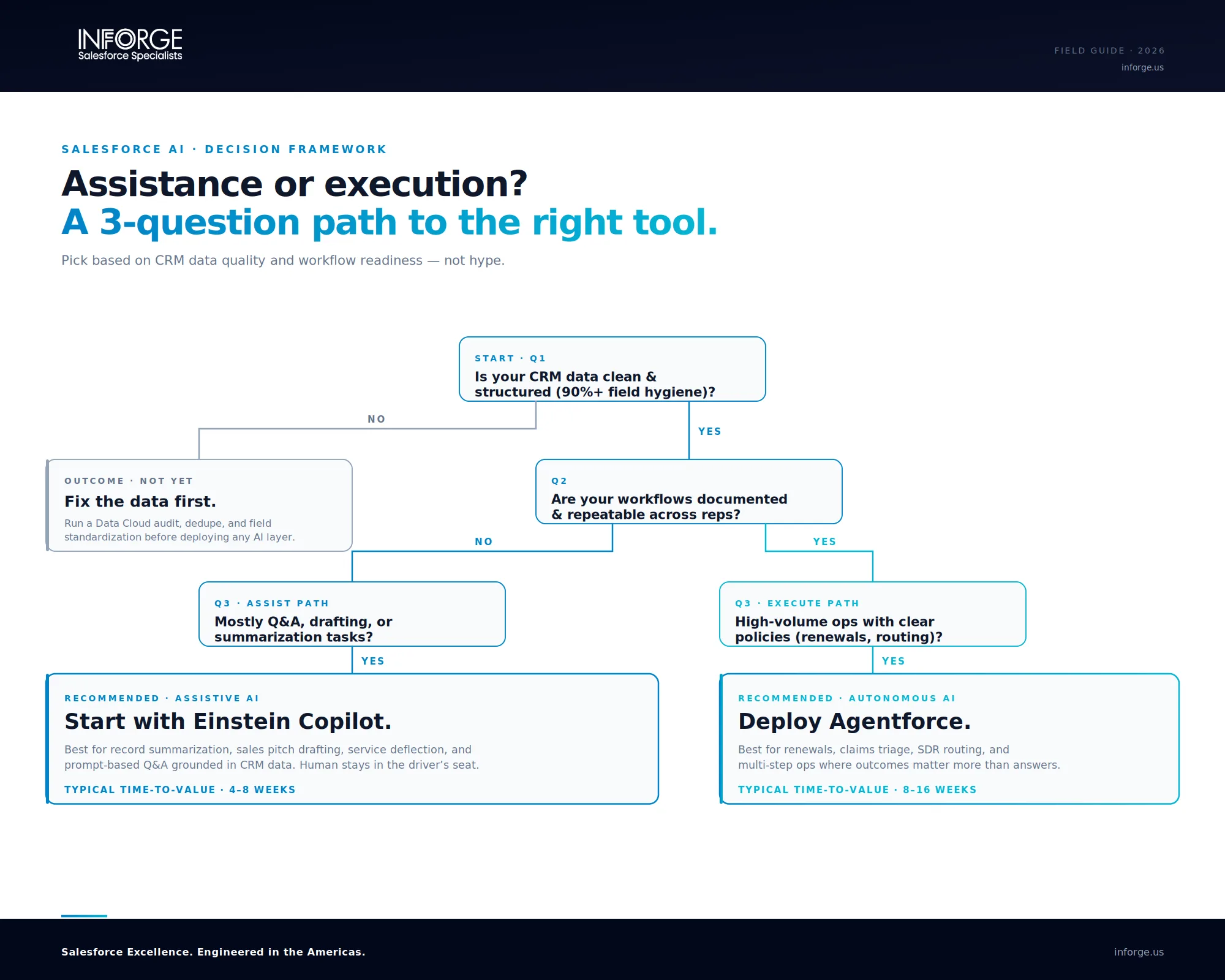
Use Agentforce Assistant (Copilot-style) if:
Your reps want faster task completion inside Salesforce without workflow disruption
Your CRM data quality is inconsistent or partially maintained
You want to start capturing AI value in days, not months
You need low implementation risk with human oversight at every step
Use Agentforce Autonomous Agents if:
You have a well-maintained Salesforce org with clean, consistent data
You have defined, repeatable sales workflows that currently rely on manual handoffs
You have the admin or implementation bandwidth to configure topics, actions, and guardrails
You need throughput gains, not just individual efficiency gains
The best implementations use both: Agentforce Assistant to accelerate rep productivity inside the workflow, and autonomous agents to handle the process layers that slow deals down between human interactions.
Summary
Einstein Copilot and Agentforce aren't two competing products — they're two operating modes of the same AI platform. Copilot-style AI makes your reps faster. Autonomous agents make your process faster. The question your sales team should actually be asking is not which one to pick, but whether your org is ready to delegate — and where the highest-value handoff points are. At Inforge, we help Salesforce-first teams answer that question with implementation that delivers results, not just a new product license.
Frequently Asked Questions
Q: Is Einstein Copilot the same as Agentforce?
A: Partially. Einstein Copilot for Salesforce was renamed to Agentforce in January 2025 with no functionality changes at the time. However, Agentforce the platform includes autonomous agent capabilities that go well beyond what Copilot offered — different architecture, different use cases, different risk profile.
Q: Can Agentforce replace my sales reps?
A: No — and it's not designed to. Agentforce handles the process layers: qualification, routing, follow-up execution, record updates. It removes the administrative friction between human interactions. Reps still own the relationship and the close.
Q: What does Agentforce cost for a sales team of 50 reps?
A: At the $125/user/month add-on tier, that's $6,250/month before Data Cloud costs, implementation services ($2,000–$6,000 per agent), and your base Salesforce license. Budget realistically — the advertised price is the floor, not the ceiling.
Q: Why do so many Agentforce deployments fail?
A: According to multiple implementation data sets, 77% of B2B Agentforce deployments fail due to data quality issues. Agentforce requires clean, consistent CRM data to reason accurately. If your Salesforce org has gaps in contact records, inconsistent opportunity stages, or poor historical data, the agents will produce unreliable outputs. Fix the foundation before deploying autonomous execution.
Q: Should we wait to adopt Agentforce?
A: If your data is clean and your workflows are defined, there is no reason to wait — early adopters are gaining compounding advantages in throughput and pipeline velocity. If your org data is inconsistent, start with Agentforce Assistant (the Copilot-style layer) and use that implementation period to clean your data in parallel.