Salesforce Admin vs Developer vs Consultant: Who Do You Actually Need?
It depends on the problem you're solving, and most companies hire for the wrong one. An admin keeps Salesforce running and adapts it day to day. A developer builds what clicks and configuration can't. A consultant figures out what should be built in the first place. Get the order wrong and you end up with a talented developer writing code for a process nobody designed, or a consultant's roadmap with no one to execute it.
Quick Answer: Hire a Salesforce admin when you need ongoing user support, configuration, reports, and data upkeep. Hire a Salesforce developer when you need custom code, complex integrations, or functionality that declarative tools can't deliver. Bring in a Salesforce consultant when you need to design or redesign processes, plan an implementation, or fix an org that isn't delivering business results. Many growing companies need all three, just not at the same time or at full-time capacity.
Key Takeaways:
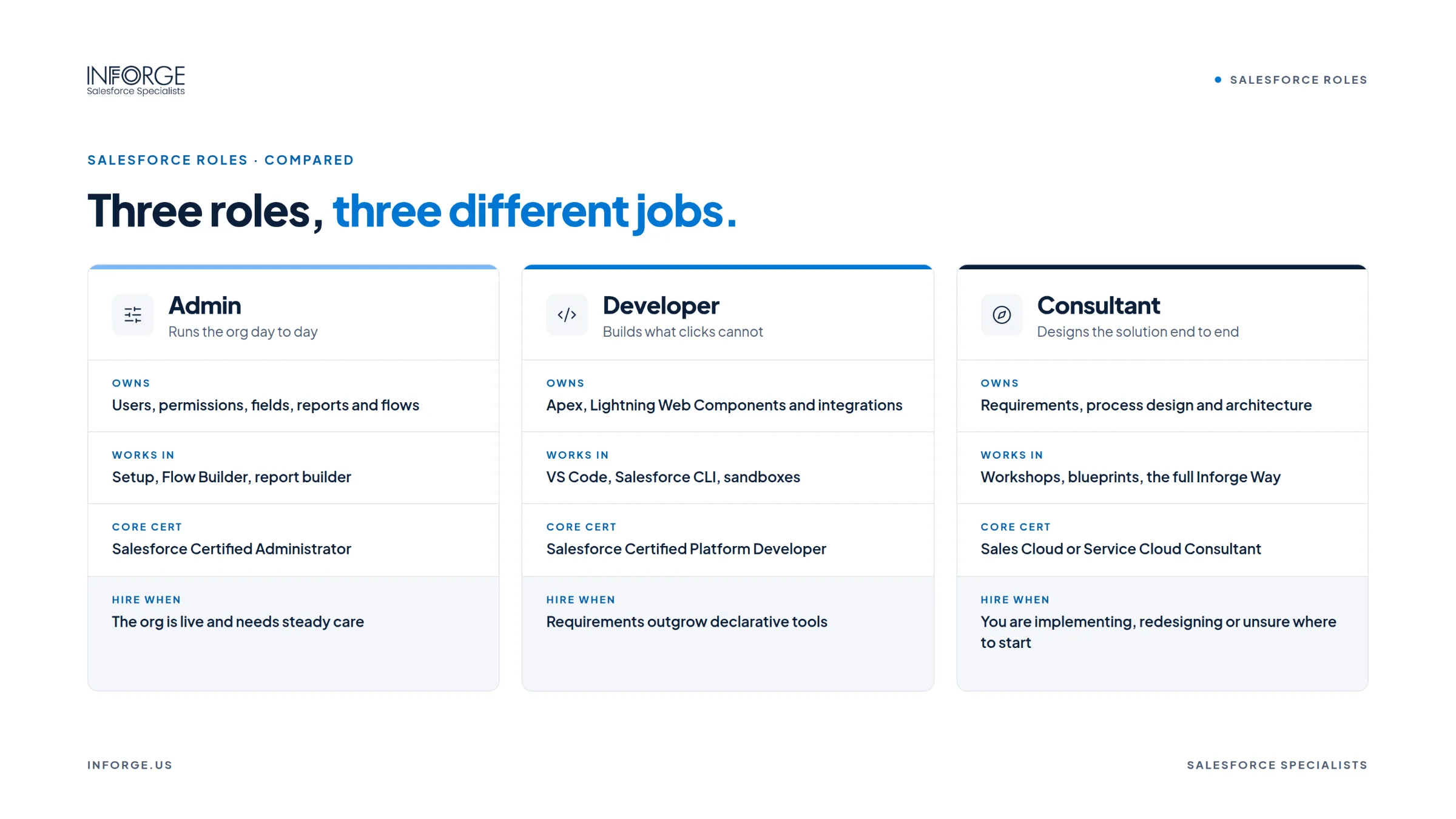
Salesforce admins own the day-to-day health of your org: users, permissions, automation, reports, dashboards, and data quality.
Salesforce developers build custom functionality with Apex, Lightning Web Components, and APIs when out-of-the-box tools hit their limits.
Salesforce consultants translate business goals into system design and lead implementations, optimizations, and recoveries.
US median salaries in SF Ben's 2026 data run from $78,000 for a junior admin to $140,000 for a senior developer, before benefits, recruiting, and ramp time.
Most mid-market companies don't need three full-time hires. A flexible, blended team often covers all three roles at a fraction of the cost.
Why This Decision Matters More Than It Looks
Salesforce is one of the most flexible business platforms on the market. That flexibility is also the trap. Almost anything can be built, which means the hard part isn't building. It's deciding what to build, who should build it, and who keeps it running afterward.
When companies get the role wrong, the symptoms are predictable:
A developer is hired to "fix Salesforce" and writes custom code for problems that a well-designed Flow would have solved, creating technical debt nobody else can maintain.
An admin is asked to lead a full implementation and spends months learning architecture on the job while the business waits.
A consultant delivers a solid design, the engagement ends, and no one internally has the skills or time to keep the org evolving.
The cost of these mistakes isn't just salary. It's adoption, data quality, and the months of momentum lost while the wrong person tries to do the wrong job.
What a Salesforce Admin Does
The admin is the owner of your org's day-to-day health. If Salesforce were a building, the admin is the facilities manager who keeps the lights on, adjusts the floor plan as teams change, and makes sure everyone has the right keys.
Typical admin responsibilities:
User management, profiles, permission sets, and security settings
Building and maintaining automation with Flow
Creating reports and dashboards for sales, service, and leadership
Data quality, imports, deduplication, and field hygiene
Managing Salesforce's three annual releases and testing what changes
Training users and fielding daily support requests
You need an admin when: your team is already live on Salesforce, users have frequent requests, reports are out of date, data quality is slipping, or no one clearly owns the system.
What a Salesforce Developer Does
Developers extend Salesforce beyond what configuration can deliver. They work in code (Apex, Lightning Web Components, SOQL) and with APIs to build custom functionality and connect Salesforce to the rest of your tech stack.
Typical developer responsibilities:
Custom Apex logic for complex business rules
Lightning Web Components for custom user interfaces
Integrations with ERPs, billing systems, data warehouses, and third-party apps
Data migrations and large-volume data processing
Code reviews, testing, deployment pipelines, and DevOps
Performance tuning and resolving governor limit issues
You need a developer when: you've hit the limits of declarative tools, you need Salesforce to talk to other systems in real time, or you're building something truly custom like a partner portal or a specialized calculation engine.
What a Salesforce Consultant Does
Consultants sit between the business and the technology. Their job is to understand what the business is trying to accomplish and design how Salesforce should support it. Some are functional (focused on process and requirements), some are technical (focused on architecture and solution design), and the best can do both.
Typical consultant responsibilities:
Discovery workshops and requirements gathering with stakeholders
Process mapping and solution design
Implementation planning, scoping, and project leadership
Org health checks and optimization roadmaps
Recovering stalled or failed implementations
Advising on which Salesforce clouds, add-ons, and AI features actually fit
You need a consultant when: you're implementing Salesforce for the first time, adding a new cloud, redesigning your sales or service process, or your org is live but not delivering the results the business expected.
Salary figures are median base pay from SF Ben's 2026 Salesforce salary data. Fully loaded cost, including benefits, payroll taxes, recruiting, and ramp time, is typically well above base salary.
How to Decide: Match the Role to the Problem
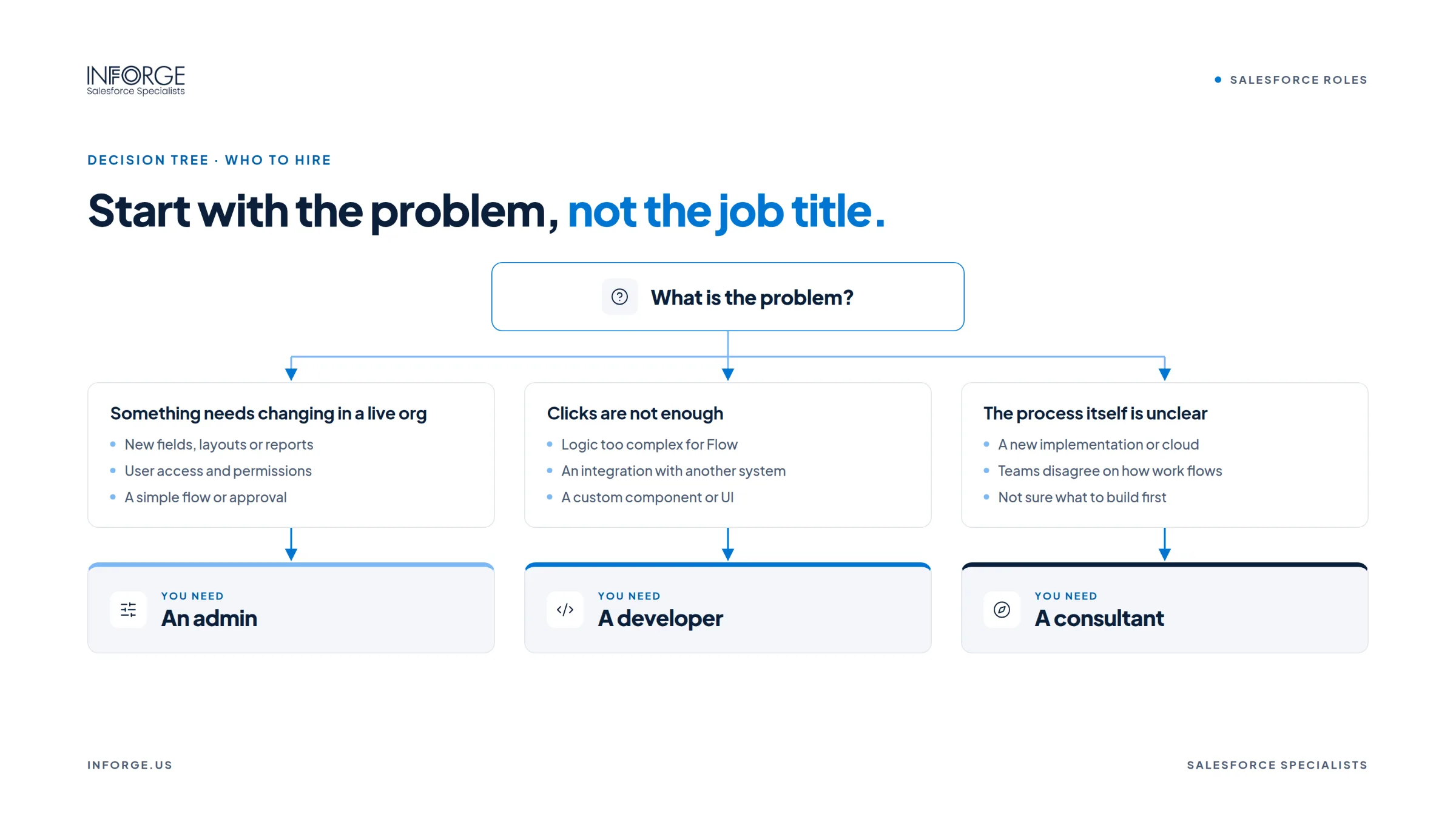
The simplest way to choose is to start with the problem, not the job title.
"We don't know how Salesforce should work for us." Start with a consultant. Design comes before build.
"We know what we want, but Salesforce can't do it out of the box." You need a developer, ideally guided by a consultant's design.
"Salesforce works, but nobody owns it and requests pile up." You need an admin.
"Our implementation stalled or users won't adopt it." Start with a consultant to diagnose, then add admin and developer capacity to execute the fix.
"We're growing fast and need all of the above." You need a blended team, which rarely means three full-time hires.
The Case for a Blended Team
Here's what most companies discover after their first year on Salesforce: the work doesn't come in neat full-time buckets. You might need 60 hours of admin work a month, a two-week developer sprint for an integration, and a consultant for a quarterly roadmap review.
Hiring three full-time employees for that workload is expensive and hard to justify. Using SF Ben's 2026 medians, one mid-level admin, one mid-level developer, and one mid-level consultant add up to roughly $321,500 in base salary alone, before benefits, recruiting fees, and the months it takes to find and ramp each person.
That's why more mid-market companies are moving to flexible models: a dedicated admin supported by on-demand developer and consultant capacity, or a fully managed team that scales up and down with the roadmap. Nearshore teams in Latin America add another advantage for US companies: real-time collaboration in overlapping time zones, at a lower cost than equivalent US-based talent.
At Inforge, we've found that the companies getting the most out of Salesforce aren't the ones with the biggest internal teams. They're the ones that match the right skill to each problem, and have someone accountable for keeping the org healthy between projects.
Summary
Admins run your org, developers extend it, and consultants design what it should become. The right hire depends on the problem in front of you: no clear design means a consultant, custom requirements mean a developer, and ongoing ownership means an admin. With US median salaries ranging from $78,000 to $140,000 per role, most growing companies are better served by a blended team that brings in each skill set when it's needed rather than three full-time hires.
Inforge provides nearshore Salesforce admins, developers, and consultants from Latin America to US companies, working in your time zone as an extension of your team.
Frequently Asked Questions
Q: What's the difference between a Salesforce admin and a Salesforce developer?
A: Admins configure and maintain Salesforce using declarative tools like Flow, reports, and permission settings. Developers write code (Apex and Lightning Web Components) and build integrations when configuration alone can't meet the requirement. Most orgs need admin work continuously and developer work in bursts.
Q: Do I need a Salesforce consultant if I already have an admin?
A: Often, yes, especially for new implementations, new clouds, or major process changes. Admins keep the system running; consultants design how the system should support the business. A consultant can also give an existing admin a clear roadmap to execute.
Q: How much does it cost to hire a Salesforce admin, developer, or consultant?
A: According to SF Ben's 2026 salary data, US median base salaries range from $78,000 to $109,000 for admins, $94,500 to $140,000 for developers, and $75,000 to $126,000 for functional consultants depending on seniority. Fully loaded costs are higher once benefits, taxes, and recruiting are included.
Q: Can one person be an admin, developer, and consultant?
A: Some experienced professionals cover more than one role, and small orgs sometimes rely on a single "accidental admin" who does a bit of everything. But depth matters. As complexity grows, one person stretched across all three roles usually becomes a bottleneck.
Q: Should I hire in house or outsource Salesforce roles?
A: It depends on volume and consistency of work. Companies with steady daily demand often keep an in-house or dedicated admin, while developer and consultant needs are frequently project based and well suited to a partner. Nearshore teams give US companies time zone alignment with lower costs than domestic hiring.
Sources used (for fact checking, not for publishing): SF Ben, Average Salesforce Salaries 2026