Sales Cloud vs Service Cloud: Which Should You Implement First?
The question comes up in almost every Salesforce evaluation. You're about to invest in the platform — but should you start with Sales Cloud to fix the pipeline, or Service Cloud to fix the support experience? Both matter. Both cost money. And deploying them simultaneously without a clear plan is one of the most common ways a Salesforce rollout fails before it even starts.
The answer isn't universal. It depends on where your organization is bleeding most — and which problem, if left unsolved, limits everything else.
Quick Answer: If your biggest challenge is generating, converting, or forecasting revenue, implement Sales Cloud first. If your biggest challenge is retaining customers and resolving cases at scale, implement Service Cloud first. If both are broken, start with the one tied to your primary revenue model — then phase in the second.
Key Takeaways:
Sales Cloud and Service Cloud are licensed separately and solve fundamentally different problems — Sales Cloud acquires customers, Service Cloud retains them.
The right implementation sequence is determined by your primary revenue motion, not your product preference.
Deploying both simultaneously without a phased plan dramatically increases your risk of failure.
A structured, phased rollout is the lowest-risk path — start with the highest-impact product, stabilize, then expand.
At Inforge, we sequence Salesforce implementations based on where the constraint actually lives — not where the loudest stakeholder is pointing.
What Sales Cloud and Service Cloud Actually Do
Sales Cloud and Service Cloud are both built on the core Salesforce platform, sharing foundational objects like accounts and contacts — but their core tools serve entirely different purposes.
Sales Cloud is built for revenue generation. It manages the pre-sale journey: leads, opportunities, pipeline stages, territory management, forecasting, and deal closure. Sales reps and account executives live here. The primary metrics it's designed to move are pipeline coverage, conversion rate, quota attainment, and forecast accuracy.
Service Cloud is built for retention. It manages the post-sale relationship: cases, knowledge bases, SLA compliance, omnichannel routing (phone, email, chat, social), and support agent efficiency. Service managers and support teams operate here. The metrics it moves are CSAT, first-contact resolution rate, average handle time, and SLA compliance.
The simplest way to frame it: Sales Cloud helps businesses acquire customers. Service Cloud helps businesses retain them.
They are not interchangeable. [INTERNAL LINK: anchor — "Salesforce product licensing guide", topic — Salesforce edition and licensing overview]
The Decision Framework: Where Is the Constraint?
Most organizations don't need a product comparison. They need a constraint analysis.
The right question isn't "which cloud is better?" It's: "What failure mode most limits our revenue right now?"
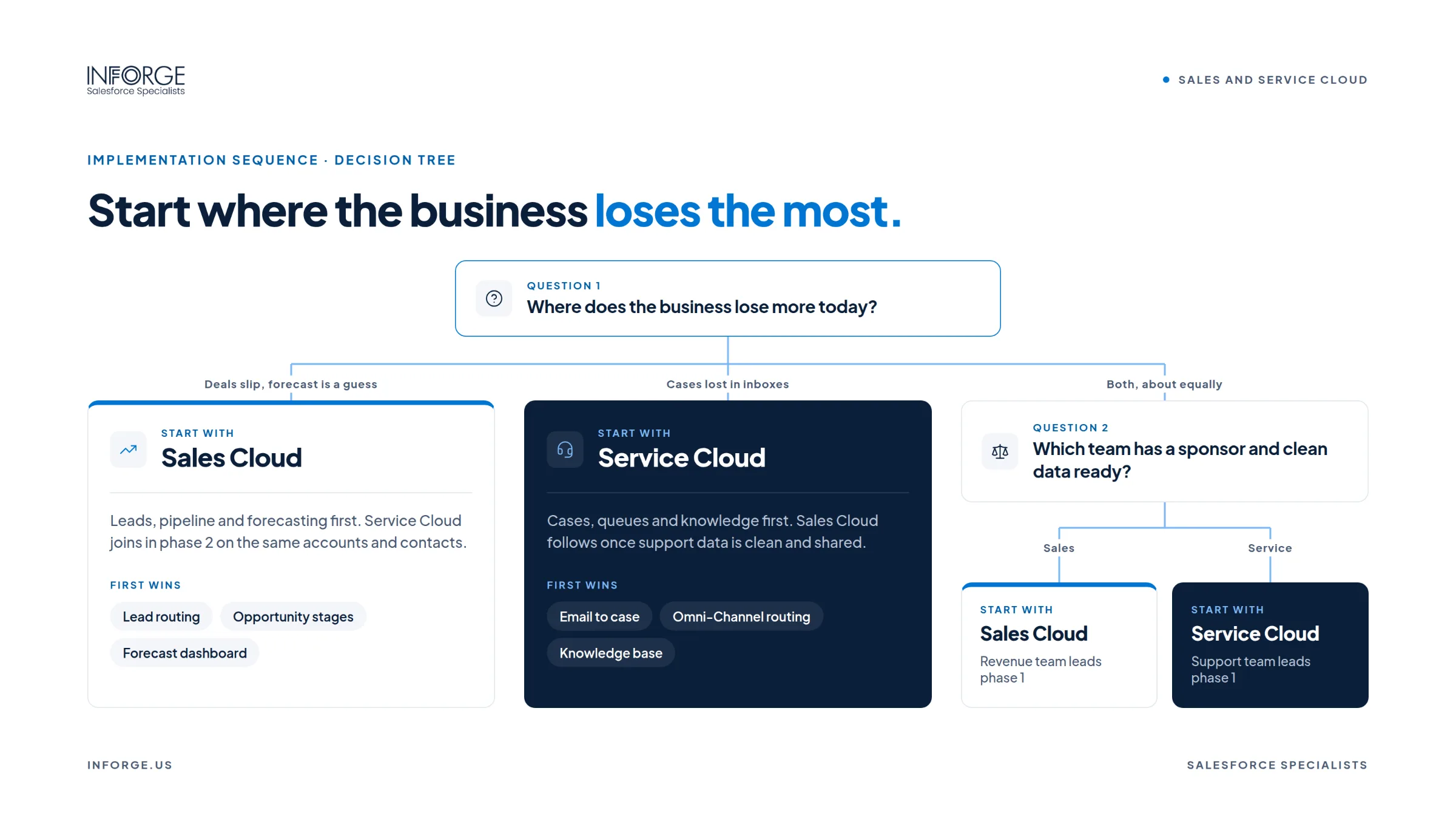
Use this framework to identify where to start:
Implement Sales Cloud First When:
Leads are getting lost or follow-up is inconsistent across reps
Pipeline stages vary by rep or team, and leadership can't trust forecasts
You have a defined sales team still managing prospects in spreadsheets or a legacy CRM
Your customer journey is primarily pre-sale — from lead to closed-won
Your primary metrics are pipeline coverage, conversion rate, and quota attainment
You're a new Salesforce customer and need the highest-impact immediate investment
For B2B companies with complex sales cycles, Sales Cloud is typically the right first move. The revenue engine needs to be functional before you optimize retention.
Implement Service Cloud First When:
Cases are managed in shared inboxes, spreadsheets, or an outdated ticketing system
Response times and SLAs are inconsistent or unmeasured
Your primary business challenge is customer retention and support quality
Your customer base is established, and retention drives more growth than new acquisition
Your primary metrics are CSAT, first-contact resolution, case volume, and SLA compliance
Your post-sale experience is creating churn that outpaces new sales
For e-commerce, SaaS, and high-volume support businesses, Service Cloud often needs to come first. Acquiring customers into a broken retention engine is expensive.
When to Phase Both:
Sales and service handoffs are broken — deals close but support has no context
You're a high-growth company scaling both acquisition and retention simultaneously
You operate in sectors like retail, telecommunications, or financial services with both high sales volume and high customer interaction demands
In these cases, the right move is still to start with one product — the one tied to your primary revenue motion — and phase in the second once the first is stable. Deploying both simultaneously without a phased plan is how implementations fail.
Why Sequencing Matters More Than Product Selection
Here's the uncomfortable reality: the product choice is secondary. The sequencing decision is where most organizations get hurt.
According to research from Johnny Grow (2025), 55% of CRM implementations fail to meet their planned objectives — and only 10% of those failures are technology-related. The primary culprits are people, process, and planning failures.
Organizations that try to deploy both Sales Cloud and Service Cloud simultaneously without a clear phased roadmap are attempting to change too many workflows, train too many user groups, and manage too many configuration decisions at once. The result is delays, budget overruns, and low adoption across both teams.
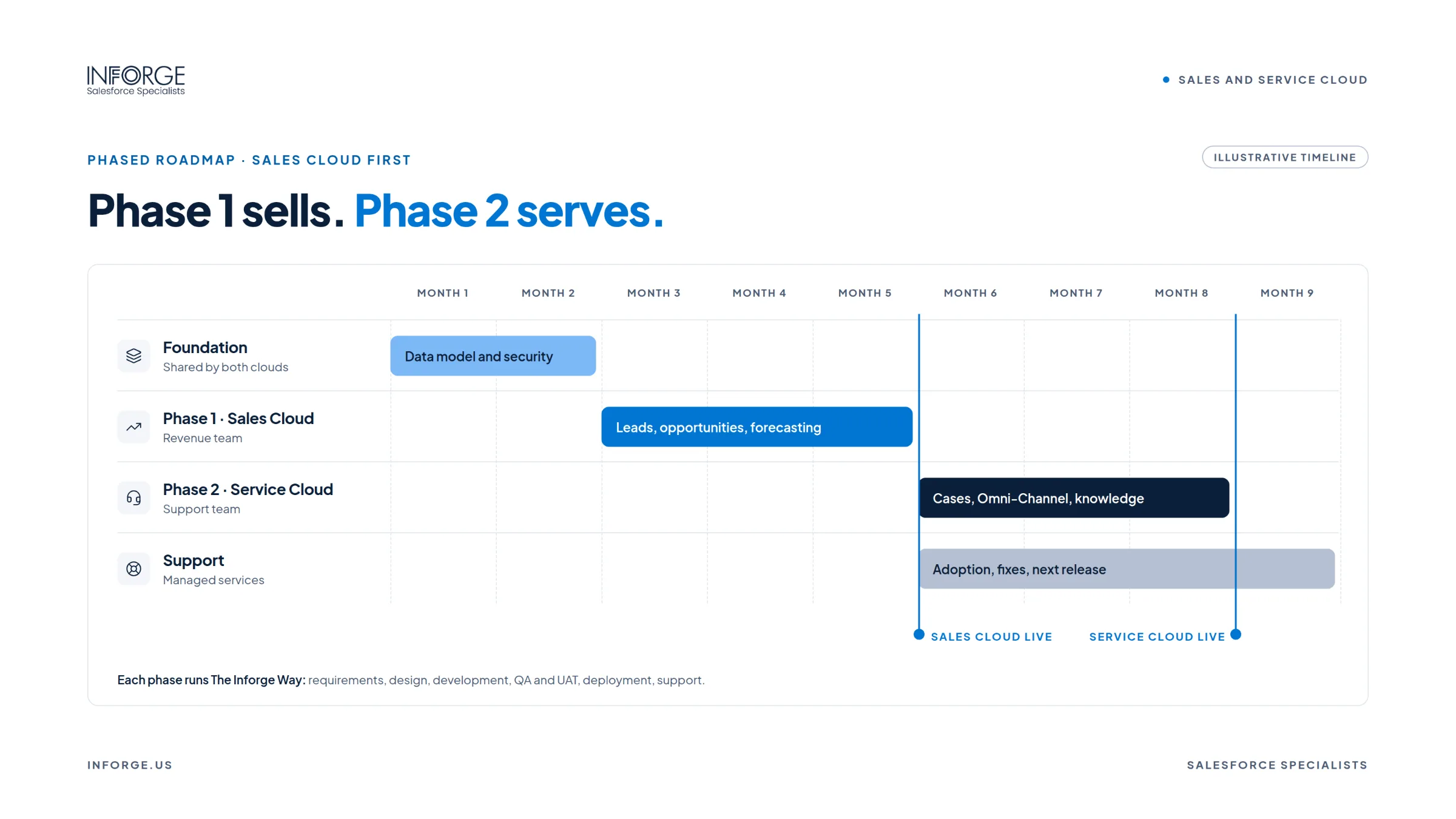
A phased rollout — starting with the product that addresses the most acute pain, stabilizing it, then expanding — is the lower-risk path. This isn't a conservative approach. It's how you actually get both products adopted.
According to Salesforce internal studies, companies using Sales Cloud realize up to 29% higher sales productivity through simplified and automated processes. That ROI only materializes when the implementation is clean, adopted, and stable — not when it's competing with a simultaneous Service Cloud rollout for admin bandwidth, stakeholder attention, and budget.
What Gets Shared Across Both Clouds
One reason organizations consider deploying both simultaneously is the shared data model. Accounts, contacts, and basic case management exist in both products — and the value of a 360-degree customer view is real.
But here's what's actually true: Sales Cloud includes basic case management functionality, while Service Cloud includes much of the Sales Cloud functionality — though not all of it, particularly around lead management. The shared foundation means you're not starting from zero when you add the second cloud. Your data model, user permissions, and account hierarchy carry over.
This is actually an argument *for* phasing — not against it. Build the right data model in Phase 1. When you add the second cloud, you're extending a stable foundation rather than retrofitting a messy one.
Salesforce also offers a combined Sales+Service Cloud package for organizations that know from the outset they need both. This can be cost-effective for organizations with clear use cases across both functions — but it doesn't eliminate the need to phase the configuration and adoption of each product's distinct features.
The Inforge Approach: Constraint-First, Not Feature-First
At Inforge, we've found that the organizations most likely to succeed with Salesforce are the ones that start by identifying the constraint — not by evaluating feature sets.
The conversation we have before any implementation starts isn't "Sales Cloud or Service Cloud?" It's: *Where is your revenue motion breaking down, and what does success look like in 90 days?*
For revenue-first organizations — those where new customer acquisition drives growth — Sales Cloud almost always comes first. For retention-first organizations — those where expansion revenue and churn prevention are the primary levers — Service Cloud comes first.
The sequencing decision shapes everything: who gets trained first, which integrations get prioritized, what data gets migrated, and what KPIs the business uses to evaluate whether the implementation worked.
Getting this decision right at the start — rather than reversing course 6 months in — is the difference between a Salesforce investment that compounds and one that stalls.
Summary
Sales Cloud and Service Cloud are not competitors. They're sequential investments in different parts of your customer lifecycle — one focused on acquisition, one on retention. The right implementation order depends on where your organization's constraint actually lives. For most B2B and revenue-first businesses, Sales Cloud comes first. For high-volume support businesses and retention-first models, Service Cloud takes priority. In either case, phase the implementation — don't try to do both at once. At Inforge, we help mid-market organizations make this sequencing decision with precision and implement whichever cloud comes first without the delays, budget overruns, and adoption failures that derail most projects.
Frequently Asked Questions
Q: Can I use Service Cloud without Sales Cloud?
A: Yes. Service Cloud is licensed separately from Sales Cloud and can be implemented as a standalone product. Many organizations — particularly those with an established customer base and mature acquisition channels — deploy Service Cloud first or exclusively. The two products share foundational Salesforce objects, so adding Sales Cloud later is straightforward.
Q: Does Service Cloud include Sales Cloud features?
A: Service Cloud includes much of the Sales Cloud functionality, but not all of it. Notably, full lead management, opportunity tracking, sales forecasting, and territory management are Sales Cloud-specific features. If your team needs to run a full sales pipeline, Sales Cloud (or the combined Sales+Service package) is required.
Q: What if we need both? Should we buy Sales+Service Cloud together?
A: Salesforce offers a combined Sales+Service Cloud package that costs more than buying each separately but gives both teams access to shared customer data from day one. If you know you need both, this package is worth evaluating. However, even with the combined package, phase your configuration and adoption — don't try to go live with full Sales and Service functionality simultaneously.
Q: How long does a Sales Cloud or Service Cloud implementation take?
A: For a mid-market organization with a defined scope, a Sales Cloud implementation typically runs 6–12 weeks for a clean Phase 1. Service Cloud timelines are similar but can extend based on omnichannel configuration complexity and knowledge base setup. At Inforge, our AI-agent delivery model compresses these timelines significantly — without sacrificing quality.
Q: What's the biggest mistake companies make when choosing between Sales Cloud and Service Cloud?
A: Choosing based on features rather than constraints. The product with the better feature list for your use case isn't the right starting point — the product that solves your most acute operational bottleneck is. Most failed implementations start with the wrong question.