Nearshore Salesforce Development: Why US Companies Are Hiring LATAM Talent
US companies hiring LATAM Salesforce talent are not chasing a trend — they are solving a specific, structural problem: the roles that actually move Salesforce projects forward are expensive, slow to fill, and increasingly scarce in the domestic market. Nearshore development from Latin America addresses all three constraints at once, without the timezone friction that makes offshore delivery difficult to manage.
At Inforge, we work inside Salesforce orgs every day. We see firsthand where delivery stalls — and more often than not, the bottleneck is not strategy, budget, or platform capability. It is the right senior talent, available at a rate the project can support.
Key Takeaways:
US Salesforce roles took several months on average to fill in the second half of 2025, with over 31,000 job postings on Glassdoor alone — yet senior roles remain extremely difficult to source domestically.
Technical Architect demand grew 27% in 2025 while supply grew just 4%, creating the widest supply-demand gap across all Salesforce roles.
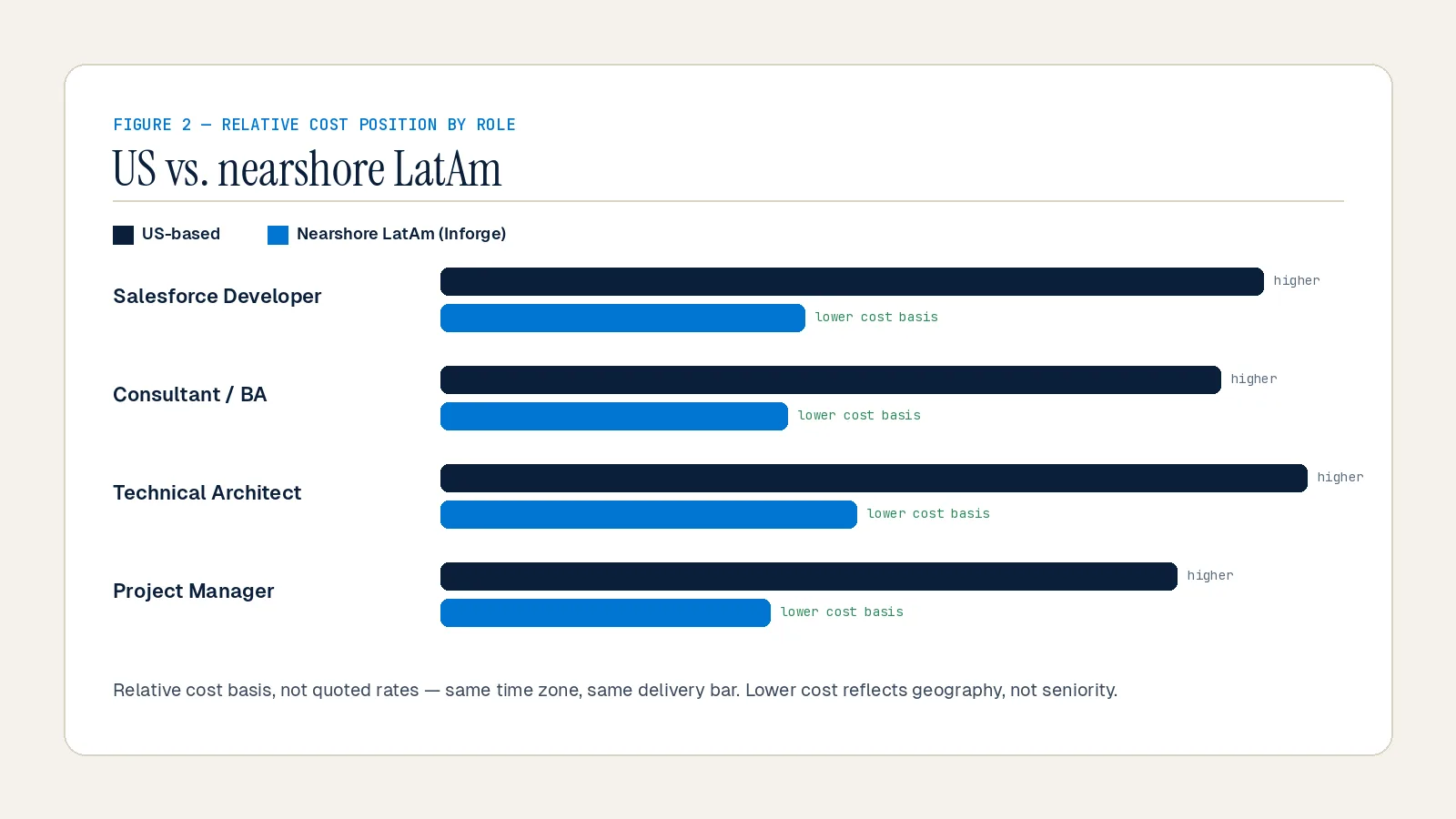
LATAM Salesforce developers cost 40–65% less than US equivalents, with full timezone overlap and strong English proficiency — no quality compromise required.
Nearshoring is not the same as offshoring. Time zone alignment, cultural compatibility, and real-time collaboration make LATAM a fundamentally different model.
The shift is structural. 37% of organizations expanded remote staffing in 2025–2026, and LATAM is increasingly the destination of choice for Salesforce-specific work.
The Salesforce Talent Market Is Not Broken — It Is Bifurcated
The Salesforce job market in 2025 is not a simple shortage story. The reality is more precise: the entry-level market is oversaturated, while senior and architect-level talent remains genuinely scarce.
According to 10K Consulting's 2025 Talent Ecosystem Report (via Salesforce Ben), global Salesforce supply grew 27% year-over-year while demand grew just 8% — meaning the market is running at over 330% saturation, with supply currently 3.4 times the available demand. That sounds like an abundance of talent. But the numbers break down sharply by role.
Technical Architects — the professionals who govern complex Salesforce orgs, design integrations, and prevent technical debt — represent just 1% of the global talent pool. Demand for that role grew 27% in 2025. Supply grew 4%. According to 10K Consulting, that is the widest supply-demand gap across all Salesforce roles, and it compounds each year because the pipeline to become a Certified Technical Architect takes five or more years to mature.
Solution Architect demand grew 21%. CPQ, Data Cloud, and Agentforce specialists are the fastest-growing high-value categories heading into 2026. These are the roles that determine whether a Salesforce project delivers ROI — and they are not found by posting on Glassdoor and waiting.
According to Focus on Force, US Salesforce roles took several months on average to fill in the second half of 2025, even with over 31,000 job postings active on Glassdoor alone. When specialized talent does exist domestically, the rate card is the next problem.
The Rate Problem Is Not Negotiable in the US Market
US Salesforce salaries are not just high — they are high at every level.
According to Glassdoor Q4 2025 data (via Focus on Force), US Salesforce Developers earn a median of roughly $127,000 per year. Architects average around $141,000. MuleSoft Developers earn approximately $138,000. Salesforce DevOps Architects command around $180,000 annually. Once payroll taxes, benefits, and overhead are added, fully loaded annual costs for senior talent can clear $160,000 to $200,000 per hire.
For mid-market companies running Salesforce implementations against fixed project budgets, that math does not work. They either delay the project, hire junior talent that cannot handle the scope, or find a different sourcing model.
Nearshore Salesforce development from LATAM is that different model.
According to verified 2025 payroll data from Howdy.com — covering over 12,500 developers across seven LATAM countries — companies nearshoring to Latin America save 60–65% on comparable talent without sacrificing quality or time zone alignment. According to Awana's 2025 LATAM Compensation Report, companies hiring LATAM tech talent achieve an average of 41% in cost savings.
For Salesforce-specific roles, Tecla reports that Salesforce developers in Latin America earn between $60,000 and $100,000 per year — roughly 40–60% below US equivalents for comparable seniority. The savings hold at every level, not just at the junior end.
Why LATAM Specifically — Not Just Any Offshore Market
The cost savings are real, but they are not the primary reason serious organizations choose LATAM over India or Eastern Europe for Salesforce work. The primary reason is operational compatibility.
Time zone overlap. LATAM engineers operate within 0–3 hours of US Eastern time depending on the country. That means live code reviews, daily standups, same-day feedback loops, and no asynchronous lag on decisions that could stall a sprint. According to Folder IT, unlike offshore outsourcing to regions like Asia or Eastern Europe, nearshore outsourcing to LATAM ensures minimal time zone differences, allowing for real-time collaboration and easier project management.
English proficiency and cultural alignment. Mexico, Colombia, Chile, Argentina, and Brazil all produce large numbers of bilingual professionals accustomed to working in US business environments. According to Tecla, all LATAM Salesforce experts in their network are fluent in English. Developers who grew up building for global markets bring cultural fluency, not just language fluency — meaning communication friction is low from day one.
Senior talent depth. LATAM is not a junior-only talent market. The region includes Salesforce Technical Architects, Solution Architects, MuleSoft specialists, and Marketing Cloud developers with multi-year enterprise implementation experience. According to 10K Consulting, emerging markets — which include LATAM — saw a 28% increase in Technical Architect supply in 2025, while established North American markets saw just 2% growth. The senior talent pipeline is building in LATAM faster than it is domestically.
Retention stability. According to Talently, LATAM Salesforce professionals value long-term partnerships and demonstrate higher engagement and retention than typical offshore hires. In a talent segment where institutional knowledge matters — because every Salesforce org is unique — retention is not a soft benefit. It is a delivery risk variable.
What Roles Make the Most Sense for LATAM Nearshoring
Not every Salesforce role belongs in a nearshore model. The strongest case is for roles where the US talent gap is sharpest and the cost delta is largest.
Technical and Solution Architects
According to 360 Degree Cloud's 2026 Salesforce Staffing Trends report, Technical Architects and Solution Architects top the list of hardest-to-fill Salesforce roles. CPQ and Revenue Cloud specialists are a close behind. With demand for TAs up 27% and supply growing just 4%, these professionals command premium rates in the US market. LATAM has certified TAs with enterprise implementation experience — at materially lower rates — and the time zone alignment makes real-time architecture governance practical.
Salesforce Developers with Specialty Stack Knowledge
Apex developers who also carry Data Cloud, MuleSoft, Marketing Cloud, or Agentforce experience are increasingly rare domestically. According to 360 Degree Cloud, Data Cloud architects and AI integration consultants represent the fastest-growing demand area in 2026. LATAM's developer community has been building these skills, with the region's IT market projected to reach $27.5 billion in 2026.
CRM Customization and Integration Teams
For companies running ongoing CRM customization work — building integrations, automating enrichment workflows, extending Sales or Service Cloud — a dedicated nearshore team provides continuity that a rotating cast of US contractors cannot. According to Fast Dolphin, a nearshore Salesforce team from LATAM is not a workaround or a compromise on quality — it is a staffing model calibrated for exactly the gap between what US-only sourcing can deliver and what the project actually needs.
How Nearshoring Actually Works in Practice
A nearshore Salesforce engagement is not outsourcing in the traditional sense. The client retains full operational control. The team works on the client's sprint cadence, attends standups, and communicates in real time. The difference from a US hire is geographic — not structural.
Engagement models vary. Staff augmentation embeds LATAM developers directly into an existing team — most appropriate when a US team needs capacity or a specific skill set for a defined scope. Dedicated nearshore teams are fully managed project units — typically scrum-led — that operate alongside internal resources. This model suits companies running multi-phase Salesforce roadmaps without the headcount to staff them domestically.
On the compliance side, a nearshore staffing partner or Employer of Record handles local payroll, taxes, and statutory benefits in each LATAM country. The US client receives a single invoice and carries no employer-of-record exposure. That removes the legal and administrative burden that historically made international hiring inaccessible to mid-market teams.
According to the 10K Consulting 2025 Ecosystem Report, the number of Salesforce partner firms grew 25% year-over-year in 2025 — the fastest expansion in half a decade — with emerging markets driving a significant share of new partner growth. The infrastructure to find, vet, and engage LATAM Salesforce talent is more mature now than it has ever been.
What to Vet Before You Hire Nearshore
The case for LATAM is strong. The execution risk is real if vetting is shallow.
Mat Roche, founder of Third Republic, told Salesforce Ben: "LATAM hiring does come with risk. The vetting and management of these hires needs to be done to a higher level than general US hiring because the spectrum of talent is broader."
That is accurate. The same region that produces certified Technical Architects also has a large pool of entry-level professionals with limited project experience. Rigorous vetting on three dimensions separates a successful nearshore engagement from a failed one:
1. Technical depth: Certifications are the floor, not the ceiling. The hire that matters has live Salesforce project experience in the specific cloud or capability area your org requires. A Platform Developer I cert does not qualify someone to architect a Data Cloud integration.
2. Communication quality: English proficiency should be assessed in a working context, not just a language test. Can the candidate run a requirements session? Walk through an architecture decision? Communicate blockers clearly without prompting?
3. Time zone commitment: Confirm that the candidate works standard overlap hours, not split-shift workarounds. Full overlap means full collaboration — anything less reintroduces the friction that makes offshore models frustrating.
Summary
US companies are hiring LATAM Salesforce talent because the domestic market has a structural problem at the senior level — demand for architects and senior specialists is outpacing supply, and the rate card for those roles exceeds what most mid-market project budgets can absorb. LATAM solves the cost equation without the timezone and communication trade-offs that make offshore models difficult to operate. The region's senior talent pool is growing faster than North America's for architect-level roles, and the infrastructure to engage it compliantly has matured significantly.
At Inforge, we have built our entire delivery model around precision — getting the right expertise into the right implementation at the right stage. Whether that means AI-assisted delivery, nearshore talent integration, or architectural oversight on a stalled org, the answer starts with understanding exactly what the project actually needs. That is how we operate, every day.
Frequently Asked Questions
Q: What is nearshore Salesforce development?
A: Nearshore Salesforce development means engaging Salesforce-certified professionals based in nearby countries — typically in Latin America — who work in the same or adjacent time zones as your US team. Unlike offshore models, nearshoring provides real-time collaboration, high English proficiency, and cultural compatibility alongside the cost savings of international hiring.
Q: How much can US companies save by hiring LATAM Salesforce developers?
A: Cost savings range from 40% to 65% compared to US-based equivalents, depending on role seniority and the specific LATAM market. Salesforce developers in Latin America typically earn $60,000–$100,000 per year, compared to a US median of roughly $127,000 for equivalent developer roles — before adding fully loaded employer costs.
Q: Which LATAM countries have the strongest Salesforce talent pools?
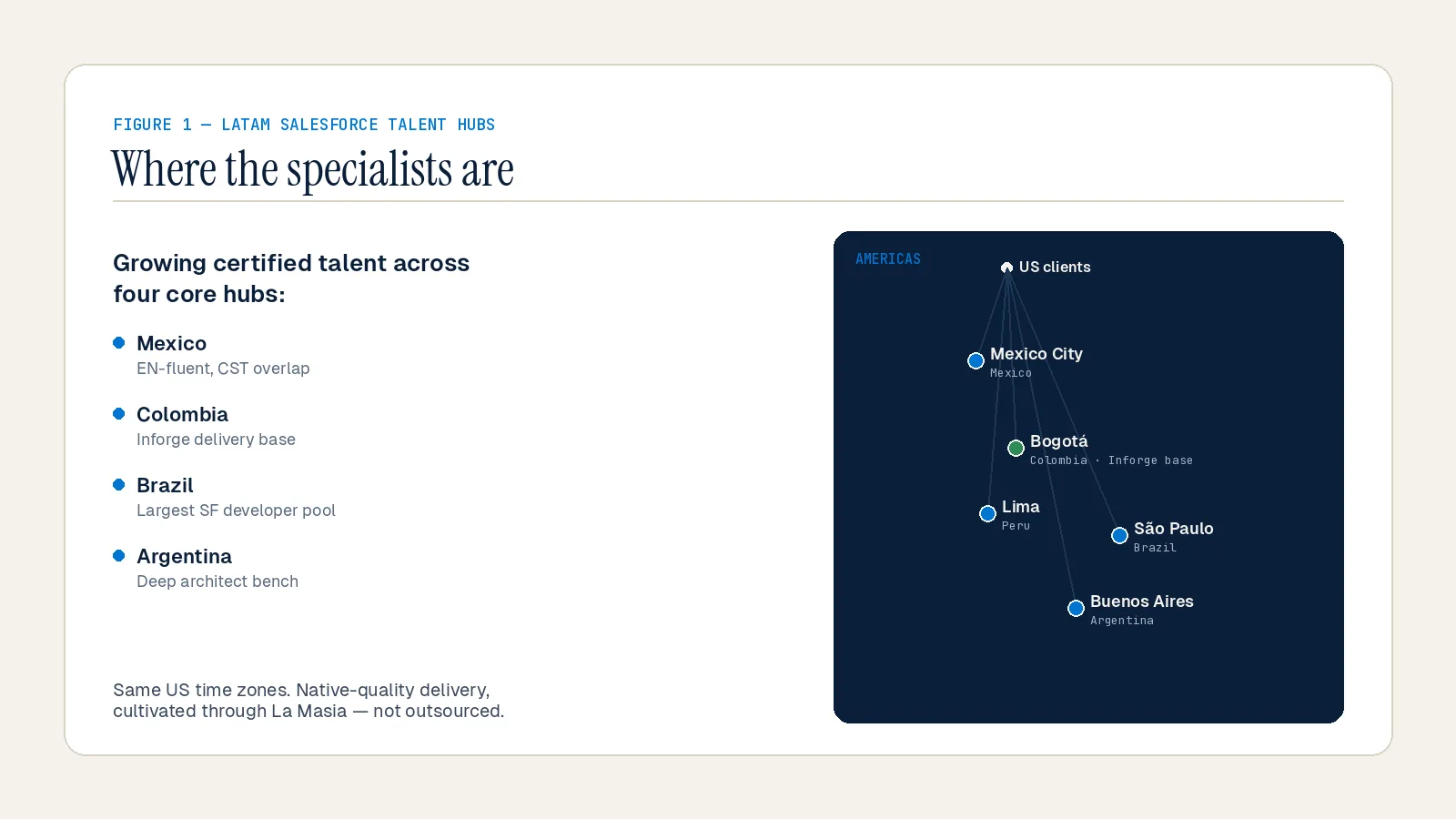
A: Mexico, Colombia, Brazil, and Argentina are the leading markets for Salesforce talent in LATAM. Mexico offers the strongest US West Coast time zone alignment and the largest developer base. Colombia and Argentina provide strong English proficiency and deep enterprise implementation experience. Brazil has the largest raw talent pool but the highest employer burden due to CLT employment rules.
Q: Is nearshore Salesforce talent as technically qualified as US talent?
A: For architect-level and senior roles, yes — with proper vetting. The 10K Consulting 2025 report shows that emerging markets including LATAM saw a 28% increase in Technical Architect supply in 2025, compared to just 2% in established markets. Certifications, enterprise implementation project history, and communication quality all need to be assessed rigorously, but the senior talent is there.
Q: What is the difference between nearshoring and offshoring Salesforce work?
A: Offshoring typically means sending work to regions like India or Eastern Europe, where the time zone gap to the US is 8–12 hours and real-time collaboration is limited to narrow windows. Nearshoring to LATAM means 0–3 hour time zone differences, allowing live standups, same-day issue resolution, and sprint participation without async delays. The collaboration model is closer to an internal team than a managed outsourcing arrangement.
