Nearshore Salesforce Developers: Why LATAM Talent Cuts Implementation Costs by 40%
If you're running a Salesforce implementation on a US-rate budget, you're overpaying. The cost gap between onshore and nearshore Salesforce developers is 40–60%, and it has nothing to do with quality. It has to do with geography, a maturing LATAM tech ecosystem, and the fact that most mid-market companies haven't updated their sourcing model in five years.
At Inforge, a Salesforce consultancy that delivers full implementations through AI agents, we've watched this talent shift accelerate. The numbers are no longer hypothetical — they're showing up in rate cards, project budgets, and delivery timelines across the ecosystem.
Key Takeaways:
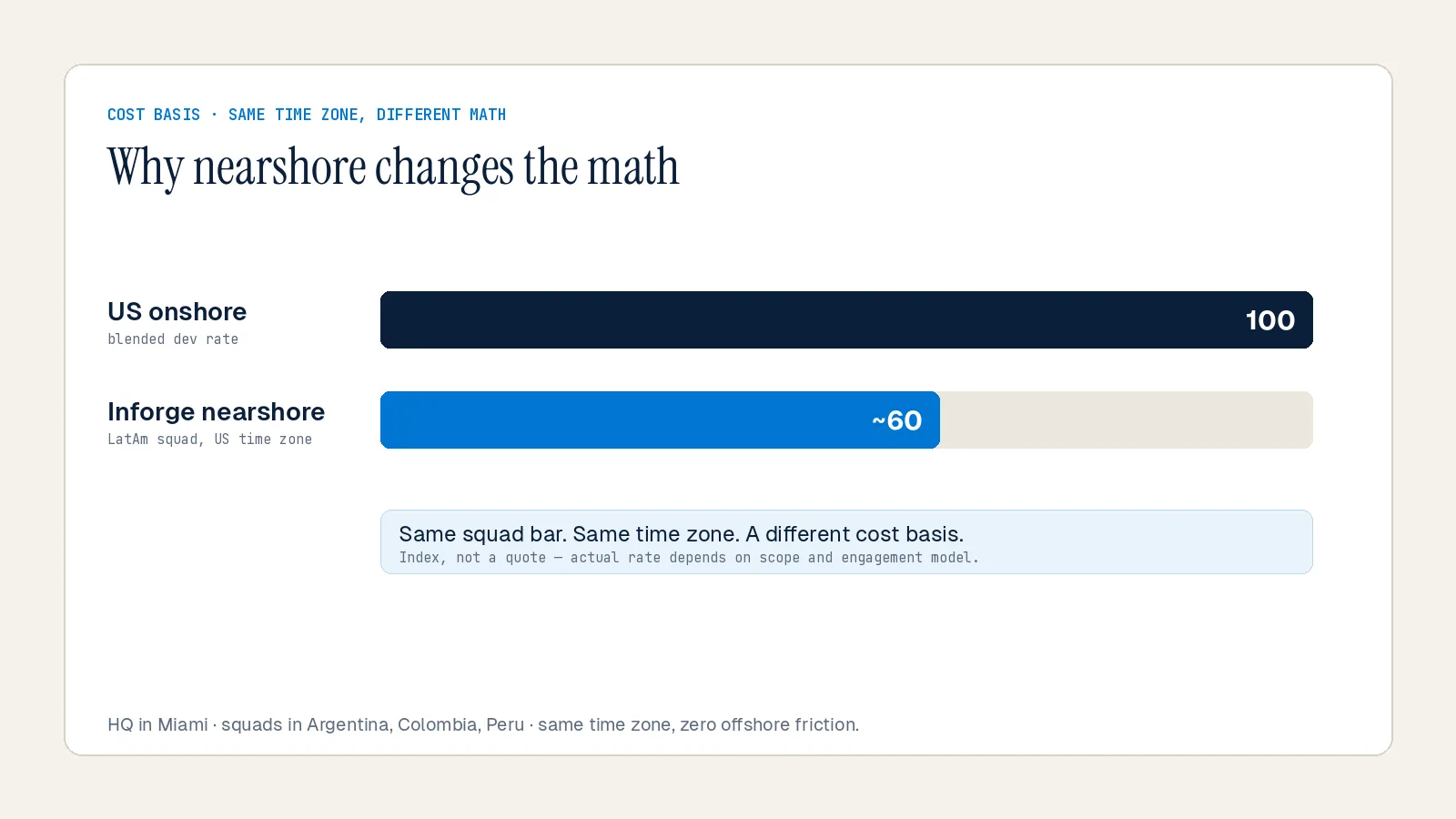
A nearshore Salesforce developer in LATAM costs $35–$70/hour versus $90–$180/hour onshore — a 40–60% reduction on a like-for-like role.
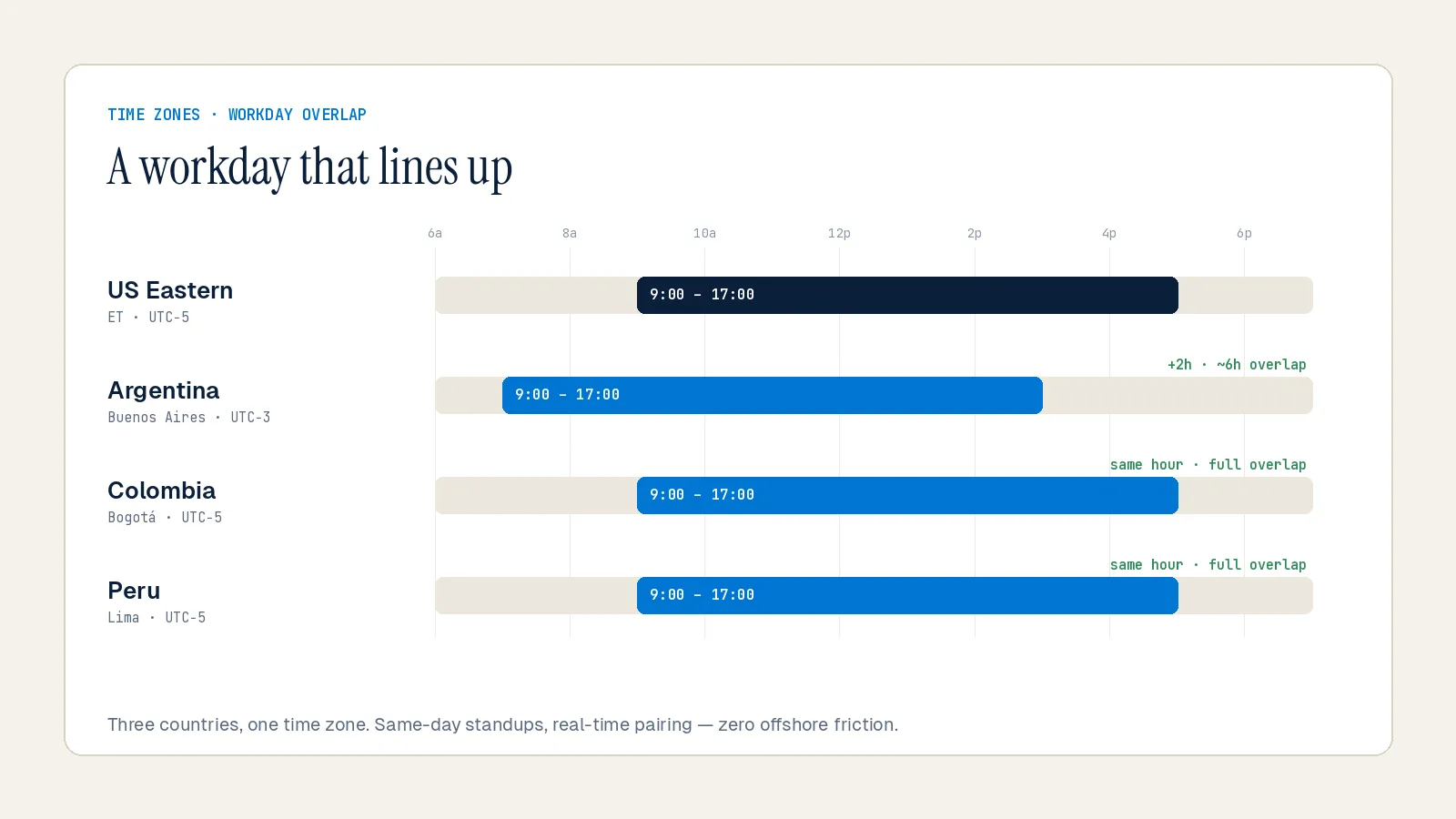
LATAM developers work within 1–3 hours of US Eastern time, enabling real-time standups, same-day code reviews, and live sprint planning.
The Latin America IT market is projected to grow at a 6.5% annual rate through 2030, deepening an already substantial Salesforce talent pool.
Cost savings extend beyond hourly rates: lower attrition, faster ramp-up, and less rework all reduce total implementation cost.
The bottleneck isn't talent quality. It's that most orgs are still using a 2018 hiring model in a 2026 market.
Quick Answer: LATAM nearshore Salesforce developers deliver 40–60% cost savings versus US-based talent. Rate parity with quality, combined with time-zone alignment and a certified talent base across Mexico, Colombia, Argentina, and Brazil, makes nearshoring the highest-ROI staffing decision for mid-market Salesforce implementations today.
The Rate Gap Is Real — and It's Not Closing
The cost case for nearshore Salesforce developers is built on verifiable market data, not vendor marketing.
According to Fast Dolphin's 2026 nearshore cost analysis, a Salesforce developer who costs $90–$180/hour onshore runs $35–$70/hour through a nearshore LATAM team — reflecting active bill rates from placements across Latin American markets. That same report confirms that Latin American nearshore rates run 40–60% below US equivalents across most technical roles, and on a five-person team over twelve months, the gap translates to $300K–$600K in annual savings before factoring in reduced vendor management overhead.
For context, the US Bureau of Labor Statistics reports a median hourly wage of $63.98 for US software developers (May 2024). Once a US staffing firm adds its markup — typically 1.3–1.65x — the client-facing bill rate lands between $83 and $106/hour for a median-skill developer. LATAM equivalents bill at $35–$70/hour through a nearshore partner.
Those savings compound fast on a Salesforce implementation. According to Peergenics' Salesforce consulting cost guide, standard US-rate implementation costs for mid-sized businesses typically fall between $30,000 and $60,000, with complex multi-cloud setups exceeding $150,000. Replacing even part of that team with nearshore talent at a 40–50% discount changes the total project economics materially.
Why LATAM — Not Just Any Nearshore Market
Nearshoring is not new. What's changed is the depth and maturity of LATAM's Salesforce talent base specifically.
According to Curotec's 2026 LATAM developer rate report, the Latin America IT market is projected to grow at a 6.5% annual rate through 2030, with continued investment across cloud, DevOps, AI, and CRM. That growth isn't happening in a vacuum — it's backed by government-supported tech programs, established university pipelines, and the presence of global firms investing in regional talent.
Combine Global Recruitment's 2025 LATAM playbook confirms that Brazil now ranks 6th worldwide for the number of software developers, with over 759,000 developers and approximately 227,000 new STEM graduates in 2023 alone. Colombia's developer base jumped from 62,000 professionals in 2021 to 85,000+ by 2024, partly driven by ProColombia's tax incentives and investment from firms like Globant and Accenture. Argentina, Mexico, and Chile round out a talent map that is deeper than any single vendor will tell you.
For Salesforce specifically, LATAM professionals hold certifications across Sales Cloud, Service Cloud, and Marketing Cloud. According to Simera's CRM growth research, developers from Mexico and Brazil are proficient across the full Salesforce stack, with strong automation logic in Flow Builder, Apex triggers, and integration work through MuleSoft.
This is not a shallow pool of admins chasing certifications. It is a maturing, multi-cloud developer market.
The Time-Zone Argument Is the One That Closes Deals
Cost savings get the meeting. Time-zone alignment closes it.
Offshore teams in Southeast Asia or Eastern Europe can match LATAM on hourly rate in some cases. They cannot match the collaboration model. According to Fast Dolphin's 2026 nearshore comparison report, Latin American professionals work within 1–3 hours of US Eastern time, enabling live standups, same-day code reviews, and real-time incident response.
For Salesforce projects, that matters more than it does in other development contexts. Salesforce implementations are iterative by design. Requirements shift. Data model decisions surface mid-sprint. Flows behave differently in production than in sandbox. When your developer is 10–12 time zones away, every question costs a day. When they're in Bogotá or Mexico City, it costs a Slack message.
According to DevNearshore's 2025 pricing analysis, nearshore projects deliver 15–25% faster outcomes due to time-zone overlap and agile maturity. For a 90-day implementation, that's two to three weeks of timeline compression — a real number, not a slide-deck estimate.
nCube's nearshore Salesforce research also confirms the operational mechanics: nearshore LATAM teams can be staffed and onboarded in 2–6 weeks compared to 3–6 months for local US hiring, with new developers joining sprint work within weeks rather than quarters.
The Hidden Cost Nobody Puts on the Spreadsheet
Hourly rate comparisons are the start of the cost analysis, not the end.
The real cost of a Salesforce developer is the hourly rate plus attrition, onboarding overhead, rework from communication gaps, and delivery delays from misaligned working hours. When you add those factors, the gap between onshore and nearshore widens beyond what the rate card shows.
According to ScioDev's 2025 software development cost analysis, developer turnover in many offshore locations can exceed 40% annually, while LATAM nearshore partners often maintain attrition rates under 15%, thanks to stronger work-culture alignment and growth paths. Every attrition event is a context reset — ramp time, documentation gaps, and sprint disruption that doesn't show up as a line item but absolutely shows up in delivery.
Talently's nearshore hiring research reports that over 80% of their LATAM developers remain long-term with client companies. That retention rate reflects the cultural alignment and career opportunity structure that makes LATAM structurally different from high-churn offshore markets.
There's also the communication variable. LATAM developers are trained and experienced in agile standups, retros, and sprint planning — they're proactive participants in delivery, not ticket-executors waiting for assignments. For Salesforce implementations, where requirements evolve and business logic needs constant translation between admin and development layers, that proactivity directly reduces rework.
The result, according to ScioDev: fewer delays, fewer mistakes, and a better total cost of ownership across the full implementation lifecycle.
The Salesforce Talent Market in 2026: What the Numbers Actually Show
The broader Salesforce talent ecosystem context matters here.
According to IDC's Salesforce Economy projections, 9.3 million ecosystem jobs are projected by 2026. But the supply of senior-level talent is not keeping pace with that demand. Per SyncGTM's 2026 Salesforce developer analysis, Technical Architect demand grew 27% in 2025 while supply grew just 4%. Senior architects represent just 1% of the global Salesforce talent pool. That scarcity drives US compensation up and extends project timelines for orgs competing for the same thin bench of senior talent.
Nearshoring addresses this directly. According to Howdy's 2026 LatAm engineer cost benchmarks, US companies hiring in LATAM achieve 60–68% cost savings compared to domestic hiring. The median US software engineer earns $125,000 in 2026, while a comparable mid-senior engineer in Mexico, Brazil, or Colombia averages $40,000 — a 68% savings before accounting for benefits and taxes.
For mid-market companies running Salesforce on a fixed implementation budget, this is not a marginal efficiency gain. It is the difference between a two-person implementation team and a four-person one — with the same budget.
What to Look for When Hiring Nearshore Salesforce Developers
Not every nearshore engagement produces the results the rate card promises. The quality variable is real.
Certifications as baseline, not differentiator. Platform Developer and Platform App Builder certifications are now minimum qualifications in the 2026 market, per Focus on Force's Q4 2025 market analysis. Employers should look for multi-cloud certifications — Data Cloud Consultant, MuleSoft, and CPQ — and verify that certifications map to production experience, not just exam prep.
Seniority alignment. Nearshore economics work best when seniority is matched to the task. Architectural decisions and complex integration work require senior developers. Configuration, testing, and admin support can be handled by mid-level talent at significantly lower rates. According to Index.dev's 2025 rate analysis, many clients achieve the best cost-quality balance by blending junior resources at $20–$30/hour with senior specialists at $70–$100/hour across LATAM countries.
Engagement model. According to DevNearshore's research, dedicated teams are cheaper long-term than project-based contracts. For implementations expected to span multiple months or require post-go-live support, a dedicated team structure delivers better economics and continuity than a fragmented staff augmentation model.
Vetting depth. The difference between a stable Salesforce org and a fragile one often comes down to the developer behind the configuration decisions. Certifications demonstrate platform knowledge — they do not guarantee experience handling production-scale complexity, as Bertoni Solutions' 2026 hiring guide makes clear. Require portfolio evidence, not just credential lists.
Summary
The 40% cost reduction claim for nearshore Salesforce developers is not a vendor promise. It's backed by BLS rate data, active LATAM bill rates, and delivery performance across thousands of engagements. LATAM offers the specific combination that Salesforce implementations require: time-zone alignment for agile collaboration, a certified talent base with multi-cloud depth, cultural compatibility with US teams, and rates that are 40–60% below onshore equivalents.
At Inforge, we run AI-agent-driven Salesforce implementations — and the talent model powering them is built on exactly this logic: the right expertise, at the right cost, with the time-zone alignment that makes iteration possible. If your current implementation budget is built on US-rate assumptions, there's a better model. It's already working for the organizations that moved first.
Frequently Asked Questions
Q: How much do nearshore Salesforce developers in LATAM actually cost?
A: Nearshore Salesforce developers in Latin America typically bill at $35–$70/hour through a nearshore partner, compared to $90–$180/hour for US-based onshore talent. The range depends on seniority, certifications, and specific cloud expertise. Multi-cloud specialists with Data Cloud or CPQ certifications command rates at the higher end of that band.
Q: Is the quality of LATAM Salesforce developers comparable to US developers?
A: Yes, for the roles that matter most on implementation projects. LATAM developers hold certifications across the full Salesforce stack — Sales Cloud, Service Cloud, Marketing Cloud — and are experienced in Apex, Lightning Web Components, Flow Builder, and MuleSoft integrations. The quality gap that existed a decade ago has closed as LATAM's tech ecosystem matured and global firms invested in regional training infrastructure.
Q: What time zone do LATAM developers work in?
A: Latin American professionals work within 1–3 hours of US Eastern time. This overlap enables real-time standups, same-day code reviews, and live sprint planning — the collaboration model that Salesforce implementations require. It is a structural advantage over offshore teams in Southeast Asia or South Asia, where time-zone gaps of 10–12 hours fragment daily iteration.
Q: How long does it take to onboard a nearshore Salesforce team?
A: Nearshore partners with pre-vetted LATAM talent can staff and onboard a Salesforce team in 2–6 weeks, compared to 3–6 months for US-based local hiring. In practice, this means developers can be contributing to sprint work within weeks of engagement — not quarters.
Q: What's the difference between nearshore and offshore for Salesforce projects?
A: Offshore teams (typically in India or Southeast Asia) offer lower hourly rates but introduce 10–12-hour time-zone gaps that slow iteration, delay feedback loops, and fragment the daily collaboration that Salesforce implementations depend on. Nearshore LATAM teams trade a small rate premium for real-time alignment — and the total cost of engagement, factoring in rework and delay, typically makes nearshore the lower-cost option when measured across a full implementation lifecycle.
