Nearshore Salesforce Consulting: How US Companies Speed Up Implementations, Cut Costs, and Outperform
Nearshore Salesforce consulting gives US companies the cost reductions of outsourcing without the coordination overhead that makes offshore projects drag. For mid-market companies running Salesforce implementations, the model closes a gap that in-house teams can rarely bridge and that offshore vendors consistently widen.
At Inforge, we've built our delivery model around exactly this reality — senior LATAM-based Salesforce talent, operating in your time zone, with an AI-native methodology layered on top. The result is faster timelines, more consistent quality, and a fraction of the cost. That's not positioning. That's how we work every day.
Quick Answer: Nearshore Salesforce consulting places certified implementation teams in nearby time zones — typically Latin America for US companies — delivering 30–50% cost savings versus domestic hiring while preserving the real-time collaboration that offshore models structurally cannot.
Key Takeaways:
Nearshore Salesforce consulting saves US companies 30–50% versus onshore rates without sacrificing implementation quality or seniority.
A 0–3 hour time zone gap (LATAM to US) preserves real-time collaboration — the single factor that makes agile Salesforce work actually function.
Offshore teams carry 15–20% hidden management overhead versus 5–10% for nearshore, narrowing the apparent labor-rate advantage.
In-house Salesforce teams cost approximately $604,600 loaded per year at minimum viable scale — most of it locked in an architect role.
Nearshore paired with an AI-native delivery methodology compounds geographic cost advantages with structural productivity gains.
Why Most US Companies Misframe the Salesforce Staffing Decision
The default framing is cost: offshore looks cheapest on paper, in-house feels safest operationally, and nearshore sits in the middle. That framing is wrong — and it's the reason so many Salesforce projects run over time and under-deliver.
According to industry surveys cited by Ascendix and Vantagepoint, roughly 30–70% of CRM implementations fail to meet their stated objectives — not because the platform is flawed, but because execution falls apart. Poor planning, unclear goals, and inadequate expertise during the build phase account for the majority of failures. The staffing model chosen at the start directly determines whether those risks accumulate or get managed.
The real question isn't "what's the hourly rate?" It's: "Which model gives us the right expertise, available when we need them, with enough overlap to iterate fast?"
In-house teams rarely satisfy all three. Offshore teams almost never do.
[INTERNAL LINK: anchor — "Salesforce implementation planning" | topic: implementation phase breakdown and common failure points]
The True Cost of Building In-House Salesforce Capability
Building an internal Salesforce team feels like control. In practice, it's the most expensive model at minimum viable scale.
According to GetGenerative's analysis of US salary data, a minimum viable internal Salesforce team costs approximately $604,600 loaded per year — with 46% of that locked in the architect role alone. You're not buying flexibility. You're buying fixed overhead that doesn't scale down when a project phase ends.
Beyond salary, you're absorbing recruitment timelines (typically 6–12 weeks per senior hire), benefits, training, and the compounding cost of capability gaps when your one Salesforce admin leaves mid-implementation.
The in-house model works when: Your Salesforce org is complex, stable, and mission-critical enough to justify full-time expertise on-site. For most mid-market companies running 1–3 major implementation cycles per year, it doesn't pencil out.
What Offshore Salesforce Consulting Actually Costs (Beyond the Rate Card)
Offshore looks like the obvious cost solution. Vendors in India or the Philippines advertise rates that undercut US-based consultants by 60% or more. The rate card is real. The total cost of an offshore engagement is not.
According to Deloitte data cited by firstfactory.com, hidden management overhead averages 15–20% on offshore engagements versus 5–10% on nearshore — narrowing the apparent labor-rate gap significantly on any agile Salesforce workstream.
The structural reason is time zones. A 10–12 hour gap with an offshore team does not just add inconvenience — it changes how work gets done. As Parallel Staff's research shows, synchronous communication drops 11% for every additional hour of time difference between collaborators. A 12-hour gap doesn't just add friction. It converts your Salesforce implementation from a collaborative sprint cycle into a slow-motion relay race where one ambiguous requirement can stall an entire week.
In Salesforce implementations specifically — where business process questions surface constantly during build, UAT cycles are iterative, and stakeholder feedback loops need to be tight — asynchronous-only collaboration is a structural liability.
Why Nearshore Wins the Actual Delivery Calculation
Nearshore Salesforce consulting, specifically from Latin America for US companies, resolves the false tradeoff between cost and collaboration.
On cost: According to Third Republic's internal data reported by Salesforce Ben, companies leveraging LATAM nearshore Salesforce talent save 30–50% versus US hiring — up to $146K in annual savings — without sacrificing seniority, experience, or technical capability. According to Applaudo's nearshore cost analysis, nearshore outsourcing can reduce labor costs by 30–70% compared to US-based providers, with the range depending on seniority mix and engagement structure.
On collaboration: Latin America's 0–3 hour time zone difference from US business hours means your nearshore team is in the same workday you are. According to AgileEngine's model comparison, nearshore teams provide 4–8 hours of overlapping working time daily — enough to run real sprint ceremonies, unblock decisions same-day, and keep UAT cycles from stalling.
On talent depth: According to Salesforce Ben's LATAM community report, one of the fastest-growing communities of Salesforce professionals globally is in LATAM, with major hubs in Argentina, Brazil, Colombia, and Mexico. The talent pool is deep, certified, and increasingly senior — and according to Combine's 2026 hiring data, 84% of LATAM placements by US companies in 2025 were for mid-level or senior positions, not entry-level fills.
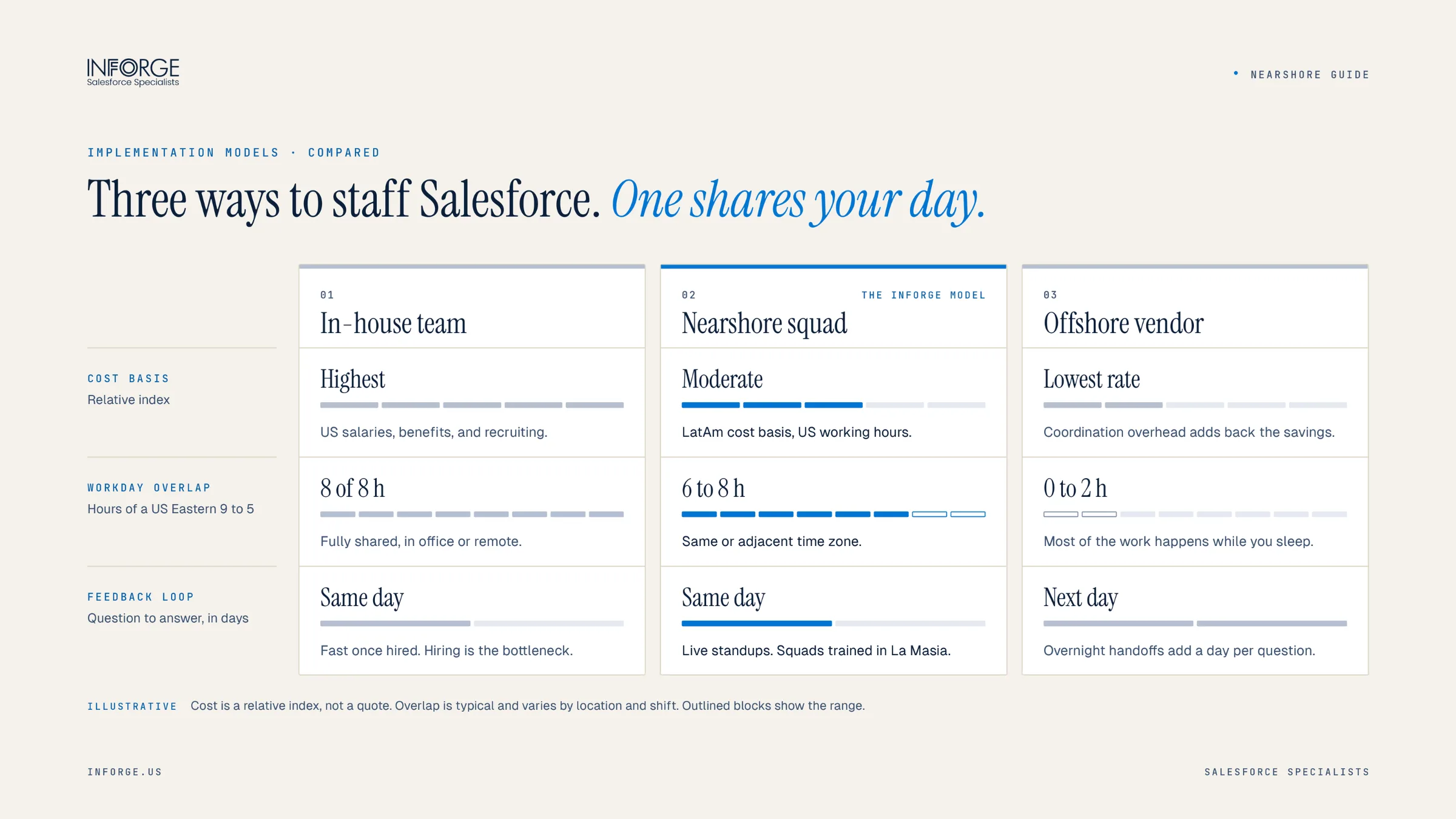
Nearshore vs. Offshore vs. In-House: The Honest Comparison
| Factor | In-House | Offshore | Nearshore |
|---|---|---|---|
| Loaded annual cost | ~$604K+ minimum | Lowest rate card | 30–50% below onshore |
| Hidden overhead | High (benefits, recruiting) | 15–20% management tax | 5–10% management tax |
| Time zone overlap (US) | Full | 10–40% | 70–90%+ |
| Collaboration model | Synchronous | Asynchronous by default | Synchronous by default |
| Talent scalability | Low | High | High |
| Cultural alignment | High | Variable | High |
| Best for | Complex, long-term orgs | Budget-only, low-complexity | Agile, iterative, mid-market |
For US mid-market companies running active Salesforce implementations, nearshore wins across every dimension that actually determines project success.
The Inforge Angle: Nearshore Plus AI-Native Delivery
Most nearshore Salesforce consultancies stop at geography. They put certified LATAM talent in your time zone and hand you a project manager. That's the baseline — and it's better than offshore or inflated onshore rates.
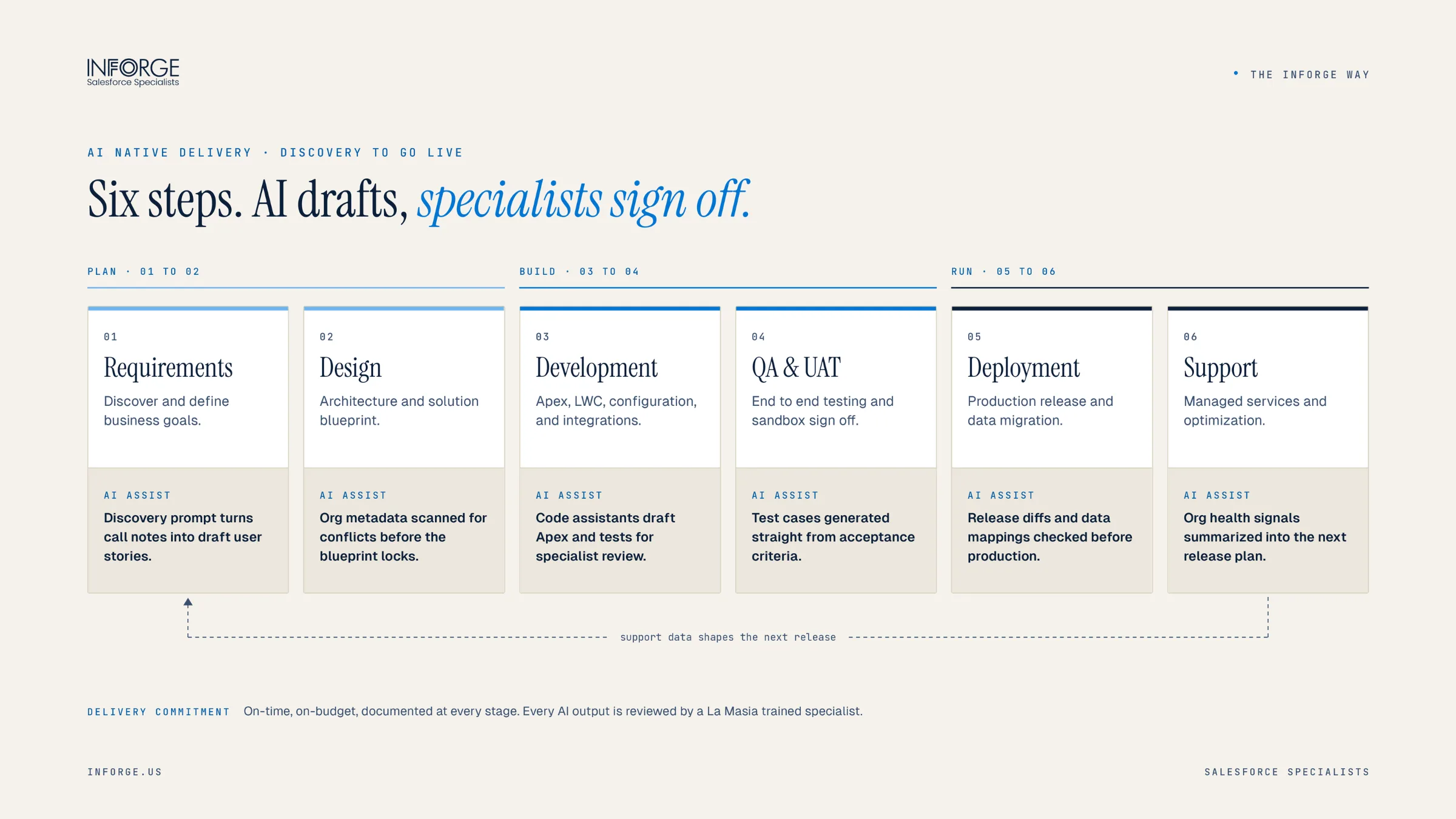
Inforge goes further. We've replaced the traditional delivery model entirely. Our Salesforce implementations are executed by AI agents — configuration, documentation, testing scaffolding, data mapping — delivered through prompts, not headcount.
The practical effect: nearshore's geographic cost advantage compounds with a structural productivity advantage. Smaller teams. Faster cycles. More consistent quality. Lower total engagement cost.
As HatchWorks noted in their 2026 nearshore analysis, when a nearshore partner delivers under an AI-native methodology, the per-engineer productivity advantage compounds the geographic advantages. We're not theorizing about this. It's how Inforge operates on every engagement.
Summary
Nearshore Salesforce consulting resolves the false choice between cost efficiency and implementation quality. For US mid-market companies, the LATAM talent pool offers genuine seniority, real-time collaboration, and 30–50% cost savings versus onshore — without the time-zone friction that makes offshore projects routinely underdeliver. In-house teams carry fixed overhead most organizations can't justify outside of long-term, high-complexity orgs. Nearshore, done right, wins on all three dimensions: speed, cost, and results.
At Inforge, we take that model further — AI-native delivery layered on top of a nearshore foundation, so every implementation runs faster, more consistently, and at a fraction of what traditional consultancies charge.
Ready to see what that looks like for your Salesforce build? [Talk to Inforge.](https://inforge.ai)
Frequently Asked Questions
Q: What is nearshore Salesforce consulting?
A: Nearshore Salesforce consulting means engaging a Salesforce implementation team located in a geographically nearby country — typically Latin America for US companies — that operates within the same or similar time zones. It combines the cost savings of outsourcing with the collaboration quality of working with a team that's available during your business hours.
Q: How much can US companies save with nearshore Salesforce consulting?
A: According to Third Republic's internal data, LATAM nearshore Salesforce talent delivers 30–50% savings versus US hiring, with up to $146K in annual savings per role. Broader nearshore outsourcing data puts the range at 30–70% depending on seniority mix and engagement structure.
Q: Why is nearshore better than offshore for Salesforce implementations?
A: Salesforce implementations are iterative — requirements surface constantly during build, UAT is a back-and-forth process, and decisions need to move fast. Offshore teams operating on a 10–12 hour time difference force asynchronous communication by default, which stalls sprint cycles and compounds errors. Nearshore teams in Latin America share 70–90% of US business hours, enabling real-time collaboration without paying onshore rates.
Q: Is it cheaper to build an in-house Salesforce team or go nearshore?
A: In most mid-market scenarios, nearshore is significantly cheaper than building in-house. A minimum viable internal Salesforce team costs approximately $604,600 loaded per year, with nearly half of that in the architect role alone — and no ability to scale down between project phases. Nearshore gives you access to senior talent on a project or augmentation basis without the fixed overhead.
Q: How does Inforge's nearshore Salesforce consulting differ from traditional consultancies?
A: Inforge runs an AI-native delivery model — Salesforce implementations executed by AI agents, not just people. This means smaller teams, faster timelines, and more consistent quality at a lower total engagement cost. We combine LATAM-based senior talent with an AI-agent delivery stack that no traditional consultancy can match on price or speed.