Is Agentforce Worth It? What Salesforce Customers Should Know Before Rolling Out AI Agents
Agentforce is worth it — for the right org. If you're already running Salesforce Enterprise Edition, your CRM data is clean and unified, and you have a defined use case in customer service or sales support, the ROI case is real. If you don't have those foundations in place, you'll spend more time and money building prerequisites than you will deploying agents. That's not a knock on the platform. It's just the honest picture most vendors skip past.
At Inforge, we've helped mid-market Salesforce customers move from evaluation to production on Agentforce. What we see most often isn't a technology problem — it's a readiness gap. This guide exists to close it.
Quick Answer: Agentforce delivers measurable ROI for Salesforce-native organisations with clean data and a targeted use case. Year-one total cost of ownership typically runs $200K–$450K+ for a 30-seat deployment. The biggest variable isn't the license — it's your data readiness.
Key Takeaways:
Agentforce pricing has changed three times since its 2024 launch. Flex Credits ($0.10/action) are now the dominant model for most deployments.
Year-one TCO for 30 seats realistically lands between $200K and $450K+ once Data Cloud, Service Cloud, and implementation costs are factored in.
Data readiness is the single biggest predictor of implementation success or failure — not budget, not headcount.
Agentforce performs strongest in customer service and Salesforce-native sales workflows. It struggles when GTM processes span systems outside Salesforce.
70% of organisations that deploy AI agents report measurable value within 60 days — but only when data foundations are in place.
What Agentforce Actually Is (And What Powers It)
Agentforce is Salesforce's agentic AI platform — autonomous software agents that reason over your CRM data, execute multi-step workflows, and take actions without waiting for a human to click a button. It launched in late 2024 and has since become, by Salesforce's own account, its fastest-growing product ever.
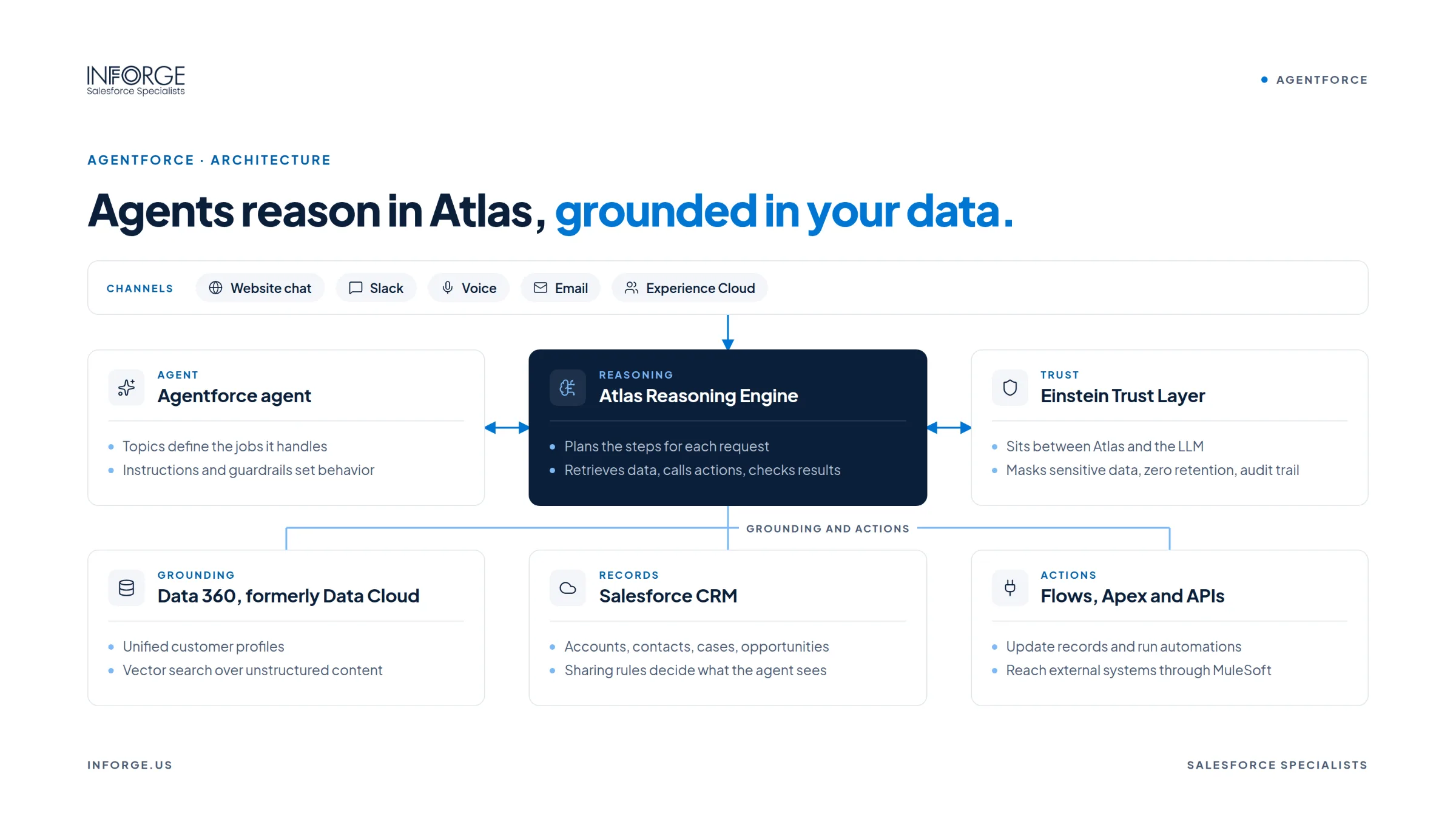
The engine underneath Agentforce is called Atlas. According to Salesforce Engineering, the Atlas Reasoning Engine acts as Agentforce's brain, using reinforcement learning and feedback loops to deliver context-sensitive responses grounded in your live Salesforce data. It doesn't just answer questions — it plans how to answer them, executes part of the plan, evaluates what came back, and decides the next step. This reason–act–observe loop runs iteratively until the goal is met or a guardrail stops it.
In practice, that means an Agentforce agent can receive a customer service inquiry, retrieve that customer's full history from Data Cloud, check relevant knowledge base articles, determine the right resolution path, and close the case — all without a human in the loop. Or flag it for escalation with full context attached, so the rep doesn't start from scratch.
According to Salesforce's Agentforce Metrics page, the platform completed 3.2 billion Agentic Work Units in Q2 2026 alone — a 97% increase from Q1 — across more than 25,000 companies in 124 countries.
The Real Pricing Picture: What Agentforce Costs in 2026
This is where most evaluations go wrong. The advertised pricing is real — but it's not the full picture.
Agentforce has gone through three pricing models since its September 2024 launch. Today, three models coexist:
Flex Credits (usage-based): $500 per 100,000 credits, where each standard agent action costs 20 credits (~$0.10). Voice actions cost 30 credits (~$0.15). Credits are tracked in real time via Salesforce's Digital Wallet. Unused credits don't roll over.
Per-conversation pricing: $2 per customer conversation. This was the original launch model and drew significant criticism for pricing out smaller organisations. It still exists for customer-facing deployments.
Per-user add-ons: $125/user/month for Sales, Service, and Field Service (unmetered usage); $150/user/month for industry clouds; $550/user/month for the full Agentforce 1 Edition, which includes 1 million Flex Credits per org per year.
There's also a lighter $5/user/month Agentforce User License that provides basic access — but it's metered and still requires Flex Credits on top.
The costs nobody mentions upfront:
Salesforce Enterprise Edition is a prerequisite: ~$165/user/month
Data Cloud (Data 360): $25–$50/user/month additional, depending on scope
Implementation: $50,000–$150,000 upfront for a production deployment
Ongoing consulting: can average $10,000–$25,000/month during rollout
Per-agent setup: $2,000–$6,000 per agent — not optional for most organisations
According to myaskai.com's 2026 Agentforce guide, a realistic Year-1 TCO for a 30-seat deployment lands between $200,000 and $450,000+ once Data Cloud implementation, credit consumption, and Service Cloud licensing are combined. That number needs to be in front of your CFO before a single agent goes live.
The Data Readiness Problem Nobody Talks About
Here's the uncomfortable truth about most Agentforce rollouts: the platform doesn't fail because of AI limitations. It fails because of data problems the org didn't know it had.
Agentforce agents act on the data they read. If that data is incomplete, duplicated, or siloed across disconnected systems, the agent doesn't just underperform — it acts confidently and incorrectly, with no human reviewing the outcome. As Thinklytics puts it: "Integration is the bottleneck, not the model."
According to Salesforce's Data 360 documentation, Data 360 must be enabled for all Agentforce use — the Einstein Trust Layer, conversation audit logging, and the Agentforce Data Library all depend on it. The distinction that matters: enabled is not the same as implemented. Enterprise Edition customers can flip the switch for free. Getting the data unified and trustworthy enough to ground an agent's decisions is a different project — one that typically adds 6–12 weeks and significant cost.
Implementing Agentforce effectively requires three foundations: clean, connected data; cloud infrastructure ready for AI workloads; and integrations to the systems where work actually happens. When teams skip the data audit, they discover mid-project that their agents can't access the records they were designed to act on.
A real example from Clientell's 2026 implementation guide: a financial services client purchased Agentforce licenses expecting to build a customer-facing agent that could access account balances and transaction history. Three weeks in, they discovered those data points required a full Data Cloud integration — adding 8 weeks and $45,000 to the project.
The pre-launch checklist that actually matters:
Data accuracy audit showing >85% field completion on core CRM objects
Duplicate resolution process established and running
Data Cloud budget secured and scope confirmed
Integration points with non-Salesforce systems mapped
Prompt engineering resources identified internally or externally
At Inforge, we treat the data audit as a non-negotiable first step — not a phase two item. It determines which use cases are viable and prevents the most expensive kind of rework.
Where Agentforce Delivers Real ROI
When the data foundations are right, the results from early adopters are worth paying attention to.
According to Salesforce's State of Service: AI Agents Edition, which surveyed 3,075 customer service professionals worldwide, adoption of AI agents in customer service increased 1.7x from 2025 to 2026 — rising from 39% to 66% of organisations. Seventy percent of those organisations reported measurable value within 60 days. The top improved KPI? Customer satisfaction — ranking ahead of handle time, rep productivity, and first-response time.
Some specific production results from real Agentforce deployments, per Salesforce's newsroom:
Wiley reported 213% ROI, with 40%+ improvement in case resolution and 50% faster onboarding for seasonal agents
Engine resolved 50% of its chat inquiries fully autonomously
Autism Queensland resolved 70% of administrative requests through its employee service agent
Salesforce's own internal deployment generated $100M in annualised cost savings while maintaining customer satisfaction
The pattern across these cases is consistent: Agentforce performs strongest when agents operate within the Salesforce ecosystem — handling customer service inquiries, routing cases, resolving known issues against a clean knowledge base, or supporting sales reps with CRM-native data. It struggles when GTM workflows span systems outside Salesforce.
Who Should Roll Out Agentforce Now — and Who Should Wait
Not every Salesforce customer is in the same position. Here's a direct framework.
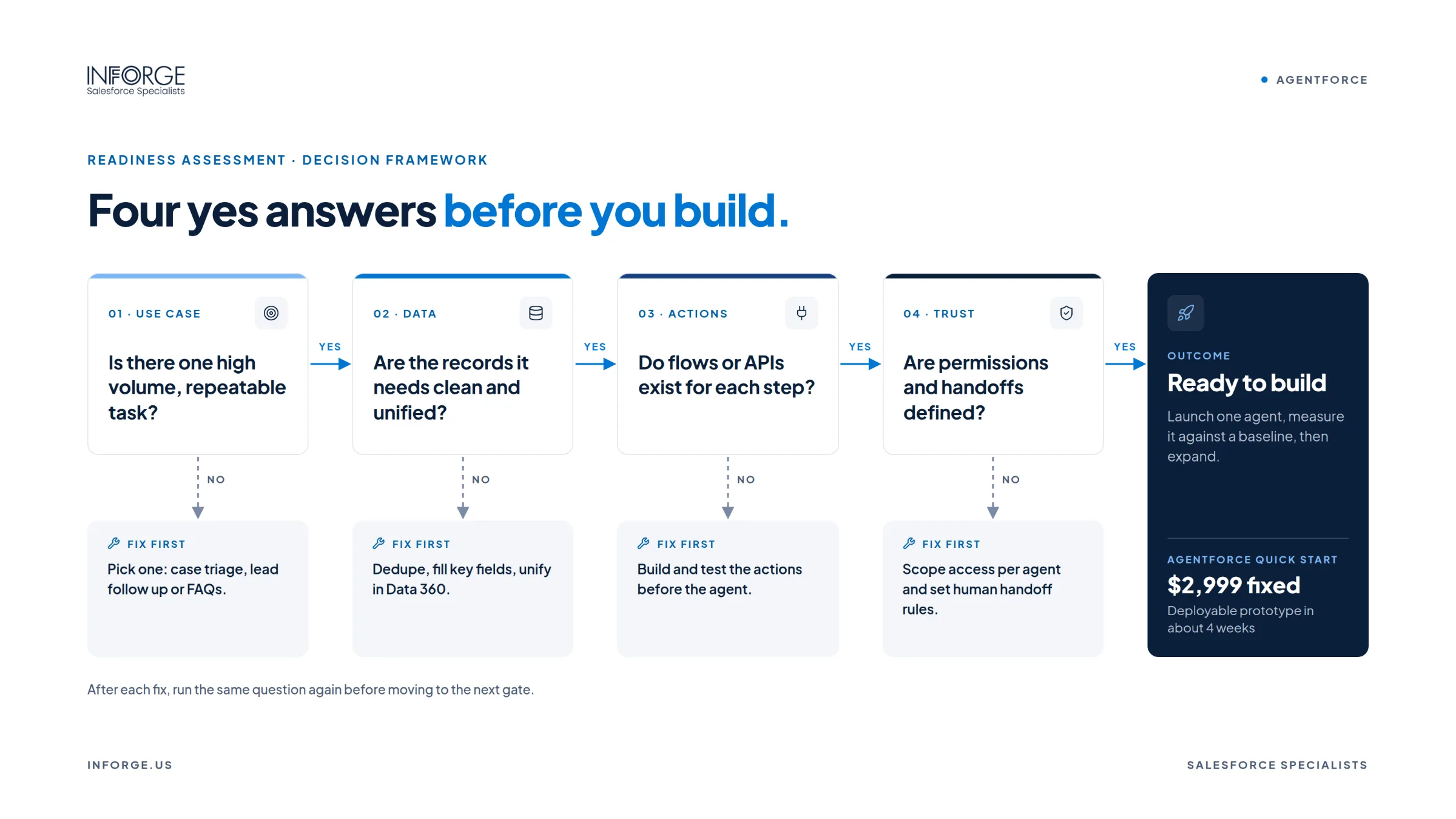
Roll out now if:
You're on Salesforce Enterprise Edition or above
Your core CRM data (accounts, contacts, cases, knowledge articles) is clean and complete
You have a single, high-volume use case in customer service or sales support
You have internal Salesforce admin capacity or a trusted implementation partner
You can absorb a 6–14 week deployment timeline without pressure to show results in week three
Wait and do the prep work if:
Your CRM data quality is unknown or inconsistent
Your workflows span multiple non-Salesforce systems with no integration layer
You don't yet have Data Cloud enabled or mapped to your core objects
Your use case requires agents to act on data that lives entirely outside Salesforce
You're looking for a quick AI win to show the board — Agentforce is not a quick-win platform
The bottleneck isn't AI capability. Most organisations aren't yet set up to delegate to it safely. The ones that are — with clean data, clear use cases, and a realistic timeline — are the ones seeing 213% ROI, not the ones who bought licenses in Q4 and scrambled to deploy by Q1.
How to Start: The One Use Case, One Department Rule
The most common mistake in Agentforce deployments is scope. Organisations scope too wide, too fast — they want an agent for sales, service, field service, and marketing simultaneously, live in six weeks.
The approach that consistently works: one use case, one department, a 30-day pilot before scaling.
Pick the highest-volume, most repetitive workflow in the department with the cleanest data. In most mid-market organisations, that's customer service case resolution or sales rep support for meeting prep and CRM updates. Build that agent first. Measure it. Tune the guardrails. Then expand.
Deployment for a single, well-scoped use case with solid data quality can go live in 4–6 weeks. The moment scope expands to multiple departments or requires Data Cloud unification from scratch, timelines extend to 6–14 months. That's not a platform problem — that's a scoping and sequencing problem.
Agentforce Foundations includes 200,000 Flex Credits at no charge for Enterprise Edition customers. Use that trial capacity to validate one use case end-to-end before committing to a full deployment budget.
Summary
Agentforce is a serious platform delivering serious results — for organisations that approach it seriously. The pricing complexity, data prerequisites, and implementation depth are all real. So are the outcomes when the work is done right. The question isn't whether Agentforce works. The question is whether your org is ready to let it work.
At Inforge, we've built our entire delivery model on AI agents — not as a product demo, but as how we operate every day. We know what it takes to move from Agentforce evaluation to production, and we know how to scope it so the first use case lands cleanly before the second one is planned. If you're evaluating Agentforce, we're worth talking to before you talk to Salesforce.
Frequently Asked Questions
Q: Do you need Data Cloud to use Agentforce?
A: Data Cloud (now called Data 360) must be enabled for Agentforce — the Einstein Trust Layer and audit logging both depend on it. Enterprise Edition customers can enable it using the zero-dollar SKU at no extra cost. A full, paid Data Cloud implementation is only required when agents need unified customer profiles, real-time data from external systems, or advanced retrieval. Scope your agent first, then determine the Data Cloud depth required.
Q: How long does an Agentforce implementation actually take?
A: A single, well-scoped use case with clean data can go live in 4–6 weeks. When data unification, Data Cloud setup, or multi-system integrations are required, realistic timelines extend to 6–14 months. The gap between vendor quotes and actual delivery almost always comes from underestimated data readiness work — not the Agentforce build itself.
Q: What's the real Year-1 total cost of ownership for Agentforce?
A: For a 30-seat mid-market deployment, realistic Year-1 TCO lands between $200,000 and $450,000+. That includes Flex Credits, Service Cloud Enterprise licensing (~$165/user/month), implementation ($50K–$150K upfront), and Data Cloud setup if required. Advertised per-action or per-user pricing covers only a fraction of the actual investment.
Q: Which departments get the most value from Agentforce?
A: Customer service teams consistently see the strongest early ROI. Salesforce's own research shows 70% of service organisations deploying AI agents report measurable value within 60 days, with customer satisfaction as the top improved KPI. Sales support use cases perform well when agents operate on Salesforce-native data. Agentforce is less effective when sales workflows span multiple non-Salesforce tools.
Q: Can a mid-market company without a dedicated Salesforce team deploy Agentforce?
A: Not without external support. Agentforce deployment requires Data Cloud configuration, prompt engineering, guardrail setup, and ongoing tuning — specialised skills most internal teams don't carry. Working with an implementation partner with direct Agentforce production experience is not optional at this stage of the platform's maturity.