How to Choose the Right Salesforce Consulting Partner: Key Questions to Ask Before Signing
The wrong Salesforce consulting partner will cost you more than a failed implementation. It will cost you six months of internal momentum, a demoralized team, and a six-figure cleanup bill. According to research from Gartner and Forrester, between 55% and 70% of Salesforce implementations fail to meet their planned business objectives — and the cause is almost never the platform. It's the partner.
At Inforge, a Salesforce consultancy that has replaced its traditional delivery model with AI agents, we've seen both sides of this problem. We've built clean implementations from scratch, and we've rescued orgs left in worse shape than they started. The pattern of failure is consistent and avoidable — if you know what questions to ask before the contract is signed.
Quick Answer: To choose the right Salesforce consulting partner, evaluate actual delivery experience (not just certifications), confirm who will be on your account day-to-day, verify their data migration track record, understand their post-go-live support model, and check for clear change management methodology — before you sign anything.
Key Takeaways:
CRM implementations fail at rates of 55–70%, driven by partner selection, not platform limitations.
Certifications are a filter, not a verdict — ask who is personally running your project, not the agency's total badge count.
A partner that skips or rushes discovery is optimizing for speed, not fit.
Industry-specific experience sometimes lives in one person at a firm — if that person isn't on your account, you're buying a reputation, not an asset.
Salesforce's partner program now uses two tiers (Select and Summit) and outcome-based competency scoring — tier alone should not be the deciding factor.
The right partner pushes back. If every answer is "yes," walk away.
Why the Partner Decision Matters More Than the Software
There are over 2,300 Salesforce consulting firms listed in the US alone, according to AppExchange data. That number includes everything from solo consultants to global firms with tens of thousands of employees. The variance in quality is enormous.
According to research consistently cited by Gartner and Forrester, 70–74% of CRM implementations fail to deliver expected value — with wasted budgets typically running $200K–$500K, not counting lost productivity and demoralized teams. The primary causes are poor scoping, weak change management, and misaligned partner selection.
The difference between a successful Salesforce implementation and a failed one is almost never the software. It's the partner and how they operate. A firm that treats your project as a delivery ticket — executing exactly what you ask for, without ever challenging whether the ask is right — will hand you a technically built system that your team refuses to use.
As the data shows, only 50% of CRM features are actively used even in organizations that consider their implementations successful. That's not a Salesforce problem. That's an implementation problem.
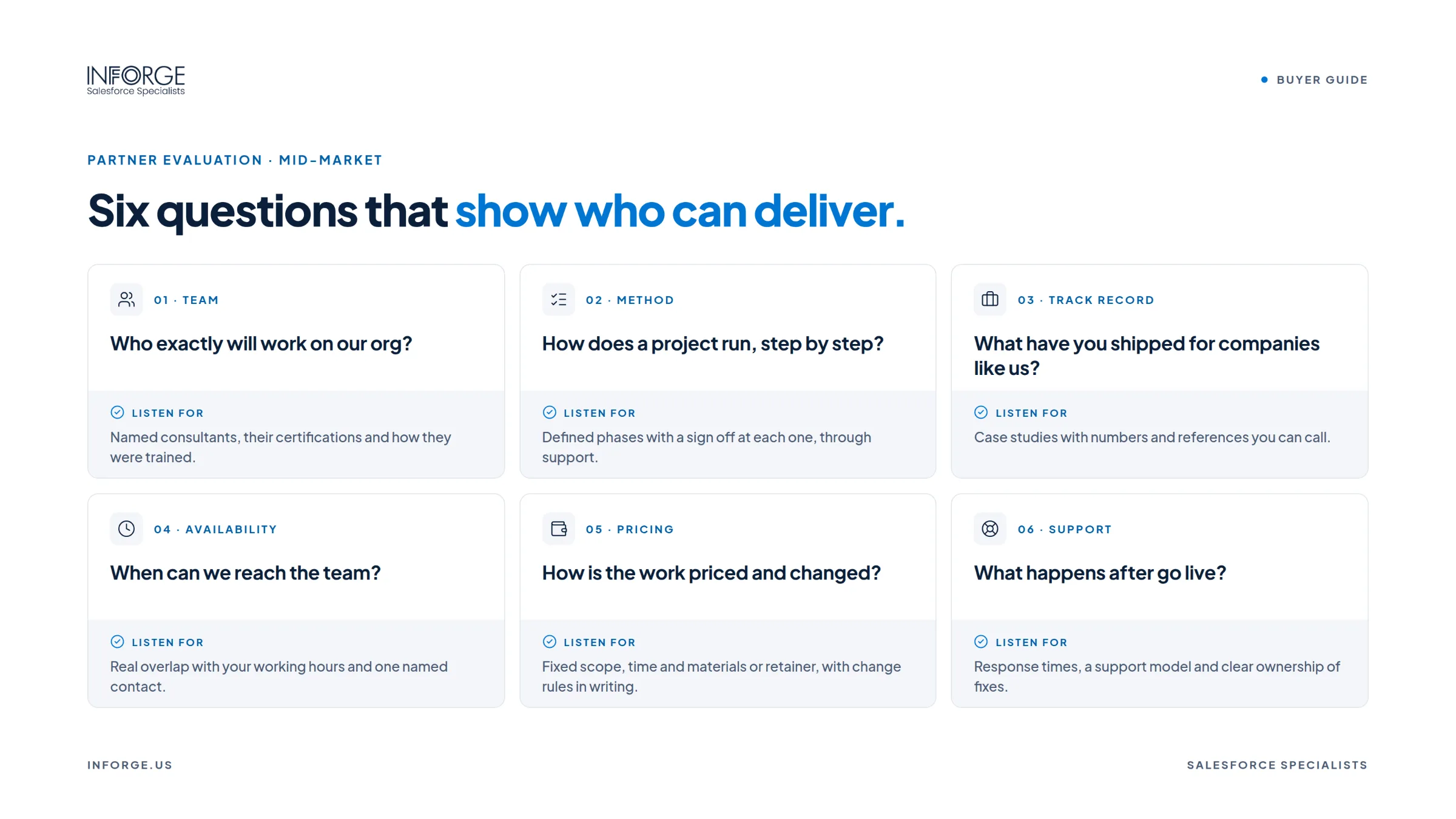
Question 1: Who Will Actually Be on My Account?
This is the question most buyers forget to ask — and the one that predicts the most failures.
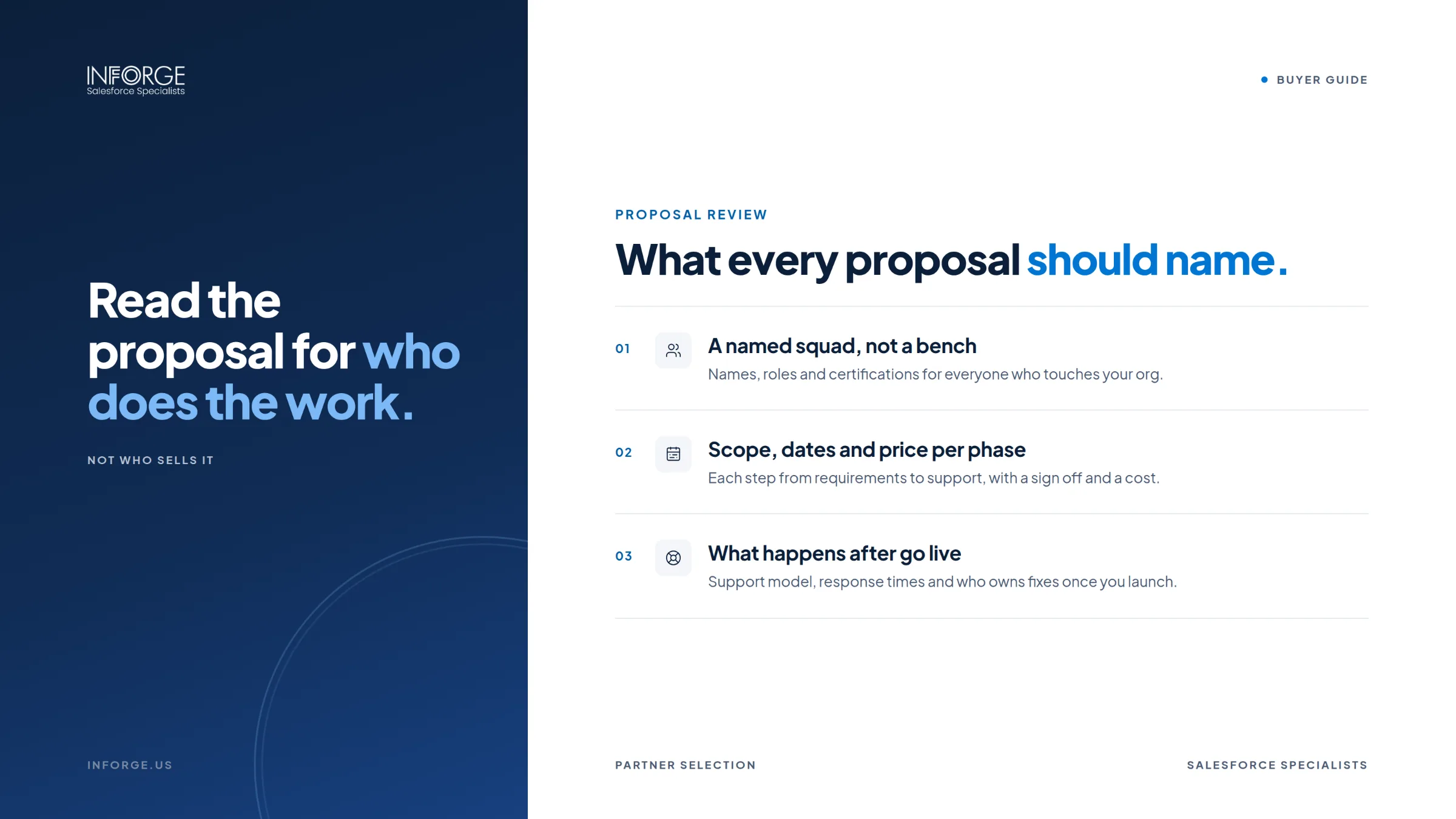
Certifications are a filter, not a verdict. Salesforce's partner tiers and individual certifications — Administrator, Platform App Builder, Application Architect, System Architect — confirm exam-passing, not project delivery. A firm with a wall of badges can still staff your project with a junior consultant who has never led an implementation solo.
Ask directly: who will be on your account day-to-day? What are their individual certifications, and how many similar projects have they personally run? Not the agency as a whole — the individual.
As of March 2026, Salesforce collapsed its four-tier partner structure into two tiers — Select and Summit — and replaced 170 legacy Navigator badges with 28 outcome-based competencies. Select confirms baseline delivery capability. Summit is reserved for firms with verified customer outcomes, high CSAT scores, and demonstrated competency in priority areas like Agentforce and Data Cloud. Tier is a useful signal, but it should not be the deciding factor — competencies, verified projects, and the actual delivery team matter just as much.
Also request team composition in writing, with architect-to-developer ratios contractually committed. Any partner that responds with "we'll assign our best available resources" without naming individuals is warning you.
The question to ask: "Can we meet the full delivery team before signing? What is their individual certification level and how many projects at our scale have they each personally completed?"
Question 2: What Does Your Discovery Process Look Like?
A partner that skips deeply understanding your business before jumping into configuration is optimizing for their timeline, not your outcomes.
Strong discovery produces tangible deliverables — documented workflows, a data model, a clear scope with explicit exclusions, and agreement on what "done" looks like before a single configuration begins. Weak discovery produces a proposal that could apply to any company, with no specific reference to your industry, your workflows, or your actual pain points.
One of the clearest signals of a weak implementation partner is a team that builds whatever the client asks for without pushing back when a request doesn't actually serve the business's goals. A genuine consulting partner's job includes telling you "no, that's not the right approach" — not just executing requirements. Elite partners challenge assumptions, question requirements, and proactively recommend improvements based on prior implementations. Order-takers execute requests, even when those requests have flaws or create technical debt.
If a partner presents a precise quote before any real discovery has happened — or provides a vague scope after discovery — both are red flags for different reasons.
The question to ask: "What are the specific deliverables at the end of your discovery phase, and how do you handle requirements that conflict with Salesforce best practices?"
Question 3: What Is Your Data Migration Track Record?
Data migration is consistently the highest-risk stage of a Salesforce implementation. According to Webvillee's 2026 analysis, 60% of CRM migrations fail due to bad data quality. Duplicate records, missing fields, and inconsistent formatting carried into the new org don't surface immediately — they show up three months after go-live, when reports come back wrong and your team loses trust in the system.
A partner with genuine data migration experience will ask about your source systems in the first conversation. They'll have a methodology for data cleansing, deduplication, validation, historical data migration, and security during migration. That methodology should be documented, not ad hoc.
Any answer that amounts to "we'll sort that out during the project" is a serious warning sign. So is a partner that has never migrated data from the specific source systems your org runs — SAP, Microsoft Dynamics, or whatever ERP and marketing platforms you use.
The question to ask: "Walk me through a data migration you completed from a system similar to ours. What went wrong, and how did you handle it?"
Question 4: How Do You Handle Change Management and User Adoption?
Implementation is 20% technology and 80% people. If a partner never mentions training, change management, or user adoption during the sales process, they don't understand what it takes to succeed. They'll hand you a configured system that your team refuses to use.
Research is consistent on this: low user adoption is the leading cause of Salesforce failure. Three months after go-live, the pattern is predictable — fewer than 40% of users log in regularly, reps enter the minimum required data to satisfy reporting requirements, and real work happens in spreadsheets.
Training crammed into a single session the day before go-live is a red flag. Adoption should be designed into the project from the scoping phase, not bolted on as a final deliverable. Ask how they handle onboarding across different user types — the rep who has never used a CRM and the operations manager who needs to trust the reporting.
The question to ask: "How do you measure user adoption success, and what specific activities in your delivery methodology are designed to drive it — not just enable it?"
Question 5: What Happens After Go-Live?
Most implementation disasters are quiet. There's no case study titled "How We Spent $80,000 and Ended Up Back in Spreadsheets." The evidence is scattered across internal frustration, unused licenses, and consultants privately telling each other how much of their business comes from cleanup work rather than new builds.
A significant portion of that cleanup business exists because the original partner had no structured post-go-live support model. Your Salesforce org will change. Salesforce itself ships three major platform updates per year. If the conversation ends at go-live, your org will drift within months.
Ask specifically whether post-implementation support is a separate contract or included in the engagement. Ask what the SLA looks like for critical issues — system-down scenarios — versus configuration requests. Ask whether the same team that built the implementation handles support or whether it's handed to a different team unfamiliar with what was built.
The question to ask: "Who supports us after go-live, what is the SLA for a critical issue, and how do you handle platform updates — proactively or reactively?"
Question 6: What Is Your Pricing Model, and What Does It Actually Include?
Pricing models in Salesforce consulting vary — fixed-scope, time-and-materials, blended day rates — and each carries different risks depending on your project's complexity and how well-defined your requirements are at the start.
Blended day rates hide the seniority mix you'll actually receive. Separate rates for architect, consultant, and admin time tell you what the staffing plan really looks like. Ask directly whether project management, testing, training, and documentation are billed inside the estimate or added on top. Ambiguity here is how projects end up 40% over budget at delivery.
For organizations evaluating AI-powered delivery models like Inforge's, the cost calculus looks different — full implementations delivered through AI agents rather than headcount pyramids can meaningfully compress both timelines and cost. That's not a pitch. That's how we operate, every day.
The question to ask: "Break out the rates by role. What is explicitly included in this estimate, and what triggers a change order?"
Red Flags That Should End the Conversation
Beyond the questions above, these signals consistently predict a difficult partnership. If you see more than two, walk away:
Generic proposals that could apply to any company, with no specific reference to your industry, workflows, or actual pain points
No discovery phase — or a discovery phase so short it couldn't have produced real insight
Senior experts in the sales meetings who vanish once junior staff take over delivery
Reluctance to name previous clients or provide references you can actually speak to
Every answer is "yes" — a strong partner tells you when an idea will create future cost or technical debt
No clear support plan after go-live, leaving you stranded when something breaks
Vague or variable pricing that can't be explained before the contract is signed
A proposed timeline that skips from discovery directly to production with no testing phase named
Summary
Choosing a Salesforce consulting partner is not a procurement decision — it's a strategic one. With CRM failure rates between 55% and 70%, the gap between a successful implementation and an expensive cleanup project almost always traces back to the partner selection. The questions in this guide are not box-ticking exercises. They are the questions that surface how a firm actually operates — under pressure, in discovery, after go-live — before you've committed your budget and your team's time to finding out the hard way.
At Inforge, we've built our entire delivery model around the principle that implementation quality should be measurable, not promised. If you're evaluating partners for a Salesforce implementation or a struggling org that needs a rescue, we'll show you exactly how we work before we ask you to sign anything.
Frequently Asked Questions
Q: How many Salesforce consulting partners are there, and how do I narrow the list?
A: There are over 2,300 Salesforce consulting firms in the US alone, ranging from solo consultants to global system integrators. Narrow the list by filtering for partners with verified experience in your industry, your specific Salesforce clouds, and your company size — then vet three to five finalists using the questions above before shortlisting.
Q: Are Salesforce partner tiers a reliable indicator of quality?
A: Salesforce's current program has two tiers — Select and Summit. Summit is the higher tier, requiring verified customer outcomes and competency scores. But tier alone is not sufficient vetting. A boutique Select partner with ten years of experience in your vertical may outperform a Summit partner that assigns a junior team to your project. Evaluate competencies, AppExchange reviews, and the actual delivery team.
Q: What is a realistic cost for a Salesforce implementation with a consulting partner?
A: Implementation consulting costs typically range from $50,000 to $500,000 depending on organization size and project complexity. Fixing a failed DIY implementation generally runs $100,000 to $250,000 — often more than working with a qualified partner from the start. AI-agent-based delivery models can compress these costs significantly on the right project profile.
Q: What is the biggest single cause of Salesforce implementation failure?
A: Low user adoption. Research consistently identifies it as the leading cause — within three months of go-live, fewer than 40% of users are logging in regularly on failing implementations. This is driven by inadequate change management, training treated as a one-time event, and a system built to match a wishlist rather than actual workflows.
Q: Should I ask for a fixed-price or time-and-materials contract?
A: Fixed-price contracts reduce your budget risk but require a well-defined scope — which is only possible after thorough discovery. Time-and-materials contracts are appropriate for exploratory or agile work but require strong internal governance to prevent scope creep. Ask any partner to explain which model they recommend for your specific project and why — and what triggers a change order under either model.