How to Choose a Salesforce Consulting Partner for 2026
The right Salesforce consulting partner shortens your implementation timeline, protects your budget, and sets your org up to grow. The wrong one does the opposite — and with over 3,400 certified consultancies now listed on AppExchange, "certified partner" no longer tells you much.
This guide gives you a practical, current framework for evaluating Salesforce consulting partners in 2026 — including how Salesforce's overhauled partner program changes what the tiers actually signal, and why AI readiness is now a non-negotiable qualification criterion.
Quick Answer: To choose the right Salesforce consulting partner in 2026, evaluate partners on five criteria: (1) current partner tier under the new Select/Summit system, (2) demonstrated AI and Agentforce delivery experience, (3) proven vertical industry expertise, (4) delivery team transparency, and (5) post-go-live support model. Never shortlist on tier alone — validate delivery evidence behind the label.
Key Takeaways:
In March 2026, Salesforce retired its four-tier system and introduced just two tiers: Select Partner and Summit Partner, with advancement now based on measurable customer outcomes rather than certification volume.
AI readiness is a primary qualification criterion in 2026 — partners without live Agentforce delivery experience are not equipped to implement what the platform now demands.
Up to 70% of Salesforce implementations fail to meet their objectives, and the partner selection decision is one of the most controllable risk factors.
The team that sells you the project may not be the team that delivers it. Always meet the named delivery architects before signing.
Post-go-live support is not optional — Agentforce deployments require ongoing tuning, and Salesforce releases three major platform updates per year.

Why Choosing the Wrong Partner Is So Costly
This is not a decision where "good enough" is a safe baseline. Research consistently shows that up to 70% of Salesforce implementations fail to meet their objectives — not because the platform is flawed, but because of poor planning, unclear goals, and low user adoption. The platform is powerful. The question is whether your partner can configure that power specifically for your business.
The financial risk is concrete. One documented case involved a manufacturer that chose an $89,000 implementation bid over a $340,000 proposal from a more experienced firm. The result: a 34% user adoption rate against an 85%+ industry standard, and a 28% decline in process efficiency from pre-implementation levels. When they eventually brought in experienced consultants for re-implementation, they spent $445,000 and lost 18 months — demonstrating that proper expertise upfront would have saved significant cost and time.
The stakes are higher in 2026 than in prior years. With Agentforce now embedded in serious Salesforce roadmaps, a partner who lacks live AI agent delivery experience is not positioned to deliver the outcomes your org will need 12 months post-go-live.
Step 1: Understand What the New Partner Tiers Actually Mean
In March 2026, Salesforce overhauled its entire partner program — and if your evaluation framework still references Gold, Platinum, or the old Base/Ridge/Crest/Summit hierarchy, it is already outdated.
What changed:
Four tiers became two. The old hierarchy of Base, Ridge, Crest, and Summit was retired. In its place, Salesforce introduced just two tiers: Select Partner and Summit Partner. Partners using the old Gold or Platinum language without acknowledging the transition are either unaware of the changes or obscuring their current standing — both are red flags.
170 badges became 28 competencies. The old credential system had grown unwieldy — 170 badges covering general Salesforce knowledge. These were consolidated into 28 focused competencies tied to specific products, industries, and AI capabilities, particularly Agentforce and Data Cloud. This is a meaningful signal. A partner's active competencies now tell you far more about what they can actually deliver than a generic tier label.
Outcomes replaced points-based scoring. Previously, partners climbed tiers by accumulating points from certifications and deal volume — which meant volume could mask poor delivery quality. Advancement in the new system is based on measurable customer results, including customer satisfaction scores, project documentation, and proven excellence in key delivery areas.
As Salesforce SVP Nick Johnston said at the time of the announcement: *"Specialization is the new currency of the agentic era."* The program was explicitly redesigned to shift the ecosystem from generalist implementation firms toward specialists who can deliver AI-driven outcomes.
What this means for your evaluation: Summit tier is a useful shortlist filter, not a final answer. A Summit label can help narrow the field, but the delivery plan and named architects should decide the contract. Always ask for the active competencies — not just the tier badge.
Step 2: Verify AI and Agentforce Delivery Experience
In 2025, asking your Salesforce partner about AI was optional. In 2026, it is a primary qualification criterion.
Agentforce — Salesforce's autonomous AI agent platform — has reached $500 million in ARR, growing 330% year-over-year, with 18,500 deals closed since launch including 9,500 paid contracts. This is the fastest ARR ramp of any product in Salesforce's 26-year history. The platform is no longer experimental. It is embedded in enterprise Salesforce roadmaps at scale.
But adoption is not the same as successful delivery. Gartner projects that over 40% of agentic AI projects will be cancelled by 2027 if governance, observability, and ROI clarity are not established upfront. Partners who have only traditional implementation experience — Sales Cloud setup, workflow automation, basic customization — are not positioned to deliver the same outcomes on AI-driven projects.
What to verify:
Can they show a live Agentforce deployment? Ask to see a completed deployment with the client's consent. What measurable outcome did it achieve — reduction in ticket volume, improvement in response time, revenue attributed to AI-qualified leads?
Do they understand Data Cloud grounding? Agentforce agents are only as reliable as the data they reason against. A capable partner understands how to ground agents in clean, trusted data through Data Cloud and configure guardrails to prevent AI hallucination in customer-facing interactions.
Do they have a post-deployment monitoring approach? Agentforce agents require continuous tuning. Partners who treat AI deployment as a go-live event rather than an ongoing operational commitment are not equipped for this product set.
At Inforge, we've found that the bottleneck is rarely the technology — it's that most orgs aren't yet set up to delegate to it. The partners who close that gap are the ones building governance infrastructure before the first agent goes live, not after.
Step 3: Evaluate Vertical Industry Expertise
A partner with generic Salesforce expertise and no industry context will build you a technically correct org that doesn't reflect how your business actually operates.
Your Salesforce partner must bring proven experience in your industry, not just platform expertise. Regulatory demands, approval workflows, territory models, and engagement patterns differ by vertical — and mistakes here are costly. A partner who understands HIPAA compliance in healthcare, or SOX requirements in financial services, or multi-brand retail workflows, brings a different level of readiness than one who treats every implementation as a blank-canvas configuration project.
Validation questions to ask:
Do they have case studies from companies similar to yours — in size, industry, and operational model?
Can they articulate your industry's standard workflows without being briefed?
Have they worked within your compliance landscape — HIPAA, SOX, GDPR, FDA?
What is their delivery record in your specific vertical over the last 24 months?
Industry expertise is not window dressing. Salesforce's own program restructuring was designed to push the ecosystem toward vertical specialization — the 28-competency framework includes explicit industry-specific credentials. A partner with active competencies in your vertical is a meaningfully stronger signal than a partner with a broad certification roster and no industry case studies.
Step 4: Meet the Actual Delivery Team
This is one of the most overlooked due diligence steps — and one of the most important.
In larger Summit Partner firms, senior consultants run pre-sales, and junior consultants handle delivery. This is not inherently a problem if you know about it upfront. It becomes a serious problem when it is a surprise mid-project. The person who presents the solution and the person who builds it may have very different experience levels — and by the time you discover that, significant budget has already been spent.
Before signing:
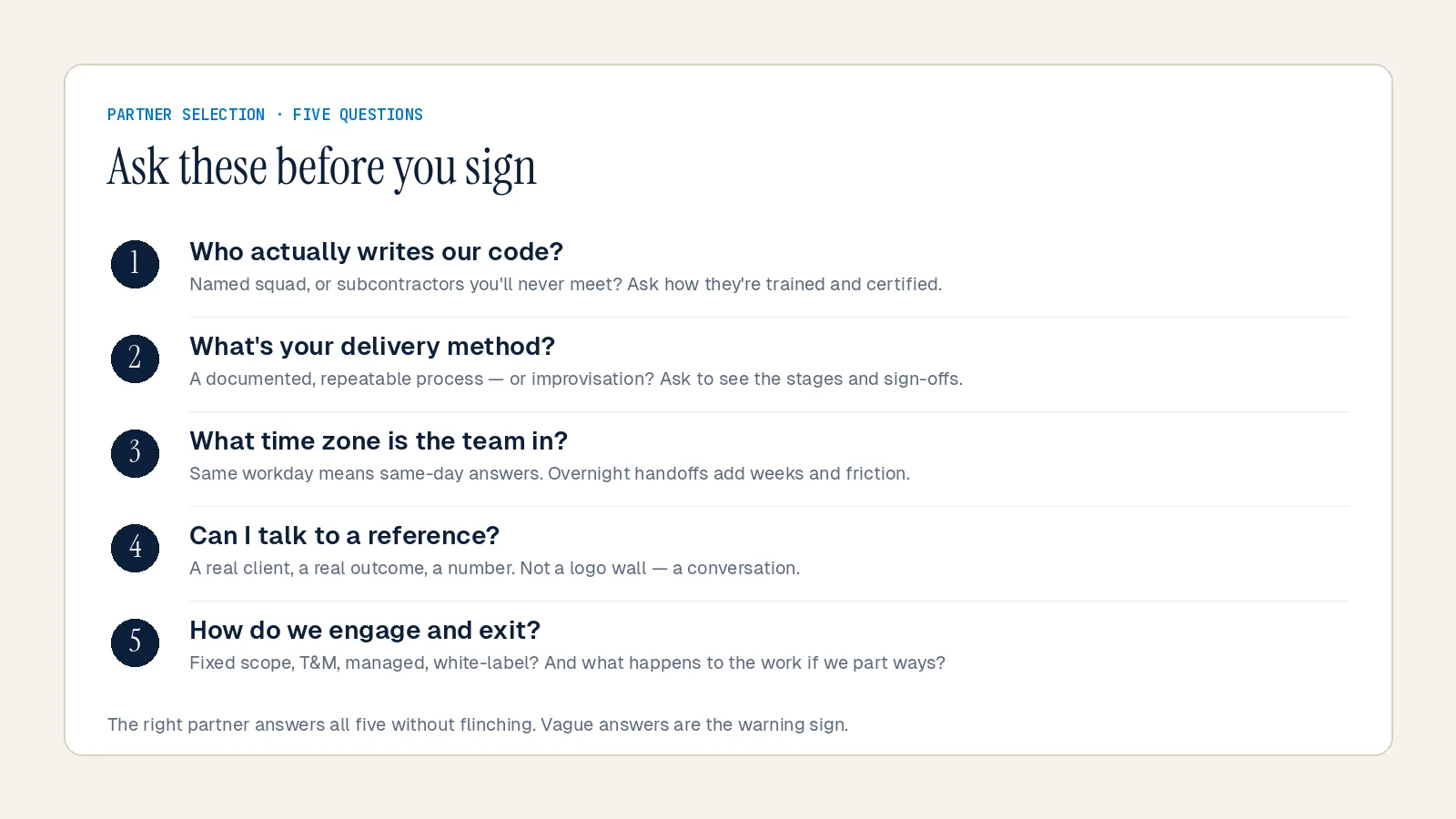
Ask to meet the named project lead and delivery architect — not the sales team.
Ask who will be your primary delivery contact, and what happens if that person leaves or is reassigned.
Ask for the certifications of the individuals assigned to your project, not the firm's aggregate certification count.
Assess the team's communication style and responsiveness. The best partnerships feel like collaboration, not outsourcing.
Staff continuity matters. A revolving door of consultants is one of the most reliable predictors of implementation delays and quality degradation. Get continuity commitments in writing.
Step 5: Scrutinize the Post-Go-Live Support Model
Go-live is not the finish line. It is the starting point.
Salesforce releases three major platform updates per year. Agentforce agents require ongoing tuning. Customizations accumulate maintenance requirements. Organizations that treat implementation as a one-time project and defer the support conversation typically find themselves with what practitioners call "design debt" — a fragmented system with overlapping automations, redundant fields, and unclear processes that become impossible to ignore in year two.
Ask every prospective partner these specific questions:
Do you offer a managed services model, and how is it structured and priced?
Who is the post-go-live escalation contact — and is it the same team that built the org?
How do you handle Salesforce seasonal releases — do you proactively review impact on our configuration?
If you deploy Agentforce, what does ongoing agent performance monitoring look like?
For businesses without internal Salesforce administrators, a managed services engagement is often the most cost-effective way to keep their environment healthy. In 2026, MSP partners are increasingly expected to understand Data Cloud configuration and Agentforce agent tuning — AI deployments require continuous optimization, not just initial setup.
Red Flags to Walk Away From
No checklist replaces judgment, but these signals reliably indicate a partner selection worth abandoning:
They still describe themselves as a Gold or Platinum partner. These tier names were retired in March 2026. A partner using this language without clarifying their current status is not current on their own program standing.
Their proposal doesn't include data migration, training, or post-go-live support. Many firms quote low initial figures but omit these line items from the base proposal. Always ask: *"What's NOT included in this quote?"*
They can't show a live Agentforce deployment. Certifications in AI capabilities are not a substitute for delivery evidence. If AI is on your roadmap, require proof of production deployment.
Senior partners sell, junior consultants deliver — and they won't confirm who's assigned. Push for named team members before the contract is signed.
They skip discovery. A good consultant maps your existing processes, interviews stakeholders, and builds a Salesforce roadmap aligned to your actual KPIs — not a template. Skipping this step is one of the most common reasons Salesforce projects fail.
Summary
Choosing a Salesforce consulting partner in 2026 is a different exercise than it was two years ago. The partner program has restructured around outcomes and specialization. Agentforce has moved from roadmap item to live deployment requirement. The difference between a partner who can navigate this landscape and one who cannot shows up in delivery speed, adoption rates, and total cost of ownership — not in the tier badge on their website.
At Inforge, we deliver full Salesforce implementations through an AI-agent-first delivery model — faster timelines, more consistent quality, and a fraction of the cost of traditional consulting headcount. That's not positioning. That's how we operate every day. If you want to see what that looks like in practice, reach out for a no-obligation scope conversation.
Frequently Asked Questions
Q: What is the difference between a Select Partner and a Summit Partner in 2026?
A: Salesforce introduced just two consulting tiers in March 2026 — Select and Summit — replacing the previous four-tier system. Summit is the higher tier, with advancement now based on measurable customer outcomes rather than certification volume. Summit status can help shortlist candidates, but it should prompt deeper due diligence, not replace it. Always verify the specific competencies a partner holds and the delivery evidence behind their tier.
Q: Do I need a partner with Agentforce experience if I'm not planning to use it yet?
A: Yes — or at minimum, a partner who understands how to build an org architecture that won't obstruct AI deployment later. Even if Agentforce isn't in your immediate scope, partners who have live deployment experience understand Data Cloud data modeling, governance requirements, and the org hygiene that AI agents depend on. Building on a foundation that can't scale to agents will create expensive rework.
Q: How do I find the right Salesforce consulting partner for my industry?
A: Start with Salesforce's Partner Finder on AppExchange, which filters by industry, product expertise, and partner tier. Then validate independently: request industry-specific case studies, confirm the partner holds relevant competencies in the new 28-competency framework, and speak directly with references from similar organizations. Your Salesforce Account Executive can also provide vetted partner recommendations for your region and sector.
Q: What should I include in a Salesforce partner RFP or shortlist evaluation?
A: Cover five areas: (1) tier and active competencies under the 2026 program, (2) AI and Agentforce delivery evidence, (3) vertical industry case studies and references, (4) named delivery team and continuity commitments, and (5) post-go-live support model with specific SLAs and pricing. Ask each partner to walk through how they would approach your specific use case — not a template response.
Q: How much should a Salesforce consulting engagement cost in 2026?
A: Consulting pricing varies significantly by firm size, partner tier, engagement type, and project complexity. Note that Salesforce increased list prices roughly 6% in 2025 for most cloud products, which has pushed overall project costs upward. The more important question is total cost of ownership — including data migration, training, and post-launch support — not the initial line item. Choosing on lowest bid is a documented path to re-implementation costs that dwarf the original savings.
