How to Choose a Salesforce Consulting Partner: A Buyer's Checklist for 2026
"Salesforce partner" isn't a single thing. There are over 4,000 consulting partners on AppExchange. Some have deployed Salesforce for Fortune 500 companies; others have completed three projects and hold a handful of certifications. From the outside, they can look identical — and choosing wrong is expensive. Research puts the CRM implementation failure rate around 55 percent, and the platform is rarely the problem. Poor data migration, inexperienced delivery teams, and a lack of post-go-live support are the real causes.
The ground also shifted in 2026. In March, Salesforce overhauled its entire partner program — retiring the old Gold, Platinum, and tier system many buyers still rely on. If a firm still calls itself "Gold" or "Platinum," that's your first signal they're not current.
Quick Answer: Evaluate a Salesforce consulting partner on five things that actually predict success: relevant industry and complexity experience, the specific certified people who'll do your work (not the ones in the sales meeting), data migration depth, AI and Agentforce readiness, and a concrete post-go-live support model. Use the partner's program tier to shortlist, but let the delivery plan — not the badge — decide the contract.
Key Takeaways:
Salesforce retired the legacy Gold/Platinum tiers in March 2026; the current consulting tracks are Select and Summit. A partner still using the old names isn't current.
As Salesforce's consulting leadership put it, "specialization is the new currency of the agentic era" — the program shifted deliberately away from generalist implementers toward outcome-focused specialists.
A Summit label can help you shortlist, but it doesn't prove the team assigned to your project has solved your exact architecture problem. Always ask for the evidence behind the tier.
Any partner who says "we'll assign our best available resources" without naming individuals is a warning sign — confirm the people in the sales process are the people who deliver.
Data migration and post-go-live support create more failures than any other part of an implementation, and most buyers don't probe them deeply enough.
The Buyer's Checklist
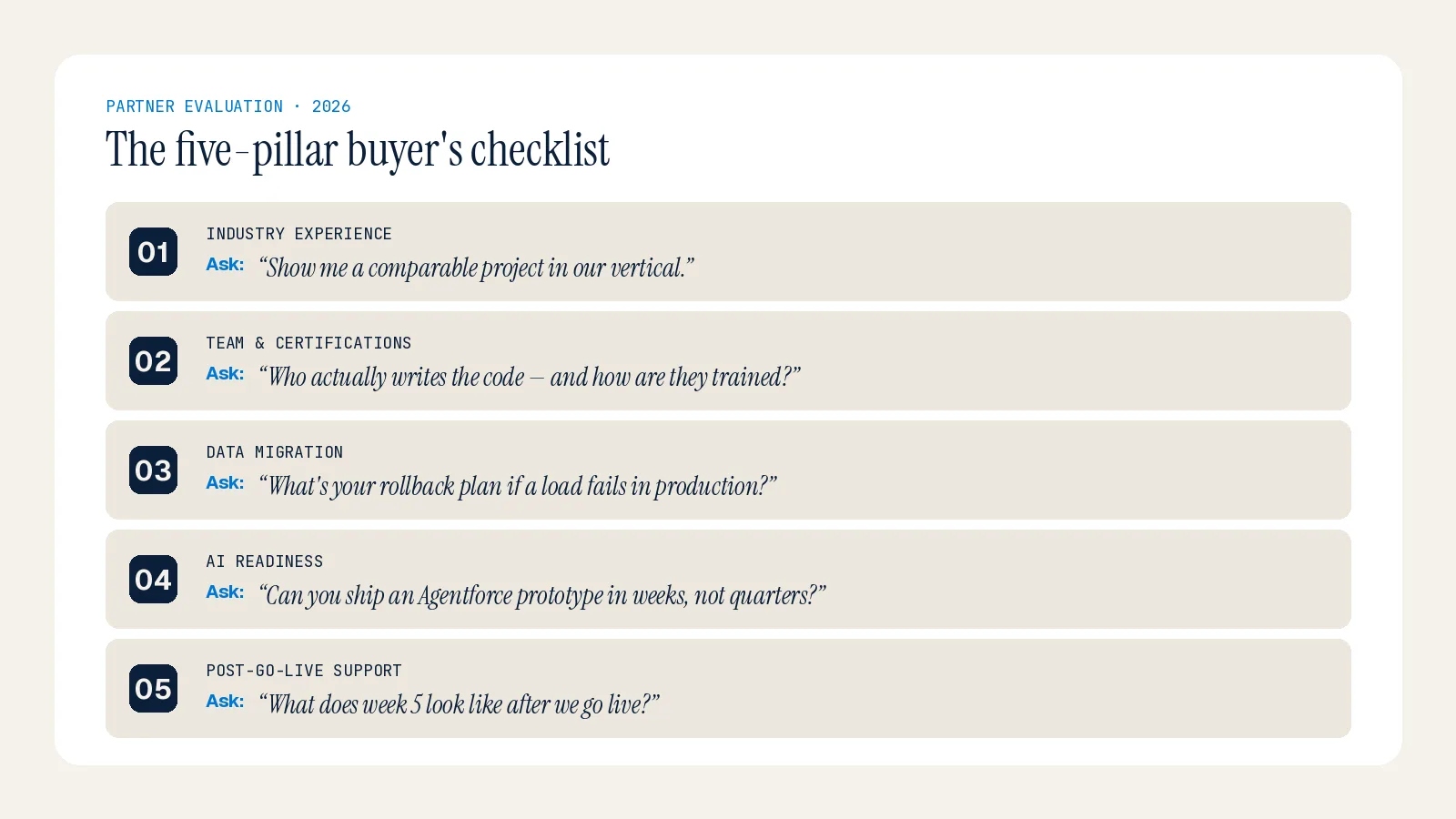
1. Verify current program standing — and look past it. Check the partner's live AppExchange profile for their current tier (Select or Summit as of 2026), number of Salesforce-verified completed projects, and average CSAT (4.5+ is a reasonable benchmark). The tier is a starting filter, not a verdict. Quantity of certifications and deal volume drove the old system; the new one is meant to reward outcomes — so dig into the actual project record behind the label.
2. Demand industry and complexity fit. Regulatory demands, approval workflows, territory models, and engagement patterns differ by vertical, and mistakes there are costly. Ask for two or three completed case studies in your industry or at your level of complexity — and specifically ask what went wrong on those projects and how it was resolved. Partners who only show flawless success stories aren't being fully transparent. A strong partner can describe your industry's standard workflows without being briefed.
3. Name the team. This is where buyers under-probe. Ask for the names and certifications of the specific consultants who will work on your project, the ratio of senior architects to junior consultants on a typical mid-market implementation, and a skill matrix for your project team. In larger firms, senior partners often run pre-sales while junior consultants handle delivery — that's not automatically a problem, but it's a problem when it's a surprise mid-project. Confirm the people you meet are the people who deliver.
4. Probe data migration depth. Moving accounts, contacts, deal history, and relationships from a legacy CRM or spreadsheets is far harder than exporting a file. Poor migration produces duplicate records, broken relationship links, missing history, and data your team won't trust from day one. Ask exactly how they extract, clean, de-duplicate, and validate — and how they preserve relationships between accounts, contacts, and opportunities.
5. Test AI and Agentforce readiness. In 2026, a partner's AI maturity directly shapes your long-term ROI, because Salesforce has moved from hand-configured workflows toward autonomous agents across clouds. Even if your immediate project doesn't involve AI, your environment will eventually need to support it — and a partner with real Agentforce experience will architect your implementation so it doesn't create technical debt when you're ready. Ask about their Data Cloud experience, their Einstein Trust Layer approach for data security, and whether they have a repeatable Agentforce framework. A good signal: they default to a "Flow-first" configuration over custom code to minimize technical debt.
6. Get the post-go-live support model in writing. Salesforce ships three major releases a year, Agentforce agents need ongoing tuning, and customizations need maintenance. Ask how the partner handles post-go-live support: is there a managed service model, how is it priced, and who is the named escalation contact? A partner who treats go-live as the finish line will leave you stranded at the moment you need them most.
Behavioral Signals to Watch in the Evaluation
A partner's behavior during the sales process predicts the engagement. Do they respectfully challenge unrealistic requirements, or agree to everything? Can they explain their architectural decisions and trade-offs in plain language? Do they take ownership of outcomes, not just deliverables? Do they communicate in the style and cadence your team needs? Experienced buyers know that spotting these early signals matters as much as counting certifications.
A Note on Cost and Model
Partner engagements range from a few thousand dollars for basic customization to several hundred thousand for enterprise-wide work. When weighing an in-house hire against a partner, remember a consultant gives you a team of specialists — architects, developers, QA — for roughly the cost of one senior hire, without the recruitment, overhead, and skills-gap risk. A managed services model often delivers more predictable monthly costs than building internal headcount, especially in high-cost talent markets. This is also where a nearshore model earns its place: a partner like Inforge pairs senior Salesforce talent across LATAM with US clients in the same time zones, giving you specialist depth and real-time collaboration without onshore rates.
Summary
The right Salesforce partner is the one whose delivery plan — not whose badge — fits your project. Verify current program standing, demand industry and complexity fit, insist on naming the actual team, probe data migration and AI readiness, and get the support model in writing. The behavioral signals during evaluation tell you the rest. If you're evaluating partners and want a senior, nearshore team that architects for the long term, the Inforge team is happy to walk you through our delivery model.
Frequently Asked Questions
Q: What are the current Salesforce partner tiers in 2026? A: Select and Summit. Salesforce retired the old Gold, Platinum, and Trailblazer-point tier system in March 2026. A partner still using the legacy names isn't current on the program.
Q: Does a Summit tier guarantee a good outcome? A: No. It can help you shortlist, but it doesn't prove the team assigned to your project has solved your specific architecture problem. Always ask for the evidence behind the tier — active competencies, the named certified specialists on your project, similar completed projects, and CSAT.
Q: What's the single most overlooked evaluation area? A: Data migration and post-go-live support. They cause more implementation failures than anything else, and most buyers don't probe them deeply. Ask exactly how data is migrated and validated, and get the support model — pricing and escalation contact — in writing.
Q: Should I hire in-house or use a consulting partner? A: A partner gives you a full team of specialists for roughly the cost of one senior internal hire, without recruitment and overhead. For complex or AI-bound implementations, the depth usually wins — and a nearshore model adds time-zone-aligned collaboration at lower cost.
