How to Choose a Salesforce Consulting Partner: 10 Questions to Ask Before You Sign
Ask questions that reveal how the partner actually works, not just what they've sold before. Every Salesforce partner has logos, certifications, and a polished deck. What separates a good partner from a costly one is who will actually do the work, how they handle discovery and change, how they price, and what happens after go-live. These 10 questions help you find out before the contract is signed.
Quick Answer: To choose the right Salesforce consulting partner, ask about their experience with companies like yours, who will be on your team and their certifications, how they run discovery, how they manage scope changes, how they price the work, how they test and handle data migration, how they drive user adoption, what support looks like after go-live, how they communicate and report progress, and whether they can share references from similar projects. Compare answers side by side, and pay closest attention to team, process, and post-launch support.
Key Takeaways:
The people assigned to your project matter more than the firm's brand or partner tier.
A strong discovery process is the clearest predictor of a successful implementation.
Ask exactly how scope changes are handled and priced before you sign.
Post-launch support and adoption planning are where many partners fall short.
References from projects similar in size, industry, and Salesforce products are worth more than generic case studies.
Why Your Salesforce Partner Choice Matters
Salesforce is only as valuable as the way it's implemented. The same platform can transform a sales team or become an expensive system nobody uses, and the difference often comes down to the partner who designed and built it.
The wrong partner can mean a stalled project, a bloated budget, an org full of technical debt, and users who quietly go back to spreadsheets. The right partner designs around how your business actually works, builds what you need without overcomplicating it, and sets you up to keep improving after launch.
The bottleneck isn't Salesforce. It's choosing who builds it.
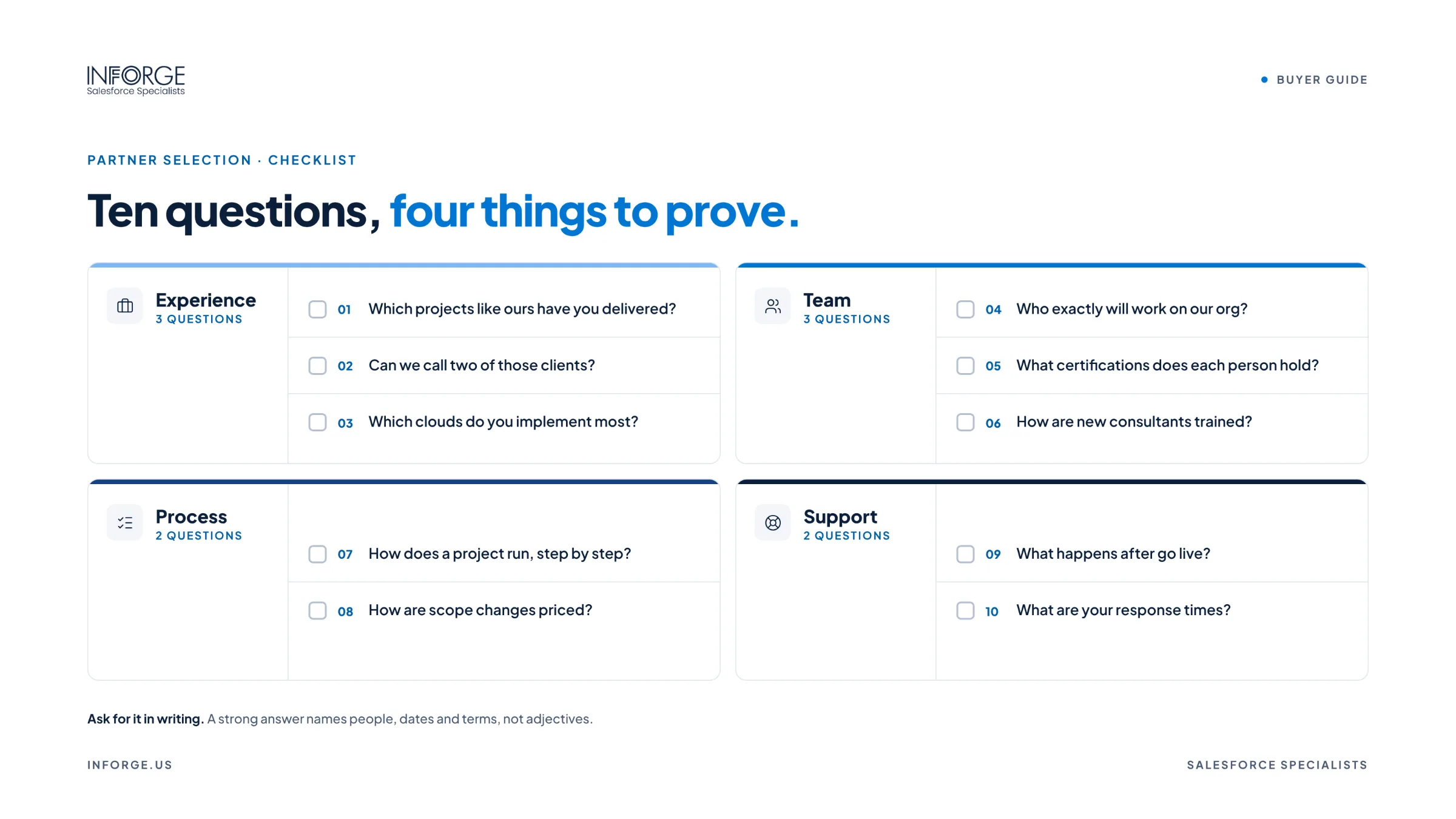
10 Questions to Ask a Salesforce Consulting Partner
1. Have you worked with companies like ours?
Ask about experience in your industry, at your company size, and with the specific Salesforce products you need. A partner who has implemented Health Cloud for a mid-sized provider brings different value than one that mostly does Sales Cloud for startups. Ask for specific examples, not general claims.
2. Who exactly will be on our team?
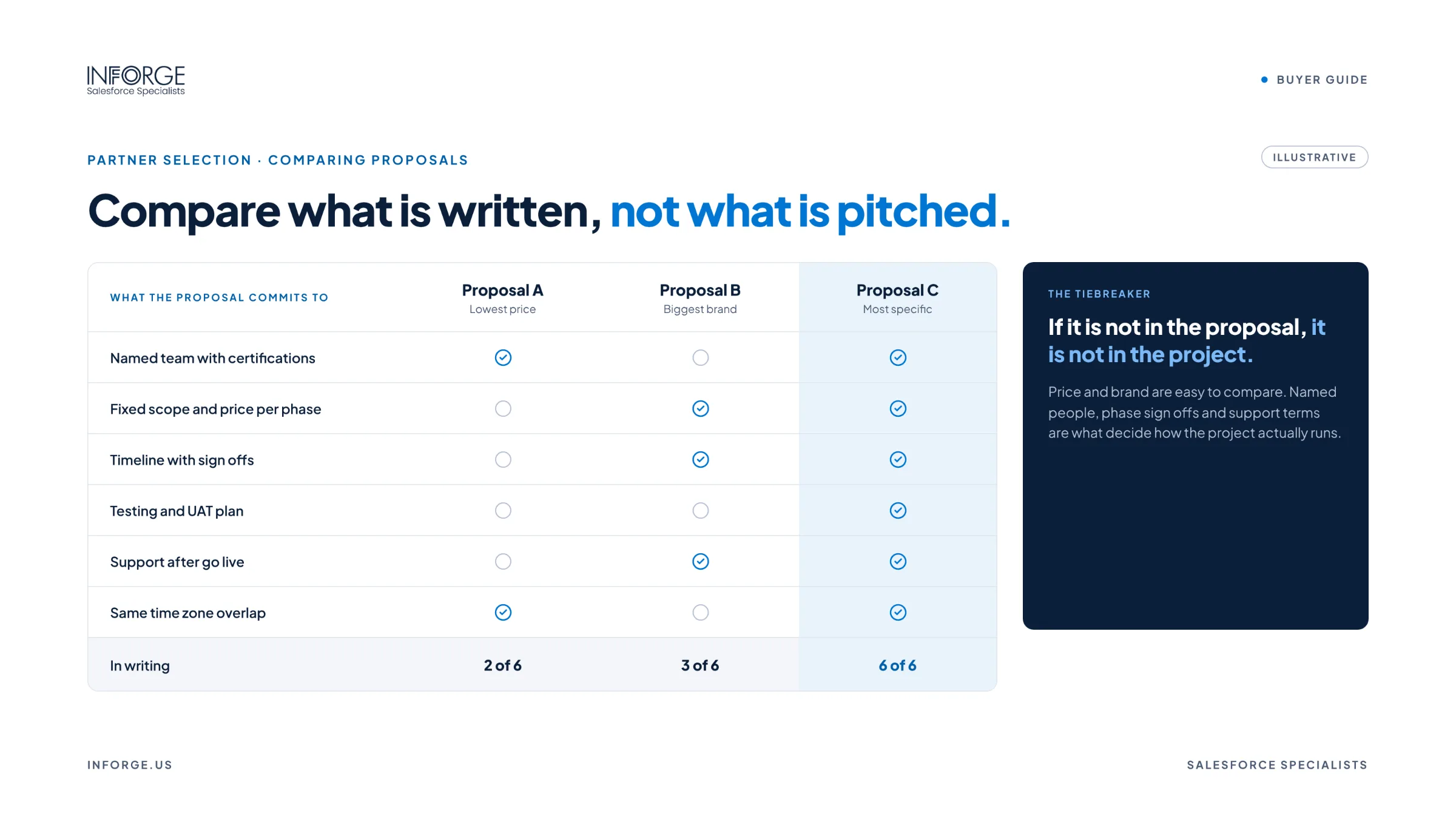
This is the most important question. Ask for names, roles, experience levels, and certifications of the people who will actually work on your project, not just the people in the sales meeting. Ask how much of their time will be dedicated to you and what happens if someone leaves mid-project. Salesforce certifications can be verified through Salesforce's public credential verification.
3. How do you run discovery?
A strong partner spends real time understanding your processes, data, users, and goals before designing anything. Ask what discovery includes, who they'll interview, and what you'll receive at the end. A partner who skips discovery or rushes to build is a red flag.
4. How do you handle scope changes?
Scope always evolves. Ask how changes are requested, evaluated, approved, and priced. A clear change process protects both sides and prevents surprise invoices.
5. How do you price the work?
Understand whether the engagement is fixed price, time and materials, or a retainer, and what's included. Ask what assumptions the estimate is based on and what would cause costs to rise. The cheapest proposal is often the one with the most assumptions.
6. How do you approach data migration and testing?
Ask how they audit and clean data, map fields, test in sandboxes, and validate results. Ask who is responsible for user acceptance testing and how defects are tracked and resolved.
7. How do you drive user adoption?
A technically perfect implementation still fails if nobody uses it. Ask about training approach, documentation, change management support, and how they design for ease of use.
8. What happens after go-live?
Ask about hypercare support immediately after launch, ongoing managed services options, response times, and how enhancements are handled. Salesforce releases updates three times a year, so long-term support matters.
9. How will you communicate and report progress?
Ask about meeting cadence, status reports, project management tools, and who your main point of contact will be. For offshore or nearshore teams, ask about time zone overlap and availability during your business hours.
10. Can we speak with references from similar projects?
Ask for two or three references from clients with similar size, industry, and scope. Ask those references what went well, what didn't, and whether they'd hire the partner again.
Red Flags to Watch For
The A team sells, the B team delivers. Senior people in the sales process who disappear after signing.
Vague answers about who's on the project. If they can't name the team, they may not have one ready.
No real discovery phase. Jumping straight to building usually means building the wrong thing.
Estimates with no assumptions listed. Expect change orders later.
Overcustomization. Recommending custom code for problems standard features or Flow could solve.
No post-launch plan. Partners who disappear at go-live leave you with a system nobody can maintain.
Partner Tier, Size, and Location: What Really Matters
Salesforce ranks consulting partners in tiers based on factors like certifications, customer success, and project volume. Tier can be a useful signal, but it's not the whole story. A smaller partner with deep experience in your industry and a dedicated, senior team may deliver better results than a large firm that assigns junior consultants.
Location matters too. Nearshore partners in Latin America give US companies real-time collaboration during business hours at a lower cost than equivalent US-based teams, without the time zone gaps of offshore models.
At Inforge, we've found that the best partner relationships aren't built on the flashiest proposal. They're built on a clear discovery process, a dedicated team the client actually knows, honest pricing, and support that continues long after go-live.
Summary
Choosing a Salesforce consulting partner is one of the biggest decisions in your Salesforce journey. Ask about relevant experience, the exact team assigned, discovery, scope changes, pricing, data migration and testing, adoption, post-launch support, communication, and references. Watch for red flags like vague staffing, skipped discovery, and estimates without assumptions. The right partner designs around your business, builds what you need, and stays with you after launch.
Inforge is a nearshore Salesforce consulting partner providing consultants, admins, architects, and developers from Latin America to US companies, working in your time zone as an extension of your team.
Frequently Asked Questions
Q: How do I choose the right Salesforce consulting partner?
A: Compare partners on relevant industry and product experience, the specific team assigned to your project, their discovery and change management process, pricing transparency, testing and migration approach, adoption support, post-launch services, and references from similar projects.
Q: Does a Salesforce partner's tier matter?
A: Tier is a useful signal of certifications and customer success, but it isn't everything. The experience and seniority of the team assigned to your project, and their familiarity with your industry, often matter more.
Q: Should I choose a fixed price or time and materials engagement?
A: Fixed price works well for clearly defined scopes. Time and materials or retainer models work better when requirements are evolving. In either case, make sure assumptions and the change process are clearly documented.
Q: What are red flags when hiring a Salesforce partner?
A: Watch for partners who can't name the team that will do the work, skip discovery, provide estimates without assumptions, recommend unnecessary custom code, or have no plan for support after go-live.
Q: Is a nearshore Salesforce partner a good option for US companies?
A: Yes, for many companies. Nearshore partners in Latin America work in overlapping time zones, enabling real-time collaboration, often at lower cost than domestic teams and without the communication delays of offshore models.