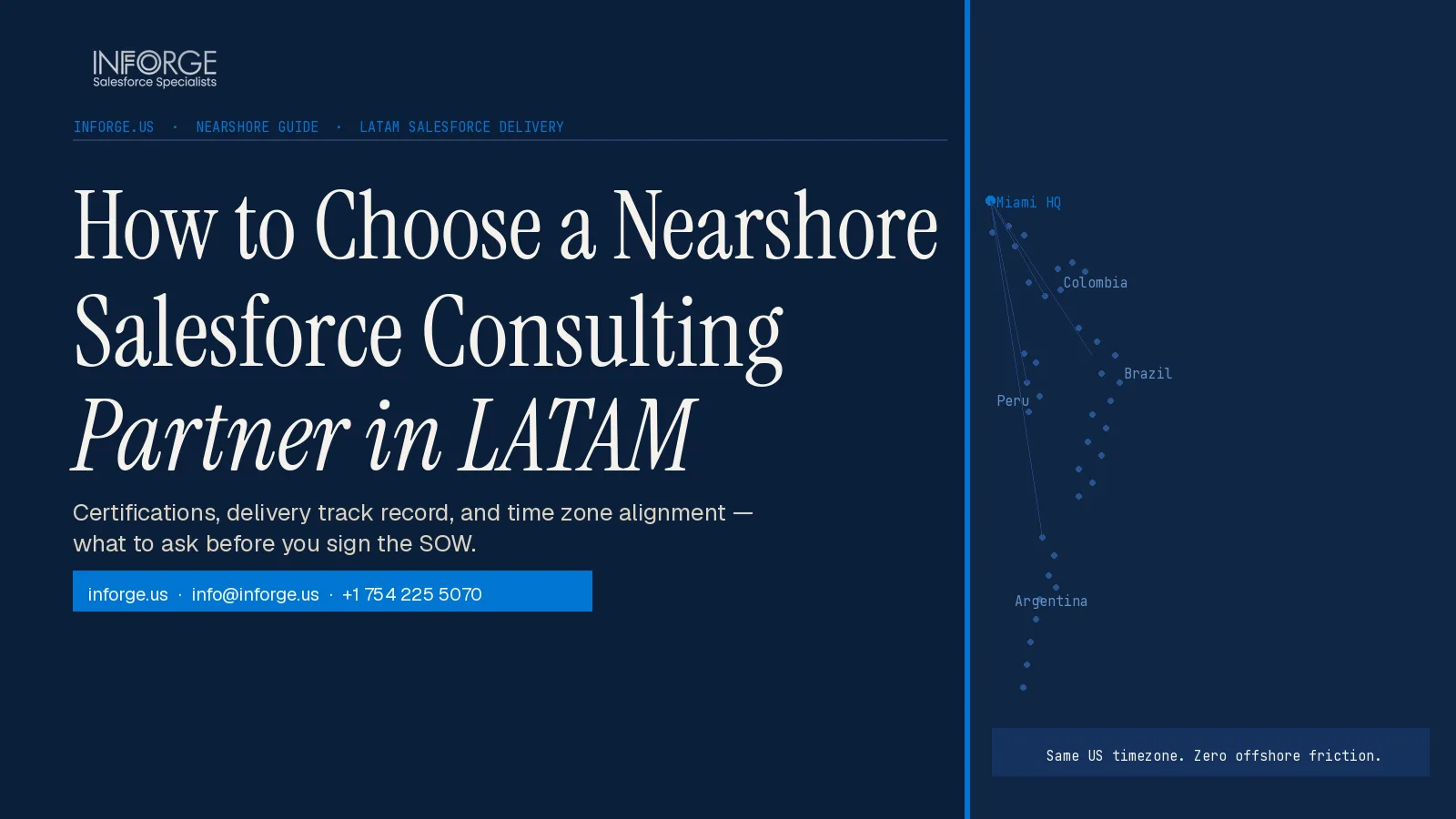
How to Choose a Nearshore Salesforce Consulting Partner in LATAM
If you are evaluating nearshore Salesforce consulting partners in Latin America, the right answer is not whoever has the most badges on AppExchange. The right answer is the partner whose delivery model matches your project complexity, whose senior talent will actually work your account, and who can prove outcomes — not just list certifications. LATAM has matured into one of the world's most dynamic Salesforce talent hubs, but that maturity also means the market is crowded with uneven options. This guide tells you exactly what to look for.
Quick Answer: Choose a nearshore Salesforce partner in LATAM by verifying their AppExchange CSAT score, Trailblazer tier (Crest or Summit), senior-to-junior team composition, Agentforce/AI certifications, and industry fit — in that order. Time-zone alignment and cost savings come standard; delivery quality does not.
Key Takeaways:
LATAM outsourcing is growing from $17.9B in 2024 to a projected $27.6B by 2028 — the talent pool is large, but quality varies sharply.
Nearshore LATAM teams cost 30–50% less than equivalent U.S. Salesforce talent without sacrificing seniority when vetted correctly.
According to Bain & Company, 80% of COOs plan to increase nearshoring over the next three years — demand is compressing the supply of strong partners.
The most common failure mode is hiring a junior-heavy team that stalls on architecture decisions. Verify team composition before signing.
AI readiness (Agentforce, Data Cloud, Flow automation) is now a non-negotiable filter, not a nice-to-have.
At Inforge, we deliver full Salesforce implementations through an AI-agent model — and it is this approach that makes us uniquely positioned to help you evaluate what a modern LATAM partner should look like.
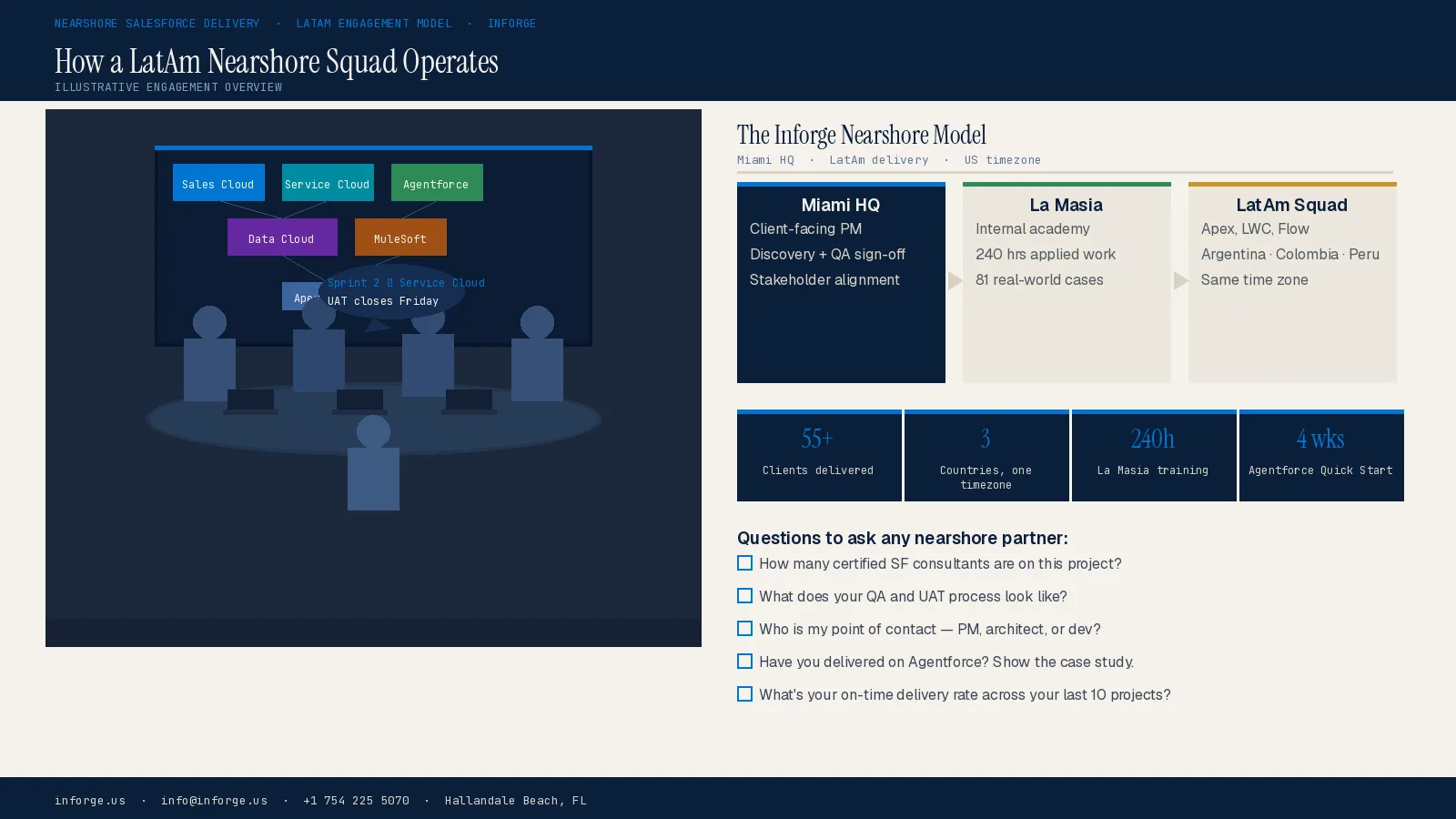
Why LATAM Has Become the Default Nearshore Salesforce Region
LATAM is not a fallback option. It is the preferred nearshore destination for U.S.-based companies running Salesforce, and the data backs that up.
According to a report by Assuresoft and The Future of Work in Latin America and the Caribbean, outsourcing to Latin America is forecasted to grow from $17.9 billion in 2024 to $27.6 billion by 2028. Mordor Intelligence projects the Latin American IT services market will expand at a 7% compound annual growth rate through 2030, fueled by demand for cloud computing, AI, and enterprise software delivery.
On the talent side, South America experienced the highest Salesforce talent supply growth globally — 42% year-over-year, according to Tercera's analysis of the Salesforce ecosystem. Companies like Salesforce itself have taken notice: the platform announced a $500 million investment in Argentina over five years, focused on workforce development and AI innovation.
For U.S.-based buyers, three structural advantages make LATAM compelling:
1. Time-zone alignment. Nearshore teams in LATAM share 3–5 hours of overlap with U.S. time zones, enabling daily standups, same-day decisions, and real-time collaboration — something a 10-12 hour offshore gap cannot replicate.
2. Cost efficiency. According to TECLA, Latin American Salesforce consultants cost 30–50% less than U.S. equivalents on average — with nCube's 2026 rate analysis confirming LATAM hourly rates of $55–$95 for mid-to-senior profiles versus $150–$300+ for U.S.-based consultants.
3. Cultural and business alignment. LATAM consultants are typically bilingual and trained in U.S. business practices, reducing the friction that offshore models introduce.
The region is not uniform, however. Mexico, Argentina, Colombia, and Brazil have distinct talent densities, cost structures, and risk profiles. Knowing which country your partner is primarily staffed from matters more than the partner's marketing website suggests.
The 6 Criteria That Actually Matter When Evaluating a Partner
Most buyers default to partner tier and logo count. Both are proxies for quality, not proof of it. Here is the evaluation framework that separates strong LATAM partners from expensive disappointments.
1. Salesforce Partner Tier and CSAT Score
Salesforce's partner program uses four tiers — Base, Ridge, Crest, and Summit — based on a composite Trailblazer score that covers certifications, customer success scores, and innovation. According to Salesforce's own partner program documentation, higher partner tiers correlate with early access to new platform releases (including Agentforce and Data Cloud), more Certified Technical Architects on staff, and stronger compliance with Salesforce delivery standards.
For mid-market companies, a Crest or Summit tier partner is the right minimum bar. Below that, you are taking on delivery risk that CSAT scores and reference calls alone may not surface in time.
Do not stop at the tier. Pull the partner's AppExchange CSAT score and read the actual review content — AppExchange reviews are often written after clients experience post-implementation support, not at go-live, which means they capture what matters most: whether the partner stuck around and fixed what needed fixing.
2. Team Composition: Senior-to-Junior Ratio
This is the single most common failure mode in nearshore LATAM engagements.
According to nCube, junior-heavy squads handle execution well but stall when architecture decisions need to be made, accumulating technical debt that takes months to unwind. The right question to ask any LATAM partner is not "how many certified consultants do you have?" — it is "who specifically will work my project, and what is their certification and project history?"
Verify:
The Solution Architect assigned to your project (not a title, a named person with a traceable record)
The ratio of senior/lead to mid-level engineers on the proposed team
Whether the partner has a documented retention strategy — Salesforce professionals with Agentforce and Data Cloud skills are in high global demand, and without retention structure, senior talent moves on mid-project
A dedicated nearshore unit (architect + engineers + admin/QA) in LATAM typically runs $20,000–$50,000/month. If a partner is pricing significantly below this range, audit the team composition carefully.
3. AI and Agentforce Readiness
The Salesforce platform has moved decisively toward agentic AI. Agentforce closed 2025 with $1.4 billion in annual recurring revenue and 18,500 total deals, growing 50% quarter-over-quarter. Partners who cannot demonstrate hands-on Agentforce, Data Cloud, and Flow automation experience are already behind the platform's trajectory.
Ask partners directly:
Have they delivered an Agentforce implementation? What was the use case and outcome?
Do they hold AI Specialist or Data Cloud certifications across the team, not just one person?
Can they articulate the difference between rules-based automation and agentic workflows — and when each is appropriate?
According to Salesforce Ben's analysis of the 2025 AI cycle, a key challenge with Agentforce in real enterprise deployments was inconsistent AI behavior, requiring partners to implement structured scripting layers and governance. Partners who have navigated this in practice are worth more than those who have only read the release notes.
At Inforge, our entire delivery model is built on AI agents — we use them to run Salesforce implementations, not just advise on them. That experience gives us a different perspective on what LATAM partners genuinely understand about agentic delivery versus what they say in a pitch.
4. Industry Depth and Vertical Fit
A Salesforce partner with general CRM experience will deliver a general CRM implementation. Mid-market companies in financial services, healthcare, manufacturing, or e-commerce need partners who understand the compliance requirements, data models, and workflow patterns specific to their industry.
According to research from SummitTech and TTMS, industry-specific experience is one of the highest-signal evaluators — partners who know your vertical solve problems faster, ask better discovery questions, and avoid the costly architecture decisions that generalist partners miss in scoping.
When requesting references, ask specifically for clients in your industry at similar revenue scale — not Fortune 500 logos used to signal capability that does not transfer to your engagement size.
5. Delivery Methodology and Post-Go-Live Support
The era of scope-build-deploy-exit is over. According to Peergenics' 2025 Salesforce consulting trends analysis, organizations are shifting to embedded support models that deliver ongoing value, with managed services turning Salesforce into a system that evolves with the business rather than behind it.
Evaluate:
Does the partner offer a formal managed services or retainer model post-implementation?
How do they handle scope change — fixed-price contracts, milestone-based billing, or flexible monthly models?
What is their SLA for critical issue resolution after go-live?
Partners who disappear at deployment create technical debt and user adoption problems that cost more to fix than the original implementation. Ask for post-go-live references, not just launch references.
6. Data Security and Compliance Posture
Nearshore engagements involve sharing data, credentials, and system access across jurisdictions. This is not a checkbox — it is a risk that has real financial consequences.
As Peergenics notes, the average cost of a U.S. data breach in 2023 hit $9.48 million. Salesforce implementations involve sensitive CRM data by definition. Any partner operating in LATAM should be able to produce:
Signed NDAs and data processing agreements before discovery begins
Evidence of SOC 2 Type II compliance or equivalent
A documented least-privilege access protocol for their engineers
Clarity on which country's jurisdiction governs the engagement
Red Flags to Filter Out Early
The LATAM Salesforce market is not uniformly excellent. Here are the signals that a partner will cost you more than they save:
Vague team assignments. If a partner cannot name the architect and lead developer before contract signature, they are staffing your project from a bench pool after the sale.
No AppExchange reviews or very few. A legitimate consulting partner with real delivery history has reviews. Absence of reviews in 2026 is a risk signal.
AI capability limited to one certified person. Agentforce and Data Cloud delivery requires team-wide fluency, not a single specialist who becomes a bottleneck.
Pricing that sounds too low. According to nCube's 2026 rate benchmarks, a LATAM senior Salesforce specialist runs $75–$95/hour. Blended team rates well below market signal junior-heavy resourcing.
No post-implementation model. Partners who only sell project engagements have no incentive to build maintainable solutions.
References that do not match your profile. Large enterprise logos on a slide deck say nothing about how this partner handles mid-market complexity and budget constraints.
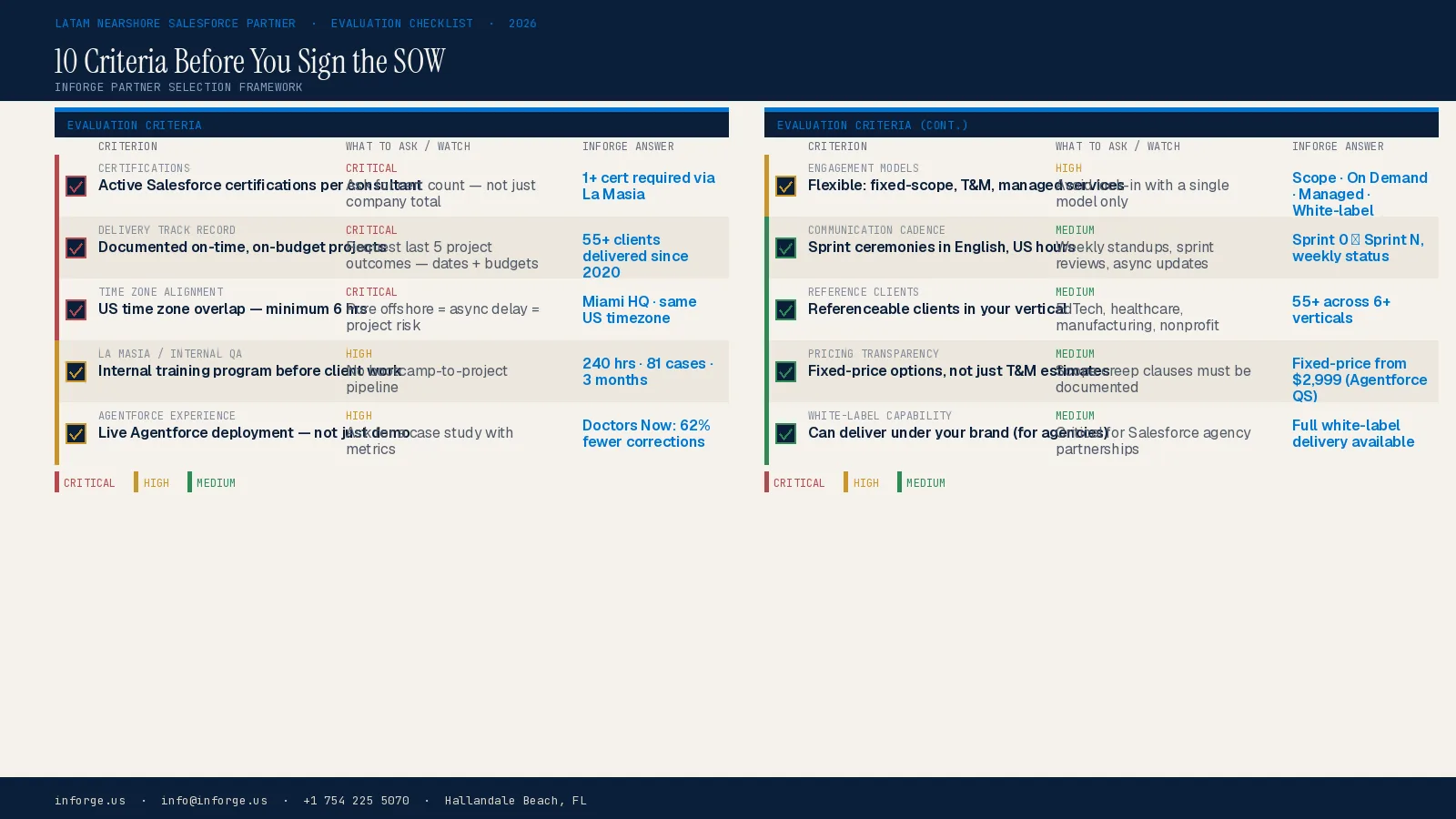
What the Best LATAM Partners Have in Common
After evaluating delivery models across the region, the strongest LATAM Salesforce partners share a consistent profile:
Certified at Crest or Summit tier with a CSAT score above 4.7 on AppExchange
Multi-cloud capability across Sales, Service, Marketing, and at minimum one industry cloud
Named senior talent with verifiable project history in similar engagements
AI-native delivery — meaning they use AI to accelerate delivery, not just configure Salesforce features
Transparent pricing with clearly defined milestone payments and change order protocols
Managed services capability for post-go-live continuity
The bottleneck is not finding LATAM partners — the AppExchange lists over 3,800 registered consultancies. The bottleneck is finding the handful whose delivery quality matches their marketing. That vetting work is not optional; it is what separates a successful Salesforce ROI from a six-figure sunk cost.
[INTERNAL LINK: anchor = "how AI agents are changing Salesforce delivery", topic = AI-agent delivery model explainer post]
Summary
LATAM is the right region for nearshore Salesforce consulting — the time-zone alignment, talent depth, and cost structure make it a structurally sound decision. But the region's growth means the partner market is uneven, and the evaluation shortcuts most buyers rely on (tier, logo count, price) are the same shortcuts that lead to failed implementations. Apply the six criteria in this guide — CSAT and tier, team composition, AI readiness, industry depth, delivery methodology, and compliance posture — and you will cut through the noise quickly.
At Inforge, we have replaced traditional consulting headcount with an AI-agent delivery model. That is not a pitch — it is how we run every engagement. If you want to understand what that means for your Salesforce project timeline and budget, start with a conversation.
Frequently Asked Questions
Q: What is the typical cost of a nearshore Salesforce consulting engagement in LATAM?
A: A dedicated LATAM team (architect, engineers, admin/QA) typically runs $20,000–$50,000 per month, compared to $60,000–$100,000+ for an equivalent onshore unit. Hourly rates for senior Salesforce specialists in LATAM range from $75–$95, versus $150–$300+ for U.S.-based consultants. The savings are real — but only if you are comparing equivalent seniority levels.
Q: How do I verify a Salesforce partner's CSAT score in LATAM?
A: AppExchange is the primary source. Search the partner by name, check their star rating and review count, and read the review content (not just the score). Also ask for their Trailblazer consulting partner tier directly — Crest and Summit partners are assessed on customer success metrics that feed into that score.
Q: What Salesforce certifications should a LATAM partner have in 2026?
A: At minimum, look for certifications across Sales Cloud, Service Cloud, and at least one industry cloud. Increasingly important are AI Specialist, Data Cloud Consultant, and Agentforce-specific credentials. A partner without AI certifications across the team is behind the platform's current direction.
Q: Is nearshore LATAM better than offshore India for Salesforce projects?
A: For U.S.-based companies, nearshore LATAM typically outperforms offshore India on collaboration quality. A 10–12 hour time difference leads to fragmented communication and delayed feedback loops on Salesforce projects, which require daily iteration. LATAM offers 3–5 hours of real-time overlap. Offshore rates are lower, but the coordination cost usually offsets the savings on complex implementations.
Q: What should I ask a LATAM Salesforce partner in the first call?
A: Ask three things: Who specifically will be the Solution Architect on my project? Can you show me an Agentforce or AI automation project you have delivered and the measurable outcome? And can you provide two references from clients in my industry at similar company size? Partners who cannot answer all three clearly in that first conversation are not ready for your project.
