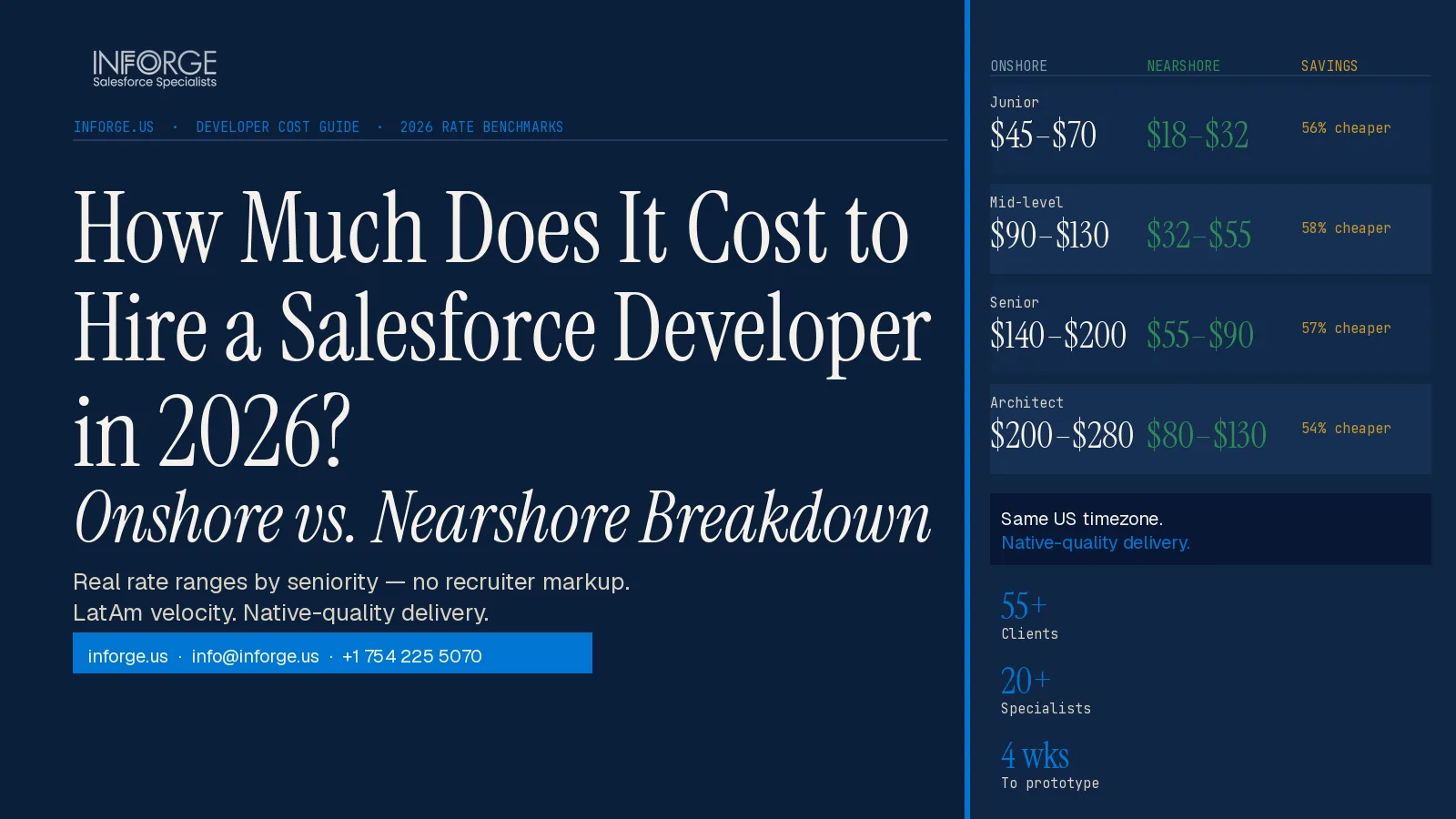
How Much Does It Cost to Hire a Salesforce Developer in 2026? (Onshore vs. Nearshore Breakdown)
Hiring a Salesforce developer in 2026 costs anywhere from $35 per hour nearshore to $180+ per hour onshore for senior specialists — but the sticker price is only the beginning. Add benefits, recruiting overhead, tooling, and training, and a US-based full-time hire quickly runs $180,000–$220,000 in total annual spend before a single line of Apex is written.
Quick Answer: A mid-level Salesforce developer in the United States costs $100,000–$147,000/year in base salary, or $60–$120/hr on contract. Nearshore (Latin America) equivalents run $55–$70/hr for mid-level and $75–$95/hr for senior talent — delivering 40–60% cost savings with full time zone overlap.
Key Takeaways:
Onshore US salaries range from ~$98K (median) to $170K+ for top-10th-percentile developers, with contractor bill rates hitting $90–$180/hr for senior roles.
Nearshore LATAM developers bill at $25–$95/hr depending on seniority, saving companies 40–60% versus US equivalents.
The real cost of an onshore hire exceeds base salary by 20–40% once benefits, recruiting, tooling, and training are factored in.
Senior and Agentforce-capable Salesforce developers command a significant premium — Technical Architects represent just 1% of global supply while demand grew 27% in 2025.
An AI-agent delivery model (like the one Inforge uses) can eliminate the hiring decision entirely for implementation work — at a fraction of both onshore and nearshore rates.
What Onshore Salesforce Developers Actually Cost in 2026
Onshore hiring in the US delivers maximum control, zero time-zone friction, and the deepest bench of enterprise Salesforce experience. It also carries the highest price tag in the market.
According to Glassdoor, the average Salesforce developer salary in the US is $130,287/year ($63/hr) as of June 2026, based on 6,700 self-reported salaries. Top earners reach $189,604 at the 90th percentile. ZipRecruiter places the figure slightly lower at $129,181/year, with the bulk of salaries ranging between $111,000 (25th percentile) and $147,000 (75th percentile).
Salary.com reports $98,348/year as of April 2026 — a figure that skews toward mid-market companies and reflects a broader range of experience levels, with the salary band running $83,786 to $112,425.
The spread between platforms is not noise — it reflects real market segmentation:
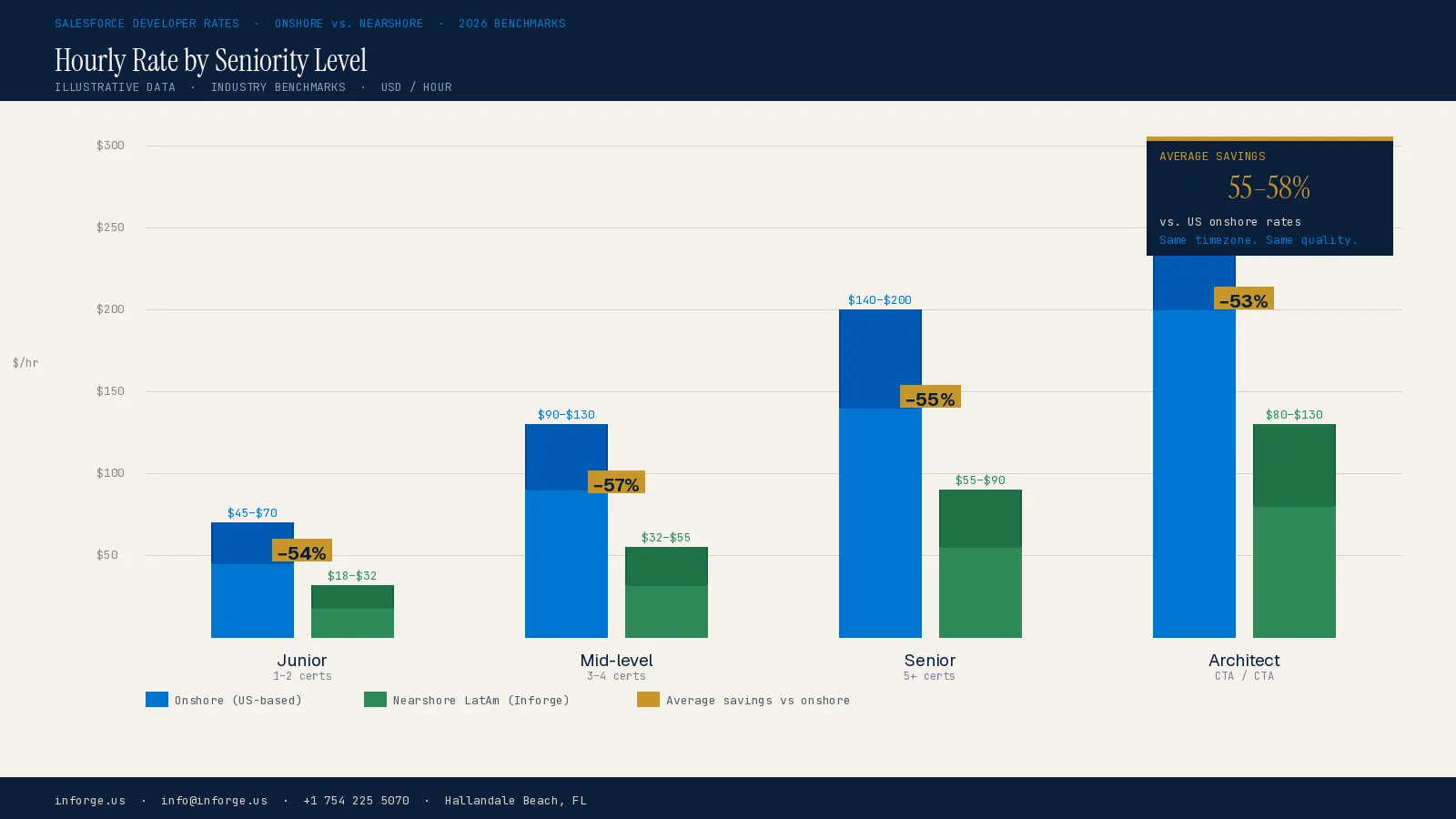
Junior developers (US): $61–$79K/year; $45–$62/hr on contract
Mid-level developers (US): $98K–$130K/year; $60–$100/hr on contract
Senior developers (US): $140K–$170K/year; $100–$160/hr on contract
Technical Architects (US): $160K–$200K+/year; $150–$200+/hr on contract
Contract rates carry a staffing firm markup (typically 1.3–1.65x over the developer's pay), which is why a developer earning $63/hr may generate a client-facing bill rate of $83–$106/hr through a domestic staffing firm.
For specialized capabilities, the premium is steeper. Developers with Agentforce and Data Cloud skills — the fastest-growing specialization in the ecosystem — are no longer a $120K hire. Industry recruiter data from KORE1 confirms that "Data Cloud and Agentforce-capable" candidates command compensation well above that threshold, with the market having repriced these skills upward since mid-2025.
The Hidden Costs Onshore Hiring Doesn't Advertise
Base salary is the floor, not the ceiling. The real cost of a full-time US Salesforce hire includes:
Benefits: Healthcare, retirement contributions, and paid leave add 20–40% to base compensation in most US markets.
Recruiting: Job advertising, recruiter fees (typically 15–20% of first-year salary for agency placements), and interview time.
Tooling and environment: Salesforce development requires sandbox environments, deployment tools, and integration platforms — costs your new hire doesn't bring with them.
Continuous training: Salesforce releases platform updates three times per year (Spring, Summer, Winter). Keeping a developer current is an ongoing line item.
Opportunity cost: Delayed hiring postpones automation improvements and reduces operational efficiency — indirectly affecting revenue growth while the role sits open.
When evaluated holistically, a $130K base salary can translate to $175,000–$195,000 in total annual cost before you account for productivity ramp time.
What Nearshore Salesforce Developers Cost in 2026
Nearshore hiring — primarily Latin America for US companies — is the model gaining the most traction among mid-market Salesforce users in 2026. The math is straightforward: comparable technical skills at 40–60% of US rates, with full workday overlap and no meaningful time-zone gap.
According to nCube, in 2026 nearshore LATAM hourly rates for Salesforce developers break down as follows:
Junior: $25–$50/hr
Mid-level: $55–$70/hr
Senior / AI+Data specialists: $75–$95/hr
For annual full-time equivalents, Tecla reports that Salesforce developers in Latin America typically earn between $60,000 and $100,000/year — roughly 40–60% below US counterparts at equivalent seniority levels. Nearshore providers confirm that a Salesforce developer who costs $90–$180/hr onshore in the US might run $35–$70/hr through a nearshore LATAM team.
A dedicated unit of Salesforce professionals — architect, software engineers, admin or QA — typically runs $20,000–$50,000/month in LATAM. An equivalent onshore unit would cost $60,000–$100,000+/month.
Country-by-Country Rate Breakdown (LATAM)
Mexico
Junior: $25–$35/hr
Mid-level: $35–$45/hr
Senior: up to $80/hr
Strong US time zone alignment and growing AI/cloud specialization
Brazil
Junior: $20–$28/hr
Mid-level: $28–$35/hr
Senior: $40–$60/hr
Largest overall talent pool; concentration in São Paulo, Rio, and Curitiba
Argentina
Junior: $18–$25/hr
Mid-level: $25–$35/hr
Senior: $35–$55/hr
Competitive rates with strong engineering fundamentals
Colombia
Rates similar to Argentina; 68% of engineers hold Bachelor's or Master's degrees
Ideal for budget-conscious projects without sacrificing quality
The LATAM IT market is projected to grow at a 6.5% annual rate through 2030, reinforcing the region's long-term viability as a nearshore development hub — not just a cost play.
Why Nearshore Works: The Time-Zone Advantage
Latin American professionals work within 1–3 hours of US Eastern Time, enabling live standups, same-day code reviews, and real-time incident response. This addresses the primary failure mode of offshore (Asia/Eastern Europe) engagements: the 10–12-hour time difference that fragments communication and slows issue resolution.
For Salesforce implementations specifically — where sprint reviews, user acceptance testing, and stakeholder alignment require real-time back-and-forth — timezone overlap is not a nice-to-have. It is a delivery requirement.
Onshore vs. Nearshore: Side-by-Side Comparison
| Factor | Onshore (US) | Nearshore (LATAM) |
|---|---|---|
| Junior hourly rate | $45–$62/hr | $25–$50/hr |
| Mid-level hourly rate | $60–$100/hr | $55–$70/hr |
| Senior hourly rate | $100–$160/hr | $75–$95/hr |
| Architect hourly rate | $150–$200+/hr | $90–$120/hr |
| Annual salary (mid-level) | $98K–$147K | $60K–$100K |
| Benefits overhead | +20–40% | Typically covered by provider |
| Time zone overlap (US) | Full | Full (1–3 hr difference) |
| Hiring timeline | 6–12 weeks avg | 2–6 weeks with nearshore partner |
| Typical cost savings vs. US | — | 40–60% |
The Seniority Gap: Where the Real Scarcity Sits
The most important pricing signal in the 2026 Salesforce market is not about geography — it is about the growing chasm between junior and senior supply.
The junior band is crowded. Salesforce's Trailhead platform and a wave of bootcamps have flooded the entry level with newly certified candidates who have badges but limited production experience. Meanwhile, according to Salesforce Ben's 2026 job trends analysis, developer is the only Salesforce ecosystem role where demand actually decreased year over year at entry levels — driven partly by this supply glut and partly by low-code tools like Flow absorbing work that used to require Apex.
At senior levels, the opposite is true. Technical Architects represent just 1% of global Salesforce talent supply, while demand for that role grew 27% in 2025 while supply grew only 4%. The 10K Consulting 2025 Talent Ecosystem Report confirms this is the widest demand-supply gap of any role in the ecosystem.
For Agentforce and Data Cloud specialists specifically — the skills driving the most enterprise urgency in 2026 — candidates with production-level Agentforce experience command salaries $15,000–$35,000 above equivalent non-AI roles. By March 2026, production Agentforce deployments were active at mid-market and enterprise companies across financial services, healthcare, and retail.
The practical implication: budget models built on average developer salaries will fail if you actually need senior talent. The market for qualified senior Salesforce developers — architects, Agentforce specialists, Data Cloud engineers — prices and behaves like a different market entirely.
Hiring Models: Which One Fits Your Situation?
Beyond geography, the engagement model determines cost structure. Each model has a different risk/cost/speed profile:
Full-Time Employee (FTE)
Best for orgs with ongoing Salesforce needs that justify permanent headcount. Highest total cost (salary + benefits + overhead), but deepest institutional knowledge over time. Continuity reduces onboarding cycles and knowledge loss — but it also locks you into a fixed cost even when project demand fluctuates.
Contract / Staff Augmentation
Best for implementations with a defined scope — cloud migrations, Agentforce buildouts, specific integration projects. You pay a premium hourly rate, but avoid benefits overhead and long-term headcount commitment. Nearshore staff augmentation is the fastest-growing model in mid-market Salesforce because it combines rate efficiency with deployment speed (2–6 weeks to onboard vs. 6–12 weeks for FTE).
Consulting Agency
Agencies carry the highest per-hour rates (particularly for US-based firms), but offset cost with team depth — architect + engineers + QA under a single engagement. For complex implementations requiring multi-cloud expertise, the agency model often delivers better total outcomes than assembling an equivalent team from scratch.
AI-Agent Delivery (The Emerging Model)
This is where the market is moving, and where the economics change fundamentally. At Inforge, we've replaced the traditional delivery model entirely — Salesforce implementations delivered via AI agents, not headcount. The result: faster timelines, more consistent quality, and a fraction of the cost of any traditional hiring model.
For mid-market companies evaluating Salesforce implementations in 2026, the question is no longer just "onshore or nearshore?" It is increasingly: "Do I need to hire at all?"
What the 2026 Salesforce Job Market Signals
The current market shows a clear bifurcation:
Supply is high at the bottom. The Salesforce ecosystem has seen broad contraction in available roles relative to candidates — with supply of available people still outpacing role demand at junior levels. This is an employer's market for entry-level talent. Companies have more candidates to choose from, processes take longer, and compensation leverage has shifted toward the buyer.
Scarcity is acute at the top. Experienced professionals who can architect solutions, lead projects, integrate Agentforce, and manage Data Cloud pipelines remain genuinely rare. 92% of developers now use AI tools, and 40–50% of task automation originally predicted for 2028 is expected to arrive by end of 2026 — compressing the timeline for organizations that need AI-ready Salesforce talent.
For hiring managers, this means the average salary benchmark is nearly useless as a planning tool. A company hiring a junior admin-level developer will find a deep candidate pool at competitive rates. A company that needs a senior architect with Agentforce production experience will find a thin market, long timelines, and compensation 30–50% above what aggregator sites report.
What Certifications Do to the Rate
Certifications directly influence compensation at every seniority level. According to Mason Frank's 2025 Careers and Hiring Guide, 83% of certified professionals believe certifications make them a more valuable candidate — and the compensation data supports this.
Moving between certification bands can significantly improve salary. Everyone with more than four Salesforce certificates reported finding their last job in under two months, while a quarter of those with fewer than three certifications said it took them more than three months. For hiring managers, this signals a useful proxy for candidate quality: certification depth correlates with both market value and placement speed.
For 2026 specifically, the certifications commanding the highest premium on top of base salary are:
Agentforce Specialist — newest, scarcest, highest premium
Data Cloud Consultant — foundational for AI-ready implementations
Salesforce Certified Technical Architect (CTA) — most demanding credential, highest compensation
Platform Developer I & II — table stakes for mid-to-senior Apex work
Certifications such as AI Specialist and Data Cloud Consultant are expected to see sharp demand growth through 2026 and into 2027 as AI-driven CRM adoption accelerates.
Summary
In 2026, the cost of hiring a Salesforce developer spans a wide range — from $25/hr for a junior nearshore developer to $200+/hr for a senior onshore architect — and the total cost of ownership runs significantly higher than the salary line alone. The onshore vs. nearshore decision is real and financially meaningful, with LATAM nearshore options delivering 40–60% savings and full time-zone alignment. But the deeper strategic question is whether your implementation work requires traditional headcount at all.
At Inforge, we've rebuilt the entire delivery model around AI agents — and the economics are not comparable to any hiring approach on this page. If you're evaluating Salesforce implementation costs in 2026, we're happy to show you what that looks like in practice.
Frequently Asked Questions
Q: What is the average cost to hire a Salesforce developer in the US in 2026?
A: The average US Salesforce developer salary ranges from $98,348 (Salary.com) to $130,287 (Glassdoor) annually, depending on the data source and experience level sampled. On a contract basis, mid-level developers bill at $60–$100/hr and senior developers at $100–$160/hr before staffing firm markup.
Q: How much cheaper is a nearshore Salesforce developer vs. US onshore?
A: Nearshore LATAM developers typically cost 40–60% less than US equivalents at the same seniority level. A senior developer billing at $120–$160/hr onshore might run $75–$95/hr through a LATAM nearshore partner. Annual full-time equivalents range from $60,000–$100,000 in LATAM vs. $111,000–$170,000 in the US.
Q: What is the real total cost of hiring a full-time Salesforce developer?
A: Base salary is only part of the picture. Benefits (healthcare, 401k, PTO) add 20–40% on top of salary in the US. Add recruiting fees (15–20% of first-year salary), tooling, ongoing certification and training costs, and ramp time, and a $130K base salary can translate to $175,000–$195,000 in total first-year cost.
Q: Which Salesforce skills command the highest rates in 2026?
A: Agentforce specialists, Data Cloud engineers, and Salesforce Technical Architects command the highest premiums. Candidates with Agentforce production experience earn $15,000–$35,000 above equivalent non-AI roles. Technical Architects represent just 1% of global Salesforce talent supply while demand grew 27% in 2025 — making them the scarcest and most expensive hire in the ecosystem.
Q: Is nearshore Salesforce development reliable enough for enterprise implementations?
A: Yes — with the right partner and vetting process. LATAM nearshore developers work within 1–3 hours of US Eastern Time, enabling real-time sprint reviews, standups, and issue resolution. Senior LATAM talent increasingly holds the same certifications as US counterparts. The practical risk is in partner selection, not the model itself.
Q: What is the alternative to hiring a Salesforce developer for an implementation project?
A: The emerging alternative is AI-agent delivery — where the implementation work is executed by AI agents rather than human headcount. At Inforge, this is the model we use internally and deliver to clients: full Salesforce implementations via prompts, not people. For implementation work with a defined scope and timeline, this model compresses both cost and delivery time beyond what any hiring model achieves.
