How Much Does a Salesforce Implementation Cost in 2026? A US Buyer's Guide
A Salesforce implementation in 2026 costs between $10,000 and $250,000+ for most US organizations — and the final number depends almost entirely on decisions made before a single line of configuration is written. Scope, partner tier, data quality, integration count, and whether you're adding Agentforce AI agents to the mix all move that number dramatically. The license fee you see on Salesforce's pricing page is just the starting line.
Quick Answer: Most mid-market US companies spend $25,000–$75,000 on a standard Salesforce implementation. Small teams with simple requirements can land closer to $10,000–$25,000. Enterprise deployments with custom development, multi-cloud rollouts, and complex integrations regularly exceed $150,000 — and that's before Year 2 costs.
Key Takeaways:
Total implementation cost is typically 1.5–3x your annual Salesforce license fee, not a flat add-on.
Consulting rates in the US run $100–$300/hour for certified partners; senior architects bill $200–$400/hour.
70% of Salesforce implementations exceed their original budget — scope creep and undiscovered data issues are the main culprits.
Agentforce AI features add $2,000–$6,000 per agent in setup cost on top of consumption-based usage fees.
AI-assisted delivery models are compressing implementation timelines and costs — and the gap between traditional and AI-first delivery is widening fast.
What Does a Salesforce Implementation Actually Include?
Implementation is not the same as licensing. The license gets you access to the platform. The implementation is everything required to make it work for your specific business — and that list is long.
A complete Salesforce deployment includes system configuration, data migration from legacy systems, third-party integrations, custom development, user training, documentation, and post-launch support. According to Sigma Infosolutions, the total investment in a Salesforce deployment extends well beyond license fees and encompasses consulting hours, data migration, integration development, user training, and ongoing administration.
Each of those components carries its own cost range. Most buyers budget for licenses and the headline implementation fee, then get surprised when data cleanup, integration middleware, and change management push the real number 40–60% higher.
Here's a practical budget breakdown by phase:
Discovery & planning: 10–15% of total budget ($5,000–$50,000)
Customization & development: 25–40% — custom fields, objects, Apex code, Flows
Data migration: 10–20% — cleaning, mapping, and loading from legacy systems
Integrations: 15–30% — connecting Salesforce to ERP, billing, support, or marketing platforms
Training & documentation: 5–10%
Post-launch support: 5–10%
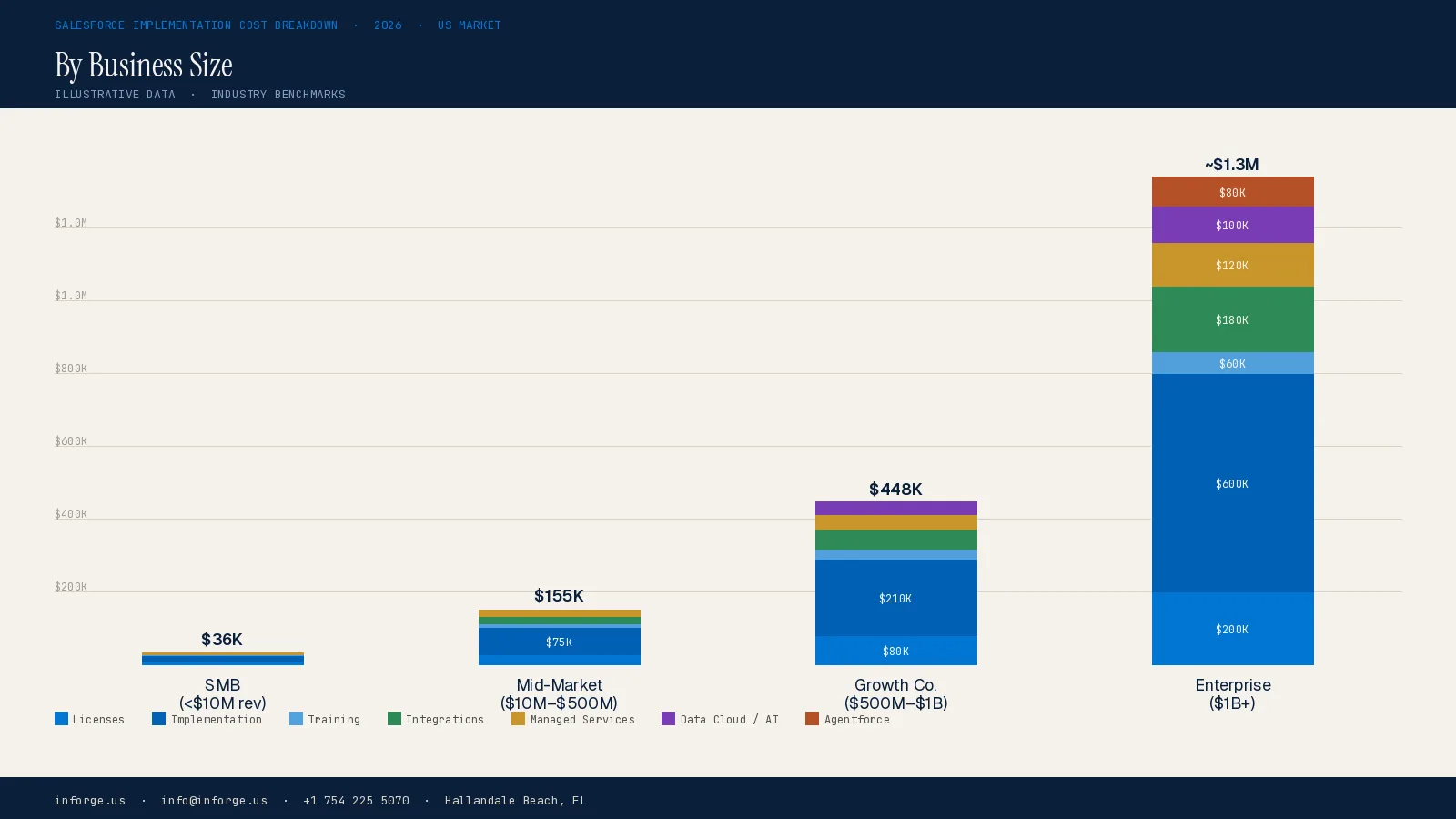
Salesforce Implementation Cost by Business Size
The single most useful way to benchmark your budget is by company profile, not headcount alone. Here are the realistic ranges for 2026 US deployments.
Small Business ($10,000–$40,000)
Small teams running a single Sales Cloud or Service Cloud with minimal customization and under 50 users typically fall in this range. At this level, a QuickStart package — a 2–4 week fixed-scope project with best-practice configuration and limited customization — is usually the right entry point.
Licensing alone for a 5-user team on the Starter Suite runs $1,500/year. On the Pro Suite at $100/user/month, a 10-user team pays $12,000/year in licenses. Add a basic implementation and first-year support, and total Year 1 cost for a small business typically runs $15,000–$30,000, according to Cynoteck.
Mid-Market ($40,000–$150,000)
This is where most US buyers land. Mid-market organizations deploying multiple Clouds, migrating data from a legacy CRM, and connecting Salesforce to existing systems should budget $40,000–$75,000 for a standard rollout. More complex projects with significant integrations and custom workflows push toward $100,000–$150,000.
According to Clear Concise Consulting, mid-size organizations with multiple Clouds and integrations land between $40,000 and $75,000, while enterprise implementations with custom development and multi-department rollouts can exceed $100,000.
For medium-sized companies overall, the total cost can range from $50,000 to $180,000 depending on scope, according to Codleo.
Enterprise ($150,000–$500,000+)
Large enterprise deployments — multi-cloud rollouts, regulated industries, custom portals, deep ERP integrations — occupy a different tier entirely. According to Folio3, enterprise implementations run $150,000–$500,000, and complex multi-cloud builds can exceed $500,000.
These projects require phased delivery, dedicated governance, and experienced partner teams. Cutting corners at this scale compounds quickly — one firm reports that projects initially scoped at $50,000 ended up at $150,000 or more after change orders and rework.
Consulting Partner Rates in 2026
Your partner choice is the single largest variable in your final cost. Rates vary dramatically by firm type, role, and engagement model.
US consulting rates in 2026:
Certified Salesforce partners: $100–$300/hour depending on tier, specialization, and location, according to Cynoteck
Senior architects: $200–$400/hour for complex technical leadership
Freelance consultants: $50–$150/hour — lower cost, higher risk for complex projects
Junior consultants (0–3 years): $30–$80/hour
Mid-level consultants (3–7 years): $80–$150/hour
Senior consultants (7+ years): $150–$250/hour, according to Melonleaf Consulting
Geography matters too. US rates are the baseline. India and LATAM rates run 30–60% lower, while UK and Western Europe rates run 10–20% higher, according to Clientell. Onshore Big 4 firms with offshore delivery teams typically blend rates at 60–70% of pure onshore cost.
Most Salesforce work isn't billed hourly — it's scoped as fixed-price projects or time-and-materials engagements with caps. Fixed-price works for well-defined scope. T&M works better when requirements are still evolving. Plan a 15–20% buffer for change orders on any fixed-price contract regardless.
The Hidden Costs Most Buyers Miss
The number on your initial quote represents roughly 40% of what you'll actually spend. The rest sits in line items that surface after the contract is signed.
1. Data cleanup. If your data lives in spreadsheets, legacy CRMs, or inconsistent systems, expect cost increases before migration even starts. Data migration alone can run $5,000–$50,000 depending on volume and quality. According to Experian research, over half of data migration projects are delayed, and just 36% stay within budget.
2. Third-party integrations. Simple integrations via AppExchange might cost a few hundred dollars. Complex API and middleware setups run $10,000–$50,000+, according to RT Dynamic. Every integration increases scope, testing surface, and potential failure points.
3. AppExchange subscriptions. Many features organizations need — advanced reporting, deduplication, document management — require paid add-ons. Each carries its own monthly or annual subscription fee.
4. Ongoing Salesforce admin costs. Salesforce needs day-to-day management. Many companies hire a full-time or part-time administrator at $70,000–$120,000/year depending on region, according to Awesome Tech.
5. Post-launch support. Managed services for ongoing optimization typically run $10,000–$45,000+ annually.
Rule of thumb: Budget 40–80% above your license cost for true Year 1 total cost of ownership. If you're spending $60,000 on licenses, your real Year 1 cost is likely $84,000–$108,000 when everything is factored in, according to Cynoteck.
Agentforce AI Costs: The 2026 Variable
Agentforce is Salesforce's AI agent platform, and it introduces a new pricing layer that most 2026 implementation budgets haven't fully accounted for yet.
Salesforce offers multiple Agentforce pricing models as of 2026:
Salesforce Foundations (free): Available to Enterprise Edition customers — includes 200,000 Flex Credits, Agent Builder, and Prompt Builder at no cost, according to Salesforce's official pricing page.
Flex Credits: $500 per 100,000 credits ($0.10 per action). Each standard AI agent action consumes 20 credits. A typical customer service conversation involving 8–15 actions costs $0.80–$1.50 under this model, according to Estarei.
Conversations pricing: $2 per resolved customer conversation for external-facing agents.
Per-user add-ons: $125–$150/user/month for employee-facing Agentforce capabilities.
Agentforce 1 Edition: $550/user/month for organizations that want fully predictable budgeting.
Beyond the platform fees, implementation of individual Agentforce agents carries its own cost. According to eesel AI's analysis, Salesforce partners quote $2,000–$6,000 per agent for setup and training, with basic setups taking 2–5 weeks per agent. For a 10-person team, total first-year Agentforce costs — including Enterprise Edition licensing, add-ons, implementation, and training — can reach approximately $140,000.
For mid-market deployments overall, total Year 1 cost with Agentforce runs $50,000–$250,000, according to Estarei.
The ROI case for Agentforce is real when volume justifies it. According to MagicFuse, Wiley reported a 213% return on investment and $230,000 in savings after implementing Agentforce, with case resolution improving over 40% in the first weeks.
Why 70% of Implementations Exceed Budget
The cost number matters less than the execution quality. Most overruns are predictable — and preventable.
According to Pletra Tech, 70% of Salesforce implementations fail to meet their objectives. The primary causes: poor planning, unclear goals, and low user adoption. A separate Forrester finding noted 41% of migration projects exceeded budget, with data and integration complexity as the main drivers.
The most common failure patterns:
Scope creep: Change orders from undiscovered requirements typically add 10–30% to original project cost. Plan a 15–20% contingency buffer.
Poor data discovery: Dirty legacy data is the most underestimated cost driver. Cleaning and mapping data adds weeks and dollars that weren't in the original SOW.
Under-investment in training: According to Gartner, 50–70% of CRM failures are due to poor user adoption. Cutting training to save money almost always backfires.
Wrong partner selection: Choosing on price rather than fit creates what the industry calls the Low-Bid Trap — the $89,000 quote beats the $340,000 proposal, but the total cost of failure and re-implementation ends up higher than either.
At Inforge, we've found that the projects that blow budget aren't the ones that were too ambitious — they're the ones that skipped a thorough discovery phase. Thirty days of rigorous scoping typically saves six months of rework.
AI-Assisted Delivery: The Cost Compression Nobody's Talking About
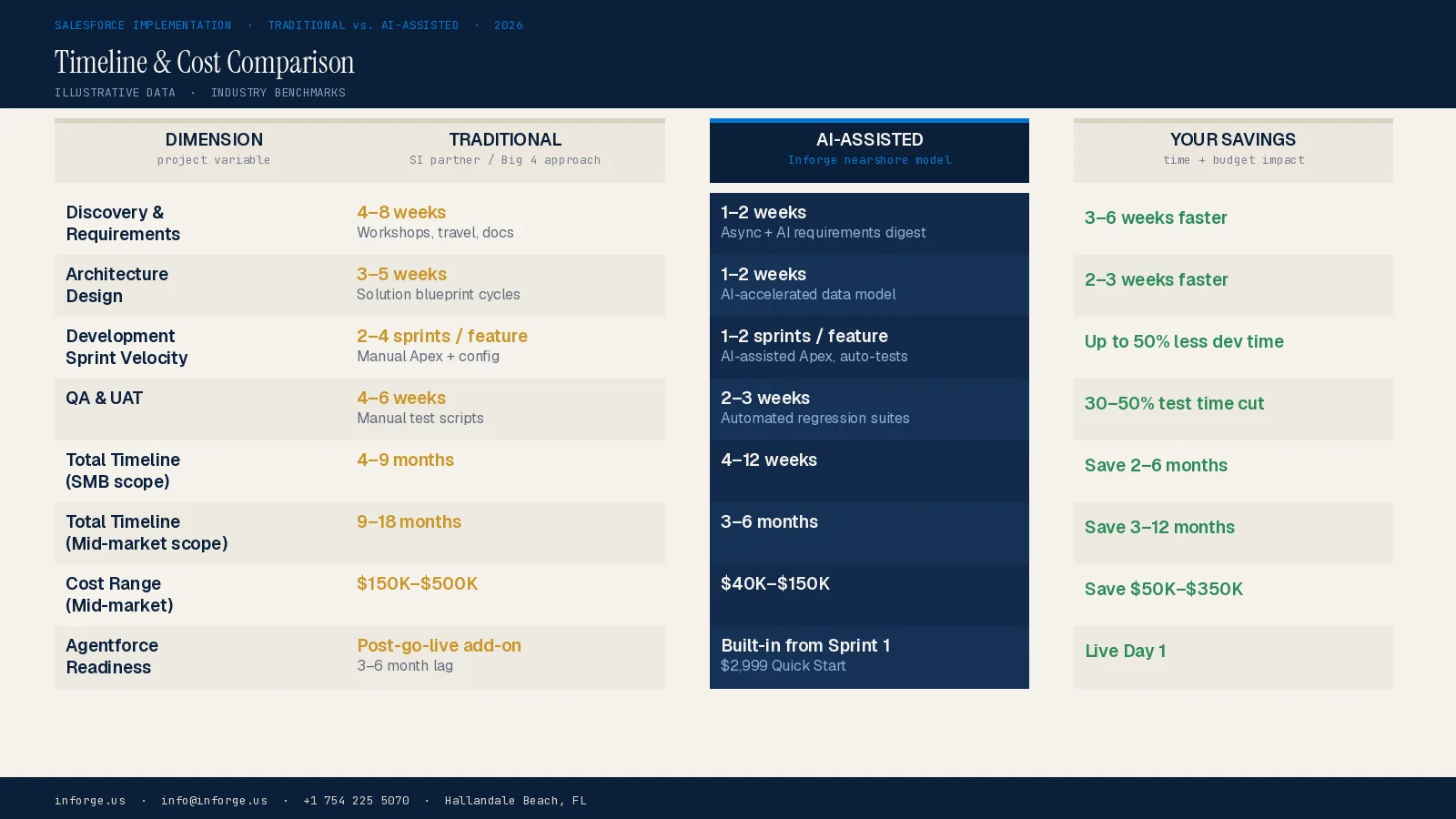
Traditional Salesforce implementations follow a predictable cost curve: discovery, design, build, test, deploy. That curve is changing.
AI-assisted delivery models — where implementations are delivered through AI agents rather than exclusively through headcount — are compressing timelines and lowering cost-per-outcome for organizations that know how to use them. According to Clientell, AI-powered implementation approaches deliver 75% faster timelines and 40–50% cost savings versus traditional methods.
This is the model Inforge operates on every day. Full Salesforce implementations delivered entirely through prompts — faster timelines, more consistent quality, at a fraction of the cost. That's not a positioning statement. It's how every project ships.
For buyers evaluating partners in 2026, the question isn't just what the quote says. It's what delivery model sits behind it. A traditional team of six billed at $200/hour for 20 weeks looks very different from an AI-first partner delivering the same outcome in a fraction of the time.
How to Structure Your Budget: A Practical Framework
Before you request a single quote, build your budget framework around these inputs:
1. Right-size your licenses. Don't buy Unlimited if Enterprise covers your needs. Assign license tiers by role, not by default. Salesforce's Pro Suite at $100/user/month is right for most growing sales teams. Enterprise at $165/user/month makes sense when you need advanced automation and API access.
2. Use the 1.5x–3x rule. Your implementation services will likely cost 1.5–3x your annual license fee. If your annual license spend is $40,000, budget $60,000–$120,000 for implementation.
3. Start with essentials, phase the rest. Launch with core features. Phase in customizations once value is proven. Over-customization at launch is the fastest path to unnecessary cost and future technical debt.
4. Model a 3-year TCO. Year 1 costs are only part of the picture. Factor in license renewals (Salesforce raised list prices ~6% in 2025 for most clouds), admin overhead, AppExchange subscriptions, and ongoing optimization spend.
5. Build in a 20% contingency. Scope creep is not a planning failure — it's a project reality. Budget for it explicitly rather than treating it as a surprise.
Summary
Salesforce implementation cost in 2026 ranges from $10,000 for small QuickStart projects to well over $250,000 for enterprise multi-cloud deployments — with the majority of US mid-market implementations landing between $40,000 and $150,000 all-in. The license fee is the smallest variable. Partner rates, data quality, integration complexity, and post-launch support determine what the real number looks like. Add Agentforce AI agents to the mix and a new layer of usage-based costs enters the equation. The organizations that budget accurately are the ones that treat implementation as a strategic investment — not a vendor quote to negotiate down.
At Inforge, we deliver Salesforce implementations entirely through AI agents — faster timelines, consistent quality, and at a fraction of traditional consulting cost. If you're mapping your 2026 budget, we can tell you what your specific project should actually cost before you talk to anyone else.
Frequently Asked Questions
Q: How much does a basic Salesforce implementation cost in the US in 2026?
A: A basic implementation for a small team (under 50 users, single Cloud, minimal customization) typically runs $10,000–$25,000. This includes configuration, basic data migration, and user training. A QuickStart package from a certified partner is usually the most cost-effective entry point.
Q: What is the typical Salesforce consulting hourly rate in 2026?
A: Certified Salesforce partners in the US charge $100–$300/hour depending on specialization and firm size. Senior architects bill $200–$400/hour. Freelancers charge $50–$150/hour. Most projects are scoped as fixed-fee or time-and-materials engagements rather than pure hourly billing.
Q: Why do Salesforce implementations go over budget so often?
A: Scope creep, undiscovered data quality issues, and under-investment in training are the top three drivers. According to industry data, 70% of implementations exceed initial quotes. The fix is a rigorous discovery phase before any configuration begins — not a lower-priced vendor.
Q: How much does Agentforce add to a Salesforce implementation cost?
A: Agentforce adds $2,000–$6,000 per agent in setup and training costs, plus ongoing consumption fees. Flex Credits cost $500 per 100,000 credits ($0.10 per agent action). Enterprise Edition customers get 200,000 Flex Credits free through Salesforce Foundations before paying. Total first-year Agentforce deployments for mid-market organizations typically run $50,000–$250,000 including underlying platform costs.
Q: Is it cheaper to implement Salesforce in-house or with a partner?
A: In-house implementations look cheaper upfront but carry higher risk, longer timelines, and more rework. Partner-led implementations reduce risk and often lower total cost of ownership — especially when the partner uses AI-assisted delivery models that compress timelines and reduce billable hours.
