How Much Does a Salesforce Implementation Cost in 2026? A Complete Pricing Breakdown
Salesforce implementation in 2026 costs between $10,000 and $500,000+, depending on company size, the number of Clouds deployed, integration depth, and your delivery model. Most mid-market companies land somewhere between $50,000 and $150,000 for a standard rollout — but that number moves fast once data migration, custom development, and post-launch support enter the picture.
If you're budgeting for a Salesforce project right now, this guide gives you every number you need — licensing tiers, consulting hourly rates, per-cloud cost ranges, hidden fees, and what AI-led delivery actually changes about the equation.
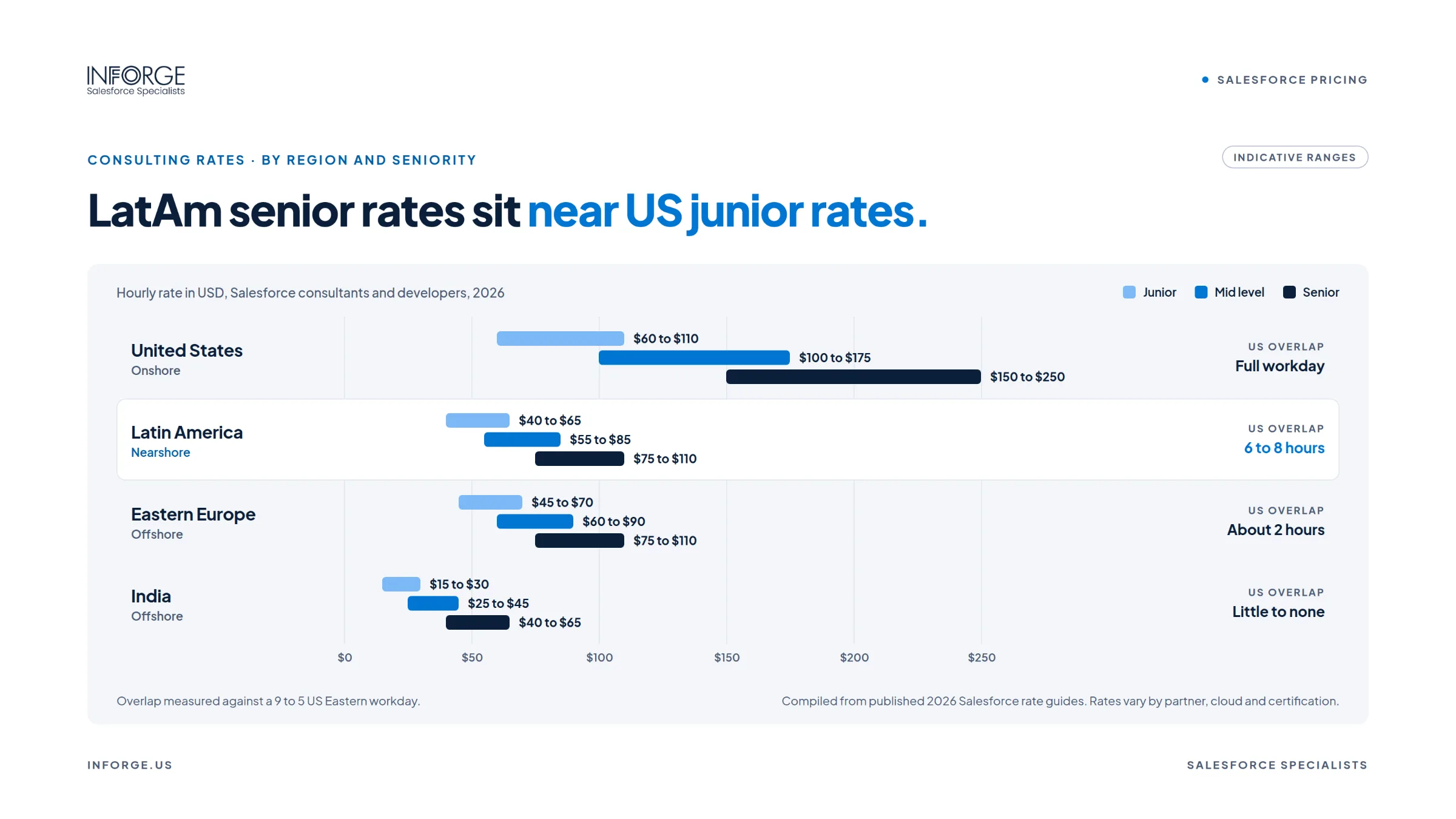
Quick Answer: A Salesforce implementation typically costs $10,000–$30,000 for small businesses, $40,000–$150,000 for mid-market companies, and $150,000–$500,000+ for enterprise deployments — before accounting for annual license fees, which are a separate ongoing cost on top of implementation services.
Key Takeaways:
Implementation spend typically runs 2–3x your annual Salesforce license fee.
Consulting and development alone represent 40–60% of total project cost.
Hidden costs — data cleanup, AppExchange apps, sandboxes, and an ongoing admin — routinely add 20–40% above the initial quote.
License tiers range from $25/user/month (Starter Suite) to $550/user/month (Agentforce 1 Sales).
AI-led implementation models are delivering 40–50% cost reductions and significantly faster timelines compared to traditional consulting approaches.
The biggest cost driver is not your user count — it's process complexity, integration depth, and data quality.
Salesforce Implementation Cost by Business Size
The single most useful starting point is a cost range anchored to your company size and deployment scope. These are real-world implementation service costs — they do not include annual license fees.
Small Business (1–50 Users)
For small teams running a standard Sales Cloud setup with minimal customization, implementation typically runs $10,000–$30,000. Timeline: 6–10 weeks.
A Starter Suite or Pro Suite quick-start engagement — the kind that gets a small team live on basic lead and task tracking — can come in as low as $3,000–$10,000 with a focused partner. Add one integration or a meaningful data migration and you're quickly in the $15,000–$30,000 range.
Mid-Market (51–500 Users)
Mid-market is where costs spread widest. A standard Sales Cloud rollout with integrations and data migration runs $40,000–$150,000, with a timeline of 14–24 weeks.
According to multiple 2026 market benchmarks, the most common mid-market scenario — Sales Cloud deployed to 11–50 users, including consulting, data migration, and basic integrations — lands between $25,000 and $80,000 in implementation services. Add Service Cloud or a Marketing Cloud layer, and that figure moves to $75,000–$150,000+.
Enterprise (500+ Users)
Enterprise implementations — multi-cloud, complex security models, multiple integrations, phased rollouts — run $150,000–$500,000+. Large multi-cloud or global programs regularly exceed $500,000, with timelines of 6–18 months.
For a company with 200+ users on Unlimited Edition, Year 1 total cost (licenses + implementation + integrations + training + a full-time admin) can reach $1.2M–$1.6M+, according to detailed 2026 TCO models.
| Business Size | Users | Implementation Cost | Timeline |
|---|---|---|---|
| Small Business | 1–50 | $10,000–$30,000 | 6–10 weeks |
| Mid-Market | 51–500 | $40,000–$150,000 | 14–24 weeks |
| Enterprise | 500+ | $150,000–$500,000+ | 6–12+ months |
| Complex Multi-Cloud / Global | Any | $500,000+ | Phased, 12+ months |
Salesforce License Pricing in 2026: What You Pay Before Implementation Starts
License fees are separate from implementation services. They're a recurring annual cost — and they're often the number companies focus on while underestimating everything else.
Here are the current Salesforce Sales Cloud pricing tiers for 2026:
| Edition | Price Per User/Month | Best For |
|---|---|---|
| Starter Suite | $25 | Small businesses testing Salesforce |
| Pro Suite | $100 | Growing teams needing automation and forecasting |
| Enterprise | $175 | Mid-size businesses needing API access and customization |
| Unlimited | $350 | Large teams needing advanced AI and priority support |
| Agentforce 1 Sales | $550 | AI-first enterprises deploying autonomous agents at scale |
Agentforce AI credits — for consumption-based agent usage — are priced at approximately $2 per conversation (or $0.10 per action on the Flex Credits model), giving orgs flexibility to pay for agent capacity without committing to the full bundle.
A practical rule that holds across 2026 data: implementation spend is usually 2–3x the annual license fee. Plan your budget around that multiplier before you talk to a single consultant.
Implementation Cost by Salesforce Cloud
Not all Clouds are equally complex to implement. Here's what each product category typically costs in implementation services alone (licenses excluded):
| Salesforce Cloud | Simple Setup | Complex Implementation | Main Cost Drivers |
|---|---|---|---|
| Sales Cloud | $10,000–$30,000 | $60,000–$150,000+ | Sales processes, territories, forecasting, integrations |
| Service Cloud | $15,000–$40,000 | $75,000–$200,000+ | Omnichannel routing, CTI/telephony, knowledge base, SLAs |
| Marketing Cloud Engagement | $20,000–$50,000 | $80,000–$200,000+ | Data model, customer journeys, channel setup |
| Marketing Cloud Account Engagement (Pardot) | $8,000–$20,000 | $40,000–$80,000+ | Lead scoring, forms, nurture programs, CRM sync |
| Experience Cloud (Portals) | $15,000–$40,000 | $80,000–$200,000+ | Branding, SSO, partner/customer self-service |
| CPQ / Revenue Cloud | $30,000–$60,000 | $100,000–$250,000+ | Product rules, pricing logic, approval workflows |
| Field Service | $40,000–$80,000 | $150,000–$300,000+ | Scheduling, mobile workforce, parts and inventory |
For organizations deploying Agentforce AI capabilities on top of an existing cloud stack, expect an additional $30,000–$70,000 in scope for autonomous agent logic design, persona setup, and prompt engineering.
Salesforce Consulting Rates in 2026: What You're Paying Per Hour
Consulting and development typically represent 40–60% of total project cost — making your choice of partner the single biggest lever on your implementation budget.
Here's the current market rate landscape:
| Consultant Type | Hourly Rate (US) |
|---|---|
| Freelance admin / junior consultant | $50–$100/hr |
| Experienced independent consultant | $100–$175/hr |
| Boutique firm (certified partner) | $125–$300+/hr |
| Senior consultant / lead | $150–$275/hr |
| Architect (Application/Technical) | $200–$400+/hr |
| CPQ / Marketing Cloud specialist | $175–$325/hr |
| Big 4 firms (Accenture, Deloitte, etc.) | $250–$500+/hr |
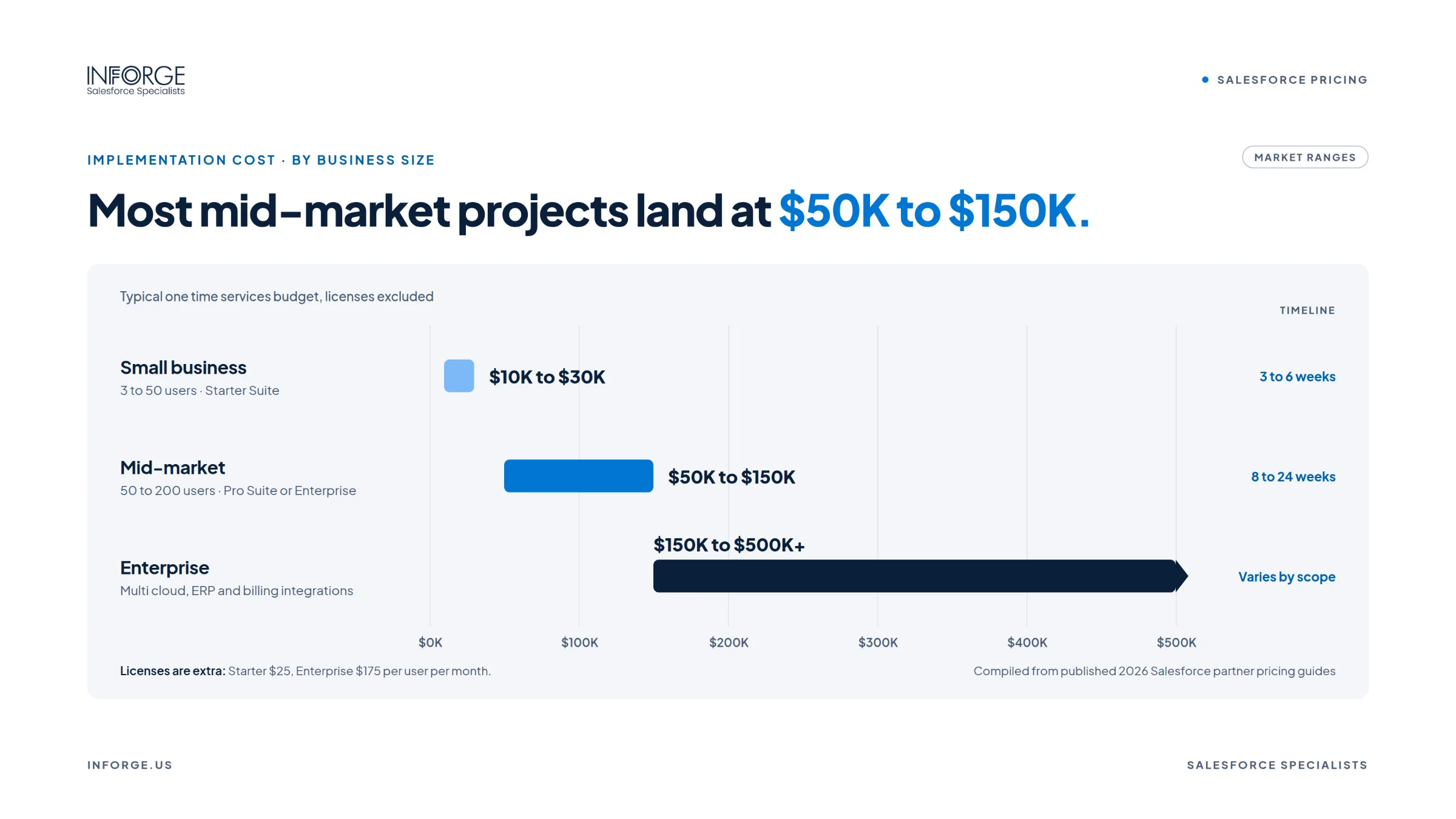
Region matters significantly. According to 2026 market benchmarks, US and Western Europe consultants charge $150–$250/hour, while offshore teams in India run $30–$70/hour. Eastern Europe sits in the $50–$100/hour range.
The important nuance: a $150/hour consultant who scopes cleanly and delivers on time is almost always cheaper than a $100/hour consultant who doesn't. Evaluate total project cost and track record, not the hourly number alone.
The Hidden Costs Most Salesforce Budgets Miss
This is where projects go wrong. According to 2026 budget analysis data, most businesses underestimate Salesforce costs by 40–80% because they only plan for licenses. Hidden costs add 20–40% above the initial quote in the majority of implementations.
Here's what gets missed:
Data Migration
Moving data from legacy systems is rarely straightforward. Data migration costs typically run $5,000–$50,000 depending on data volume, format quality, and the number of source systems. Messy or legacy data can increase implementation costs by 30–50% beyond original estimates — because cleaning, deduplicating, and mapping records to Salesforce's data model is labor-intensive work that can't be automated away.
According to Sigma Info's 2026 implementation cost analysis, data migration "involves not just moving records but cleaning, deduplicating, and mapping them to Salesforce's data model, which can require significant manual review for organizations with years of accumulated data quality issues."
Integrations
Each connected system — ERP, marketing platform, billing system, telephony — adds mapping, development, testing, and API-limit planning to the project. A standard ERP-to-Salesforce integration using a middleware platform like MuleSoft or Boomi typically costs $10,000–$40,000 for design, development, and testing. Custom integrations without a middleware layer carry higher long-term maintenance costs on top of that.
User Training and Change Management
Training is consistently the most underbudgeted line item in Salesforce implementations — and it has the most direct impact on whether your team actually uses the platform after go-live. Structured role-based training programs typically add $5,000–$20,000 to project costs, depending on team size and workflow complexity. Individual Salesforce training programs range from $500 to $5,000 per user, depending on the role and certification level required.
A technically complete implementation that the team doesn't adopt is money completely wasted.
AppExchange Add-Ons
Many features that companies expect to be standard — advanced reporting, deduplication, document management, e-signatures — require paid third-party apps from the Salesforce AppExchange. Each carries its own monthly or annual subscription fee, and these costs rarely appear in an initial implementation quote.
Data Storage Overages
Salesforce includes limited data storage per edition. As your database grows, storage overages add up — particularly for companies with large historical datasets. Additional storage costs approximately $125/month per 500MB.
Ongoing Administration
Once the implementation is done, someone has to run the org. A dedicated internal Salesforce admin typically costs $80,000–$120,000 annually in salary. Organizations that outsource administration budget $2,000–$8,000/month for ongoing support, system updates, and user enablement.
What Your Year 1 Budget Actually Looks Like
Here's a realistic Year 1 total cost scenario for a mid-market company with 50 users on Salesforce Enterprise edition:
| Cost Item | Estimated Cost |
|---|---|
| Annual Licenses (50 × $175 × 12) | $105,000 |
| Implementation Services | $75,000–$150,000 |
| Integrations | $20,000–$50,000 |
| User Training | $10,000 |
| Ongoing Admin (part-time or outsourced) | $40,000–$60,000 |
| Year 1 Total | ~$250,000–$375,000 |
| Year 2–3 Annual | ~$150,000–$200,000 |
The license is only 28–42% of that Year 1 total. The rest is everything else. This is why the 2–3x multiplier rule exists — and why it's one of the most reliable benchmarks in the market.
[INTERNAL LINK: Salesforce total cost of ownership — a 3-year TCO model for mid-market companies]
How AI-Led Implementation Changes the Cost Equation
Traditional Salesforce implementations follow a familiar pattern: discovery → design → build → test → train → go-live. That pattern is expensive, slow, and human-hours-dependent at every stage.
AI-led delivery models are changing that math. According to Getclientell's 2026 AI implementation benchmark, companies using AI-first approaches are completing implementations 75% faster with 40–50% lower costs compared to traditional consulting methods. The shift from an 8-month median timeline to a 3-month median is the result of automating the parts of implementation that have always consumed the most billable hours: discovery, documentation, configuration, and testing.
Partners using AI tools now report 15–30% labor reductions through automation of org audits, user story generation, and configuration tasks — cutting timelines from months to weeks and reducing rework.
At Inforge, we don't just consult on AI-led Salesforce delivery — we run our entire implementation practice on it. Full Salesforce implementations delivered entirely through AI agents, not headcount. The result is faster timelines, more consistent quality, and a fraction of the cost of traditional consulting. That's not a pitch. That's how we operate, every day.
The bottleneck in most Salesforce implementations isn't capability. It's that the traditional delivery model was designed for a world where every step required a human in the loop.
How to Choose the Right Implementation Partner
The delivery model you choose has more impact on your final cost than almost any other decision. Here's a practical framework:
For small businesses and SMBs: An experienced independent consultant ($100–$175/hr) or a boutique certified partner gives you senior skills without the overhead of a large firm. Insist on a fixed-scope engagement based on a paid discovery phase.
For mid-market companies: A boutique Salesforce consulting firm with demonstrated delivery on projects of similar scope and complexity is usually the right fit. Ask for references from companies your size. Check their AppExchange partner status and certification depth.
For enterprise deployments: Large SI partners (including Big 4) bring breadth and capacity — but at $250–$500+/hour for senior resources, and with blended offshore models that can introduce quality variability. Evaluate whether the team that pitches you is the team that delivers.
For any size: Regardless of which model you choose, insist on a written scope listing every object, automation, integration, and report before you sign. Scope gaps are where budget overruns are born.
Summary
Salesforce implementation in 2026 is a significant investment at every company size — and the total cost is almost always higher than the license quote suggests. The real bill includes consulting, data migration, integrations, training, AppExchange tools, and ongoing administration. Planning for 2–3x your annual license fee as a Year 1 budget is the most reliable heuristic in the market.
The delivery model you choose is now the biggest lever on cost. AI-led implementation approaches are demonstrably faster and cheaper than traditional consulting — and at Inforge, that's not just an observation we make about the market. It's the model we run on. If you're evaluating a Salesforce implementation and want to understand what agent-first delivery actually looks like in practice, we're the proof.
Frequently Asked Questions
Q: How much does a Salesforce implementation cost in 2026?
A: Salesforce implementation costs range from $10,000 for a basic small-business setup to $500,000+ for large enterprise deployments. Most mid-market implementations land between $50,000 and $150,000 in implementation services, not including annual license fees. The final number depends on your edition, user count, customization needs, integrations, and data complexity.
Q: Are Salesforce license fees included in the implementation cost?
A: No. License fees are a separate, ongoing cost. Implementation costs cover the work required to configure, customize, migrate, and deploy Salesforce — not the software subscription itself. A realistic Year 1 budget must account for both.
Q: What are the biggest hidden costs in a Salesforce implementation?
A: The most common budget surprises are data cleanup and migration (which can add $5,000–$50,000), AppExchange add-ons for features you expected to be standard, third-party integrations with ERP or marketing systems, user training that determines adoption success, and an ongoing Salesforce admin once the project is live. These items routinely add 20–40% above the initial partner quote.
Q: How much do Salesforce consultants charge per hour in 2026?
A: Mid-level Salesforce consultants charge $100–$250 per hour. Senior architects and CPQ specialists charge $200–$400/hour. Big 4 firms charge $250–$500+/hour for senior resources. Solo consultants average around $150/hour, with offshore rates 30–60% lower depending on region.
Q: Can AI really reduce Salesforce implementation costs?
A: Yes — measurably. AI-led delivery models are completing implementations with 40–50% lower costs and timelines that are 75% shorter than traditional consulting approaches. The savings come from automating the most labor-intensive phases: discovery, documentation, configuration, and testing. At Inforge, this is the only delivery model we use.
Q: What is Agentforce and how does it affect implementation costs?
A: Agentforce is Salesforce's AI-powered platform for deploying autonomous agents inside your CRM. The Agentforce 1 Sales bundle is priced at $550/user/month. Implementing Agentforce capabilities adds $30,000–$70,000 to implementation scope for agent logic design and prompt engineering. AI credits for consumption-based usage are approximately $2 per conversation or $0.10 per action on the Flex Credits model.