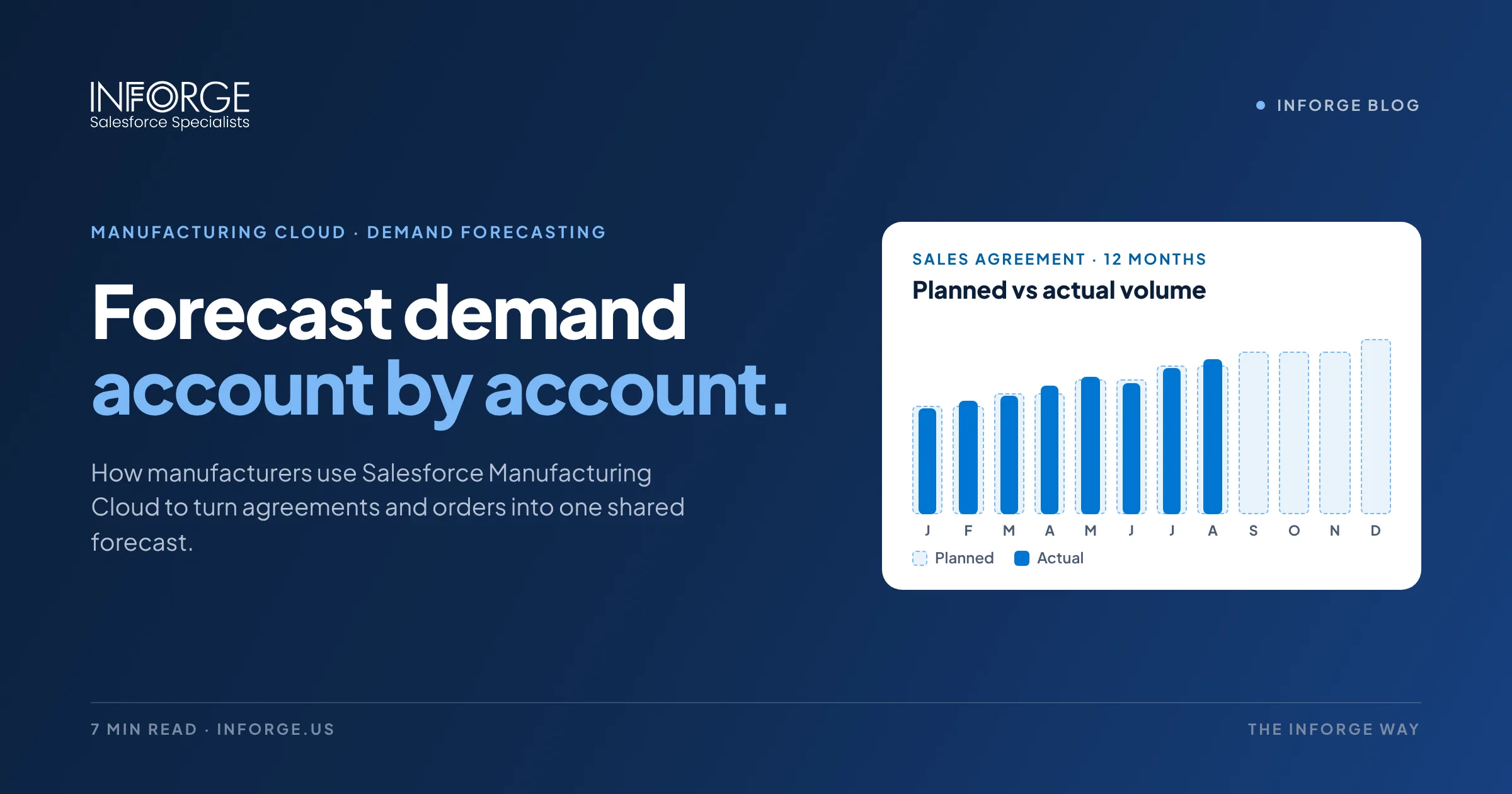
How Manufacturers Use Salesforce Manufacturing Cloud to Forecast Demand
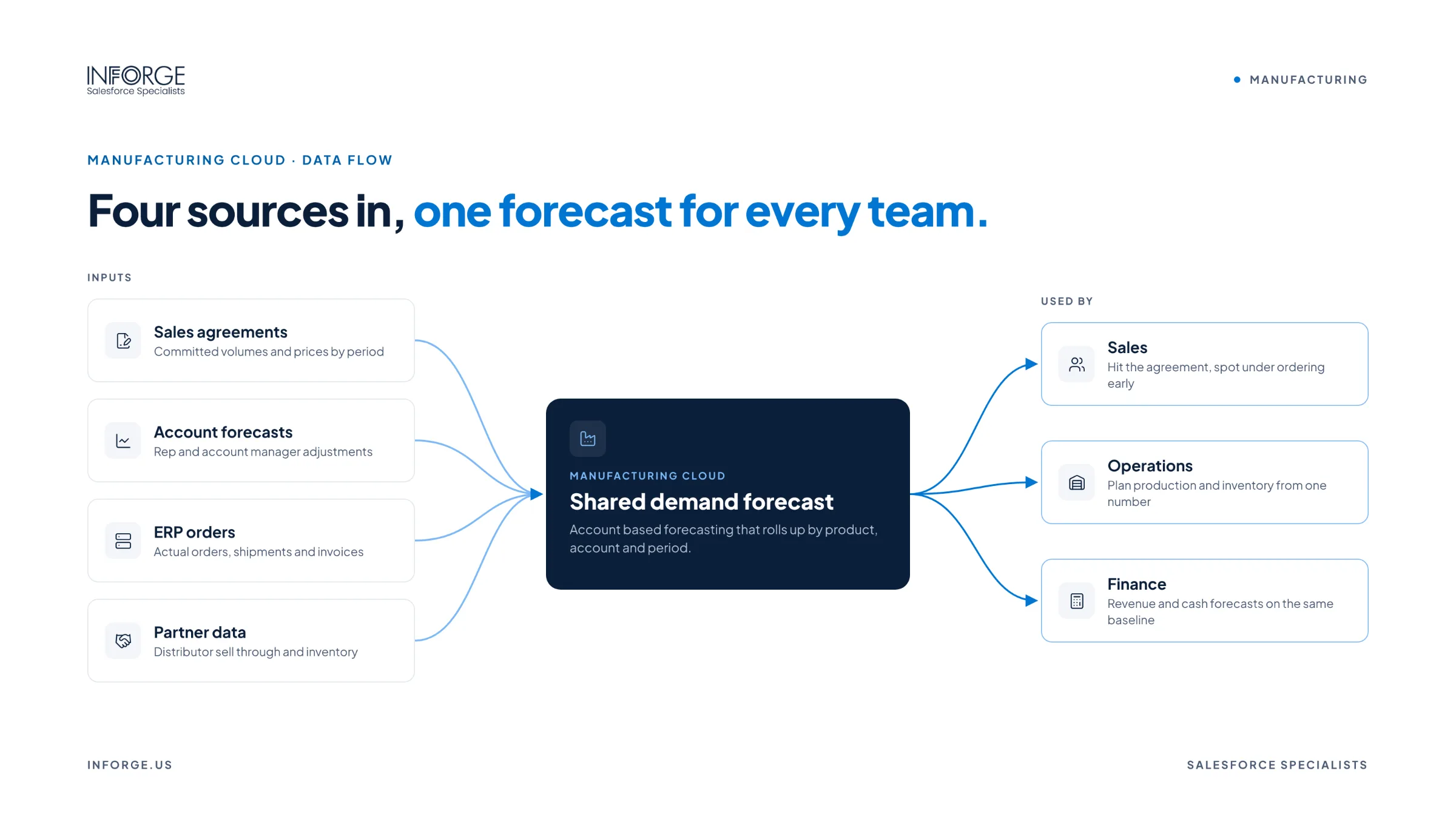
They use it to connect what sales knows about customers with what operations needs to plan production. Manufacturing Cloud brings sales agreements, account-level forecasts, order history, and ERP data into one place in Salesforce, so manufacturers can see expected demand by customer, product, and period, compare plans to actuals, and adjust before shortages or excess inventory show up. The result is a forecast that sales, operations, and finance can actually agree on.
Quick Answer: Manufacturers use Salesforce Manufacturing Cloud to forecast demand by capturing negotiated volumes in Sales Agreements, building account-based forecasts that combine run-rate business with new opportunities, pulling in orders and actuals from the ERP, tracking planned versus actual quantities and revenue, and sharing forecasts with operations and finance. Many add Data Cloud to unify ERP and channel data and Agentforce to surface forecast changes and next steps for account teams.
Key Takeaways:
Manufacturing Cloud is Salesforce's industry CRM for manufacturers, built around how manufacturers sell: long-term agreements, run-rate business, and channel partners.
Sales Agreements capture negotiated terms, planned quantities, and revenue over time, then compare them to actual orders.
Account-based forecasting combines agreement volumes, run-rate business, and new opportunities into a forecast by account, product, and period.
ERP integration is essential. Forecasts are only as good as the order and actuals data flowing into Salesforce.
The biggest value comes from aligning sales, operations, and finance around one shared forecast.
Why Demand Forecasting Is Hard for Manufacturers
Manufacturers live and die by their forecasts. Overestimate demand and you're stuck with excess inventory and tied-up cash. Underestimate it and you miss shipments, pay for expedited materials, and frustrate customers.
Yet in many manufacturing companies, forecasting is still pieced together from spreadsheets. Sales has customer insight in their heads and inboxes. Operations works from ERP history. Finance builds its own projections. Customer agreements live in contracts nobody tracks against actual orders. By the time the numbers are reconciled, they're already out of date.
Manufacturing sales also doesn't look like typical pipeline-based selling. Much of the revenue comes from recurring run-rate business and multi-year agreements, not just new deals. Standard CRM forecasting, built around opportunities, misses most of what drives manufacturing demand.
The bottleneck isn't forecasting skill. It's disconnected data and a CRM that doesn't reflect how manufacturers sell.
What Salesforce Manufacturing Cloud Does
Manufacturing Cloud builds on Sales Cloud with data models and tools designed for manufacturers. Key capabilities include:
Sales Agreements to capture negotiated terms, products, planned quantities, and revenue over the life of a customer agreement
Account-based forecasting to project demand and revenue by account, product, and period
Planned versus actual tracking that compares agreement and forecast volumes to real orders from the ERP
Partner and channel visibility for manufacturers selling through distributors and dealers
Rebate and program management for customer and channel incentive programs
Data Cloud and Agentforce for manufacturing to unify ERP and operational data and surface insights for account teams
How Manufacturers Use It to Forecast Demand
1. Capturing agreements as structured data
Instead of keeping customer commitments buried in contracts or spreadsheets, manufacturers record them as Sales Agreements in Salesforce. Each agreement shows the products, planned quantities, and expected revenue by period. That turns commitments into data operations can plan against.
2. Tracking planned versus actual
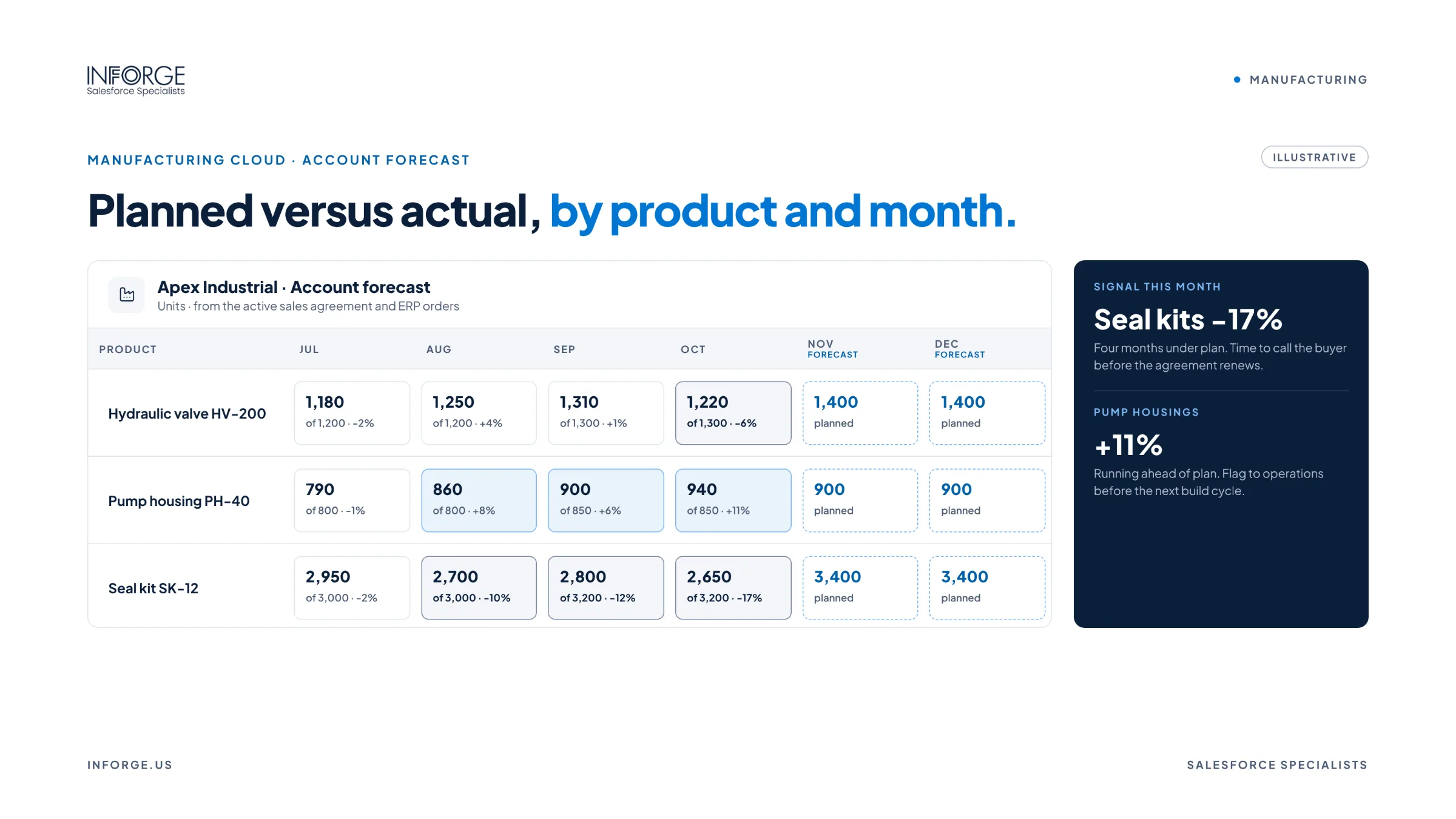
With ERP order data flowing into Salesforce, account teams can see whether customers are ordering what they committed to. A customer running 20% below plan for two months is an early warning for both the account team and the supply chain.
3. Building account-based forecasts
Account-based forecasting combines agreement volumes, run-rate business, and open opportunities into a forecast by account and product. Account managers adjust forecasts based on what they hear from customers, adding the human insight that historical data alone can't capture.
4. Rolling up forecasts for operations and finance
Forecasts roll up by product, region, or business unit, giving operations visibility for production and inventory planning, and finance a revenue forecast tied to real customer data.
5. Including channel partners
Manufacturers that sell through distributors can bring partner forecasts, inventory, and sell-through data into the picture, so demand isn't hidden one step down the channel.
What Separates Successful Manufacturing Cloud Implementations
They integrate the ERP early. Orders, shipments, and actuals must flow into Salesforce reliably, or planned versus actual tracking breaks down.
They clean product and account data. Product hierarchies and account structures need to match between Salesforce and the ERP.
They define a forecasting process, including who updates forecasts, how often, and how adjustments are reviewed.
They design for account managers. If updating the forecast feels like extra admin work, it won't happen.
They bring operations and finance in from the start, so the forecast is built to serve everyone who depends on it.
At Inforge, we've found that the manufacturers getting the most from Manufacturing Cloud aren't the ones with the most features turned on. They're the ones that connect their ERP data cleanly, define a clear forecasting rhythm, and get sales, operations, and finance working from the same numbers.
Summary
Demand forecasting is hard for manufacturers because the data lives in disconnected systems and standard CRM forecasting doesn't reflect run-rate business and long-term agreements. Salesforce Manufacturing Cloud addresses this with Sales Agreements, account-based forecasting, planned versus actual tracking, partner visibility, and ERP integration, with Data Cloud and Agentforce adding unified data and AI-driven insights. Success depends on clean ERP integration, aligned product and account data, a defined forecasting process, and buy-in across sales, operations, and finance.
Inforge helps manufacturers implement and optimize Salesforce Manufacturing Cloud and ERP integrations with nearshore Salesforce consultants, architects, and developers working in US time zones.
Frequently Asked Questions
Q: What is Salesforce Manufacturing Cloud?
A: Manufacturing Cloud is Salesforce's industry CRM for manufacturers. It adds Sales Agreements, account-based forecasting, partner and channel tools, and manufacturing-specific data models on top of Sales Cloud.
Q: How does Manufacturing Cloud help with demand forecasting?
A: It captures negotiated volumes in Sales Agreements, combines them with run-rate business and opportunities in account-based forecasts, compares plans to actual ERP orders, and rolls forecasts up for operations and finance.
Q: What are Sales Agreements in Salesforce?
A: Sales Agreements record the negotiated terms of a customer agreement, including products, planned quantities, and revenue by period, and track them against actual orders over time.
Q: Does Manufacturing Cloud integrate with ERP systems?
A: Yes. ERP integration is central to most Manufacturing Cloud implementations, bringing orders, shipments, and actuals into Salesforce so forecasts reflect real demand.
Q: Is Manufacturing Cloud only for large manufacturers?
A: No. Mid-market manufacturers use it too, often starting with Sales Agreements and account forecasting for their most important customers before expanding.