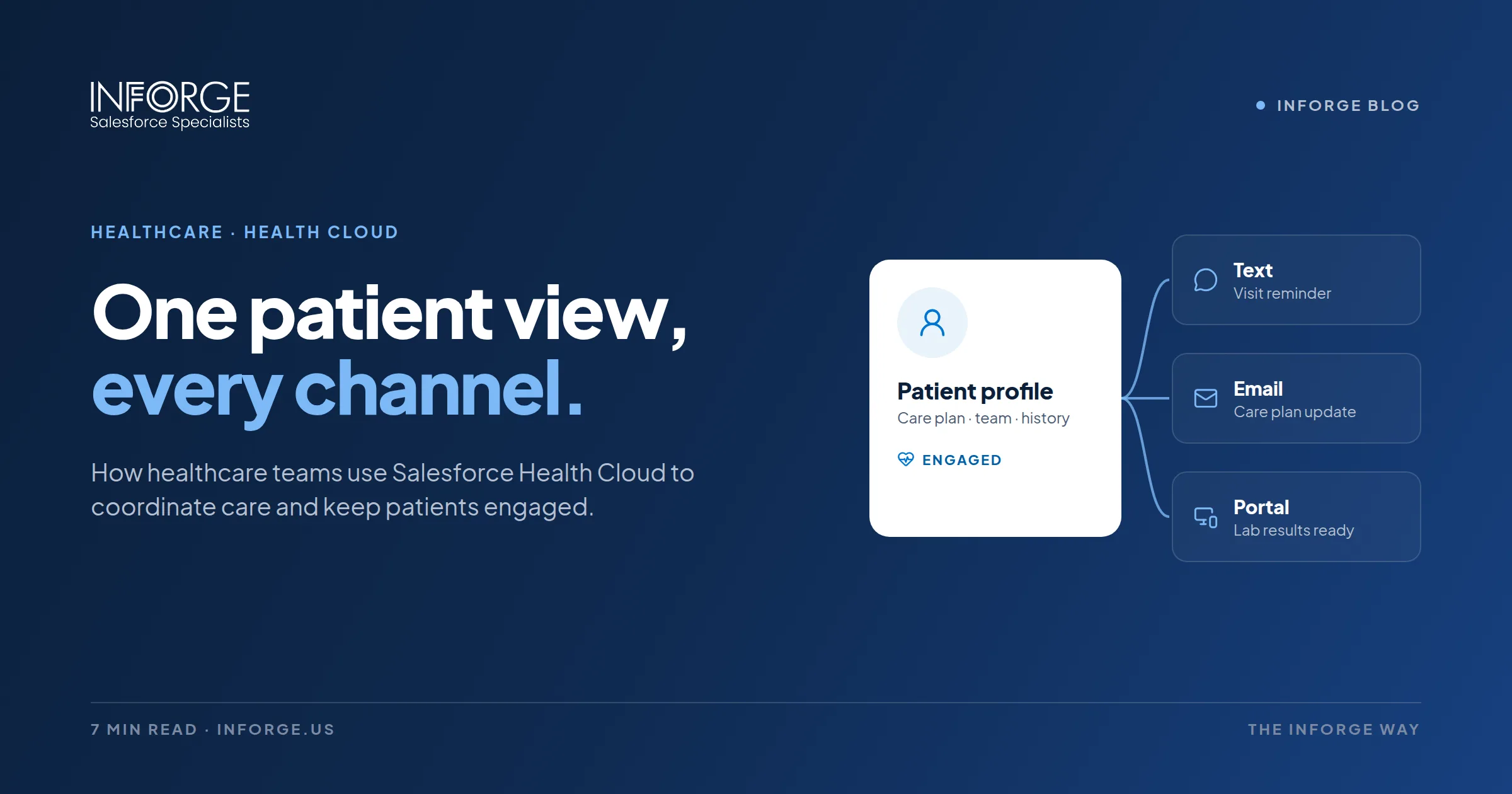
How Healthcare Organizations Use Salesforce Health Cloud to Improve Patient Engagement
They use it as the engagement layer that sits on top of the EHR. The EHR is built to document care. Health Cloud is built to manage the relationship: every call, message, referral, appointment, care plan, and follow-up, in one place, so care teams and contact centers can engage patients proactively instead of reactively. That shift is what turns scattered touchpoints into a connected patient experience.
Quick Answer: Healthcare organizations use Salesforce Health Cloud to create a unified patient profile that combines clinical data from the EHR with non-clinical engagement data, personalize outreach and reminders across text, email, and portal channels, coordinate care plans across teams, streamline patient access and intake, and power AI agents that handle routine requests. The result is more consistent communication, fewer gaps in care, and a patient experience that feels coordinated rather than fragmented.
Key Takeaways:
35% of patients say they'd consider switching doctors if digital tools were frustrating or outdated, according to a Software Finder survey reported by eMarketer.
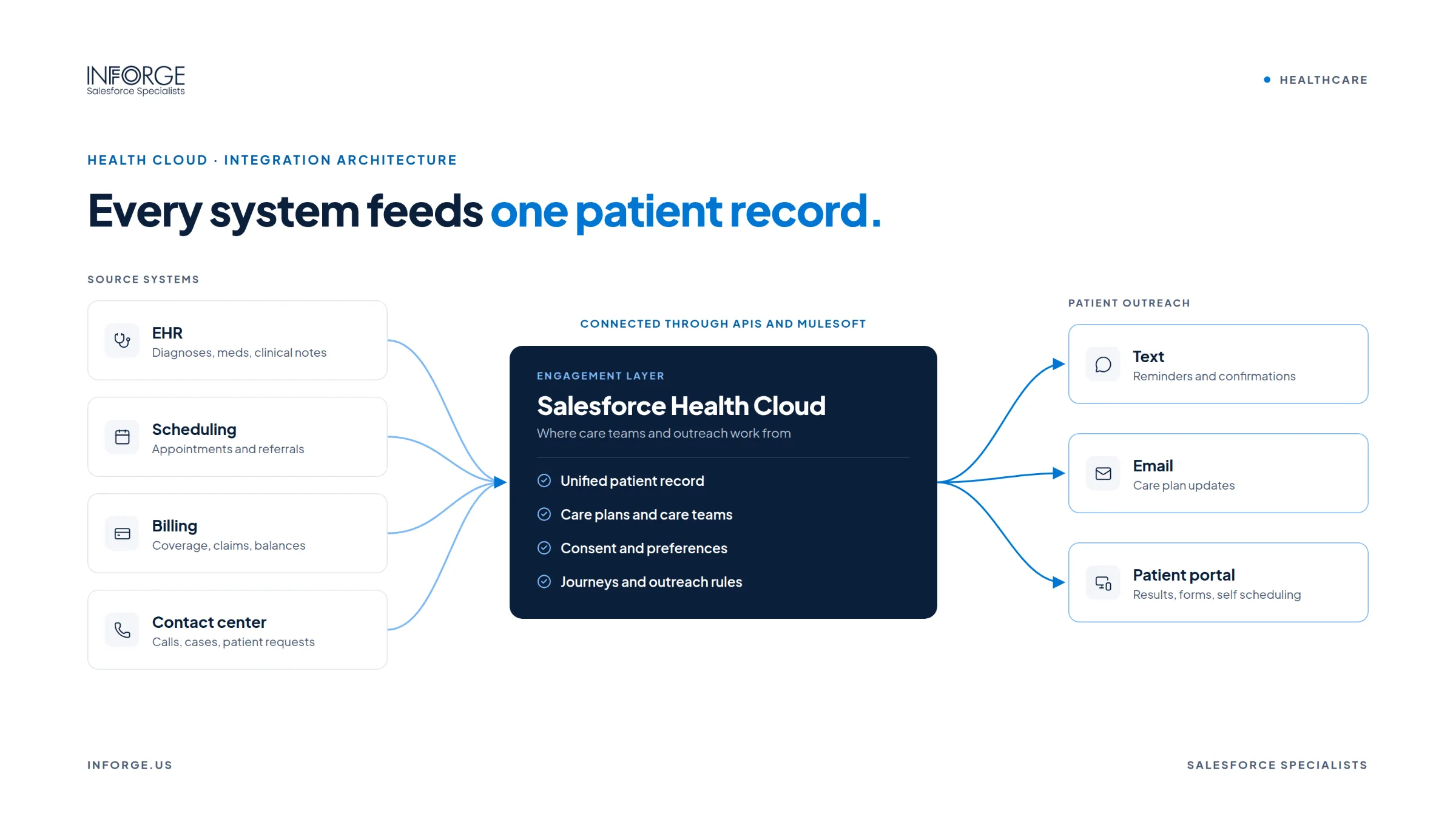
Health Cloud complements the EHR rather than replacing it, using FHIR R4, HL7, and MuleSoft integrations to bring clinical data into the engagement layer.
The highest-impact use cases are patient access and intake, referral management, care coordination, personalized outreach, and contact center service.
Salesforce was named a leader in IDC's 2026 MarketScape for U.S. Patient Engagement and Enablement Technology Solutions.
Results depend less on the platform and more on clean data, the right integrations, and a clear engagement strategy.
Why Patient Engagement Has Become a Retention Issue
Patients are judging healthcare organizations by the same standards they use for every other service in their lives. They want to book online, get reminders by text, receive quick answers, and feel like the organization knows who they are.
When that doesn't happen, they leave. A Software Finder survey of 956 US adults, reported by eMarketer, found that 35% would consider switching doctors if their digital tools were frustrating or outdated. At the same time, only 36% of consumers say they use provider patient portals, according to a July 2025 PYMNTS survey cited in the same report. Many organizations have invested in digital tools that patients simply aren't using.
The underlying problem is fragmentation. Patient information is spread across the EHR, scheduling systems, call center tools, marketing platforms, billing systems, and spreadsheets. A care coordinator, a contact center agent, and a marketing team may all be talking to the same patient with no shared view of the relationship.
The bottleneck isn't clinical care. It's everything that happens around it.
What Salesforce Health Cloud Actually Does
Health Cloud is Salesforce's healthcare-specific CRM platform. It's designed to sit alongside the EHR, not replace it. According to Salesforce, Health Cloud uses built-in FHIR R4 and HL7 standards and bi-directional EHR integration through MuleSoft to bring clinical data into a single view alongside engagement, service, and claims history.
In practice, that gives healthcare organizations:
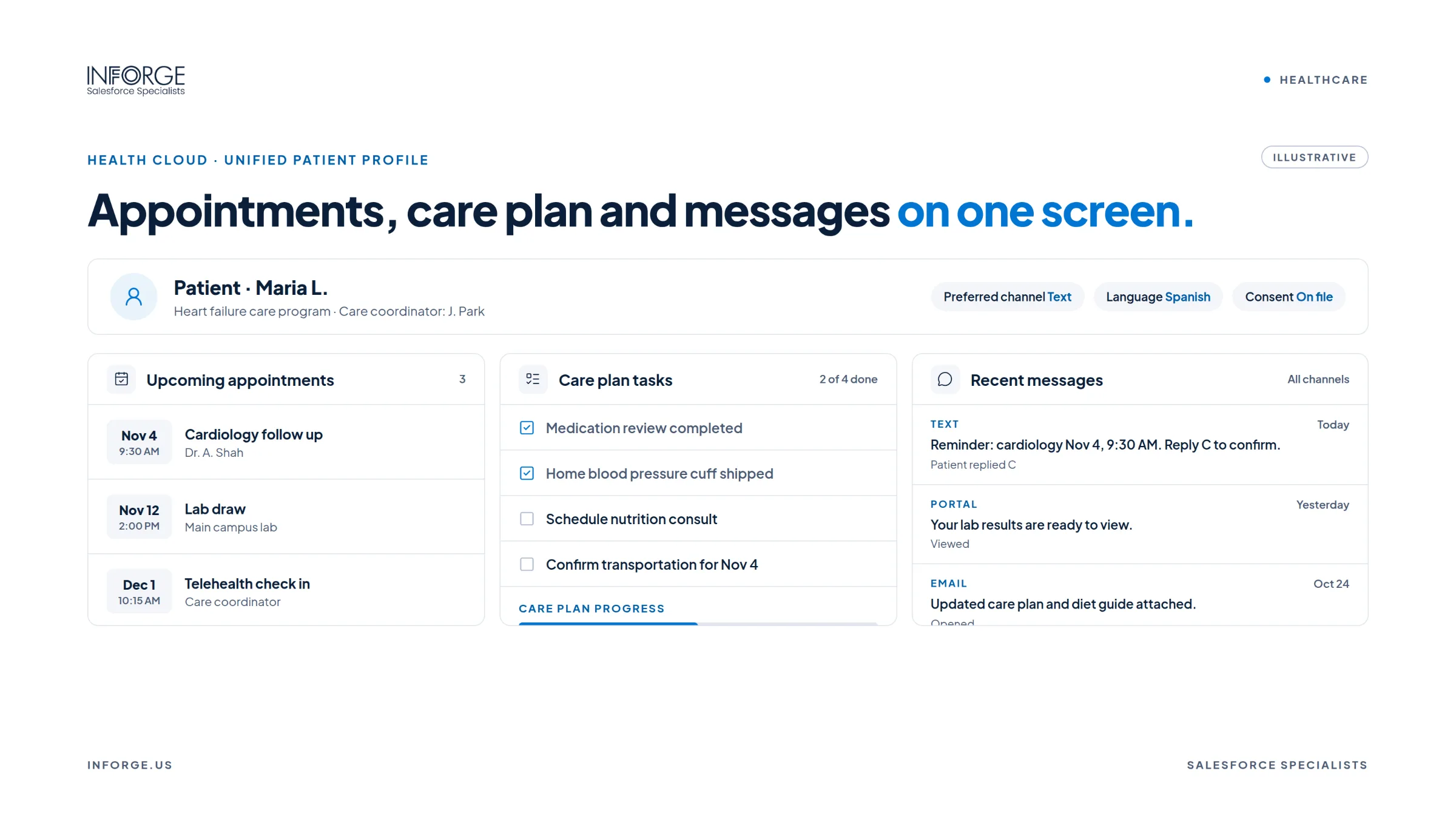
A unified patient profile combining demographics, conditions, care team members, appointments, communication preferences, and interaction history
Care plans and care coordination tools that assign tasks, track progress, and keep teams aligned
Patient access and intake workflows for scheduling, referrals, and eligibility checks
Omnichannel engagement across text, email, phone, portal, and chat, connected to Marketing Cloud and Service Cloud
AI agents through Agentforce that handle routine patient requests and support staff with summaries and next best actions
Five Ways Healthcare Organizations Use Health Cloud to Improve Engagement
1. Building a true 360 degree patient view
The foundation of every Health Cloud deployment is a single patient record that brings clinical and non-clinical data together. When a patient calls, the contact center agent sees upcoming appointments, recent visits, open referrals, care team members, preferred language, and preferred channel, without switching between five systems. That context is what makes every interaction feel personal.
2. Streamlining patient access and intake
The front door is where patient experience is won or lost. Health Cloud supports self-service scheduling, digital intake, insurance and benefits verification, and referral tracking. Referral management is especially high value: tracking referrals from creation to scheduled appointment closes one of the biggest leakage points in healthcare, where patients are referred but never actually booked.
3. Coordinating care across teams
Care plans in Health Cloud let care coordinators, nurses, social workers, and specialists work from the same set of goals, tasks, and patient updates. For chronic condition management, behavioral health, and post-discharge programs, this keeps patients from falling through the cracks between appointments.
4. Personalizing outreach at scale
With unified data, organizations can segment patients and send personalized, timely communication: preventive care reminders, appointment confirmations, post-visit follow-ups, medication adherence check-ins, and care gap outreach. Messages go out on the channel each patient prefers, which matters when so many patients aren't logging into portals.
5. Scaling the contact center with AI agents
Contact centers are often the first point of contact and the biggest source of patient frustration. With Agentforce for Health, organizations can deploy AI agents that answer common questions, help patients schedule or reschedule, check benefits, and route complex requests to the right human team with full context. In 2026, CVS Health announced it is using Salesforce's Agentforce Health to deliver faster, more personalized call center care for millions of members.
What Separates Successful Health Cloud Implementations
Health Cloud is a powerful platform, but healthcare organizations don't get results just by buying licenses. The implementations that deliver the most value share a few traits.
They start with specific engagement goals. Reducing referral leakage, improving post-discharge follow-up, or cutting contact center wait times, not "improving patient experience" in general.
They get the EHR integration right. Health Cloud is only as useful as the clinical data it can access. Integration planning has to happen early.
They clean and govern patient data. Duplicate patient records and inconsistent data undermine everything from outreach to AI agents.
They design for HIPAA from day one. Salesforce supports HIPAA compliance, but permissions, consent management, field-level security, and data access still have to be configured correctly.
They plan for adoption. Care coordinators and contact center staff need workflows that save them time, not add clicks.
At Inforge, we've found that the healthcare organizations seeing the fastest results from Health Cloud aren't the ones that implement every feature at once. They're the ones that pick one high-impact engagement workflow, integrate the data it needs, and expand from there.
Where to Start
For most healthcare organizations, the highest-ROI starting points are:
Patient access and referral management. Direct revenue impact by reducing leakage and filling schedules.
Contact center modernization. A unified patient view and AI agents reduce handle times and improve satisfaction.
Care coordination for a specific population. Chronic care, behavioral health, or post-discharge programs with measurable outcomes.
Personalized outreach and care gap closure. The broadest impact, but it depends on clean, unified data from the first three.
Summary
Patients now expect a coordinated, digital-first experience, and 35% say they'd consider switching doctors when digital tools fall short. Salesforce Health Cloud helps healthcare organizations meet that expectation by acting as the engagement layer on top of the EHR: unifying patient data, streamlining access and intake, coordinating care, personalizing outreach, and scaling the contact center with AI agents. The organizations that succeed start with a specific engagement goal, get the EHR integration and data quality right, and build from there.
Inforge helps healthcare organizations implement and optimize Salesforce Health Cloud with nearshore Salesforce consultants, admins, and developers who work in US time zones.
Frequently Asked Questions
Q: What is Salesforce Health Cloud used for?
A: Health Cloud is a healthcare-specific CRM used to manage patient relationships and engagement. Organizations use it for unified patient profiles, patient access and intake, referral management, care coordination, personalized outreach, and contact center service.
Q: Does Salesforce Health Cloud replace the EHR?
A: No. Health Cloud complements the EHR. The EHR remains the system of record for clinical documentation, while Health Cloud acts as the engagement and coordination layer, pulling in clinical data through standards like FHIR and HL7.
Q: Is Salesforce Health Cloud HIPAA compliant?
A: Salesforce supports HIPAA compliance for Health Cloud and will sign a Business Associate Agreement. However, compliance also depends on how the org is configured, including permissions, field-level security, consent management, and data access policies.
Q: How does Health Cloud improve patient engagement?
A: It gives care teams and contact centers a complete view of each patient, enables personalized outreach on each patient's preferred channel, tracks referrals and care plans so nothing falls through the cracks, and uses AI agents to handle routine requests quickly.
Q: How long does a Health Cloud implementation take?
A: It depends on scope and integrations. A focused first phase, such as referral management or contact center modernization, can often go live in a few months. Enterprise-wide deployments with multiple EHR integrations typically run longer and are rolled out in phases.
Sources used (for fact checking, not for publishing): eMarketer, 35% of patients would switch doctors · Salesforce Healthcare (IDC MarketScape, FHIR/HL7/MuleSoft) · Salesforce healthcare news (CVS Health, May 2026)