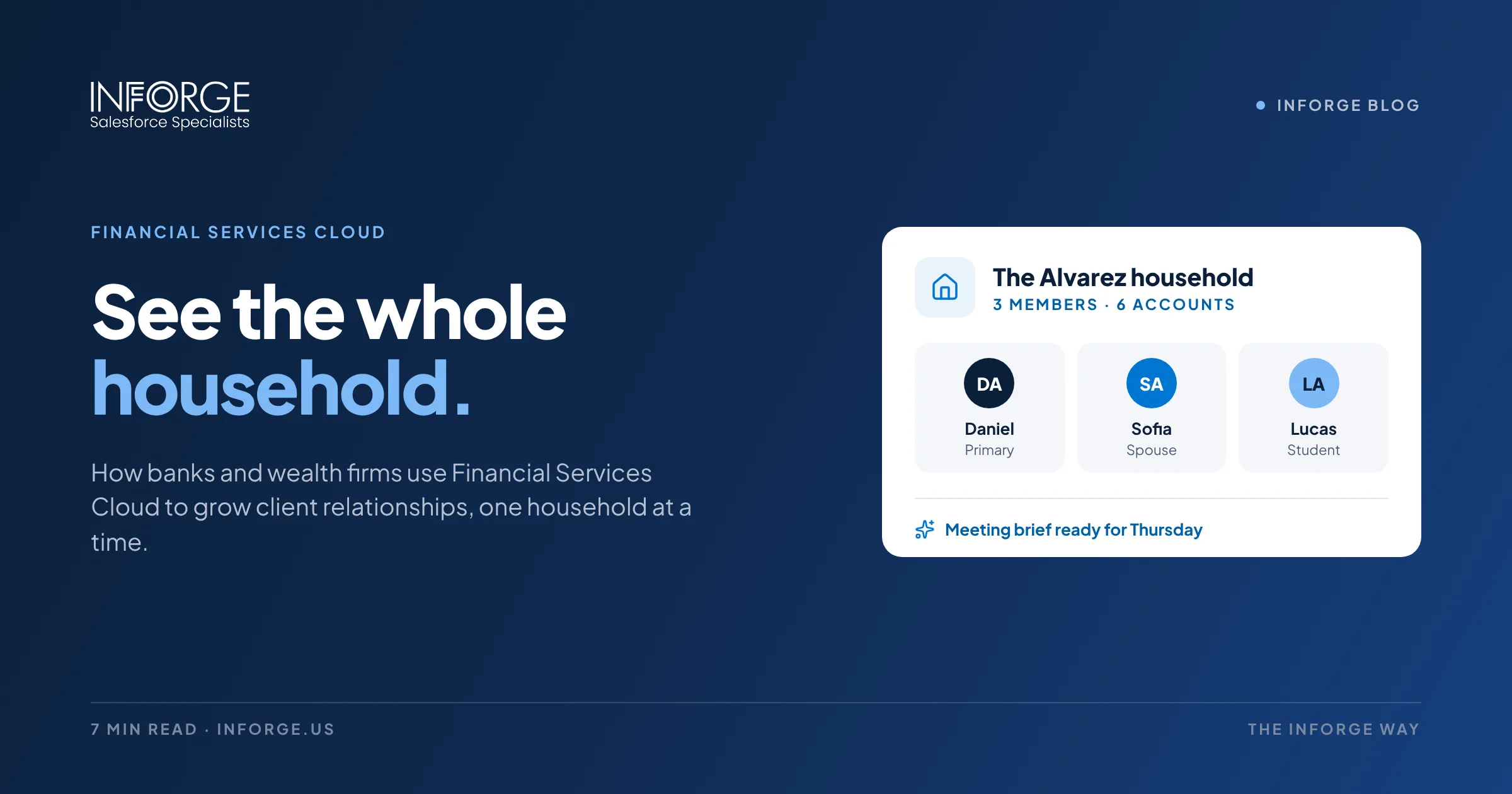
How Financial Services Firms Use Salesforce Financial Services Cloud to Grow Client Relationships
They use it to turn scattered client data into a complete picture of every relationship, and then act on it. Financial Services Cloud brings together data from core banking, custodial, policy, and planning systems, maps households and connections between clients, and gives advisors, bankers, and agents the context they need to engage at the right moment. Firms that use it well grow relationships because they stop reacting to clients and start anticipating them.
Quick Answer: Financial services firms use Salesforce Financial Services Cloud to build a unified client view across systems, map households and relationships, track financial goals, surface life events and growth opportunities, automate onboarding and service processes, and deploy Agentforce agents for meeting prep, follow-ups, and routine service requests. The result is more personalized engagement, more relevant cross-sell and referral opportunities, and more time for relationship managers to spend with clients.
Key Takeaways:
Financial Services Cloud is Salesforce's industry-specific CRM for banking, wealth management, and insurance, with data models and workflows built for financial relationships.
It unifies data from core banking systems, custodians, policy systems, and third-party sources into a single client view, according to Salesforce.
Household and relationship mapping helps firms understand who influences decisions and where the next opportunity is.
Agentforce for Financial Services adds AI agents for advisor and banker meeting prep, follow-ups, and routine banking service tasks.
Salesforce reports customer BCU handles escalated cases 27% faster with Agentforce.
Why Client Relationships Are Hard to Grow in Financial Services
Financial services firms often know a lot about their clients. The problem is that the knowledge is scattered.
Account data lives in the core banking platform. Investment data lives with the custodian. Policies live in an insurance system. Financial plans live in planning software. Notes live in emails, spreadsheets, and the advisor's memory. Each team sees a slice of the client, and nobody sees the whole relationship.
That fragmentation costs firms in three ways:
Missed opportunities. A client with a maturing CD, a new business, or a child heading to college is a natural conversation starter, but only if someone notices.
Inconsistent service. Clients repeat themselves across channels because the person helping them doesn't have context.
Lost relationships. When a relationship lives in one advisor's head, it leaves when that advisor does.
The bottleneck isn't client data. It's connecting it to the people who serve the client.
What Salesforce Financial Services Cloud Does
Financial Services Cloud builds on Sales Cloud and Service Cloud with data models, objects, and workflows designed specifically for banks, credit unions, wealth management firms, and insurers.
According to Salesforce, the platform unlocks data from core banking, wealth, and insurance systems and unifies it around the customer, so firms can personalize engagement using industry-specific automation and AI.
Key capabilities include:
Unified client profiles that combine accounts, holdings, policies, interactions, and service history
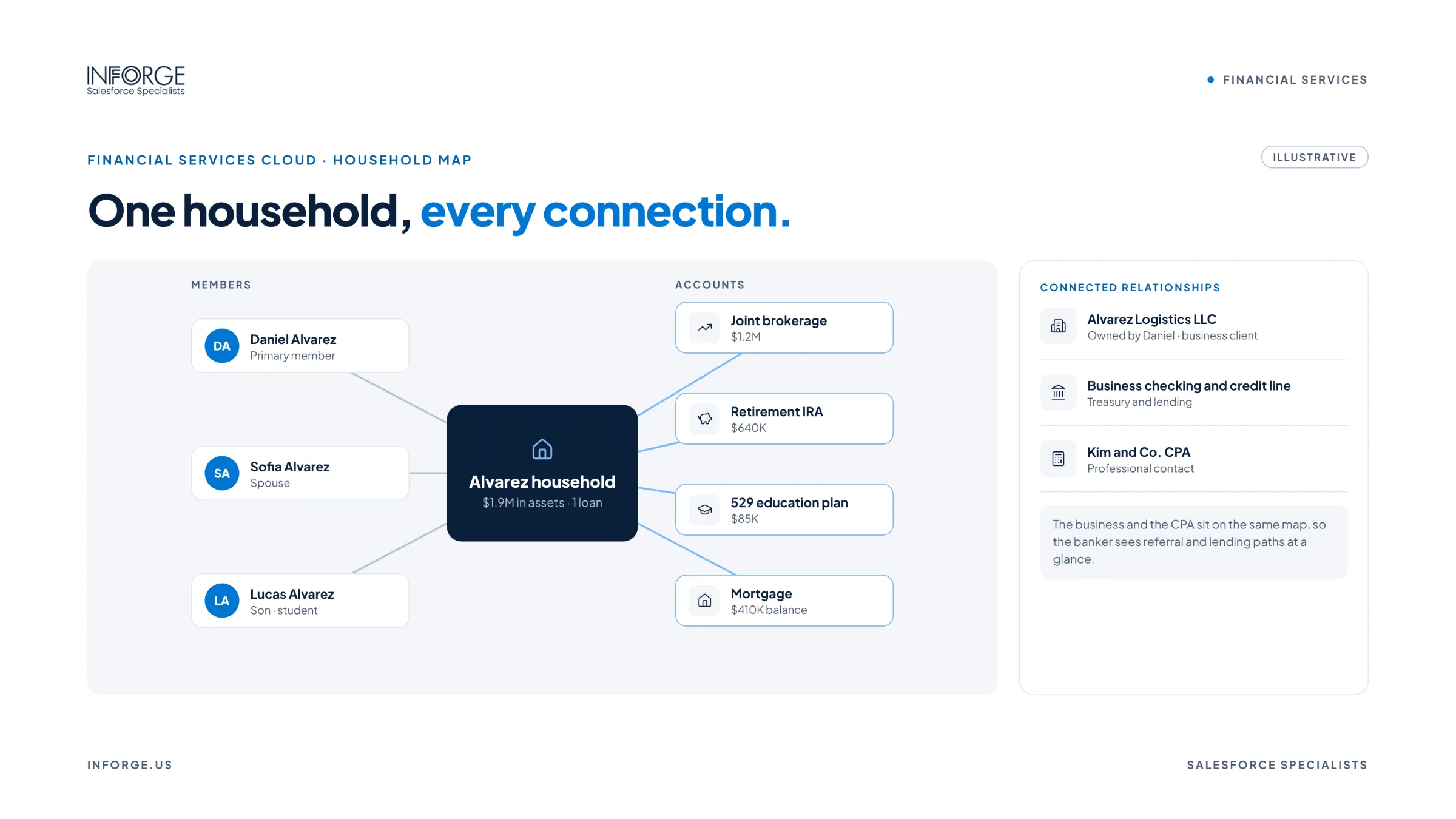
Household and relationship mapping through the Actionable Relationship Center, showing family members, business connections, and professional relationships
Financial goals and plans to track client objectives and progress
Client onboarding and service workflows for account opening, document collection, and requests
Actionable segmentation to target outreach to the right clients at the right time
Agentforce for Financial Services with prebuilt agent templates for advisors, bankers, and service teams
Five Ways Firms Use Financial Services Cloud to Grow Relationships
1. Seeing the whole relationship, not just the account
The foundation is a single view of the client and their household. When an advisor opens a client record, they see accounts across the firm, held-away assets where available, recent service requests, upcoming life events, and who else in the family or business is connected. That context turns every conversation into a relationship conversation instead of a transaction.
2. Mapping households and influencers
Financial decisions are rarely made alone. Relationship mapping shows spouses, children, business partners, trusts, and professional advisors like CPAs and attorneys. Firms use this to engage the next generation before wealth transfers, identify referral sources, and serve families as a unit.
3. Spotting growth opportunities proactively
Salesforce positions Financial Services Cloud to surface life events, held-away assets, and changes in financial activity so relationship managers know where to engage and why. A new business, a home purchase, a retirement date, or a large deposit becomes a prompt for outreach, rather than something discovered too late.
4. Streamlining onboarding and service
The first 90 days of a new relationship shape everything after. Guided onboarding workflows, digital document collection, and service case management reduce friction and give clients a consistent experience across branches, advisors, and digital channels.
5. Scaling relationship managers with AI agents
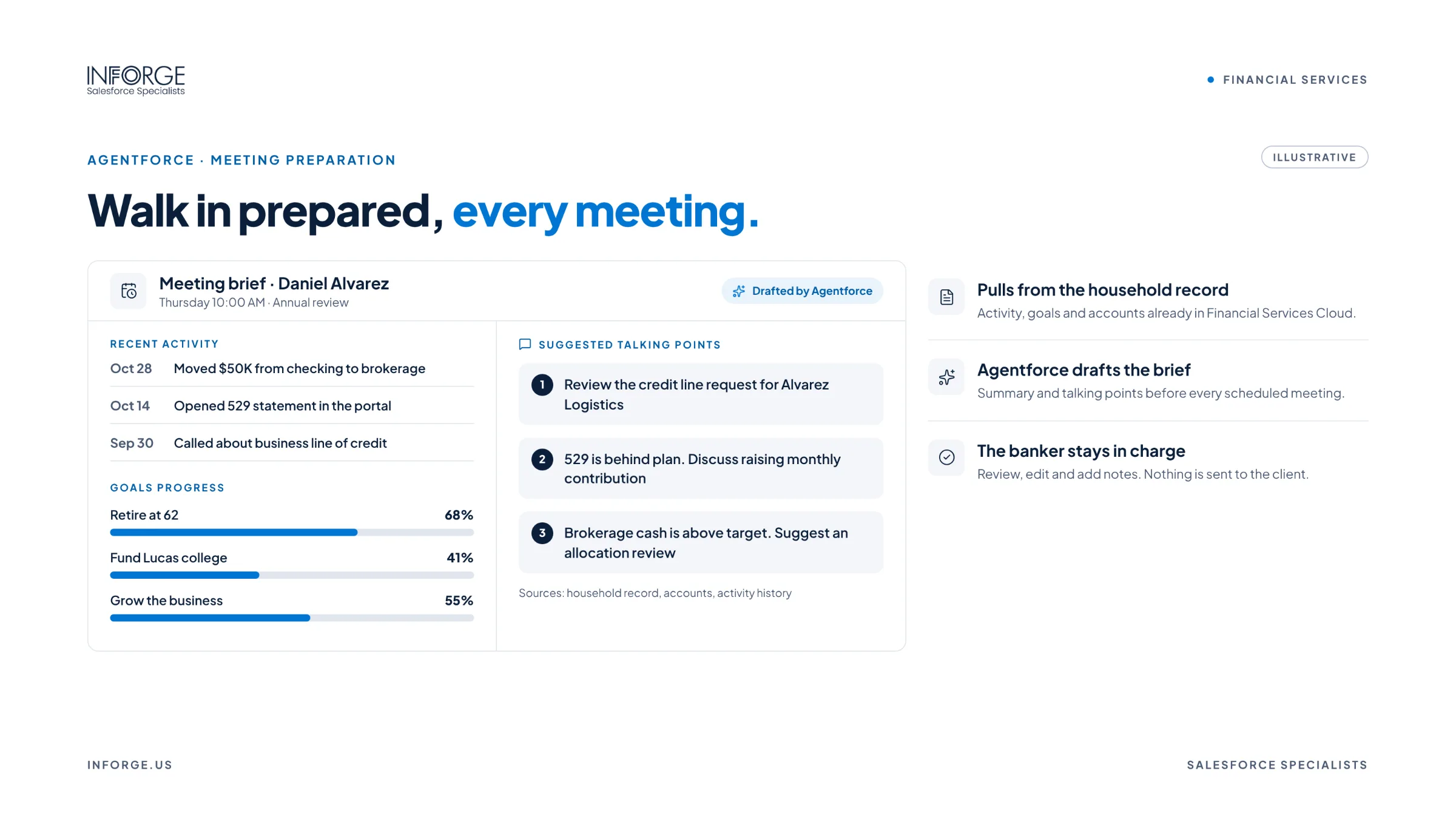
Agentforce for Financial Services includes templates for advisor and banker agents that prepare meeting agendas from portfolio data, past interactions, and client milestones, then summarize meetings and create follow-up tasks. Service agents handle routine requests like card issues and account inquiries. Salesforce reports that customer BCU now handles escalated cases 27% faster with Agentforce.
What Separates Successful Financial Services Cloud Implementations
Financial Services Cloud is powerful, but firms don't grow relationships just by turning it on. The most successful implementations share a few traits:
They start with integration strategy. The value depends on which systems feed the client view. Core banking, custodial, and policy integrations need to be planned early.
They clean client data before migrating. Duplicate clients and broken household records undermine relationship mapping from day one.
They design for advisor adoption. If the platform adds clicks instead of saving time, advisors won't use it. Simple layouts and AI-assisted prep make the difference.
They build compliance in. Field-level security, sharing rules, audit trails, and consent tracking need to reflect regulatory obligations.
They focus on one growth motion first. Next-generation engagement, referral programs, or onboarding, rather than everything at once.
At Inforge, we've found that the financial services firms getting the most from Financial Services Cloud aren't the ones that implement every feature. They're the ones that get the data foundation right, design around how advisors actually work, and expand from one clear growth use case.
Summary
Financial services firms grow client relationships when every advisor, banker, and service rep can see the full relationship and act on it. Salesforce Financial Services Cloud makes that possible by unifying data from core systems into a single client view, mapping households and connections, tracking goals, surfacing growth opportunities, and scaling teams with Agentforce. Success depends on integration planning, clean data, advisor adoption, and built-in compliance.
Inforge helps banks, wealth management firms, and insurers implement and optimize Salesforce Financial Services Cloud with nearshore Salesforce consultants, admins, and developers working in US time zones.
Frequently Asked Questions
Q: What is Salesforce Financial Services Cloud?
A: Financial Services Cloud is Salesforce's industry-specific CRM for banking, wealth management, and insurance. It adds financial data models, household and relationship mapping, goals tracking, and industry workflows on top of Sales Cloud and Service Cloud.
Q: How does Financial Services Cloud help grow client relationships?
A: It gives relationship managers a complete view of each client and household, surfaces life events and opportunities, supports personalized outreach, and automates prep and follow-up so advisors can spend more time with clients.
Q: Can Financial Services Cloud integrate with core banking and custodial systems?
A: Yes. Salesforce positions Financial Services Cloud to unify data from core banking, custodial, policy, and third-party systems. Integration approaches vary by system and are a key part of implementation planning.
Q: What is Agentforce for Financial Services?
A: It's Salesforce's set of AI agent templates for financial services, including agents that help advisors and bankers prepare for meetings and follow up, and service agents that handle routine banking requests.
Q: Is Financial Services Cloud only for large banks?
A: No. It's used by credit unions, regional banks, wealth management firms, and insurers of many sizes. Smaller firms typically start with a focused scope, like client onboarding or advisor productivity, and expand from there.