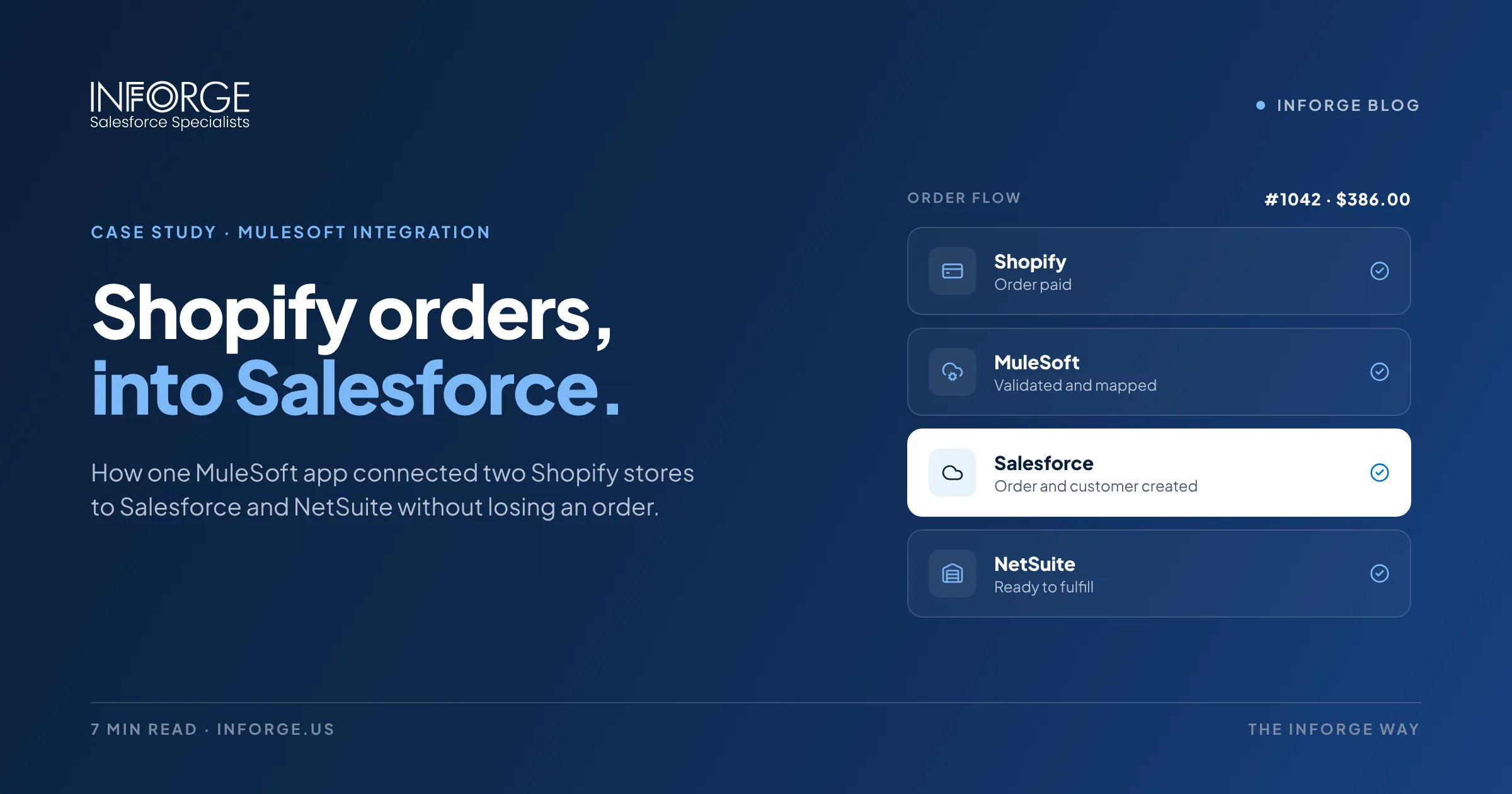
How Do You Get Shopify Orders into Salesforce? A MuleSoft Integration Case Study
With one reliable integration that treats every paid order as something that can't be lost. For a hardware manufacturer running two Shopify storefronts, Inforge built a single MuleSoft application that delivers every paid order into Salesforce, where the client's team turns it into native records and sends it on to NetSuite. It went live on both storefronts before a new consumer store opened pre-orders, with two days to spare.
Quick Answer: Inforge connected two Shopify storefronts to Salesforce using one MuleSoft application running on CloudHub 2.0. Every paid order is received through verified Shopify webhooks, written to staging objects in Salesforce, and backed up by an hourly recovery job that catches anything a webhook missed. Most orders reach Salesforce in under 10 seconds, there have been zero rejected webhooks since go-live, and the client owns the code, keys, and runbook from day one.
Key Takeaways:
One MuleSoft app serves both Shopify storefronts. Each store is configuration, not a separate deployment.
Most orders travel from Shopify webhook to Salesforce in under 10 seconds.
Zero rejected webhooks since go-live.
Both storefronts were live with two days to spare before the consumer launch, and Phase 1 closed within the agreed hours.
The integration is backed by 85 automated tests built on real, anonymized webhook payloads.
The Challenge: Two Storefronts, One CRM, a Fixed Launch Date
The client, a hardware manufacturer, sells through two Shopify storefronts and runs its business on Salesforce and NetSuite. Three pressures shaped the project.
Every order had to flow. Every paid Shopify order needed to reach Salesforce, where the client's team converts it into native records and passes it on to NetSuite, their ERP. A missing order meant a missing sale in the CRM and a gap in fulfillment and finance downstream.
There was a launch to hit. A new consumer storefront was about to open pre-orders, and its orders had to land in Salesforce from day one. The deadline wasn't flexible.
The platform changed mid-project. Partway through, the client standardized on MuleSoft Anypoint for every Shopify integration, so the build moved to MuleSoft without moving the launch date.
The bottleneck wasn't connecting two systems. It was making sure no order could ever slip through the cracks, on a timeline that couldn't move.
What We Built: One Integration for Both Storefronts
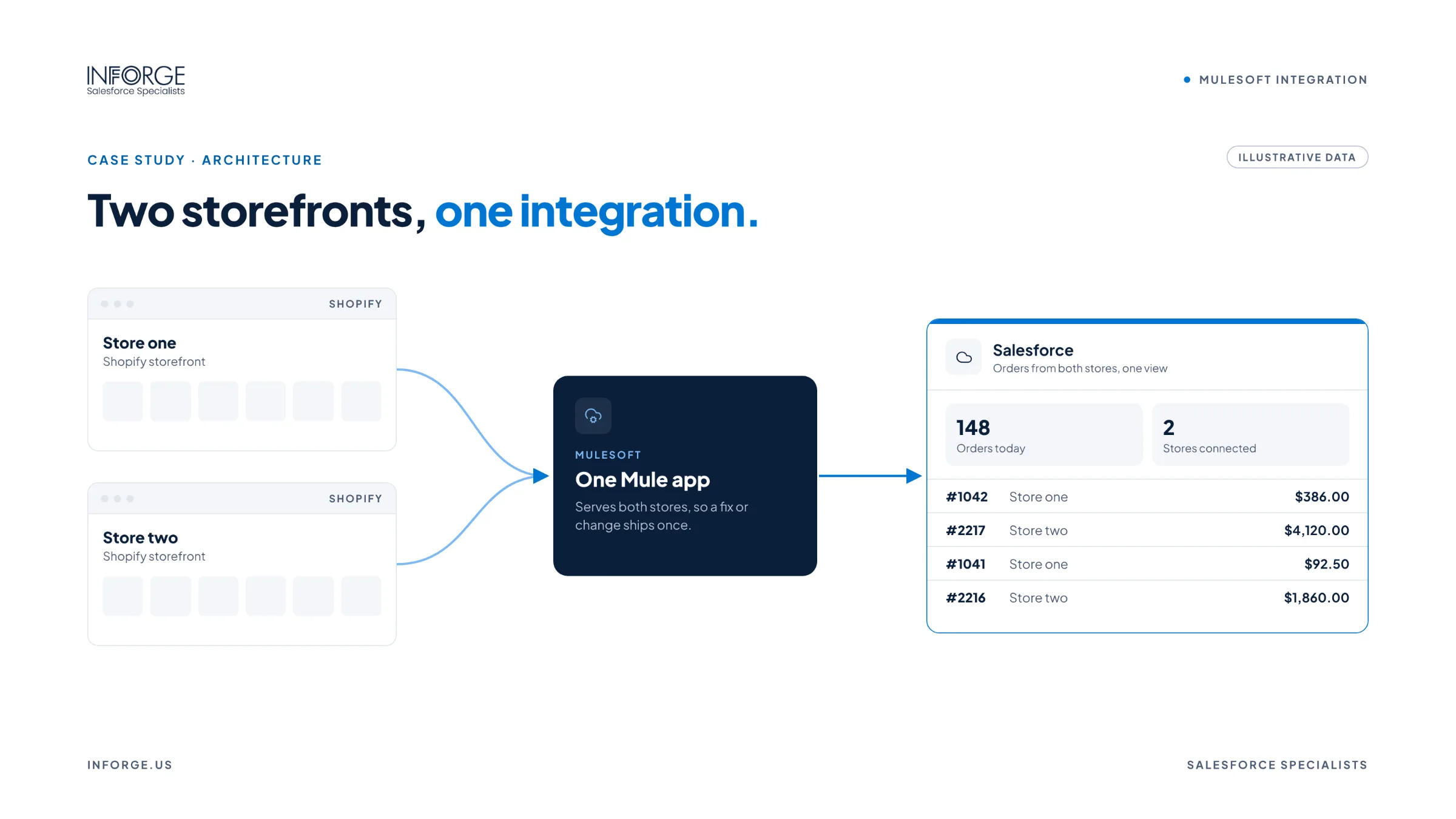
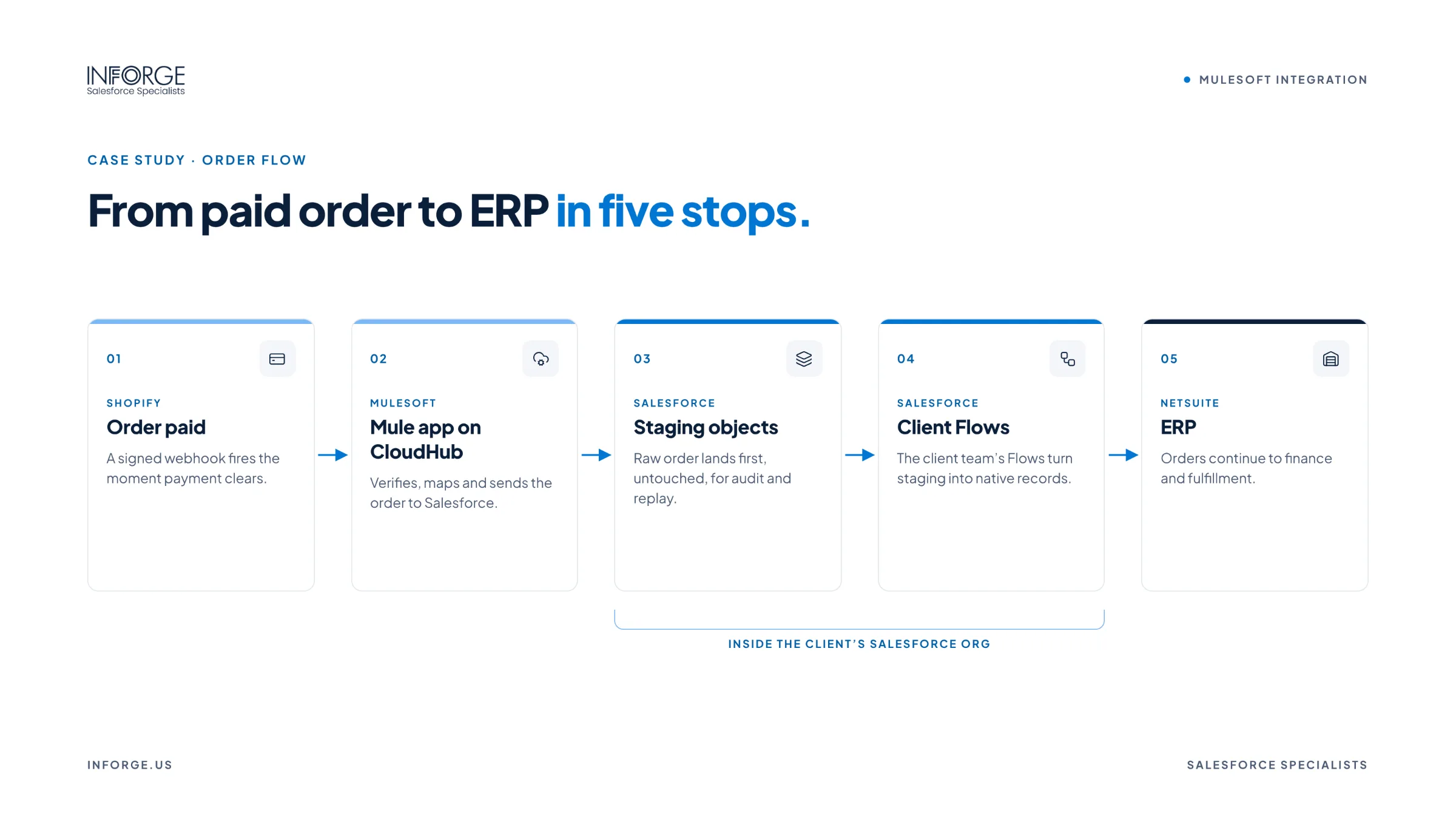
Inforge built a single Mule application on CloudHub 2.0 that handles orders from both storefronts. The flow is straightforward:
Shopify. A customer pays for an order on either storefront, and Shopify sends a webhook.
Mule app. The MuleSoft application on CloudHub 2.0 verifies the webhook and processes the order, with an hourly recovery job running alongside it.
Staging in Salesforce. The order is written to staging objects in Salesforce.
Client's team. The client's own Flows turn staged orders into native Salesforce records.
NetSuite. Orders continue on to the ERP.
The project had a clear boundary from the start: Inforge delivers every paid order to staging, and the client's team owns everything after that. That separation kept responsibilities clear, made testing simpler, and let the client keep control of their own business logic in Salesforce.
How It Holds Up: Built Not to Lose an Order
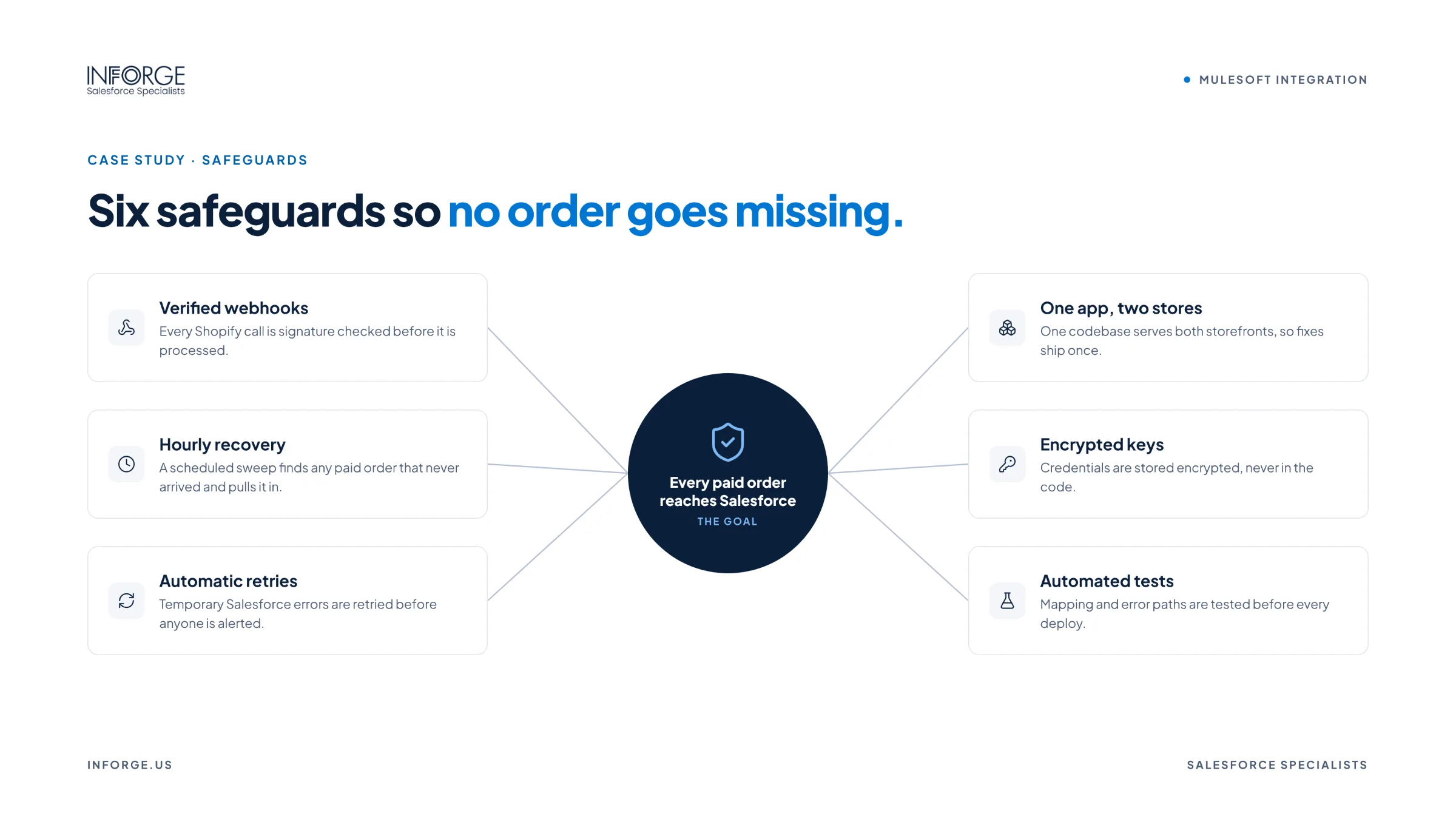
For an order integration, reliability is the whole point. Every design decision was made so that an order is either delivered or clearly flagged, never silently lost.
Verified webhooks. Every Shopify webhook's signature is checked before anything is written, so only genuine orders from the client's stores get through.
Hourly recovery. Webhooks can occasionally fail to arrive. A scheduled job runs every hour to pick up any paid order a webhook missed.
Automatic retries. Transient errors retry on their own. Anything that still fails is flagged for attention, not dropped.
One app, two stores. Each storefront is configuration rather than a separate deployment. Adding a third store later doesn't mean building a new integration.
Encrypted configuration. Secrets are encrypted per environment, with a separate key for each.
85 automated tests. The test suite is built on real Shopify webhook payloads, anonymized, so the integration is tested against the data it actually receives.
The Results
Acceptance was signed off on both storefronts, and Phase 1 closed within the agreed hours.
2 storefronts live from one app. Both stores run through the same integration.
Under 10 seconds for most orders. That's the typical time from Shopify webhook to Salesforce.
0 rejected webhooks since go-live. Every genuine webhook has been accepted and processed.
2 days to spare. Both storefronts were live before the consumer store opened pre-orders.
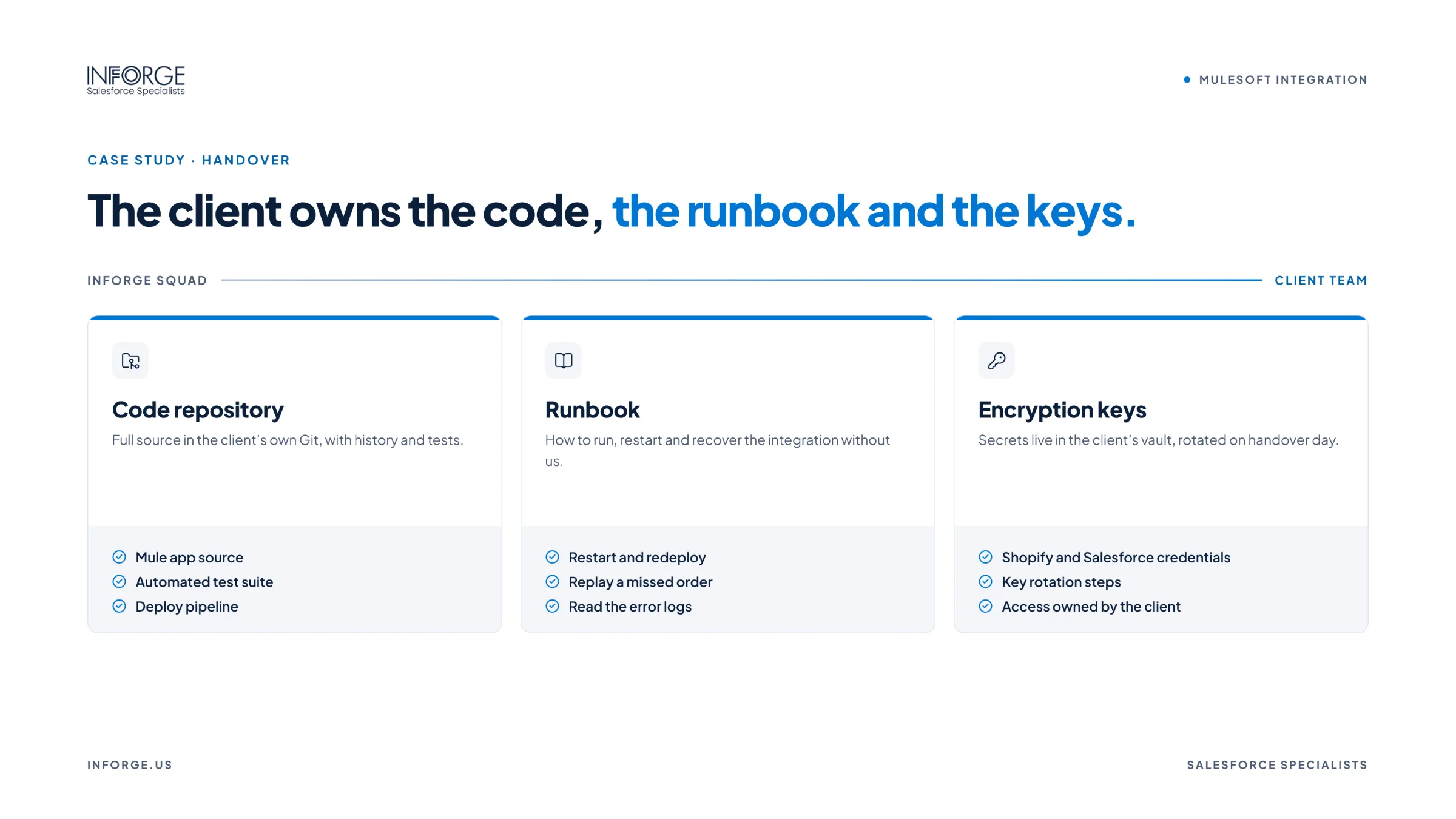
Handover: The Client Owns It from Day One
A good integration shouldn't depend on the partner who built it. The handover was designed so the client could run the integration on their own immediately.
Code in their repository. The source code and tests live in the client's GitHub, with nothing of Inforge's left in the configuration.
A runbook to operate it. The client's team has documented steps for deploying, reading the logs, recovering orders, and adding a new store.
Keys in their hands. Encryption keys were delivered by one-time link, followed by a week of hypercare support.
At Inforge, we've found that the integrations that last aren't the most complex ones. They're the ones with a clear boundary, built-in recovery, real tests, and a handover that leaves the client fully in control.
Summary
A hardware manufacturer needed every paid order from two Shopify storefronts in Salesforce before a new consumer store opened pre-orders, and the integration platform changed midway through the project. Inforge built one MuleSoft application on CloudHub 2.0 with verified webhooks, hourly recovery, automatic retries, encrypted configuration, and 85 automated tests. Both storefronts went live with two days to spare, most orders reach Salesforce in under 10 seconds, and there have been zero rejected webhooks since go-live. The client owns the code, runbook, and keys from day one.
Inforge builds Salesforce and MuleSoft integrations for US companies with nearshore Salesforce architects, developers, and consultants working in your time zone.
Frequently Asked Questions
Q: How do you integrate Shopify with Salesforce?
A: One reliable approach is a middleware integration like MuleSoft that receives Shopify order webhooks, verifies them, and writes orders into Salesforce. In this project, orders land in staging objects, and the client's own Flows turn them into native records.
Q: Why use MuleSoft for a Shopify to Salesforce integration?
A: MuleSoft gives companies a standard platform for integrations, with deployment, monitoring, and security in one place. In this case, the client standardized on MuleSoft Anypoint for every Shopify integration, so building there kept their architecture consistent.
Q: What happens if a Shopify webhook fails?
A: The integration includes an hourly recovery job that picks up any paid order a webhook missed, plus automatic retries for transient errors. Anything that still fails is flagged instead of lost.
Q: Can one integration handle multiple Shopify stores?
A: Yes. In this project, a single Mule application serves both storefronts, with each store set up as configuration rather than a separate deployment. Adding another store doesn't require a new build.
Q: How fast do Shopify orders reach Salesforce?
A: For most orders in this project, it takes under 10 seconds from the Shopify webhook to Salesforce.