Dreamforce 2026 Recap: What the Agentic Enterprise Actually Means for Your Salesforce Stack
Dreamforce 2026 ran September 15–17 at Moscone Center in San Francisco, and the one-line summary is this: Salesforce told the world its own user interface is now optional. AIforce, Koa, Claudeforce, and a roster of seven job-ready Agentforce agents don't just add features — they change where Salesforce work happens and who (or what) does it.
For Salesforce consultancies, RevOps leaders, and Salesforce admins evaluating what to prioritise next, the noise-to-signal ratio from a show this size is brutal. This recap skips the onstage theatre and focuses on what moved, what's actually shipping, and what your org should do about it.
Key Takeaways:
AIforce is the new interface layer that brings Salesforce data, workflows, and permissions into Claude, Slack, and any MCP-compatible surface — without requiring users to open the CRM.
Koa is Salesforce's first CRM-specific reasoning model, built with NVIDIA on Nemotron, and is currently in pilot with select customers.
Claudeforce (Salesforce inside Claude) moved into open beta, shipping 37 pre-built sales skills for all paid Claude plan users.
Seven named, job-ready Agentforce agents are now available — six are generally available, Hunter (outbound sales) is in pilot ahead of a November 2026 GA.
The bottleneck is no longer the technology. It's data readiness and governance.
AIforce: Salesforce Stops Selling Screens
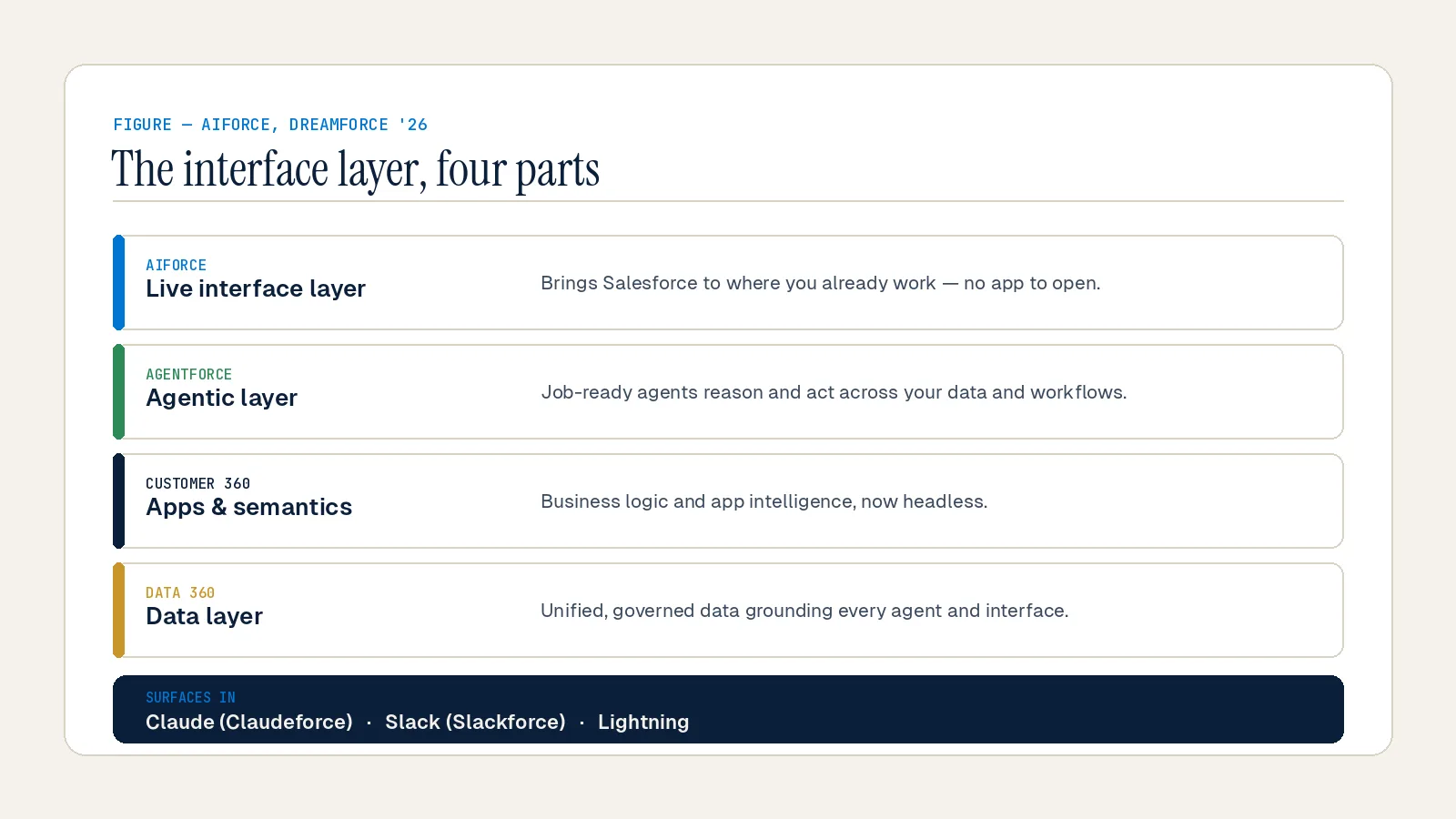
The headline announcement wasn't a new cloud or a pricing change. According to Salesforce's keynote on September 15, AIforce is a live interface layer that carries Salesforce data, logic, and permissions to wherever people and agents already work — Claude, Slack, or the Lightning search bar. You don't need to open Salesforce to do Salesforce work.
AIforce launched with three surfaces: Claudeforce (Salesforce skills inside Anthropic's Claude), Slackforce (agentic workflows and CRM actions inside Slack), and Agentforce Coworker (an AI teammate embedded in the Lightning interface itself). The theme is consistent: Salesforce becomes a capability layer, not a destination.
According to Salesforce's official architecture diagram, the full stack now has four pillars — Data 360 at the foundation, Customer 360 for business logic and semantic intelligence, Agentforce for the agent workforce, and AIforce as the interface layer on top. Each layer has a clear job. The mapping is one-to-one.
For mid-market Salesforce orgs, this is the clearest signal yet that implementation work is shifting toward data architecture, permissions design, and agent configuration — not screen layouts and Lightning pages.
Claudeforce and the Anthropic Partnership
Salesforce and Anthropic expanded their partnership significantly. Claudeforce, now in open beta on all paid Claude plans, ships 37 pre-built sales skills covering prospecting through pipeline hygiene, with Tableau analytics and service, marketing, and commerce skills coming next.
According to Salesforce's Dreamforce keynote notes, Deloitte, GitLab, and Legora were among the pilot customers, and a separate Salesforce Development plug-in for Claude Code arrives with more than 40 skills for builders.
The trust model matters here: access inside Claude is scoped to what each user can already see in Salesforce, and no Salesforce data is retained by the model. That's the architecture answer to the question every procurement team will ask.
For orgs already working in Claude day-to-day, this is additive. For orgs evaluating whether to bring Claude into their workflow, it becomes a meaningful reason to move now.
Koa: Salesforce's Own Reasoning Model
Salesforce built its first CRM-specific reasoning model. Koa was developed with NVIDIA using the Nemotron foundation, and it's already in pilot with customers including Formula 1 and UChicago Medicine.
The goal, according to Salesforce's keynote, is straightforward: frontier models know everything about the world and almost nothing about your specific business. Koa closes that gap by reasoning through real CRM situations — evaluating customer history, scoring opportunities, and determining next actions using multiple layers of CRM context.
General availability in U.S. regions is expected winter 2026. The practical implication for now: Salesforce is building model routing logic that lets the platform choose between cheap, fast Koa calls and full frontier model calls depending on the task. That cost-routing story is where the real ROI lives.
Seven Job-Ready Agents — and What 'Job-Ready' Actually Means
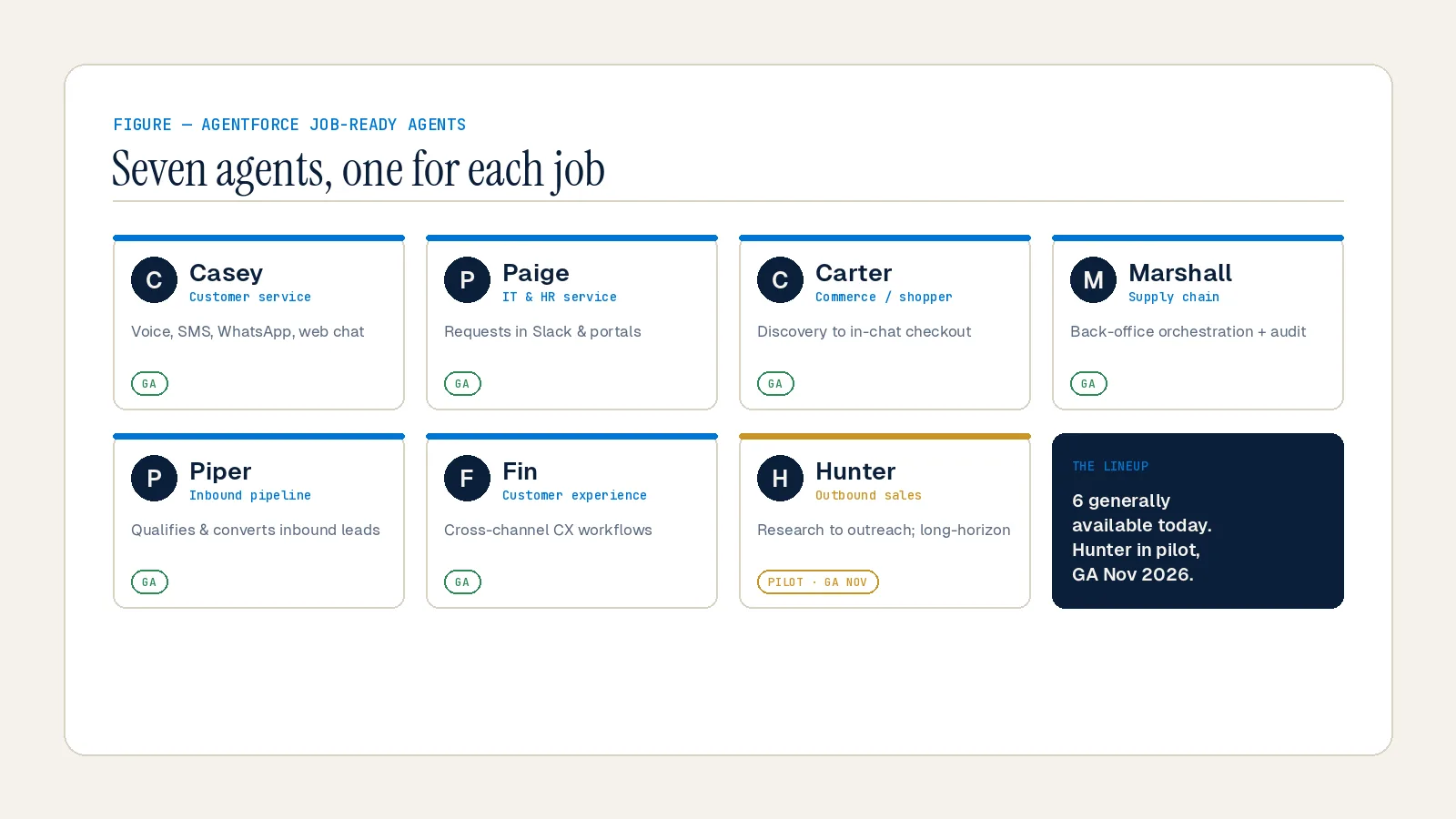
According to Salesforce's pre-Dreamforce announcement on September 11, seven named, prebuilt agents are now available: Casey (customer help and service), Paige (IT and HR employee requests), Carter (shopper and in-chat checkout), Marshall (supply chain and back office), Piper (inbound pipeline generation), Fin (complex multi-channel customer workflows), and Hunter (outbound sales prospecting).
Six are generally available. Hunter is in pilot, with general availability planned for November 2026.
Hunter is the one to watch. According to Salesforce's Agentforce keynote, it runs on a new long-horizon runtime that lets an agent pursue goals over days or weeks, not just a single conversation. It builds a task plan, connects to email to learn a seller's voice, drafts outreach, and adapts as new context arrives. Benioff claimed Hunter generated $500 million in pipeline for Salesforce internally last quarter — a number worth scrutinising, but directionally significant.
The enterprise adoption case on stage was specific. According to Salesforce's Agentforce keynote customer proof, Fulton Bank went from first login to 20-plus live use cases and roughly 3,000 users within six weeks. Adecco is rolling Agentforce Coworker to 27,000 employees across 40-plus countries. Engine resolves half its chat inquiries fully with AI.
These aren't cherry-picked pilots. They're production deployments with named customers and specific numbers — and that's a meaningful shift from Dreamforce 2025's positioning.
Headless 360 and AgentExchange: The Infrastructure Story
Under the keynote headlines sits the architecture work that actually matters for implementation teams.
Headless 360 reframes Salesforce from a set of application screens into a set of governed capabilities that any authorised agent — inside or outside Agentforce — can discover and execute, using Model Context Protocol (MCP) as the open standard. The Headless 360 MCP Server, now in open beta with GA expected in November, exposes four core tools (Discover, Describe, Dispatch, and Dispatch Read Only), backed by a skill library. Every transaction runs as the authenticated user and respects existing CRUD, field-level security, sharing rules, and permission sets.
For Salesforce admins, the practical implication is this: the flows, approval chains, and validation rules you've built over years are exactly what Headless 360 exposes to AI agents. Your existing work becomes the intelligence agents inherit. That's not a threat to admin relevance — it's an argument for getting your data model clean before agents start reasoning over it.
AgentExchange, meanwhile, absorbs AppExchange and the Slack Marketplace into one unified storefront, with unified billing, semantic search powered by Data 360, and discovery inside Agentforce Builder. According to Salesforce's Dreamforce announcements, AgentExchange includes listings from Anthropic, AWS, Google, Microsoft, Docusign, and more than 13,000 total listings backed by a $50M Builders Fund.
What's Still Missing: The Honest Version
Dreamforce delivered a coherent architecture and real customer proof. It did not deliver every answer.
No AIforce pricing was announced. Pricing and packaging are listed as subject to change. For procurement and operations teams, that means consumption-based cost modelling is still a guess until Salesforce moves on this.
The governance questions are real. Identity and permissioning across connected apps, audit trails for agent actions, and what happens when an agent surfaces data from loose sharing rules — these are design problems the customer owns, not checkboxes Salesforce solves for you. The Trusted Enterprise AI Harness and the AI Control Plane give you the tools; the work is still yours.
Data readiness is the real constraint. An agent that reasons over a pipeline nobody trusts delivers confident wrong answers at scale. The single most important thing a Salesforce org can do right now isn't evaluate agents — it's get the data model right.
At Inforge, we've run Salesforce implementations entirely through AI agents since before Dreamforce made it a keynote theme. The consistent finding: the technology is ready. The data is usually not. That's where the implementation work lives.
Summary
Dreamforce 2026 confirmed the direction Salesforce has been signalling all year: the CRM is becoming an intelligence platform, not a destination. AIforce, Koa, Claudeforce, and seven job-ready agents are the product expression of that shift. The orgs that benefit earliest are the ones with clean data, clear permissions, and a partner who knows how to configure agents against real business processes — not just demo them.
Inforge delivers full Salesforce implementations through AI agents. We've been operating this way since before the keynote made it a headline. If Dreamforce 2026 gave you a list of things to act on and no clear path to the first one, [INTERNAL LINK: talk to an Inforge consultant — start with a free data readiness assessment].
Frequently Asked Questions
Q: What was the biggest announcement at Dreamforce 2026?
A: AIforce — a live interface layer that brings Salesforce data, workflows, and permissions into external tools like Claude, Slack, and the Lightning search bar without requiring users to open the traditional CRM. It launched with three shipping surfaces: Claudeforce, Slackforce, and Agentforce Coworker.
Q: What is Koa and when is it available?
A: Koa is Salesforce's first CRM-specific reasoning model, built with NVIDIA using the Nemotron foundation. It's designed to reason through real business situations using CRM context — customer history, opportunity scoring, next-best-action. It's currently in pilot with select customers, with general availability in U.S. regions expected in winter 2026.
Q: What are the seven Agentforce job-ready agents?
A: Casey (customer service and help), Paige (IT and HR), Carter (shopper and in-chat checkout), Marshall (supply chain and back office), Piper (inbound pipeline generation), Fin (complex multi-channel workflows), and Hunter (outbound sales). Six are generally available; Hunter is in pilot with GA planned for November 2026.
Q: Is Agentforce Coworker available now?
A: Yes. Agentforce Coworker was made generally available at Dreamforce 2026. It runs inside the Lightning interface and is the first surface in the AIforce family that's fully available to all eligible customers.
Q: What should my Salesforce org do first after Dreamforce 2026?
A: Before evaluating any new agent or interface layer, audit your data model. Agents reason over whatever data they can access. Duplicate records, loose sharing rules, and untrusted pipelines produce confident wrong answers at scale. Clean data architecture is the prerequisite — everything else comes after.
