Agentforce vs. Custom Apex Agents: Which Salesforce AI Approach Fits Your Business in 2026
If you are running Salesforce in 2026, you are no longer deciding whether to use AI agents. You are deciding how to build them. The two dominant paths are Agentforce — Salesforce's native autonomous agent platform — and custom Apex-driven agents that give your developers full programmatic control. Both are legitimate. Both have real tradeoffs. And choosing the wrong one costs time, money, and credibility with leadership.
At Inforge, we run our entire Salesforce delivery model through AI agents. We have built on both sides of this decision. Here is the honest breakdown.
Key Takeaways:
Agentforce excels for standard CRM workflows — service resolution, lead qualification, SDR outreach — where prebuilt templates and the Atlas Reasoning Engine give you a fast, governed path to deployment.
Custom Apex agents are the right choice when your logic is complex, deterministic, and cannot be handed to an LLM to reason about — multi-object calculations, financial transfers, bulk data operations.
The false binary is "Agentforce OR Apex." The most effective implementations use both: Agentforce orchestrates decisions, Apex executes the precision logic underneath.
According to BCG and Forrester 2026 data, vendor-deployed platforms like Agentforce achieve 2.4x faster payback than fully custom-built alternatives.
Data quality is not a nice-to-have. It is the single most important pre-deployment condition for either approach.
Quick Answer: For most mid-market Salesforce orgs with standard CRM use cases, Agentforce with custom Apex actions is the fastest, most governable path to production in 2026. Pure custom Apex agents make sense only when your workflows have logic that probabilistic LLM reasoning cannot safely handle.
What Agentforce Actually Is in 2026 (Not What the Marketing Says)
Agentforce is not a chatbot upgrade. It is an autonomous agent platform built natively inside Salesforce that executes multi-step CRM workflows without waiting for a human to approve each step.
Since its launch at Dreamforce 2024, the platform has moved fast. Agentforce 360 reached general availability in January 2026, introducing four major capabilities: the new Agentforce Builder for faster agent development, Agent Script for deterministic control flows, Agentforce Voice for natural conversations across channels, and Intelligent Context for grounding agents in unstructured enterprise data. By Q1 FY2027, Agentforce and Data 360 combined ARR had grown to $1.2 billion — making it the most rapidly adopted new product in Salesforce's 25-year history.
The architecture that makes it work:
Atlas Reasoning Engine: Plans and executes multi-step workflows, breaking tasks into sub-steps and evaluating at each decision point.
Agent Builder: A low-code canvas where admins define topics, connect actions via Flows, MuleSoft, APIs, or Apex, and write natural-language instructions.
Einstein Trust Layer: A non-negotiable security boundary that enforces zero data retention, toxicity detection, and audit trails by default — HIPAA and GDPR aligned.
Data 360 (formerly Data Cloud): The intelligence layer that grounds every agent decision in unified customer context — purchase history, support tickets, web behavior.
Command Center: Live observability across all deployed agents and their performance.
According to Digital Applied, enterprises deploying Agentforce report 30 to 40 percent reductions in response times and measurable deflection of routine support volume away from human agents. The Service Agent template alone achieves deflection rates of 40 to 60 percent for routine inquiry categories when paired with a well-configured knowledge base.
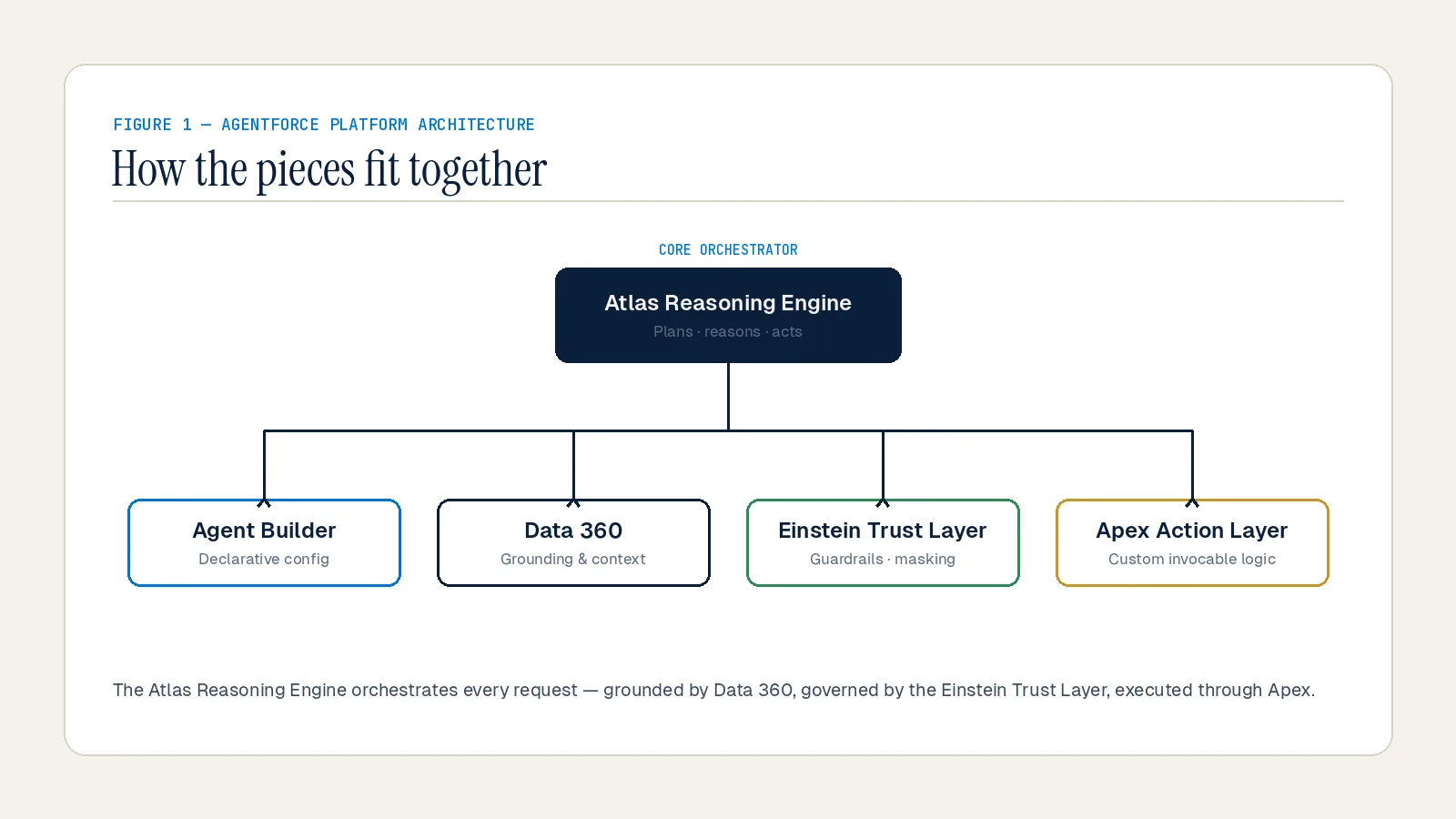
The key point most evaluators miss: Agentforce does not replace Apex. It orchestrates it. When an Agentforce agent decides to take an action, it executes that action by calling your existing Flows and Apex classes. The automation you have already built becomes the toolkit the agent reaches into.
What "Custom Apex Agents" Actually Means
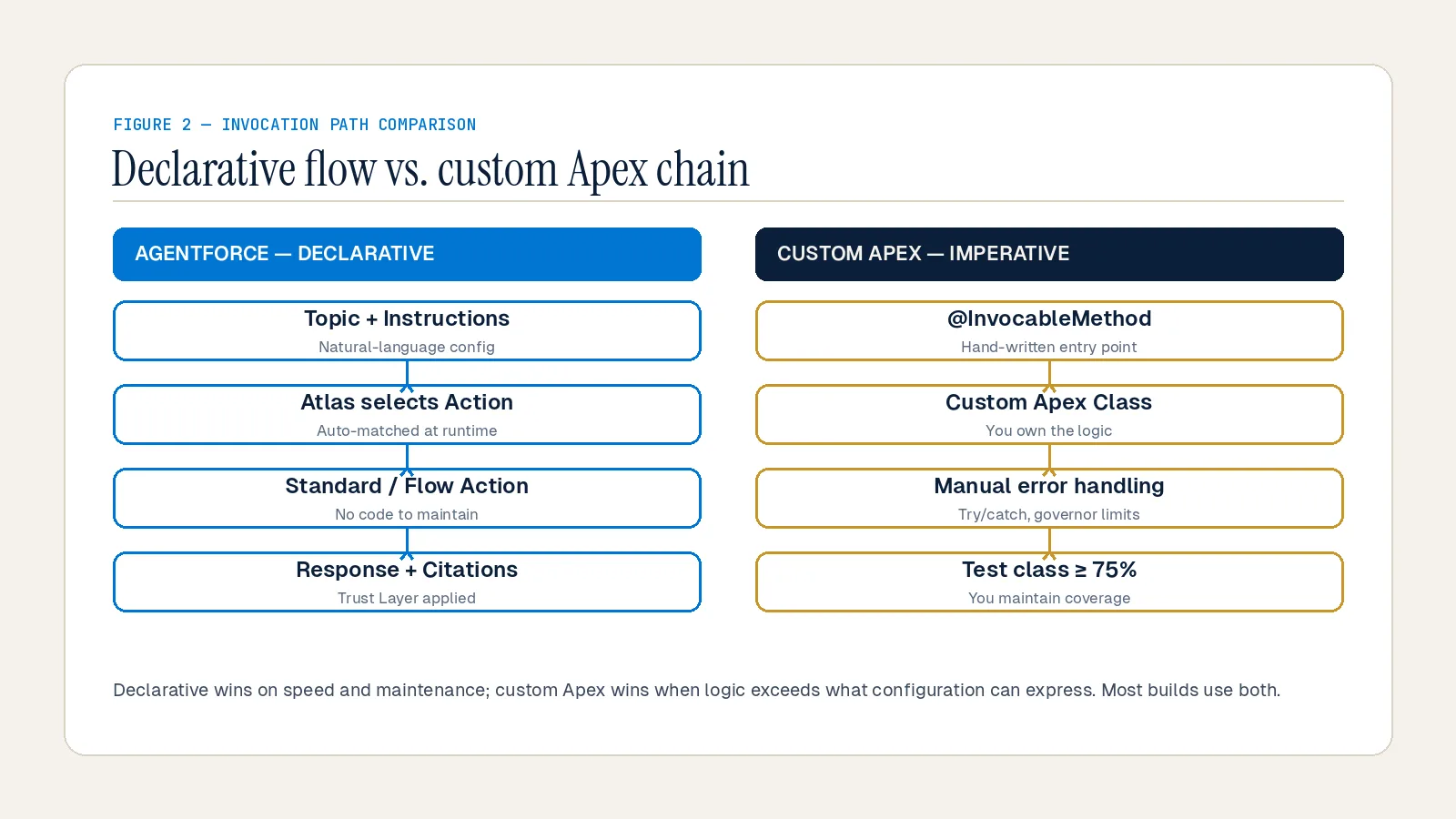
Custom Apex agents are not a separate product category — they are a development pattern. You write server-side Apex logic, annotate your methods with `@InvocableMethod`, register them as agent actions in Agent Builder, and the Atlas Reasoning Engine determines when to call them based on conversation context.
According to SFDC Developers, any operation you can perform in Apex — complex calculations, multi-object queries, external API calls, custom data transformations — can become an action the agent invokes. This is where Agentforce becomes genuinely powerful for technically sophisticated orgs.
What Apex actions unlock that standard Agentforce actions cannot:
Complex scoring algorithms — risk calculations, custom lead scoring models, credit decisioning logic
Multi-object transactional operations — updates that must succeed or fail atomically across multiple objects
External system integrations — legacy ERP calls, financial APIs, supply chain systems that MuleSoft connectors do not cover
Deterministic compliance paths — workflows where every step must follow a fixed sequence that an LLM cannot reorder
The important distinction for 2026 is between custom Apex actions inside Agentforce (the hybrid model, and usually the right answer) versus fully bespoke Apex-driven agents built outside Agentforce entirely (a different architecture with different tradeoffs).
The Spring '26 release formalized this with Agent Script — a deterministic control layer that pairs fixed programmatic sequences with LLM reasoning. Sensitive operations like order cancellations or financial transfers now follow strict programmatic paths, while the LLM handles conversational nuance around them. This is the direction the platform is moving: hybrid agents that are both precise and adaptable.
The Real Tradeoffs: A Decision Framework
The question is not which approach is better. It is which approach fits your constraints.
When Agentforce (with prebuilt or lightly customized templates) is the right call
Your use case maps to a standard CRM workflow. Agentforce ships templates for sales development, service resolution, marketing engagement, and commerce support. Each includes pre-configured topics, actions, and guardrails. According to tenetizer.com, one logistics partner built a vendor negotiation bot in 8 hours instead of 3 days using pre-configured blueprints. If your use case is lead qualification, case deflection, SDR outreach, or appointment scheduling, you do not need to write a line of code.
You need to move fast and prove ROI. According to BCG and Forrester 2026 data, vendor-deployed platforms achieve 2.4x faster payback than custom-built alternatives, with a median time-to-value of 5.1 months. Organizations getting the clearest ROI in 2026 are not the ones that deployed across every department at launch — they picked one measurable use case and scaled from what the data showed.
You need built-in governance. The Einstein Trust Layer is non-configurable and non-optional. Every Agentforce agent runs within it by default. For regulated industries — healthcare, financial services, public sector — this is not a nice-to-have. It is a deployment prerequisite that Agentforce satisfies out of the box.
Your admin team is leading the build. Agent Builder requires no separate development environment. Admins define topics, write natural-language instructions, and connect actions using Flows and existing automations. The 2026 platform shift is real: the traditional boundaries between declarative and programmatic development are blurring.
When custom Apex actions (or full Apex agents) are the right call
Your logic is deterministic and cannot tolerate probabilistic reasoning. According to Salesforce Monday, complex bulk data operations, integrations requiring precise error handling, and platform-level logic still belong in Apex. If every step must be auditable and the sequence cannot vary, structured code remains the right tool.
You have specific governor limit considerations. The underlying Apex actions inside Agentforce are still subject to standard Salesforce governor limits. For high-volume, performance-critical operations, this matters and must be designed around explicitly.
Your business logic is proprietary and deeply custom. Unique pricing models, complex approval hierarchies, industry-specific calculation engines — these are not scenarios prebuilt templates address. Custom Apex actions expose exactly the logic you need and nothing more.
You need multi-object transactional integrity. When a workflow requires that three Salesforce objects update atomically — or not at all — Apex triggers and transactions are the right architecture. An LLM reasoning engine is not.
The hybrid model: what we actually recommend
The bottleneck is not AI capability. It is that most orgs are not yet set up to delegate clearly to it.
At Inforge, the architecture we use — and implement for clients — is consistent: Agentforce handles reasoning and orchestration, Apex handles precision execution. The agent decides when to act and why. The Apex method determines exactly how. This is not a compromise. It is the design the platform is built for.
The most common implementation mistake is building one agent that does everything. Start with a single, well-defined use case — one with clear success criteria, a defined escalation path, and measurable volume. Prove it. Then scale.
Where Agentforce Falls Short in 2026 (and What to Do About It)
No honest evaluation ignores the limitations. Here is what is real in 2026:
Pricing complexity creates budget unpredictability. According to Gartner's 2026 Customer Service Technology survey, 61% of enterprise CX leaders running Agentforce pilots cited "unpredictable cost scaling" as a top frustration. The consumption-based model — $2 per conversation or $0.10 per action under Flex Credits — compounds fast at volume. Most advanced deployments require Data 360 (formerly Data Cloud), pushing real first-year costs into the $150,000–$600,000 range for mid-market teams according to Default's 2026 review.
The mitigation: start with Salesforce Foundations. Enterprise Edition and above customers get 1,000 conversations, 250K Data Cloud credits, and Agent Builder access at no additional cost. Run your pilot before committing to a commercial tier.
Architectural limits constrain complex multi-departmental agents. Each Agentforce agent supports 15 topics and 15 actions per topic. For enterprises building complex cross-departmental workflows, this requires splitting logic across multiple specialized agents — which is actually good architecture anyway, but does require planning.
Data quality is the deployment killer. An AI agent reasons from the data it can see. If your Salesforce records are incomplete, inconsistent, or outdated, the agent will produce outputs that reflect that. According to ekfrazo.com, data quality is the single most important environmental factor before deploying Agentforce. A data quality initiative will return more foundational value than Agentforce if your org is not already clean.
Governor limits still apply to Apex underneath. Complex Apex logic inside agent actions can introduce latency if not optimized. According to SFDC Developers, if an agent is taking too long to decide which action to take, it usually indicates that the descriptions in the `@InvocableMethod` annotation are ambiguous or overlapping. Debugging requires analyzing reasoning logs, not just stack traces.
The Numbers Behind Agentforce Adoption in 2026
Context for where this platform actually sits in enterprise deployment:
Agentforce ARR reached $1.2 billion by Q1 FY2027, growing 114% year-over-year — the fastest-growing product category in Salesforce history according to enway.com (citing Salesforce earnings releases).
According to cyntexa.com, Salesforce delivered 2.4 billion Agentic Work Units (AWUs) by end of FY26, growing 57% in a single quarter.
According to Salesforce's own operations data, Agentforce handled over 2.8 million interactions and saved employees more than 500,000 hours through Agentforce in Slack alone.
Wiley, the publishing company, saw case resolution improve by over 40% in the first weeks after deploying Agentforce, with seasonal agents onboarding 50% faster and total documented ROI of 213% with $230,000 in savings.
According to BCG and Forrester 2026 data, the median payback period across agentic AI deployments is 5.1 months, with SDR agents paying back in 3.4 months.
According to Salesforce MuleSoft research (April 2026), the three most cited barriers to Agentforce deployment are: risk and compliance readiness at 42%, internal AI expertise gaps at 41%, and legacy infrastructure incompatibility at 37%.
The adoption reality: only around 12% of Salesforce's 150,000+ customers have deployed an agent as of mid-2026 according to Default's analysis. The platform is proven. The gap is organizational readiness, not technology maturity.
[INTERNAL LINK: What Does an AI-Ready Salesforce Org Actually Look Like? | data readiness for Agentforce]
Summary
Agentforce in 2026 is production-grade infrastructure, not a pilot program. The Atlas Reasoning Engine, Agent Script for deterministic control, and native integration with your existing Apex and Flow investments make it the fastest path to agentic automation for most Salesforce orgs. Custom Apex agents — whether as standalone implementations or as actions inside Agentforce — remain the right tool for precision logic that cannot be probabilistically reasoned.
The decision framework is straightforward: if your process is standard, use Agentforce templates. If your process is unique, use Agentforce with custom Apex actions. If your process is deterministic, safety-critical, and cannot tolerate LLM variance, write Apex and wire it into Agent Script. In practice, almost every production-grade deployment is the hybrid model.
At Inforge, we have replaced our entire delivery model with AI agents — including the Salesforce implementations we build for clients. We know which architecture decisions hold in production and which ones collapse at scale. If you are evaluating either path, we would rather show you our own stack than pitch you a framework.
[INTERNAL LINK: How Inforge Delivers Salesforce Implementations Through AI Agents | inforge delivery model]
Frequently Asked Questions
Q: Can I use Agentforce without custom Apex development?
A: Yes. Agentforce ships prebuilt templates for service, sales, and marketing use cases that require no Apex. Admins configure topics, actions, and guardrails using Agent Builder with declarative tools and natural-language instructions. Custom Apex becomes valuable — and sometimes necessary — when your business logic exceeds what standard actions cover.
Q: What is the difference between Agentforce and a custom Apex trigger?
A: An Apex trigger fires on a specific platform event with deterministic, hard-coded logic. Agentforce uses the Atlas Reasoning Engine to decide which action to take based on context — then calls your Apex classes to execute. Triggers are precise and predictable. Agentforce is contextually intelligent. The two are complementary, not competing.
Q: How much does it cost to get started with Agentforce in 2026?
A: Enterprise Edition customers and above can access Agentforce at no additional cost through Salesforce Foundations, which includes 1,000 conversations, 250K Data Cloud credits, and Agent Builder access. Beyond the free tier, pricing runs $2 per conversation or $0.10 per action under Flex Credits. Full production deployments requiring Data 360 typically cost $150,000–$600,000 in the first year for mid-market teams.
Q: What makes an organization "ready" for Agentforce deployment?
A: Three preconditions matter most: clean, structured Salesforce data (agents produce outputs that reflect the quality of the data they read); documented, modular processes (if your workflows only exist in people's heads, no agent will behave consistently); and a single scoped use case with measurable success criteria to start. Organizations that skip these preconditions extend timelines rather than compress them.
Q: Should we build one large agent or many specialized agents?
A: Many specialized agents. The most common implementation mistake is trying to build one agent that handles everything. Salesforce's own multi-agent architecture, and the Agent Script framework introduced in Spring '26, are designed for specialized agents collaborating — not monolithic agents attempting to reason across every department simultaneously. Start narrow. Prove it. Then expand.
