Agentforce 360: What Salesforce's Biggest AI Release Means for Your Business
Salesforce just shipped its most significant AI release to date. Agentforce 360 is not a rebrand or a roadmap update — it is a generally available platform connecting humans, AI agents, and unified data in one system. If your org runs on Salesforce, this changes what is possible right now.
Key Takeaways:
Agentforce 360 is generally available, with 12,000 customers already deployed across enterprise and mid-market accounts.
It introduces Agent Script, Agentforce Voice, hybrid reasoning, and a unified Data 360 layer — all production-ready.
Salesforce now supports Google Gemini, Anthropic Claude, and OpenAI models natively inside the Atlas Reasoning Engine.
The platform is accessible directly from ChatGPT and Google Workspace — not just inside Salesforce.
Most orgs are not yet structured to delegate to agents. That gap is the real risk — not the technology.
Quick Answer: Agentforce 360 is Salesforce's fourth-generation AI agent platform, launched in October 2025, combining enterprise-grade agents, a unified data layer, voice AI, and multi-model reasoning into a single production-ready system. It is live, broadly adopted, and directly relevant to any team running CRM workflows on Salesforce today.
What Salesforce Actually Shipped
Agentforce 360 is the fourth major release in Salesforce's agentic AI roadmap, following the original Agentforce launch in October 2024, Agentforce 2dx in March 2025, and Agentforce 3 in June 2025. According to Salesforce, the platform now has 12,000 customers and has delivered measurable results at scale — Reddit deflected 46% of support cases and cut resolution times by 84%, while Adecco handled 51% of candidate conversations outside standard working hours using agents.
This is not a pilot programme. It is production infrastructure.
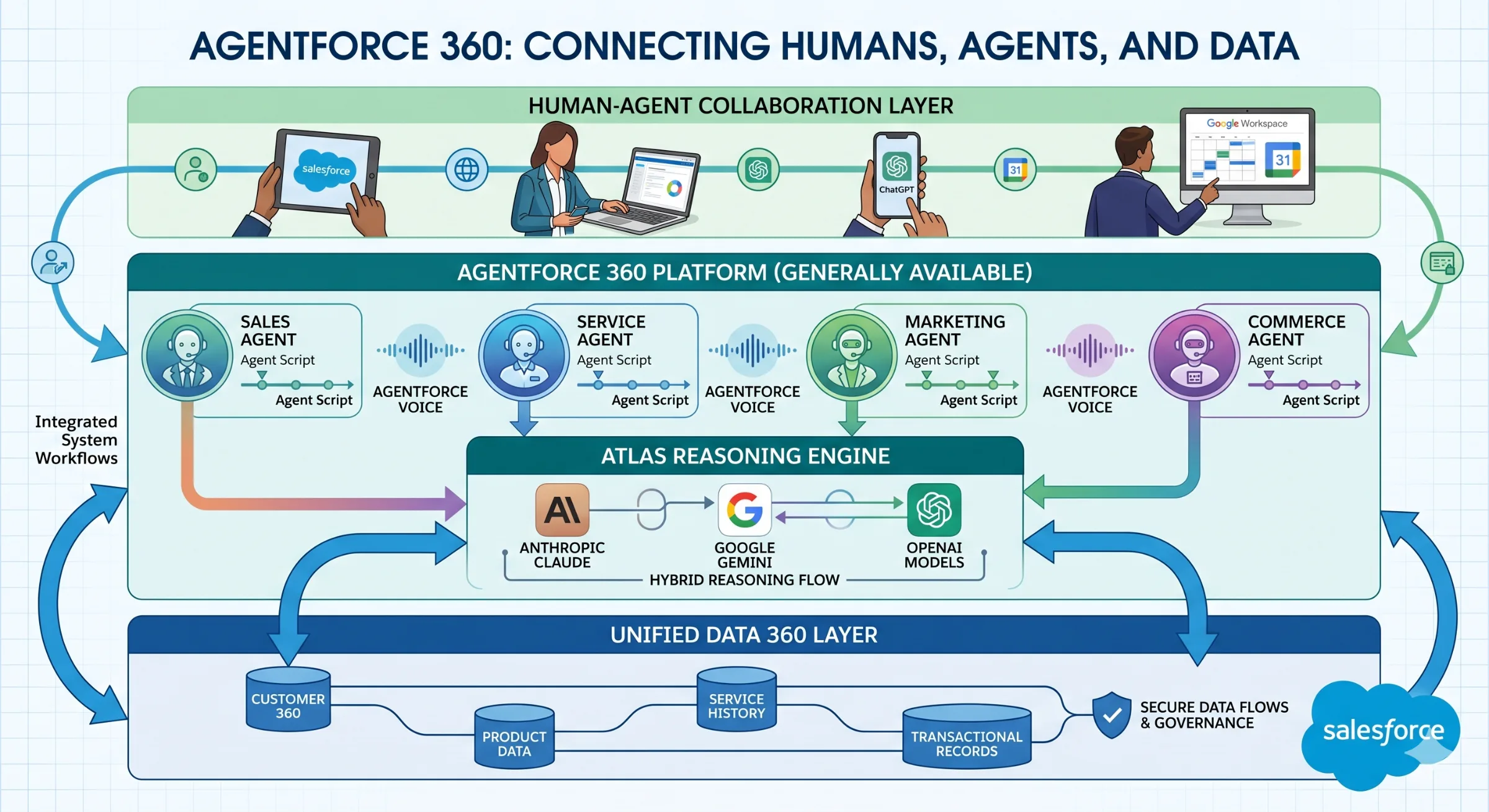
The four core components of Agentforce 360 are:
Agentforce 360 Platform — The agent-building layer, featuring a new conversational builder, hybrid reasoning for accuracy and control, and voice capabilities.
Data 360 — A unified data layer that gives every agent real-time business context. Intelligent Context converts unstructured documents into structured, actionable data for agents automatically.
Agent Script — A new scripting language for controlling agent behaviour. It combines AI reasoning with deterministic logic — conditional rules, if/then branching, precise tool use — so agents behave predictably in complex scenarios.
Agentforce Voice — Native voice AI for customer interactions, integrated with Amazon Connect, Five9, Genesys, NICE, and Vonage. According to Salesforce, 80% of all inquiries still start by phone — Voice makes those interactions fully agent-driven and CRM-connected.
The Model Ecosystem Is Now Multi-LLM
One of the most consequential changes in Agentforce 360 is model flexibility. Salesforce AI agents now support Google Gemini, Anthropic Claude, and OpenAI models natively inside the Atlas Reasoning Engine. Customers are no longer locked to a single model — they can select the reasoning engine that fits the task.
This also plays out in where agents live. Salesforce launched Agentforce Sales as a native ChatGPT app, enabling sales reps to query leads, update opportunities, and trigger workflows directly from ChatGPT conversations. Separately, Agentforce 360 extends across Google Workspace — users can surface Salesforce capabilities from Gmail, Meet, and Sheets.
The practical implication: your team does not need to change where they work. The agents come to them.
What Changed Between Agentforce 3 and Agentforce 360
Agentforce 3, released in June 2025, solved the observability problem — the inability to monitor, diagnose, and govern agents at scale. It introduced the Command Center, a unified console for real-time monitoring of agent health, error rates, escalations, and usage trends. It also added native Model Context Protocol (MCP) support, enabling plug-and-play interoperability with 30+ third-party systems including AWS, Google Cloud, IBM, and Stripe.
According to Salesforce's Slack Workforce Index data cited at the Agentforce 3 launch, AI agent usage increased 233% in six months, with 8,000 customers signing up to deploy Agentforce in that period alone.
Agentforce 360 builds on that foundation — adding voice, scripting control, expanded model choice, and the full Data 360 layer. The trajectory is clear: each release addressed a specific enterprise blocker. Observability. Interoperability. Voice. Deterministic control. The blockers are running out of excuses.
What This Means If You Are Running Salesforce Today
Most Salesforce orgs have Einstein features enabled and barely used. They have automation flows that break on edge cases. They have RevOps teams copy-pasting data between systems that should have been connected years ago.
Agentforce 360 does not solve any of that automatically. What it does is make the ceiling dramatically higher — and the floor more accessible. Low-code tools mean admins can build and deploy agents without developer cycles. Data 360 means agents have real context, not just field values.
But the bottleneck is not the platform. The bottleneck is that most orgs are not yet structured to delegate to it.
At Inforge, we have replaced our entire delivery model with AI agents. Full Salesforce implementations, delivered through prompts. Not a proof of concept — our actual operating model. That experience has taught us one thing clearly: the technology is ready. The org design is what takes work.
The teams that move now — building agent-ready data structures, defining clean delegation boundaries, and testing agents in controlled scopes before scaling — will have a compounding advantage over the next 12 months.
What You Should Do Next
You do not need to deploy Agentforce 360 across your entire org this quarter. You need to start in one lane.
Here is the practical sequence:
1. Audit your data quality. Agentforce agents are only as good as the data in Data Cloud and your core objects. If your lead and contact records are inconsistent, clean that first.
2. Identify one high-volume, low-variance workflow. Case routing, lead qualification, contract status updates — pick the process where agent error costs the least and volume is the highest.
3. Deploy in a sandbox with Agent Script guardrails. Use the deterministic scripting layer to define exactly what the agent can and cannot do. Do not rely on open-ended reasoning for mission-critical flows on day one.
4. Measure and scale. Agentforce 3's Command Center gives you real-time performance data. Use it before expanding agent scope.
Inforge runs this playbook with every client. The Salesforce AI implementation is not the hard part. Deciding where to start — and what to govern — is where most teams stall.
Summary
Agentforce 360 is the most complete Salesforce AI agent platform released to date. Voice, scripting control, multi-model reasoning, unified data, and cross-platform availability are all production-ready. The 12,000-customer deployment base and documented case outcomes confirm this is not vapourware — it is operating infrastructure. At Inforge, we have been running agent-first Salesforce delivery since before Agentforce existed. The organisations that treat this release as a starting gun — rather than something to evaluate in 2026 — are the ones that will compound fastest.
Frequently Asked Questions
Q: What is Agentforce 360 and how is it different from earlier versions of Agentforce?
A: Agentforce 360 is the fourth major release of Salesforce's AI agent platform, launched in October 2025. It adds voice AI, a new Agent Script scripting language for deterministic agent control, multi-model support including Google Gemini and Anthropic Claude, and a unified Data 360 layer — building on the observability and interoperability improvements introduced in Agentforce 3.
Q: How much does Agentforce cost?
A: Agentforce pricing starts at $2 per conversation, with standard volume discounts available. Salesforce has also introduced flexible pricing tiers and guidance to help companies incorporate Agentforce into their budgets.
Q: Can Agentforce agents work outside of Salesforce — in tools like ChatGPT or Google Workspace?
A: Yes. Salesforce launched Agentforce Sales as a native ChatGPT app in late 2025, and Agentforce 360 also extends across Google Workspace, surfacing Salesforce capabilities in Gmail, Meet, and Sheets. Agents route through Salesforce's CRM intelligence and Trust Layer regardless of where the user interface lives.
Q: What is Agent Script and why does it matter?
A: Agent Script is a new scripting language introduced in Agentforce 360 that lets teams define exact agent behaviour using conditional logic and if/then rules. It gives organisations deterministic control over agents — so agents don't just reason freely, they follow defined pathways for mission-critical workflows.
Q: Do I need a Salesforce implementation partner to use Agentforce 360?
A: You can get started without one, but most mid-market orgs hit a ceiling quickly without clean data architecture, proper agent scoping, and governance design. An implementation partner with hands-on Agentforce experience — like Inforge — helps you skip the expensive trial-and-error phase and move directly into production with agents that actually hold up.
