10 Agentforce Use Cases That Are Actually Working in Production
Most AI content is still prospective. "Will transform." "Expected to deliver." "Organizations are exploring."
This post is different. Every Agentforce use case below has real numbers behind it — live deployments, measurable outcomes, named companies. If you're evaluating whether Agentforce is ready for production, this is what you actually need to see.
Key Takeaways:
Agentforce is live in production across customer service, sales, recruiting, field service, and internal operations
Real deployments show autonomous case resolution rates between 62% and 76%
The bottleneck isn't the technology. It's getting your data and workflows agent-ready before you build
Scale without headcount is the consistent theme — not AI replacing humans, but AI absorbing volume so humans do higher-value work
According to Salesforce, Agentforce users have collectively reported over $100M in annualized cost savings
1. Tax-Season Service Automation: 1-800Accountant
Tax week is the worst time to have insufficient support coverage. For 1-800Accountant, it's the highest-demand period of the year — and historically the most expensive to staff.
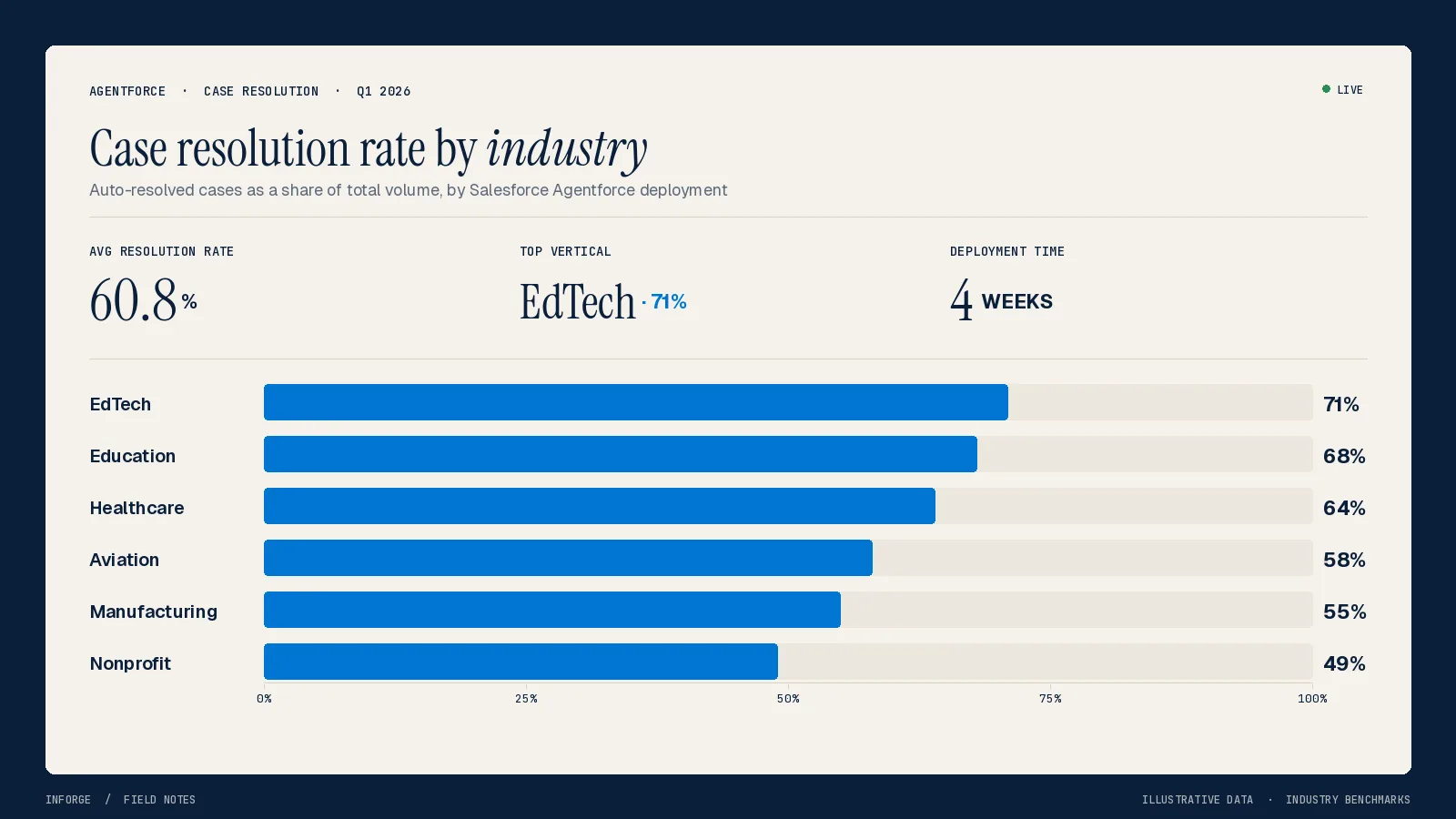
They deployed Agentforce to handle inbound chat during peak season. The result: Agentforce autonomously resolved 70% of their chat engagements during tax week in 2025. CPAs stayed focused on complex client work. Volume was absorbed without adding headcount.
This is the use case most service orgs should build first — not because it's the most sophisticated, but because the ROI is fastest to prove.
2. Customer Support at Scale: Salesforce's Own Help Site
Salesforce deployed Agentforce on its own help site — as "Customer Zero" for the platform. The agent was built on top of Data Cloud, using retrieval-augmented generation across over 740,000 knowledge articles, case histories, and product documentation.
When customers asked about account-specific details like API limits, the agent pulled their actual entitlements and usage history instead of returning generic search results. When a case needed escalation, it handed off to a human with a full conversation summary — no repeat context.
The outcome: Agentforce now resolves 76% of customer inquiries autonomously, having handled over 1.7 million conversations, with a 65% reduction in response time.
Salesforce also reports that after one year as Customer Zero, their SDR agent worked on over 43,000 leads and generated $1.7 million in new pipeline from dormant ones — and Agentforce in Slack gave their teams 500,000 hours back by handling routine tasks.
3. Lead Qualification and SDR Coverage: Asymbl
Asymbl used Agentforce to automate daily lead engagement across inbound, outbound, and nurture channels. The AI agent qualifies leads autonomously, freeing human SDRs to focus on strategic outreach only.
The numbers are notable: the hybrid model delivers the same coverage as a team five times larger, saving $575K annually. Agentforce scaled their targeted engagement by 427% without disrupting existing workflows.
This is the clearest production example of AI expanding capacity without expanding payroll.
4. Financial Reporting Automation: Fortune 500 Enterprise
A Fortune 500 enterprise was consolidating financial reports across five departments — sales, legal, HR, operations, and product — manually. Each quarterly report took 15 business days and cost approximately $2,200 to produce, with an average of 3 errors per report.
After implementing Agentforce with a multi-agent architecture (an AnalyzerAgent for KPIs, a NarratorAgent for executive summaries, and a RiskCriticAgent for compliance review), the results were substantial: reporting time dropped 99%, from 15 days to 35 minutes. Cost per report fell from $2,200 to $9. Error rate dropped from 3 per report to 0.3 on average. Stakeholder satisfaction rose from 72% to 91%.
This is what happens when you treat agentic AI as a process redesign, not a feature.
5. Post-Call Processing and Wrap-Up Automation
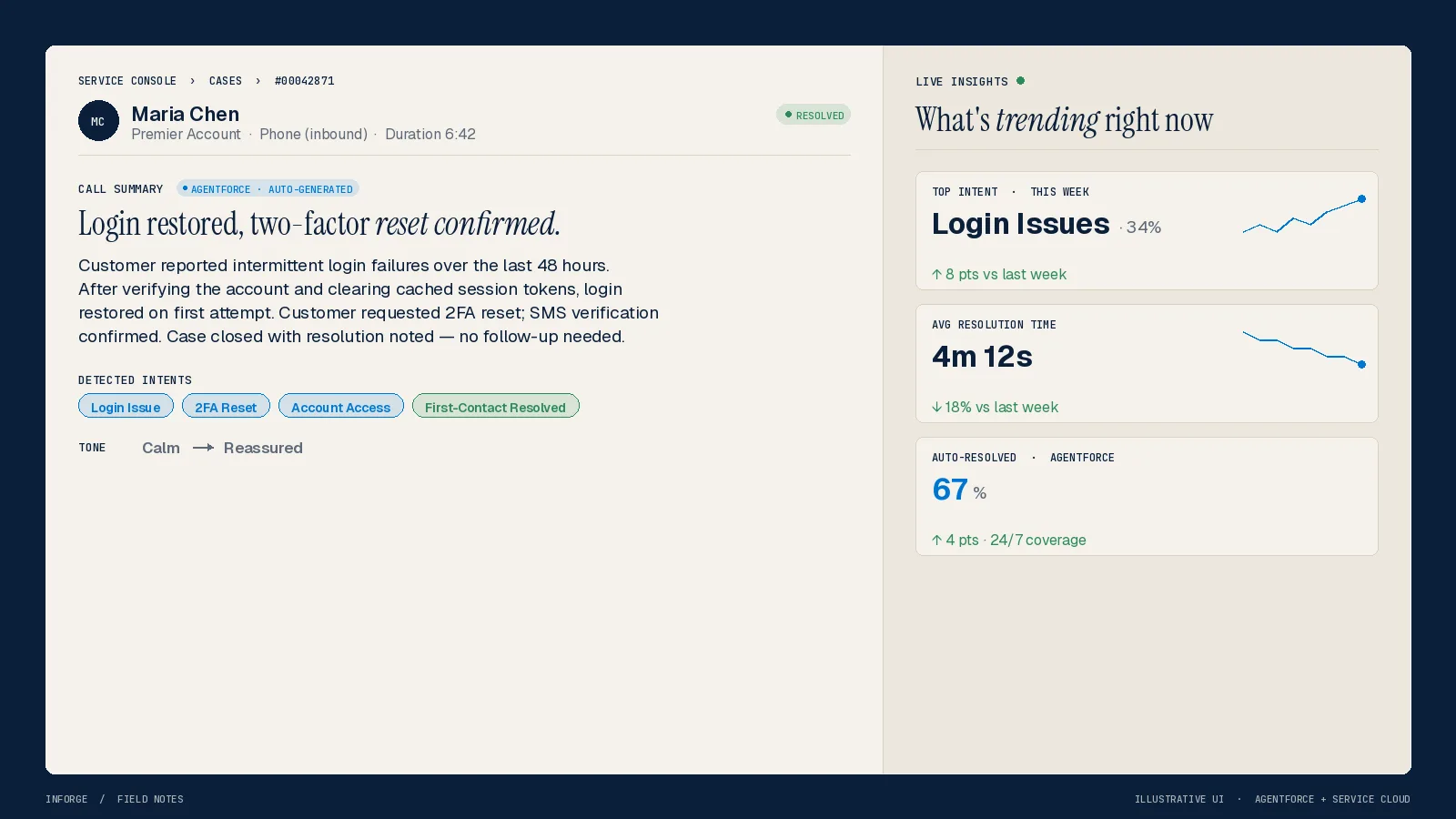
After every customer interaction, service reps have historically needed to summarize the conversation in the CRM, tag the intent, and complete follow-up tasks like confirmation emails. It's low-value work that compounds into hours of weekly overhead.
An Agentforce agent can automate all of these tasks — while also spotting trends in summaries and collating product feedback to share with marketing, research, and sales teams. This is now one of the most widely adopted internal Agentforce use cases for contact centers on Salesforce.
The efficiency gain is immediate. The strategic value — having trend data surface automatically — tends to be underestimated until it's live.
6. Publisher Self-Service: Wiley
Wiley, the global publisher, faced service call spikes at peak academic periods — particularly at the start of new semesters. The pressure on human agents was unsustainable.
They built AI-powered Agentforce agents to help customers resolve issues independently. The outcome: Agentforce increased self-service results and efficiency by over 40% and achieved a 213% ROI from its Service Cloud integration. Agents are now also helping human reps draft personalized, contextual responses to queries — augmenting, not replacing.
7. Autonomous Recruiting: Adecco Group
The Adecco Group places one million people a day into roles globally. At that volume, manual resume screening and candidate shortlisting becomes a bottleneck — regardless of how good your team is.
Adecco developed Agentforce agents that sift through resumes automatically, create shortlists, and manage end-to-end screening processes. Agentforce now engages candidates as soon as they apply, capturing key details and surfacing top matches so recruiters can prioritize the strongest fits.
This is one of the most compelling enterprise Agentforce use cases because it doesn't just speed up HR — it changes the ratio of recruiters to candidates a team can effectively serve.
8. IT Support Deflection: Internal Enterprise Deployments
In 2025, Salesforce expanded Agentforce into HR and IT service with dedicated consoles inside Agentforce Service. The agent evaluates the employee request, internal knowledge content, and the user's case history to provide personalized self-service — and can autonomously perform tasks like logging time off, issuing parking tokens, and enabling app access by integrating with adjacent systems.
In one deployment tracked publicly, the agent handled 40% of all IT support cases with 74% accuracy. Projected savings reached $1.4 million annually, with a target of resolving 75% of cases autonomously by end of 2025.
For IT teams carrying a growing support backlog, this is a straightforward productivity unlock that doesn't require custom development.
9. Luxury Retail Personalization: Saks
For Saks, the challenge was closing the gap between in-store and digital experience. In-store, associates know customers by name, purchase history, and style preference. Online, that context had historically been lost.
Saks deployed Agentforce to create AI agents capable of delivering personalized product recommendations to online buyers. The agents know what customers have bought before and understand visual prompts to suggest the best-placed products. For human agents on the phone, Agentforce surfaces smart responses based on the customer's Salesforce profile and knowledge articles.
Saks leveraged Data Cloud to unify browsing, purchase, return, and service data into a single view — giving both AI and human agents the full picture to offer every customer a "VIP-level" experience.
This use case shows what becomes possible when agentic AI is grounded in a clean, unified data model.
10. Field Service Dispatching and Pre-Work Briefing
In April 2025, Salesforce launched Agentforce for Field Service — a library of pre-configured skills to help organizations build agents that serve off-site workers.
The most impactful deployed capability: Agentforce automatically assigns jobs to field workers based on skills, profile, and location, while intelligently filling cancellations. It also sends pre-work briefs detailing the parts and tools field workers may need, weather conditions to monitor, and safety rules relevant to the job scope.
For organizations running large field operations — utilities, telcos, equipment maintenance — this eliminates dispatcher overhead and reduces the risk of technicians arriving unprepared.
What Separates the Deployments That Work
Across these 10 use cases, one pattern holds: the organizations getting results didn't start with the most ambitious agent. They started with a well-scoped problem, clean data, and a clear definition of what success looks like.
According to Salesforce, over 18,000 companies across 124 countries are now using Agentforce — and those reporting the best outcomes consistently cite data readiness as the defining variable. Agents are only as good as the data they reason over.
At Inforge, we've found that the highest-ROI Agentforce deployments happen when organizations treat agent configuration as a business process redesign exercise — not a technical integration project. The prompts are the easy part. The work is in the data, the escalation logic, and the use case selection.
Summary
Agentforce is past the pilot stage. The use cases above — spanning service, sales, recruiting, operations, and field work — are live, measured, and delivering outcomes worth paying attention to. The common thread isn't the technology. It's the deliberate approach to scoping, data preparation, and iteration. If your org is evaluating Agentforce, the question isn't whether it works. It's whether your data and processes are ready to support it.
Frequently Asked Questions
Q: Which Agentforce use case delivers ROI the fastest?
A: Customer service deflection — specifically autonomous case resolution and post-call wrap-up automation — consistently delivers the fastest measurable ROI. It's easy to baseline, easy to measure, and the volume justification is usually immediate.
Q: Do you need Data Cloud to run Agentforce effectively?
A: Not always, but data quality and accessibility are the most common limiting factors in production deployments. Agentforce is more effective when agents have access to a unified, clean customer data model — whether that's through Data Cloud or a well-maintained CRM org.
Q: How many companies are actually using Agentforce in production?
A: According to Salesforce, over 18,000 companies across 124 countries are currently using Agentforce to build and deploy AI agents.
Q: Is Agentforce suitable for internal operations, or just customer-facing use cases?
A: Both. Production deployments include IT support deflection, financial reporting automation, employee HR self-service, and post-call processing. Internal use cases often have faster time-to-value because data access is more controlled.
Q: What's the most important factor in a successful Agentforce deployment?
A: Data readiness and use case scoping. Organizations that start with a well-defined, narrow use case — and ensure their underlying Salesforce data is clean and structured — consistently outperform those who try to deploy broadly before proving the model.
