From Cloud Chaos to Clean Data: How AI is Redefining Migration and Orchestration
- Javier Ramirez
- Nov 12, 2025
- 9 min read
The cloud wars have yet to slow down - they’re speeding up by leaps and bounds. AWS holds a commanding 29 percent of the market share, but Azure is nipping at its heels with 20 percent and Google Cloud bringing up the rear with 13 percent. Together, these three cloud giants take up an astonishing 62 percent of the global cloud market - a $107 billion industry that’s grown by an eye-watering 28 percent year on year. Growth rates like that are just about unheard of in the tech world. This surge is largely driven by rapid cloud adoption, as organizations increasingly recognize the business value and flexibility enabled by cloud technologies.
But the numbers are only half the story. What’s really got most companies stumped isn’t the process of jumping onto the cloud bandwagon - it’s figuring out how to get all the various platforms to play nice with each other. This challenge represents a fundamental shift in how organizations approach cloud migration and orchestration, requiring new strategies and tools. Every single cloud platform is a force to be reckoned with on its own, yet somehow getting them to seamlessly integrate with each other during cloud migration remains one of the biggest headaches tech teams and business leaders face.
The Bane of the Cloud: Why Integration's the Real Challenge
A manufacturing client nailed the problem when they said:
“We’ve got AWS for storage, Azure for analytics and Salesforce for customer data - but none of it feels connected”
That’s the reality for a whole lot of enterprises. They’ve got the right tech, they’ve got the right people - but data ends up living in separate silos like it’s some kind of digital fortress. Legacy systems are a major contributor to these data silos and integration challenges, making it difficult for organizations to unify their information. The issue isn’t about a lack of skills - it’s the fact that these systems are all operating in their own little bubbles, not communicating with each other like they should.
Nowhere is this problem more starkly visible than in data migration - one of the most grudge tasks of all in the business world. The migration process is often complex and fraught with challenges, especially when moving data from legacy systems to modern platforms. Every single company has to move data from old systems to new ones, from spreadsheets to customer relationship managers, or from multiple clouds into one single ecosystem. But while the tools promise a smooth ride, reality is far from it.
The Hidden Pitfalls of Cloud Migration
For most data engineers, ETL specialists and Salesforce admins, the really tough bit of migration isn’t the spreadsheet itself - it’s all the dodgy stuff that comes with it. Take for instance:
Not having a clue what all that spreadsheet data actually means\
Broken lookup relationships that just don’t seem to want to behave\
Mismatched field types that send the whole operation haywire\
Those pesky dataloader errors that always seem to kick in at the worst moment - like 2 a.m. in the morning\
The endless loop of “Why is Account ID blank yet again?”\
Inconsistent naming conventions that cause confusion and errors across data assets
Undocumented transformation logic and reliance on tribal knowledge can further complicate migrations, making it harder to maintain consistency and troubleshoot issues.
One of our clients - a Salesforce developer at a logistics company - told us about how their pipeline blew up not once, but twice in the same week, thanks to mismatched fields and corrupted lookups. They knew how to fix it - the problem was they didn’t have a tool that worked with them, not against them.
Platforms like MuleSoft, Talend and Flatfile are all pretty powerful. But the snag is, they require you to learn their way of doing things before you can even start executing your own. For experienced teams, it’s like being asked to read a new pilot manual mid-flight - you don’t need to learn how to fly, you just need some decent in-flight entertainment. There’s also a risk that tribal knowledge is lost when switching tools, especially if key processes and transformation logic aren’t properly documented.
Meet Edison AI: Migration Without the Headaches
That’s where Edison AI comes in. We built it as the polar opposite of traditional ETL tools—a truly AI embedded solution that integrates intelligence throughout every stage of the migration workflow. It’s a system that doesn’t need hours of setup or manual mapping. Instead, it kind of ‘gets’ what the expert is trying to do and just gets on with it.
With Edison AI, migration is as simple as uploading a Google Sheet. The AI then:
Reads it and makes sense of the data
Cleans up and transforms the fields with no fuss
Automatically detects relationships like account to contact
Migrates everything into Salesforce with zero lookup errors
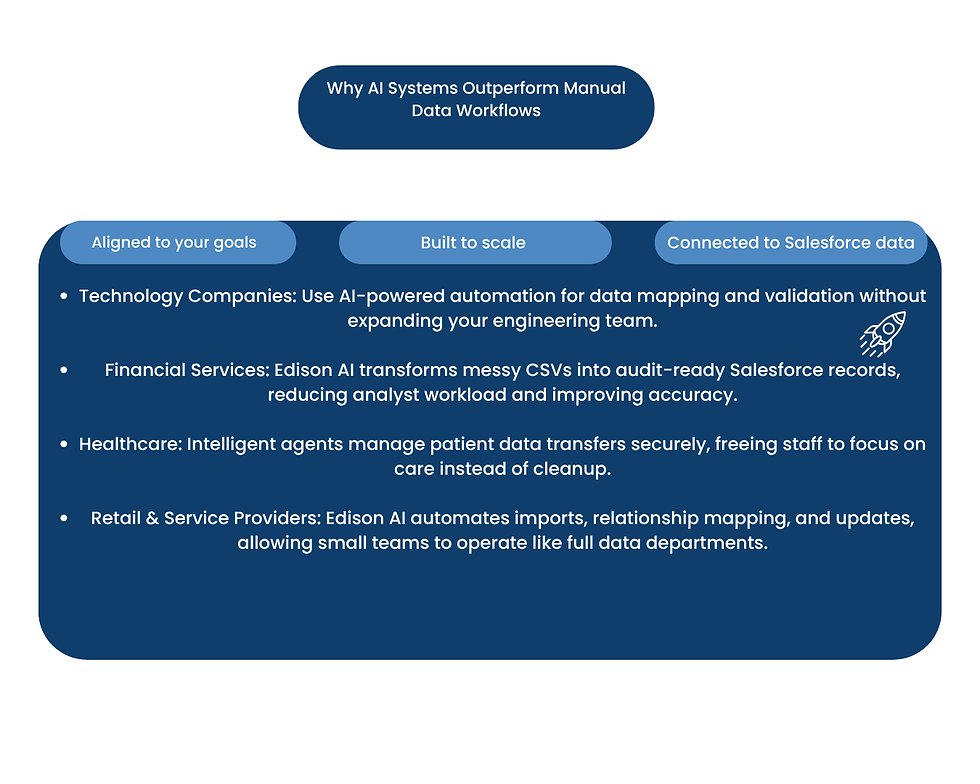
AI enables automated risk detection and migration planning for a smoother process
Uses AI tools for lineage tracking, ensuring data traceability and compliance
Completes the whole process in under five minutes—no cleanup scripts, no pipelines, no babysitting required
AI enhances the migration process by providing adaptive, intelligent automation that optimizes every step. Some of the key capabilities of Edison AI include automated data mapping, error detection, and lineage tracking for comprehensive governance and compliance.
For our clients, this has completely turned the tables on how they view migration. It’s not about learning another tool—it’s about finally having one that understands what they’re trying to do.
A Client Story: From Stuck to Sorted
We had a mid-sized retail client who’d been wrestling with trying to get their customer and transaction data into Salesforce for two solid months. Traditional migration timelines were a major pain point, causing delays and operational headaches. Their admin team was capable, their engineer was experienced - yet every single import ended in errors, partial uploads and missing relationships.

The moment they gave Edison AI a go, everything changed. The AI automatically cleaned up their dataset, detected relationships between objects and migrated the data without a single hitch, resulting in high quality data being imported into Salesforce. What’d taken two months to solve was sorted in minutes.
Their Salesforce admin summed it up best:
“It’s like the tool finally gets it”
That moment - when technology just blends into the background and workflow becomes effortless - is what AI in the enterprise should be all about.
The Bigger Picture: Intelligent Workflow Orchestration in the Cloud
What Edison AI does for data migration is just a small part of a much bigger shift that’s happening in the cloud ecosystem. Every single company now relies on a mix of services - AWS for infrastructure, Azure for analytics, Google Cloud for AI workloads and Salesforce for customer data. The challenge isn’t about adoption anymore - it’s about integration. Cloud modernization is driving the need for better integration as organizations transform legacy systems to cloud environments, upgrade infrastructure, and improve data management. This shift is also accelerating the move towards cloud native environments, which enable seamless integration, rapid deployment, and operational readiness.
That’s why Salesforce’s 2 percent market share in global infrastructure is actually much more significant than it initially looks. It’s not just another cloud provider - it’s the bit of string that ties all the various systems, data and customer experience together. 2025 has us thinking that the best cloud strategy isn’t about choosing just one provider, it’s about making them all work together seamlessly, through smart orchestration and some seriously clever AI automation. The industry is at an inflection point, requiring new approaches to orchestration and integration. Intelligent orchestration, powered by AI-driven automation, is emerging as the next step in cloud management, optimizing resource provisioning and workload shifting for greater efficiency and resilience.
Managing Cloud Costs in the Age of AI
As organizations double down on digital transformation, cloud computing has become the backbone of innovation, scalability, and efficiency. But as artificial intelligence and machine learning models become embedded in every layer of enterprise data management, managing cloud costs is turning into a whole new ballgame.
The real challenge? Visibility. With data migrations happening more often and at greater scale, it’s easy to lose track of how data assets are being used, what data dependencies exist, and how system behavior impacts your bottom line. Performance bottlenecks, schema mismatches, and technical debt can quietly drive up cloud costs—often without anyone noticing until the bill arrives.
This is where AI-powered tools and intelligent workflow orchestration step in. By automating repetitive tasks and streamlining data engineering processes, AI-driven systems help data teams cut through the noise. They surface hidden inefficiencies, flag cost spikes, and even suggest optimizations in real time. The result: higher data quality, fewer surprises, and a direct line to operational efficiency.
But managing cloud costs isn’t just about automation—it’s about being AI-ready. As more business logic and strategic initiatives are powered by AI models, organizations need robust governance frameworks, model versioning, and approval workflows. This ensures that every AI-driven system aligns with business priorities and cost optimization goals, not just technical requirements.
Gone are the days when static assumptions and rough estimates were enough.
In the real world, cloud costs can spiral if you’re not proactive. Intelligent automation and AI-driven tools give data leaders the insights they need to make smart decisions—whether that’s reallocating resources, optimizing workloads, or ensuring compliance readiness.
Ultimately, the future belongs to organizations that treat cloud cost management as a strategic enabler, not just a line item. By embracing AI-powered solutions, prioritizing data accuracy, and building in governance from day one, companies can unlock significant cost savings, drive business value, and gain a true competitive advantage.
In this new era, managing cloud costs isn’t just about keeping the lights on—it’s about fueling the next wave of AI transformation, supporting mission-critical data work, and making sure every dollar spent on the cloud delivers real business impact.
AI - The New Orchestrator
Try to imagine a world where data just flows freely between different platforms, where your salesforce records just automatically update the Azure analytics dashboards, where your AWS logs sync up nicely with your marketing systems, and a business leader can actually just “talk” to their data in plain English.
That future isn't years away, it’s already starting to happen.AI isn't just making cloud operations a little bit easier - it’s actually running the show.
Just like how Edison AI can automate the clean up and migrations of data, enterprise AI is now actually automating the orchestration of entire platforms. AI systems are now responsible for managing complex cloud workflows, using predictive analytics to anticipate and prevent issues before they impact operations. The same smarts that powers the end to end migration can unify cloud environments, get rid of any unnecessary redundancy, and surface insights in an instant.
For organizations, achieving AI readiness is crucial to fully leverage these capabilities and ensure their infrastructure is prepared for AI and machine learning workloads. It's also essential to separate experimental AI from production environments, so new models can be tested safely without risking the stability of live systems. With AI-driven orchestration, service disruption during migrations and ongoing operations is minimized, ensuring continuous availability and operational stability.
Why This Matters
Every CTO and RevOps leader I talk to is saying the same thing - their teams are more than capable, but the tools they have are all disconnected. AI is what finally bridges that gap. As AI takes over routine data tasks, the role of human analysts is evolving, allowing them to focus on higher-level strategy and insight rather than manual data processing.

When engineers stop wasting time debugging CSV files, they can get back to thinking about the architecture. When admins stop fiddling with field remapping, they can get on with automation. While AI automates moving data and streamlines migrations, human expertise remains essential for oversight, ethical decision-making, and handling complex scenarios that require judgment and context. And when business leaders actually trust their data, they can finally start focusing on growth.
That’s the real value - getting some of that time back, redirecting some of that energy, and really making that intelligence pay off.
The Bottom Line
At Inforge, we genuinely believe that experts don't need more tools - they just need better ones. Edison AI is a whole new way of working - one where AI isn't just an extra tool but the actual engine that drives things. Edison AI is redefining migration projects by reducing complexity and risk, making them more efficient and less error-prone.
Migration is no longer some dull manual chore - it’s a conversation between you and your data. AI-driven orchestration can detect and respond to latency spikes during migrations, ensuring system performance and resilience. As the cloud ecosystem just keeps on evolving, the principle still applies - the future isn't about adopting some new technology, it’s about just making what you already have work together through some real intelligence. Handling sensitive data, such as patient data, with AI-driven solutions ensures compliance and security throughout the process.
The world doesn't need another ETL framework (yawn) - it needs orchestration that just magically takes care of itself. And with Edison AI, that future is already here.


Comments